
Topic
Ecclesiology
1,163 sermons · All topics
The Gospel and Jerusalem Sinners

Peter's Pentecost sermon in Acts 2:22–42 presents the gospel as an objective message focused on the life, death, resurrection, and exaltation of Jesus Christ — not a feeling or a personal response. This exposition works through Peter's call to repentance and baptism, the nature of imputed righteousness received by faith alone, and the sovereign scope of God's grace that reaches even the murderers of Christ. The sermon closes with the practice of the early church — steadfast continuance in apostolic doctrine, fellowship, the Lord's Supper, and prayer — as the pattern for all who are genuinely saved by grace.

The Third Missionary Journey, Part 7
Acts 20:32–38 concludes Paul's farewell address to the Ephesian elders at Miletus, functioning as a pastoral charge that moves from doctrinal grounding to ethical example to affectionate departure. The sermon treats three movements: Paul's commendation of the elders to God and the Word of His grace as the only sufficient resource for long-term ministry, Paul's example of non-covetousness and manual labor as a rebuke against ministerial greed, and the tearful parting as a model of godly gratitude for the instruments of grace. A sustained excursus defends the biblical warrant for paying pastors from 1 Corinthians 9, 1 Timothy 5, and 2 Timothy 2, establishing that Paul's voluntary self-support was the exercise of a right, not the abolition of one. The sermon closes with a call to pray for faithful ministers and to value the means God ordains for the salvation of sinners.

Sunday School - Biblical view of self-defense, part 2
Matthew 5:38–42 is frequently misread as a blanket prohibition against self-defense, capital punishment, and just war — three instances of justifiable homicide that Scripture plainly upholds. This exposition argues that Jesus is not contradicting the lex talionis (the law of retribution found in Exodus, Leviticus, and Deuteronomy) but is correcting the Pharisaic misapplication of a civil-judicial principle to everyday interpersonal conduct. The passage addresses four specific situations — insult, litigation, conscription, and benevolence — and calls believers to a disposition of forbearance in personal relations, while leaving entirely untouched the legitimacy of lawful self-defense, just war, and capital punishment as administered by the civil magistrate.

The Third Missionary Journey, Part 6
Acts 20:28–31 records the Apostle Paul's pastoral charge to the Ephesian elders at Miletus — a charge that functions as the first pastors' conference in the new covenant era. The passage demands that elders take heed to themselves and to all the flock, that they shepherd the blood-bought church of God, and that they remain vigilant against both external persecution and internal doctrinal corruption. The theological weight of the phrase 'the church of God which He purchased with His own blood' opens into a precise treatment of the communication of idioms, establishing that the divine and human natures of the one person of Christ are the ground on which Scripture can speak of God's own blood. Ministers are called to feed the flock with the whole counsel of God, warned that savage wolves and ambitious false teachers will arise, and exhorted to watch and warn with the same tear-stained fidelity that marked Paul's three years in Ephesus.

The Third Missionary Journey, Part 5
Acts 20:17–27 records the Apostle Paul's address to the Ephesian elders at Miletus — the only extended speech in Acts directed specifically to Christian leaders. The sermon examines Paul's review of his own apostolic ministry as a model for pastoral faithfulness, tracing his humility and tears, his unflinching proclamation of repentance toward God and faith in Christ, and his resolve to press toward Jerusalem despite the Spirit's testimony of chains and tribulations ahead. Paul's declaration of innocence in verse 27 — grounded in his refusal to shun the whole counsel of God — is pressed as the standard against which every gospel minister will stand accountable before God.

The Third Missionary Journey, Part 4
Acts 20:1–16 narrates Paul's closing movements on his third missionary journey — through Macedonia and Greece, into Troas where Eutychus falls to his death and is raised, and then south toward Jerusalem. The passage is used to argue that the early church's pattern of worship is not merely descriptive but carries prescriptive force: the Lord's Day (the first day of the week), corporate assembly, the Lord's Supper, and the preaching of God's Word are the God-ordained elements of Christian worship, regulated by Scripture alone. Cessationist and confessional commitments frame the reading throughout, and the sermon closes with a direct call to sinners to trust in Christ's imputed righteousness and atoning blood as the only ground of salvation.

The Whole Armor of God
Ephesians 6:10–20 calls the people of God to don the whole armor of God — not as an invitation to physical combat, but as a summons to faithful spiritual warfare against the devil and his hosts. The sermon works through three movements: the commands to be strong in the Lord and to put on the armor, the reasons rooted in the nature of the spiritual enemy, and a pastoral survey of each piece of armor from the belt of truth to the sword of the Spirit and prayer. The controlling emphasis falls on standing — not heroics, but covenantal steadfastness in union with Christ, who is already exalted far above all principalities and powers.
Stewards of the Mystery

1 Corinthians 4:1–5 presents ministers of Christ not as celebrities or gurus but as servants and stewards entrusted with the mystery of the gospel — a role demanding faithfulness, not worldly success. Against the backdrop of the factionalism at Corinth, where worldly wisdom had infiltrated the church's evaluation of apostles, Paul asserts that the only judge competent to assess a steward's motives is the Lord himself. The sermon traces three movements: the nature of the steward's calling, the irrelevance of human verdict, and the eschatological praise that awaits the faithful at Christ's return.

Pressing On In Christ for Sanctification

Philippians 3:10–21 sets out the doctrine of sanctification as the necessary and purposeful continuation of justification — not its cause. The justified believer, having been conformed to Christ's death by the Spirit's regenerating work (Romans 6), is called to press forward in mortification of the old nature and vivification of the new, never resting in past attainments. Christ's purpose in saving sinners is not merely to deliver them from hell but to conform them to his image for the glory of God — the ordo salutis moving through justification and sanctification toward final glorification. The sermon calls believers to disciplined, Christ-dependent pressing on through Word, prayer, church attendance, and zealous good works, while warning that those who corrupt the gospel by mingling works with grace are enemies of the cross whose end is destruction.

The Third Missionary Journey, Part 3
Acts 19:21–41 records Paul's final days in Ephesus, culminating in a riot instigated by the silversmith Demetrius, whose financial interests were threatened by the gospel's advance against idolatry. The passage is examined under four headings: Paul's strategic plans for further ministry, the anger of the silversmiths rooted in profit dressed as piety and patriotism, the confused uproar in the theater, and the intervention of the city clerk whose cool legal reasoning protected the church. The exposition draws out the apologetic purpose of Luke's account — demonstrating that Roman civil authority found no legal fault with Christianity — and closes with an urgent call to forsake every idol and trust the righteousness of Christ alone.

The Third Missionary Journey, Part 2
Acts 19:11–22 presents four movements in Paul's ministry at Ephesus: the unusual miracles God works through him, the humiliating defeat of the itinerant Jewish exorcists who invoke Christ's name without saving faith, the voluntary burning of occult books by Ephesian believers as fruits of genuine repentance, and a Lukan progress report declaring that the word of the Lord grew mightily and prevailed. The sermon argues for cessationism — that the apostolic sign-gifts authenticated the apostles and their message and have ceased with the closing of the canon — while exposing the fraudulence of those who imitate them today. Believers are called to examine all teachers by Scripture, to expect progressive fruits of repentance throughout the Christian life, and to take confident hope from the unstoppable advance of the gospel.

The Messiah, The Baptist, And The Kingdom
Matthew 11:2–15 presents three interlocking questions: who is Jesus the Messiah, who is John the Baptist, and what is the nature of the kingdom of heaven? The sermon works through John's imprisoned inquiry — not as rank unbelief but as a struggle with the shape of the messianic agenda — and Christ's answer, which grounds assurance in fulfilled Old Testament prophecy rather than in political deliverance. John is then assessed by Christ himself as more than a prophet, the very subject of Malachi's covenant-messenger prophecy, a man of unflinching courage who stands as a model for preachers and all believers. The enigmatic kingdom-violence saying of verse 12 is read as a positive-negative pairing: the kingdom forcefully advances through proclamation and regeneration, but violent men persist in opposing and plundering it until Christ's enemies are made his footstool.
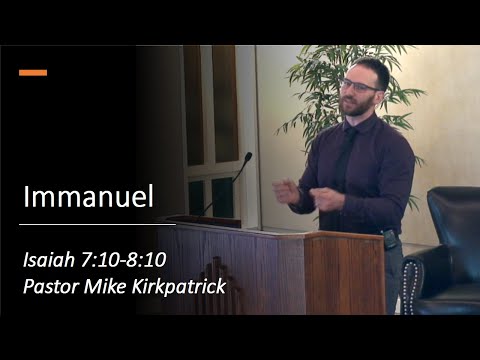
Immanuel
Isaiah 7:10–8:10 presents the Immanuel prophecy not as a comfortable seasonal text but as a word of judgment against Ahaz's faithless trust in Assyria and a word of hope for the covenant remnant. The sermon traces two contrasting realities: 'Assyria with us,' the consequence of royal unbelief, and 'God with us,' the promise that anchors the remnant through exile and desolation. The Immanuel sign finds its definitive fulfillment in Matthew 1, where the virgin-born Son saves his people from sin rather than merely political oppression — a truth that remains the ground of steadfastness for the church in every era of suffering and exile.

Waging the Good War
First Timothy 1:18–20 charges Timothy to wage the good warfare of the Christian faith, grounded in faith and a good conscience. This exposition identifies two weapons of the faithful minister—trust in the living God and a conscience calibrated by sound doctrine—set against the backdrop of false teachers who have shipwrecked the faith by rejecting the gospel of free and sovereign grace. The sermon then turns to the solemn consequence of neglecting that warfare, tracing the excommunication of Hymenaeus and Alexander as a case study in church discipline executed for the purity of the church and the potential restoration of the offender. Hearers are pressed to examine whether they possess genuine discernment regarding the gospel and genuine sensitivity toward sin, waging the warfare not to earn salvation but in response to the grace already secured in Christ.

The Third Missionary Journey, Part 1
Acts 19:1–10 opens Paul's extended ministry in Ephesus on the third missionary journey. The sermon works through three exegetical questions: the identity of the disciples Paul encounters (argued to be genuine Christian believers, not pre-Christian inquirers), the relationship between John's baptism and Christian baptism (argued to be one and the same ordinance), and the significance of the Spirit's coming with tongues and prophecy (argued to be a salvation-historical confirmation of Pentecost's fulfillment, not a normative pattern for all believers). The exposition concludes by drawing out Paul's ministry at the school of Tyrannus as a model of bold, reasoned, expositional gospel preaching that God uses to spread the word across an entire province.

The Ministry of Apollos
Acts 18:24–28 introduces Apollos of Alexandria as a case study in what faithful gospel ministry requires. Six marks characterize this man — eloquence grounded in scriptural mastery, accurate instruction in the way of the Lord, fervency of spirit governed by knowledge, precise teaching, bold proclamation, and humble openness to correction — and these same marks should shape the church's prayers for and training of men for public ministry. Luke's phrase 'believed through grace' discloses the ordo salutis: saving faith is itself the gift of God's sovereign grace to dead sinners. The sermon closes by pressing both the need for trained, bold preachers and the equally urgent need for obedient hearers, applying the gospel of justification by faith alone to any who have not yet come to Christ.

The Christian Husband/Father
The duties of the Christian husband and father are examined through the book of Proverbs, with Proverbs 4:1–9 as the anchor text and wide-ranging support from Deuteronomy and the New Testament. The sermon sets forth the godly husband as one who fears the Lord, deals with sin, provides for his household, protects his wife, communicates faithfully, and maintains sexual purity. The Christian father is then treated under four heads — being a godly man, loving his children, instructing them in word and life, and disciplining them with both verbal correction and, when necessary, the rod — all exercised in love rather than anger or indulgence. The closing application calls fathers to confess sin before their households, pray for and preach law and gospel to their children, and rest not in their own performance but in the imputed righteousness of Christ.

The Second Missionary Journey, Part 9
Acts 18:12–28 traces the close of Paul's second missionary journey through three episodes: his trial before the Roman proconsul Gallio, his departure from Corinth back to Antioch, and a preview of the Alexandrian Jewish teacher Apollos. The exposition treats Gallio's dismissal of the Jewish charge against Paul as a model of properly bounded civil authority — punishing wrongdoing, not regulating theology — while also exposing Gallio's failure to protect Sosthenes as a departure from impartial justice. Paul's continued residence in Corinth after the hearing illustrates faith in the sustaining promises of Christ, and the sermon closes with a call to pray for faithful gospel preachers and an obedient people who respond to their ministry.

Exodus 1
Exodus 1 traces the rapid shift from Israel's prosperity under Joseph to their brutal subjugation under a new Pharaoh who knew nothing of the covenant arrangement his predecessors had honored. The chapter moves in two broad movements: the origin of the oppression in the multiplication of Israel, which paradoxically fulfilled God's Abrahamic promise of seed and land, and the gravity of that oppression as Pharaoh escalated from forced labor to state-sponsored infanticide. The defiance of the Hebrew midwives Shiphrah and Puah, grounded in the fear of God rather than the fear of man, illustrates the Reformed conviction that civil obedience finds its limit where God's law begins. The sermon closes by drawing three contemporary applications: vigilance against the gradual escalation of tyranny, confidence in the sovereign providence of God who keeps his covenant promises even through suffering, and the call to Spirit-wrought courage that refuses to silently deny Christ.

The Second Missionary Journey, Part 8
Acts 18:1–11 records Paul's arrival and eighteen-month ministry in Corinth, one of the most morally degenerate cities of the ancient world. The sermon traces Paul's gospel strategy — reasoning in the synagogue, enduring Jewish opposition, and turning to the Gentiles — before dwelling on Christ's night vision to Paul: 'Do not be afraid, for I have many people in this city.' The doctrine of election explains how Christ could speak with certainty of many yet-unconverted people awaiting the call; the gospel, not moral reform or civil intervention, is the sole instrument for transforming a corrupt culture. The sermon closes with a call to pray for and to be men who preach Christ and Him crucified, stand under opposition, persevere in weakness, and believe the promise that Christ is present with His church in the great commission.

The Rejection of Heretics
Titus 3:9–15 closes Paul's letter to Titus with a sharp command to avoid unprofitable disputes and to reject the divisive man — a command the broader pastoral epistles and the apostolic witness consistently reinforce. The sermon distinguishes heresy from damnable heresy, identifying denial of the Trinity, the hypostatic union, and justification by faith alone as the errors that condemn, while pressing the church not to confuse the struggling saint with the proud, self-serving false teacher. Church discipline for doctrinal error is treated with the same gravity as discipline for moral sin, and the concluding emphasis on good works is grounded in the confession that such works are the fruits and evidences of a true and lively faith, not the grounds of justification.

Introduction to the Book of Exodus
The book of Exodus is not a standalone document but the second movement of the Pentateuch, continuing the story of the covenant people from Genesis through to their deliverance from Egypt, the giving of the law at Sinai, and the construction of the tabernacle. This introductory study surveys the book's structure through three themes — deliverance, demand, and dwelling — and traces how each anticipates Christ: Moses as covenant mediator prefiguring the greater Mediator, the Passover lamb pointing to the sacrifice of Christ, and the tabernacle foreshadowing the incarnation. The threefold division of God's law (moral, judicial, ceremonial) is explained with reference to the 1689 London Baptist Confession of Faith, with particular attention to why the moral law remains perpetually binding while the judicial and ceremonial laws have expired. The study closes by applying the Immanuel principle — that God redeems his people in order to commune with them — to the corporate worship of the New Covenant church.

The Christian's Duty toward Non-Christians
Titus 3:1–3 sets out the Christian's duty toward both civil government and all people outside the church. The sermon traces the divine origin of civil government from Genesis 9 through Romans 13 and 1 Peter 2, arguing from Francis Turretin's two-kingdom framework that Christ rules both the civil and spiritual spheres, and that the civil state therefore has no authority to command the church as church. Verse 3's catalogue of pre-conversion vices — foolishness, disobedience, malice, hatred — is read as a theological reason for patient, peaceable, and humble conduct toward non-Christians: believers were once exactly what they now struggle to bear in others, and those others may yet become objects of the same sovereign grace.

The Manifestation of God's Grace
Titus 2:11–15 presents God's grace not merely as the ground of salvation but as the very teacher of holy living. This exposition traces four aspects of grace in the passage: its appearance in the incarnation and atoning work of Christ, its instruction toward denial of ungodliness and worldly lusts and pursuit of sober, righteous, and godly life, its demonstration in the deity of the returning Christ and the definite redemption he accomplished, and its proclamation through authoritative gospel ministry. The controlling hermeneutical key is the grammatical and theological priority of the indicative over the imperative: believers obey not in order to be saved but because they have been saved, and inverting that order collapses the gospel into moralism.

The Second Missionary Journey, Part 5
Acts 17:10–15 records the ministry and departure of Paul and Silas at Berea, where the Jewish hearers were commended as 'more noble-minded' than those in Thessalonica because they received the word with readiness and examined the Scriptures daily to verify Paul's proclamation of Jesus as the Christ. The sermon expounds three movements in the text — the perseverance of the missionaries, the tenacity of unbelieving opposition, and the noble-mindedness of the Bereans — and draws sustained application from Nehemiah 8 and the parable of the sower in Luke 8 on the right reception of God's word. The Berean example is pressed as a standing model for the church: Scripture is sufficient and self-evidencing, and the truth has nothing to hide and everything to gain by investigation. Hearers are exhorted to come to the word with expectancy, attentiveness, reverence, and responsiveness, since faith comes by hearing and hearing by the word of God.

Titus 2:7 - Reverence and Humour in Preaching
Titus 2:7 calls the preacher to manifest dignity and gravity (Greek: semnotes) in the proclamation of the word. This brief exposition distinguishes judicious, fitting humor — illustrated from Spurgeon, Elijah's mockery of Baal's prophets, and Christ's condemnation of the Pharisees — from the coarse, shock-value language that has characterised certain celebrity preachers, treating reverence in preaching as a positive imperative with direct application to contemporary ministry.

The Instruction of the Church, Part 2
Titus 2:6–10 addresses young men, Titus himself as minister, and bondservants, calling each group to a specific pattern of conduct grounded in the gospel. Young men are summoned to comprehensive self-control, while Titus is charged to exemplify good works and to teach with integrity, gravity, and incorruptible soundness — precisely so that opponents are silenced and put to shame. Bondservants are exhorted to willing obedience, pleasing service, honest fidelity, and freedom from back-talk or pilfering. The overarching motive uniting every group is that their conduct may adorn the doctrine of God our Savior — not earn salvation, which rests solely on the redemptive work of Christ received through faith alone.

The Second Missionary Journey, Part 4
Acts 16:35–17:9 records Paul's departure from Philippi and his gospel ministry in Thessalonica on the second missionary journey. The passage presents two interlocking lessons: Paul's principled invocation of his Roman citizenship to protect the integrity of gospel ministry, and his rigorous expository method of reasoning, explaining, and demonstrating from the Old Testament Scriptures that Jesus is the Christ who had to suffer and rise. The sermon draws out three grounds on which a Christian may lawfully invoke civil rights — innocence, governmental accountability, and future precedent — while insisting that the efficient power behind every conversion is the sovereign grace of God through the Holy Spirit, not the eloquence of the preacher. Hearers are called to imitate the relentless faithfulness of Paul, Silas, and Jason, and to proclaim the kingship of Jesus regardless of civil hostility.

The Instruction of the Church, Part 1
Titus 2:1–5 instructs specific people groups within the church to live in a manner consistent with sound doctrine — not as a means of salvation, but as the fruit of it. This exposition works through the virtues required of older men (sobriety, reverence, temperance, soundness in faith, love, and patience), the conduct and teaching role of older women, and the domestic calling of younger women. The complementarian ordering of church and home is grounded not in culture but in the creation and fall account of Genesis 1–3, with particular attention to 1 Timothy 2 as a cross-reference. The governing purpose of all these exhortations is stated in verse 10: that the conduct of God's people would adorn, rather than blaspheme, the doctrine of God our Savior.
The Second Missionary Journey, Part 3
Acts 16:16–34 traces two episodes in Philippi: the exorcism of a slave girl's python spirit and the midnight conversion of the Philippian jailer. The passage confronts the reader with the hostility that faithful gospel ministry provokes — illegal imprisonment, beating without due process, and the solidarity of civil and commercial interests against the missionaries — while demonstrating that neither chains nor stocks can suppress the prayer and praise of those conquered by grace. The climax turns on the jailer's question, 'What must I do to be saved?', and the apostolic answer cuts through every form of salvation-by-works or salvation-by-experience: believe on the Lord Jesus Christ, and you will be saved. The sermon presses hearers to distinguish justification from sanctification, to receive the gospel offer without complicating it, and to rejoice as those delivered from sin, damnation, and the righteous wrath of God.