
Topic
Ecclesiology
1,163 sermons · All topics
1689 2LBC - Chapter 1 - Hermeneutical Principles

Hermeneutics — the science of biblical interpretation — stands at the center of this study through paragraphs 5 to 10 of Chapter 1 of the 1689 London Baptist Confession of Faith. The session works through five principles: the scope of Scripture (Christ as its organizing center), the sufficiency of Scripture (including good and necessary consequences), the perspicuity of Scripture, the availability of Scripture through faithful translation, and the two classical interpretive rules — the analogy of Scripture and the analogy of faith. The study closes by defending the proper use of creeds, confessions, and the writings of faithful theologians as gifts Christ has given to his church, while insisting that Holy Scripture alone is the supreme and final judge in all controversies of religion.

The Neglect of Weighty Matters
Jesus condemns the scribes and Pharisees in Matthew 23:23–24 not for tithing mint, anise, and cumin, but for doing so while neglecting the weightier matters of the law: justice, mercy, and faith. The Pharisaic imbalance is neither ancient nor extinct — the same tendency to obsess over religious minutiae while bypassing the moral and covenantal substance of God's law persists in the church today. Drawing on Micah 6:8, Hosea 6:6, and the broader prophetic tradition, this exposition argues that genuine obedience to God is universal and balanced, not selective and performative.

2nd London Baptist Confession of Faith (1689) - Sunday School Study - July 18, 2021
The self-authenticating authority of Scripture cannot be separated from sound principles for reading it. This 1689 London Baptist Confession of Faith Sunday school study works through chapter one, paragraphs five through ten, drawing out the hermeneutical principles the divines embedded there: the scope of Scripture (all glory to God through Christ), the sufficiency of Scripture (confined to God's glory, man's salvation, faith, and life), the perspicuity of Scripture (salvation truths are plain even to the unlearned), and the availability of Scripture in translation. The session also addresses textual criticism, the transmission history of the biblical manuscripts, and the distinction between necessary inference and explicit statement as sources of scriptural authority. Hearers are called to come to the biblical text with humility, the illumination of the Spirit, and a due use of ordinary means rather than intellectual pride or lazy avoidance.

Live Stream - July 18, 2021
John 1:19–28 records an official delegation from the Pharisees interrogating John the Baptist about his identity. He denies being the Christ, Elijah in bodily form, or the promised Prophet of Deuteronomy 18, and instead confesses himself to be the voice crying in the wilderness of Isaiah 40 — the forerunner sent to prepare the way of Yahweh, who is Jesus. The sermon draws from Zechariah's Lucan prophecy in Luke 1 to show that John's preparatory ministry announced not merely the arrival of a king but justification by faith alone through the remission of sins. The application presses the church to imitate John's humility, courageous preaching, and singular aim: to make Christ preeminent rather than themselves.

The Defense of the Faith
Jude 3 commands every believer — not merely pastors or theologians — to contend earnestly for the faith once for all delivered to the saints. This sermon examines the exhortation itself, the internal threat posed by sneaky, ungodly apostates who pervert grace and deny Christ, and the practical preparedness Jude prescribes: remembering apostolic warning, building up on the most holy faith through Scripture and prayer, and resting in the assurance that God himself preserves his people. The defense of the faith is not pessimistic trench-holding but confident advance grounded in Christ's promise to build his church against which the gates of Hades shall not prevail.

The Ministry of the Word
What is the basis and method of God's ordained means for saving sinners? This sermon on 2 Timothy 4:2 argues that the preaching of the Word stands as the primary instrument through which God saves the lost and builds his church, grounding that claim in the logical chain of Romans 10, the divine pleasure announced in 1 Corinthians 1, and the final apostolic charge of Paul to Timothy. The sermon challenges the contemporary drift toward audience-driven church strategies, calling both preachers and hearers to fidelity to the proclaimed Word as the irreplaceable means of grace.

The Conversion of Cornelius
Acts 10:34–48 records the official inclusion of Gentiles in the covenant promises of God — a watershed moment in redemptive history. Peter's sermon before Cornelius and his household sets forth the peace, person, work, and prophetic witness of Jesus Christ, culminating in the declaration that through His name, whoever believes will receive remission of sins. The sovereign Holy Spirit falls upon the hearers before Peter has even finished speaking, confirming that salvation is of the Lord and that divine initiative — not human free will — drives the conversion of sinners. The passage concludes with the baptism of the entire household, a commanded public identification with the Triune God that pictures, but does not accomplish, the inward work already wrought by grace through faith.

The Hope of the Nations
Psalm 67 frames both the church's need for God's mercy and the church's missionary calling to the nations as inseparable realities. The psalmist's threefold petition — mercy, blessing, and communion with God for the church — is the ground from which prayer for the salvation, worship, and righteous governance of the nations flows. Drawing on the Aaronic blessing, the Abrahamic covenant, and the New Testament's Great Commission, the sermon argues that the church's received grace creates an inescapable obligation to proclaim that grace to the ends of the earth. The closing application calls the congregation to corporate prayer, support of the missionary enterprise, and fidelity to the gospel message as the only means God has ordained for the hope of the nations to be realized.

The Elements of Family Worship
Deuteronomy 6:6–7 commands parents to teach God's word diligently to their children in every season of daily life, and this sermon traces that mandate across both Testaments — from Abraham's household religion in Genesis 18, through the Psalms and Proverbs, to Paul's charge in Ephesians 6:4 and the example of Timothy's mother and grandmother. The preacher argues that family worship is a clear biblical obligation whose specific form is left to the conscience, and that failure to instruct children in the fear of God — illustrated negatively by Eli and Samuel's sons — leaves them unguarded against a culture actively hostile to Christ. Fathers and mothers are exhorted to commit first to public Lord's Day worship, to honour the sanctification of the Sabbath, and then to establish a family altar consisting of Scripture reading, prayer, and singing — scaled appropriately for their household — as the primary means of passing covenant knowledge to the next generation.

Exodus 10
Exodus 10 records the eighth plague of locusts and the ninth plague of darkness, both of which expose Pharaoh's hardened pride and vindicate the sovereignty of God over Egypt, its rulers, and its gods. The hardening of Pharaoh's heart is examined not as a capricious act but as a judicial act of divine justice against a man and a dynasty already guilty of enslaving and murdering God's people. The passage carries forward two covenantal purposes: the public declaration of God's supremacy and the transmission of that knowledge to successive generations within the covenant community. Believers are called to pray for God's glory above all earthly concerns, to refuse embarrassment over God's justice, and to trust his sovereignty even in prolonged seasons of affliction.

The Call to Faithfulness in Perilous Times
Paul's warning in 2 Timothy 3:1–9 concerns not pagan opposition but a more dangerous internal threat: professing Christians within the local church who bear the outward form of godliness while denying its power. The sermon works through the passage in four movements — recognising the danger of 'the last days,' identifying the vice list under categories of pride, lovelessness, disobedience, slander, and treachery, heeding the exhortation to withdraw from such persons, and receiving encouragement that their folly will be publicly exposed. The congregation is called to maintain vigilant, doctrinally grounded churchmanship, to agonise over the church's internal corruptions as Ezekiel's faithful remnant did, and to resist both despair and naivety, trusting Christ's promise that the gates of Hades shall not prevail against his church.
Introduction to the 2nd London Baptist Confession 1677/1689
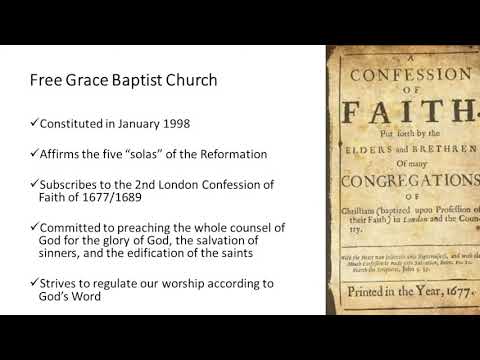
Why should a church bind itself to a confession of faith? This introductory lesson on the Second London Baptist Confession of 1677/1689 grounds the answer exegetically in Ephesians 4 — where Christ gives gifted men to the church so that the body attains doctrinal unity and is no longer tossed about by every wind of teaching — and then traces the historical origins of the 1689 among the Particular Baptists, distinguishing them from Anabaptists, Presbyterians, and Congregationalists. Four functions of a confession are developed: defining, defending, discriminating, and disciplining with reference to the doctrine of the church. The lesson closes by distinguishing Reformed theology (Calvinism plus covenant theology plus the regulative principle) from mere five-point Calvinism, and by defending the confession's silence on matters of Christian liberty as a feature, not a defect.

The Lord's Assessment of John the Baptist - Matthew 11:2-15
Matthew 11:2-15 presents Christ's own assessment of John the Baptist, and this exposition works through two movements: the question John sends from prison concerning the Messiah's identity, and the Lord's threefold commendation of John as no mere reed, no court prophet, but the greatest born of women and the anti-typical Elijah. The sermon argues that John's struggle was not with who Jesus was but with the implications of the messianic reign — why the herald of judgment should languish in prison while the Messiah's full justice remained deferred — a tension the church in every age must learn to hold without abandoning confidence in God's sovereign timetable. Listeners are called to pray for and expect ministers who combine the light of sound exegesis with the heat of genuine conviction, men who, like John, neither fear nor flatter any flesh.

The Royal Wedding
Psalm 45 presents a royal wedding between the divine-human Messiah and his church, and the sons of Korah compose it as a song of love that the New Testament apostles and the entirety of the Old Testament prophetic witness sustain. The sermon works through the psalm's four sections — the psalmist's intention, the perfections and person of King Messiah, the instruction to the bride, and the closing declaration — demonstrating that a divine Messiah was not a novelty invented by John or Paul but was anticipated in the Hebrew Scriptures. Christ is celebrated as fairer than the sons of men, committed to truth and righteousness, triumphant over his enemies, fully God and fully man in the hypostatic union, and the one who clothes his bride in imputed righteousness received through faith alone. The appropriate response of the church is repentance, exclusive allegiance, worship, and gladness before her great King.
The Mission of the Word, Part 1
John 1:6–9 introduces John the Baptist not as an independent figure but as a divinely commissioned witness whose entire ministry exists to point to the Word made flesh. This sermon examines the origin, nature, and function of that witness ministry, demonstrating that the Baptist's testimony belongs to a network of overlapping witnesses — Father, Son, Holy Spirit, Scripture, and signs — that ground saving faith in historical reality rather than a blind existential leap. The function of John's witness is inseparable from its purpose: that sinners would believe on Christ as the Lamb of God who takes away the sin of the world, not merely imitate him as a moral example. The sermon closes with a call to keep law and gospel in their proper places, so that sinners driven by the law's killing power may look by grace to the one who is both the true light and the only hope of the world.

The Ethics of Motherhood
Titus 2:3–5 sets older women in the church as instructors of younger women in the domestic virtues that honor the created order and adorn the doctrine of God. Against a cultural moment that treats the word 'mother' as offensive and obliterates God-wrought gender distinction, the passage calls women to love husbands and children, to exercise discretion, chastity, and diligence in the home, and to submit to their own husbands — not as cultural accommodation but as a reflection of the eternal created order grounded in Genesis and reaffirmed by Christ's redemption. The overarching rationale Paul supplies is theological: the conduct of women in household and church either blasphemes or adorns the Word of God before a watching world. The sermon closes by grounding every duty in grace alone through faith alone in Christ alone, warning that no degree of faithful motherhood constitutes grounds for justification.

The Practice of the Church
Acts 2:41–47 describes the first-century church's response to apostolic preaching and, when read in light of the whole New Testament, is prescriptive for churches today. The sermon traces two main movements: the power of the gospel that produces faith, repentance, and baptism, and the fourfold practice of the church — steadfast continuation in the apostles' doctrine, fellowship, the breaking of bread, and prayer. Cessationism is applied to the signs and wonders of the apostolic era, while the ongoing marks of the church are drawn from the Belgic Confession's articles on the true church and the obligations of her members. The practical burden is that believers must resist both the reduction of church life to entertainment and the temptation to substitute online participation for embodied, corporate worship.

The Good Soldier of Jesus Christ
The qualifications and character of faithful gospel ministry are examined through 2 Timothy 2:1–7, where Paul gives Timothy three interlocking commands: be strong in the grace of Christ, commit sound doctrine to faithful men who can teach others, and endure hardship as a soldier of Jesus Christ. Three metaphors — the devoted soldier, the disciplined athlete, and the diligent farmer — together with the dedication of the disciple, frame what faithfulness in pastoral ministry demands. The sermon presses both pastors and congregations to resist the pressure of cultural and governmental opposition, to identify and train men for ministry, and to understand that the dignity of gospel preaching warrants the highest standards of devotion, discipline, and endurance.

The Lukewarm Laodiceans
Revelation 3:14–22 confronts the church in Laodicea with a charge of spiritual lukewarmness — not outright apostasy, but ineffectual, self-satisfied religion that neither heals nor refreshes. Drawing on the city's historical wealth, its piped-in tepid water supply, and the covenantal language of Leviticus 18, this exposition argues that lukewarm Christianity is, in the end, no Christianity at all. Christ's threatened judgment is not arbitrary but covenantal, and his counsel to buy gold, white garments, and eye salve from him is an act of love that calls the church to honest self-assessment, renewed zeal, and genuine repentance.

The New and Living Way
Hebrews 10:19–25 presents two grounds of confidence for the people of God — boldness of access to the Holy of Holies through Christ's blood and flesh, and the possession of a great high priest over the house of God — and then presses three exhortations upon that foundation: draw near, hold fast the confession of hope, and consider one another to stir up love and good works. The sermon traces the problem of sinful man's exclusion from God's presence from Exodus 40 through the Levitical sacrificial system to its resolution in the incarnation and definite atonement of Christ, who consecrated a new and living way. Particular attention is given to the prohibition against forsaking the assembly, argued to be grammatically tied to the third exhortation and theologically governing all three, so that corporate Lord's Day worship is the ordained context in which God's people draw near, are educated in hope, and mutually provoke one another to love and good works. The sermon closes by calling the unconverted to look to Christ and the converted to embrace their shared responsibility for one another's souls through faithful churchmanship.

The Second Commandment
The Second Commandment (Deuteronomy 5:8–10) does not merely forbid the worship of false gods — it forbids the worship of the true God in a false manner, a distinction that carries enormous weight for how the church orders its worship today. The sermon works through the commandment's prohibition against idols and images (including pictorial representations of Christ), the theological rationale grounded in God's jealousy and immutability, the transgenerational consequences of false worship understood not as a hereditary curse but as the imitation of godlessness, and the promise of mercy to those who love and obey God. The positive application is the Regulative Principle of Worship: only what God has commanded is acceptable, and anything beyond or contrary to that command — however sincere the motive — constitutes the offering of strange fire to Yahweh.

The Ministry in Rome
Acts 28:11–31 records the Apostle Paul's arrival in Rome under house arrest and his sustained ministry to the Jewish leaders there, demonstrating that divine providence — not Roman law or Jewish opposition — governs the advance of the gospel. The sermon traces Paul's two meetings with the Roman Jews: his defence of his innocence and his grounding of the gospel in the hope of Israel, and then his full-day exposition of Christ from Moses and the prophets, which divides his hearers between belief and hardened unbelief. The open-endedness of Acts is shown to be deliberate fulfilment of Acts 1:8 — Christ's commission to witness from Jerusalem to the uttermost parts of the earth has been accomplished. Hearers are called to resist fear, to proclaim Christ from the Scriptures with confidence, and to rest in sovereign grace as the sole explanation for why any sinner believes.

Nov 08, 2020 Sunday PM Service

First Timothy 5:1–2 instructs Timothy — and by extension all Christians — on how to treat members of the congregation according to age and gender, framing those relationships by analogy to the family. The sermon grounds this instruction in the Fifth Commandment, drawing on Westminster Larger Catechism questions 124–131 to show that the commandment's scope extends beyond natural parents to all relationships of authority, age, and equality. Pastors must exhort older men as fathers, younger men as brothers, older women as mothers, and younger women as sisters with all purity — avoiding harshness on the one side and laxity or impropriety on the other. The closing application presses the doctrine of adoption: because believers are children of God and joint-heirs with Christ their elder brother, the church is a genuine household, and its members bear mutual responsibility to encourage and bear one another's burdens without waiting for pastoral direction.

The Utility of Confessions and Introduction to the Second London Baptist Confession
Confessions of faith are not competitors to Scripture but are faithful summaries of biblical doctrine, and the church has historically depended on them for good reason. This address introduces the Second London Baptist Confession of 1689, tracing its historical origins among the Particular Baptists of the 17th century and its relationship to the Westminster Confession and the Savoy Declaration. Five interlocking uses of a confession are then examined: defining church doctrine, defending it against error, discriminating between members and officers on doctrinal grounds, disciplining departures from orthodoxy, and distinguishing confessed doctrine from matters of Christian liberty. The goal is not confessional enslavement but confessional clarity — guardrails that protect the church and free her members to worship and grow in the grace and knowledge of Christ.

The Great Commission
The Great Commission (Matthew 28:18–20) constitutes Christ's formal mandate to his church for this age: going, making disciples, baptizing believers, and teaching them to observe all that he commanded. The authority behind the commission is Christ's present, universal lordship — not a future investiture but a reigning reality — and the assurance sustaining it is his promised presence to the end of the age. Baptism is treated as believers' baptism by immersion, an initiatory ordinance that publicly identifies the disciple with the triune God and symbolises union with Christ in his death, burial, and resurrection. The sermon calls the church to be comprehensively about this single focused mission — preaching the gospel for justification, then grounding the justified in sanctification through the teaching ministry of the local church.

The Hearing before the Sanhedrin, Part 1
The trial of Jesus before the Sanhedrin (Matthew 26:57–64) was no honest hearing but a predetermined execution by the highest religious court in Israel, assembled in violation of their own law and Scripture. This sermon examines the setting of the hearing, the fraudulent witness testimony regarding the temple, and the high priest's sworn examination of Jesus — in which Christ openly affirms that He is the Messiah, the Son of God, and Daniel's Son of Man. The temple charge against Jesus is shown to be a deliberate misquotation and misinterpretation of John 2:19, where Christ spoke not of the physical structure but of His own death and resurrection. The Sanhedrin's wickedness is set in sharp contrast to the resolve of Christ, who endures this sham trial in silence and then under oath, fulfilling Isaiah 53 and Daniel 7, in order to accomplish the salvation of His people.

David's Rise and Saul's Resentment
1 Samuel 18 traces the beginning of David's rise to prominence and Saul's corresponding descent into envious rage. The chapter presents a sustained contrast between Jonathan's covenant faithfulness — his willing deferral to David as the Lord's anointed — and Saul's increasingly vicious antagonism, from murderous spear-throwing to cynical manipulation of marriage negotiations. The sermon draws out the theological spine of the narrative: the presence of Yahweh with David is both the cause of his success and the source of Saul's terror, a pattern that points forward to the New Covenant reality that those united to Christ by faith enjoy the peace, protection, and communion of God. Listeners are called to watch against both external and internal threats to the kingdom, and to pursue the God-fearing faithfulness modelled in David rather than the self-securing apostasy of Saul.

The Meeting with James in Jerusalem
Acts 21:17–40 narrates Paul's final recorded visit to Jerusalem, where he meets with James and the elders before being seized by a mob in the temple. The sermon works through four aspects of the meeting — reception, report, response, and recommendation — to demonstrate that James and Paul were in full theological harmony, both preaching justification by grace alone through faith alone in Christ alone. The arrest that follows illustrates both the rage of unbelieving Israel and the sovereign providence of God, who uses Roman civil authority to preserve his apostle. Hearers are urged to imitate Paul's spirit of conciliation on secondary matters, insist on the gospel above all else, and trust the God who receives sinners.

The Third Missionary Journey, Part 8
Acts 21:1–16 concludes Paul's third missionary journey with his determined journey to Jerusalem in the face of repeated prophetic warnings and the tearful pleas of fellow believers. The passage grounds Paul's resolve not in stoic courage but in his consuming vision of the gospel: men and women under God's wrath and curse, and Christ alone as the remedy. The sermon draws out Paul's love for the gathered people of God, his complementarian ecclesiology (defending male leadership in church office from 1 Timothy 2 and the cessation of revelatory gifts), and his example of a missionary strategy that planted self-governing, elder-led churches across the Roman Empire.

Live Stream - Baptisms: Jordana Van Oort, Will and Tara De Rover, Fran Guliker
Acts 2:14-42 provides the apostolic pattern for the church's proclamation of the gospel and the administration of baptism. Peter's Pentecost sermon is examined as a model: the gospel centers on the life, death, resurrection, and exaltation of Jesus Christ; the law exposes guilty sinners who cannot fix themselves; and repentance and faith — not baptism itself — are the grounds of salvation. Four believers are baptized as a public sign of their union with Christ in his death and resurrection, their remission of sins, and their commitment to walk in newness of life, with the congregation reminded that sovereign grace, not race or ritual, determines who is called.