
Scripture
John
196 sermons

The Healing of a Blind Man, Part 2

John 9:13–34 records the formal interrogation of a man born blind by the Pharisees following his healing by Jesus. The passage exposes the willful unbelief of Israel's religious leadership — men who suppress plain evidence, commit perjury, and wield coercion against a helpless witness — while simultaneously tracing the healed man's growing confession of Christ, from 'he is a prophet' to 'if this man were not from God, he could do nothing.' The sermon argues that opposition to the Son of God is always opposition to the Father who sent him, and that the courage to confess Christ in the face of exclusion and shame is the mark of genuine discipleship.

The Healing of the Blind Man
John 9:1–12 presents the healing of a man born blind as a sign that Jesus is the light of the world — not merely a title (John 8:12) but a function he enacts in restoring both physical and spiritual sight. The sermon addresses the disciples' question about the cause of the man's blindness by distinguishing between suffering that is a direct consequence of particular sin and suffering that is ordained by God's sovereign providence to display his works. God's absolute sovereignty over all creatures and all their actions — including congenital affliction — is defended from Scripture and the 1689 LBCF chapter on providence, with Job, Paul, and the man born blind as converging witnesses that God's people walk by faith in Romans 8:28 when affliction comes. The sermon closes with an evangelistic appeal drawn from John's stated purpose: that readers believe Jesus is the Christ, the Son of God, and have everlasting life.

The Joy of Abraham in the Day of Christ
John 8:54–59 presents the most concentrated claim to divine identity in this chapter: Jesus asserts unity with the Father, declares that Abraham rejoiced to see His messianic day, and finally identifies Himself as the eternal 'I Am' of Exodus 3:14. The sermon traces Abraham's anticipatory faith through the protoevangelium of Genesis 3:15, the Abrahamic covenant promises, and their fulfilment in Christ alone, demonstrating that old covenant saints were justified by grace alone through faith alone in Christ alone. The response of the religious leaders — picking up stones for blasphemy — confirms what they rightly understood Jesus to be claiming: equality with the Father. The sermon closes with a direct call to faith, contrasting the animosity of unbelieving Jerusalem with the joy of Abraham, and urging hearers not to harden themselves against the one who promises that whoever keeps His word shall never see death.

The Children of the Devil, Part 4
John 8:48–53 records the Jews' escalating accusation that Jesus is a Samaritan and demon-possessed — the very imitation of their father the devil that Jesus exposed in verse 44. This sermon works through Jesus' threefold denial of the demon charge: he honors the Father, does not seek his own glory, and speaks the words of eternal life — each point being precisely what a demon-possessed man would never do. The expositor presses the doctrinal stakes of verse 51 — 'if anyone keeps my word, he shall never see death' — as a gracious promise held out even to those who would shortly take up stones, and calls hearers to come to Christ for justification before facing the eternal judgment from which no doubling-down on false religion can shield them.

The Children of the Devil, Part 3
John 8:44–47 records Christ's unflinching indictment of the unbelieving Jewish religious leaders as children of the devil, a verdict he confirms by exposing three marks of their paternity: they reject the truth he speaks precisely because it is truth, they cannot convict him of a single sin, and they do not hear God's words because they are not of God. The sermon draws out the theological weight of each mark — the devil as murderer and father of lies in contrast to Christ as life and truth — and applies these diagnostic tests to the question of assurance: those who are of God love Christ and love the Word. The exposition closes with a call to both the congregation and the unconverted to rest in the imputed righteousness of Christ, received by faith alone, as the only ground of a right relationship with God the Father.

The Children of the Devil, Part 2
John 8:42–47 presents one of the most confrontational moments in Christ's public ministry: his declaration that the religious leaders who claimed God as their Father were in fact children of the devil. This sermon works through three elements of that indictment — the rejection of their claim to divine sonship (v. 42), the affirmation of their total inability to receive Christ's word (v. 43), and the opening of his identification of their true father (v. 44). The doctrine of eternal generation grounds the argument: because the Son is consubstantial with the Father, rejection of the Son is conclusive proof that God is not their father. The sermon extends the application to warn the church against those who, like these leaders, do the desires of the devil — whether as false teachers within or persecuting powers without — and calls believers to the one antidote: love for Christ as the fruit of regeneration and sovereign grace.

The Children of the Devil, Part 1
John 8:37–41 records Jesus systematically dismantling the religious establishment's claim that physical descent from Abraham constitutes spiritual standing before God. Working through the Jews' twofold assertion — that Abraham is their father and, in verse 41, that God is their father — Jesus marshals three evidences that expose the claim as groundless: their murderous intent toward him, their refusal to receive his word, and their rejection of the one he came from. The sermon drives toward the conclusion that membership in the family of God is secured not by race but by grace through faith in Jesus Christ, the promised seed of Genesis 3:15, and calls every hearer to examine whether they have received or rejected that word.

The Freedom in Receiving the Son, Part 2
John 8:33–36 sets two irreconcilable conditions before every person: slavery to sin or freedom in the Son. Working through Jesus' response to the objecting Jews — His declaration of spiritual slavery in verse 34, His illustration from the household in verse 35, and His promise of true liberty in verse 36 — this sermon argues that sin's bondage is total, that the sinner is constitutionally blind to his own condition, and that freedom comes exclusively through the only-begotten Son who abides in the Father's house forever. The law of God must be pressed upon the conscience so that sinners know their malady before they can receive the remedy: the Son who makes men free indeed.

The Freedom in Receiving the Son
John 8:30–36 sets before the reader a sharp contrast between the blessedness of spiritual liberty and the wretchedness of spiritual slavery. This sermon expounds the theological order of salvation — justification by grace alone through faith alone precedes and produces the disciple's abiding in Christ's word, not the reverse — and then traces what that freedom means: deliverance from the curse of the law, the condemnation of sin, the wrath of God, and the tyranny of the devil. The church's calling to be the pillar and ground of the truth (1 Timothy 3:15) demands that she identify, propagate, contend for, and protect that truth in every generation.
Clip: Breathtaking kindness! And the danger of rejecting the Son
Drawing from John 8:21–29, this sermon clip sets before the listener two and only two positions: the breathtaking kindness of the God who sent his Son to save sinners, and the deadly consequence of dying in unbelief. The gospel offer is pressed with urgency — Christ receives all who come to him and casts out none — while the condemnation of those who refuse to believe that 'I am' is stated with equal plainness. The hearer is called to stop wavering and believe on the Lord Jesus Christ for everlasting life.

The Danger of Rejecting the Son, Part 2
John 8:25–29 confronts the persistent Jewish rejection of Jesus by pressing two questions: who is he, and what does his coming death mean? The sermon expounds Christ's identity as the eternal Son sent by the Father — God from God, light from light, true God from true God — and shows that his crucifixion and resurrection will vindicate that identity before the very men who condemned him. The active obedience of Christ, summarized in his declaration that he always does what pleases the Father, grounds the imputed righteousness sinners need for justification. Hearers are called to rest in the only true God and Jesus Christ whom he has sent, the knowledge of whom is itself the substance of eternal life.
The Danger of Rejecting the Son
John 8:21–29 records Jesus warning a hostile religious leadership that they will die in their sins if they do not believe that He is the great I Am — the divine Son eternally generated from the Father, sent into the world in the economy of redemption. The sermon works through the passage in three movements: the announcement of Christ's departure and the condemnation it implies, the question of His identity and the slander levelled against Him, and the reference to His crucifixion as the moment of disclosure. The central doctrinal burden is that a deficient Christology — whether ancient Arianism, Sabellianism, or modern proposals of eternal functional subordination — amounts to the very unbelief Christ condemns, and that the church's primary calling is to preach the triune God with particular weight on who the Son is and what He has done for sinners.

The Truthful Testimony of the Lord
John 8:13–20 records the Pharisees' flat rejection of Christ's self-testimony — 'your witness is not true' — and his threefold response: the intrinsic truthfulness of his witness grounded in his divine origin and destination, the confirming unity he shares with the Father, and the law of two witnesses satisfied by Father and Son together. The passage closes with the Pharisees demanding to see the Father, only to be told that their ignorance of the Son proves their ignorance of the God they claim to worship. The sermon presses upon the hearer that to receive or reject Christ is to receive or reject the Father, and calls unbelievers to look in faith to the one mediator between God and men.

The Light of the World
In John 8:12, Jesus declares 'I am the light of the world,' a claim that situates him within the great 'I Am' tradition of Exodus 3:14 and the Isaianic servant songs, asserting both his full deity as the eternal Son and the universal scope of his messianic mission to Jew and Gentile alike. The sermon traces the 'I Am' statements across John's Gospel, showing that Jesus consciously identifies himself with Yahweh and that the light-imagery of the Old Testament finds its fulfillment in his person and work. Darkness in John is not physical but ethical — the guilt, depravity, and rebellion of a world that hates the light — and the follower of Christ, by grace through faith, passes from that darkness into the light of life. The church is therefore called to hold forth the word of the gospel as light in a morally darkened age, trusting that God is able to transfer sinners from the kingdom of darkness into the kingdom of his Son.

The Woman Caught in Adultery
John 8:1–11 presents the Pharisees placing Christ on the horns of a dilemma: uphold the law of Moses and condemn the woman caught in adultery, or show compassion and be exposed as an antinomian. This sermon works through the passage in two movements — the woman brought to Christ (vv. 1–6) and the woman forgiven by Christ (vv. 7–11) — demonstrating that Jesus resolves the dilemma not by choosing one horn but by upholding both simultaneously. He appeals to the Mosaic witness laws of Deuteronomy 17 and 19 to silence the hypocritical accusers, then pronounces forgiveness, illustrating that the gospel pattern is 'get and do' rather than 'do and get.' The passage stands as a vivid display of Christ as both the holy lawgiver who writes with his finger and the friend of sinners who bids the thirsty come and drink.

The Reaction to Jesus and His Words
John 7:40–53 records the sharply divided public reaction to Jesus's preaching at the Feast of Tabernacles and the private opposition of the Sanhedrin to him and his followers. The crowd fractures over whether Jesus is the promised prophet of Deuteronomy 18 or the Christ himself, while the religious leadership responds not with argument but with contempt, attempting to silence him through force and scorn. The temple officers sent to arrest Jesus return empty-handed, confessing that no man has ever spoken as he has — a testimony that magnifies Christ's divine authority even as the Sanhedrin descends into lawlessness. The sermon calls hearers to abandon the confusion of the crowd and the hardness of the Sanhedrin, and instead to come to Christ in faith, receiving the everlasting life he freely offers.

The Feast of Tabernacles, Part 4
On the last and greatest day of the Feast of Tabernacles, Jesus stood and cried out two declarations that divide all of humanity: 'Where I am, you cannot come,' addressed to those who persist in unbelief, and 'If anyone thirsts, let him come to me and drink,' addressed to all who would believe. This sermon expounds John 7:32–39, tracing the murderous intentions of the Pharisees and chief priests, the sovereign rejection of the reprobate by Christ himself, and the astonishing mercy that leads him to offer living water to the very crowd seeking his arrest. The evangelist's commentary in verse 39 is shown to be a post-resurrection theological statement linking the abundant giving of the Holy Spirit to the glorification of Christ, drawing on the Old Testament water-and-Spirit passages and fulfilled at Pentecost according to Joel's prophecy.
The Feast of Tabernacles, Part 2
John 7:14–24 presents two confrontations: the Jews question Christ's authority, and Christ in turn questions the Jews' ethical integrity. The sermon works through three grounds of Christ's authority—his unity with the Father, the regenerate hearer's capacity to receive his word, and his mission to glorify the Father rather than himself—before turning to Christ's indictment of the Jews for plotting murder while professing fidelity to the Mosaic law. The exposition closes with Christ's appeal to righteous judgment over mere appearance, and the preacher applies the whole passage as a call to sinners to come and drink from the one who alone satisfies the soul's thirst.

The Feast of Tabernacles, Part 1
John 7:1–13 presents the Feast of Tabernacles as the backdrop for intensifying hostility toward Jesus, whose unbelieving half-brothers urge Him to seek public exposure — a suggestion rooted in a man-centered, politically distorted messianic expectation. Christ refuses to act on their counsel, insisting instead on the divine timetable that governs every movement of His redemptive mission. The passage confronts two errors simultaneously: the assumption that physical proximity to Jesus produces saving faith, and the temptation to shrink from confessing Christ under social pressure — both of which the text answers by pointing to sovereign grace and the covenant community as God's appointed means of steadying His people.

The Bread of Life Discourse, Part 4
John 6:48–59 brings the Bread of Life discourse to its conclusion, with Christ pressing upon unbelieving hearers the absolute necessity of eating His flesh and drinking His blood — a sustained metaphor for saving faith in His atoning sacrifice. The sermon demonstrates that this language is not eucharistic or literal but is the equivalent of coming to, receiving, and believing on Christ as the one who gives His flesh for the life of the world. The exposition draws out five doctrines of grace embedded in the discourse — total depravity, unconditional election, particular redemption, irresistible grace, and the preservation of the saints — and closes by tracing the glory of Christ seen in the incarnation, His power to save, His divine origin, and His patient mercy in repeating the same call to faith before a rejecting audience.

The Bread of Life Discourse, Part 3
John 6:41–51 records the Jews' grumbling rejection of Jesus as the bread of life and his pointed rebuke of their unbelief. This sermon expounds that rejection in two movements: the nature of the Jews' complaint against Christ's divine origin, and Christ's twofold response — his assertion of the Father's sovereign, efficacious drawing of sinners and his appeal to the prophetic scriptures that learning from the Father issues in coming to the Son. The doctrines of total depravity and total inability are drawn from verse 44 and grounded in parallel texts from John 1, Romans 8, and Ephesians 2, establishing that salvation is possible only because the Father draws whom he will. The sermon closes with an exhortation to look to Christ in faith for everlasting life, the sole remedy for the problem of human sin.

The Bread of Life Discourse, Part 2
John 6:35–40 presents Christ as the Bread of Life whose identity, sovereignty, and redemptive mission are inseparable. The sermon expounds three movements in the text: Christ's self-identification as the Bread of Life with its attendant promise that those who come to Him will never hunger or thirst; the declaration of divine sovereignty in verse 37, grounding the certainty of salvation in the Father's eternal gift of a people to the Son; and the revelation of the Father's will in verses 38–40, encompassing the Son's mediatorial mission, the preservation of all given to Him, and the call to every sinner to see the Son in the preaching of the Word and believe. The doctrines of grace — total depravity, unconditional election, definite atonement, irresistible grace, and the perseverance and preservation of the saints — are shown to arise directly from the text, and the sermon closes by pressing the free offer of the gospel against both Arminian uncertainty and hyper-Calvinist paralysis.

The Bread of Life Discourse, Part 1
John 6:22–34 records the opening exchange of the bread of life discourse, in which Jesus confronts a crowd whose pursuit of Him is driven entirely by physical appetite rather than spiritual need. The sermon works through three movements: the exposed motive of the people (vv. 22–26), the Savior's exhortation to labor for food that endures to everlasting life (vv. 27–29), and the crowd's demand for a sign to rival Moses (vv. 30–34). Central to the exposition is Jesus' declaration that the 'work of God' is faith in the One the Father has sent — a faith that is itself God's gift — and His identification of Himself as the true bread of God who comes down from heaven to give life to the world, surpassing the manna of the wilderness and extending to every tribe, tongue, people, and nation.
The Lord Who Treads the Waves
John 6:16–21 records the fifth of the seven signs in John's Gospel: Jesus walking on the Sea of Galilee toward his storm-tossed disciples. The sermon works through two movements — the disciples' vulnerability in the storm and the Savior's sovereign approach across the water — to establish that Jesus, by treading the waves, enacts what the Old Testament attributes exclusively to Yahweh (Job 9:8; Psalm 77:19; Isaiah 43:16), thereby demonstrating his consubstantiality with the Father and his lordship over the natural order. The divine self-disclosure 'I am' (ego eimi), voiced both here and at key junctures throughout John's Gospel, is shown to be Jesus' deliberate appropriation of the covenant name revealed to Moses in Exodus 3:14. The sermon closes by pressing the theological remedy for the fear that afflicts God's people: a right knowledge of Christ as the great I AM displaces anxiety about trials, persecutions, and earthly circumstances.

The Feeding of the Five Thousand
John 6:1–15 presents the feeding of the five thousand as a sign — a theological event designed to reveal who Jesus is, not merely a remarkable act of provision. The miracle is set against the backdrop of the Passover and the Mosaic exodus, inviting comparison between the manna in the wilderness and Jesus as the living bread come down from heaven. The crowd's response — declaring him the prophet of Deuteronomy 18 and then attempting to seize him as a political king — exposes the persistent confusion between a physical, temporal messianic expectation and the spiritual, eternal salvation Christ actually came to accomplish. The sermon calls hearers to see in the bread and fish the One who supplies all things abundantly, who has both the compassion and the omnipotence to save every sinner who comes to him in faith.

The Rejection of the Son
John 5:41–47 records Christ's closing rebuke to the Jewish religious leaders who rejected Him despite the testimony of John the Baptist, His works, the Father, and the Scriptures. The sermon expounds two principal charges Jesus levels against His opponents: their refusal to receive the honor that comes from God alone, and their complete absence of love for God — demonstrated precisely by their rejection of the One the Father sent. Working through the accusation by Moses in verses 45–47, the exposition shows that to reject Christ is simultaneously to reject Moses, to reject the Father, and to worship an idol in place of the living God. The sermon closes with a call to receive Christ by faith, in whom alone eternal life is found.

The Witnesses for the Defense
In John 5:31–40, Jesus faces charges of blasphemy and Sabbath-breaking and responds not by deflecting but by calling four corroborating witnesses to establish his consubstantiality with the Father: John the Baptist, his own works, the Father's testimony, and the Scriptures themselves. The sermon traces each witness in turn, showing that Christ's equality with God is not a later theological invention but the central claim of his own ministry, attested by every strand of divine revelation. The passage culminates in a sobering indictment: those who search the Scriptures seeking eternal life while refusing to come to Christ have missed the entire point of revelation, for Christ is the telos of all Scripture. Hearers are called to reckon with the gravity of sin and to come to Christ by grace through faith as the only ground of everlasting life.
The Consubstantiality of the Son, Part 3
John 5:27–30 presents the Son of God claiming the divine prerogatives of life-giving and universal judgment as proof of His consubstantiality with the Father — the same divine nature, not a derivative or lesser deity. The sermon works through the distinction between the present spiritual resurrection of verse 25 and the future general resurrection of all mankind in verses 28–29, establishing that the 'good' who rise to life are those justified by faith alone, whose works are the fruit and evidence of that faith rather than its ground. Christ's declaration in verse 30 — 'I can of myself do nothing' — is shown to be not a confession of subordination but an assertion of the unity of the divine will across the three persons. Hearers are called either to take refuge in Christ's blood and righteousness before the day of judgment, or, if already believing, to long with biblical legitimacy for the coming of the just Judge who will vindicate His church and right every wrong.

The Consubstantiality of the Son, Part 2
John 5:24–30 presents Jesus responding to the Jewish charge that he made himself equal with God — not by retreating, but by affirming it through two divine functions: authority over life and authority over judgment. This sermon works through the declaration of that authority in eternal life (vv. 24–25), the rationale grounded in the eternal generation of the Son from the Father (vv. 26–27), and the promise of his authority on the final day of judgment (vv. 28–30, previewed). Central to the argument is the doctrine of consubstantiality — that the Son shares the one simple undivided divine essence with the Father from all eternity — which grounds both his power to effectually call dead sinners to life and his right to preside as judge of all the earth. The sermon calls hearers to receive Christ by faith, since only God himself can save sinners, and it is the voice of the Son of God alone that awakens the spiritually dead.
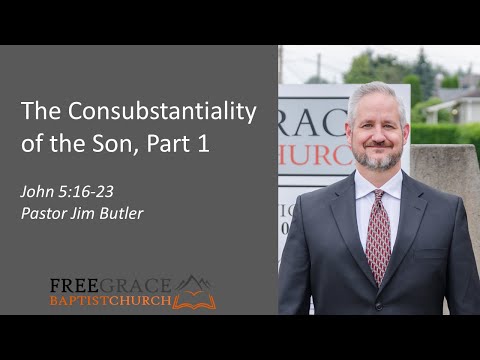
The Consubstantiality of the Son, Part 1
John 5:16–23 records the Jewish charge that Jesus made himself equal with God — and Christ's unequivocal affirmation of that charge. Working through verses 16–23, this sermon demonstrates that Jesus responds not by correcting a misunderstanding but by confirming, through four lines of argument, that he is consubstantial with the Father: sharing the same works, the same love, the same life-giving power, and the same sovereign rule. The stakes are ultimate — to dishonor the Son is to dishonor the Father, and to lack the Son is to lack God entirely.