
Scripture
John
196 sermons

The Healing at Bethesda

John 5:1–15 presents the healing of a paralyzed man at Bethesda as a display of Christ's sovereign initiative, mercy, and power. The man's 38-year infirmity — physical, helpless, and rooted in personal sin — mirrors the spiritual condition of every sinner apart from grace: unable to save himself and without recourse. Christ seeks the man out from a great multitude, issues a word of command that effects immediate and complete healing, and then addresses the deeper need by calling him to repentance. Against this glory, the opposition of the Jewish leaders — fixating on Sabbath casuistry while ignoring a manifest work of God — warns against a religion so narrowly fastidious that it cannot acknowledge divine mercy.

The Healing of the Nobleman's Son
John 4:43–54 records the second sign Jesus performed in Galilee: the healing of a royal official's son from a distance of sixteen miles. The passage exposes both the deficient faith that demands visible proof before believing and the sufficient power of Christ's spoken word, which heals without physical presence. The nobleman's earnest intercession for his dying son becomes a pointed application for parents to implore God persistently for their children's spiritual wellbeing. The sign itself points beyond physical healing to the life given to all who believe the word of Christ.

Clip - Sinners, don't despair!
Drawing from the account of the Samaritan woman and villagers in John 4, this clip addresses those who remain outside of saving grace with a direct and tender appeal: do not despair, but come to Christ. The Evangelist John wrote his Gospel precisely for this purpose — that readers might believe Jesus is the Christ, the Son of God, and that believing they might have life in His name.

The Savior of the World
John 4:27–42 traces three interlocking movements — the Samaritan woman's testimony, Christ's teaching on the harvest, and the Samaritans' confession that He is the Savior of the world — to argue that Christ's saving work crosses every ethnic and religious boundary without exception. The passage exposes the active and passive obedience of Christ as the twin grounds of justification: His perfect compliance with the law of God and His atoning death together constitute the righteousness sinners receive by faith alone. The Samaritans' declaration in verse 42 is not merely a first-century curiosity but a standing gospel call — Christ is the Savior of the world, and all who hear are summoned to come and see Him.

The Meeting with the Samaritan Woman, Part 2
John 4:16–26 presents Jesus exposing a Samaritan woman's sin through the law in order to drive her to the living water of eternal life, then correcting the corrupted worship of Samaria and declaring the arrival of new covenant worship. The sermon argues that true worship of God is irreducibly Trinitarian: the Father is the object, the Son is the mediator and the truth through whom access is granted, and the Holy Spirit is the enabling power. Jesus' self-disclosure as the great I Am — the fulfillment of Exodus 3:14 and the prophetic expectation of Deuteronomy 18 — confirms that the Messiah the woman anticipated is the very one speaking to her. Hearers are called to receive the living water freely offered and to engage in the distinctly Trinitarian worship that Christ here commands.

The Meeting with the Samaritan Woman, Part 1
John 4:1–15 presents Jesus passing through Samaria not merely as a geographical necessity but as a divine appointment rooted in his mission to save sinners without distinction of race, sex, or moral standing. The sermon examines the two natures of Christ as the theological ground for understanding why Jesus is both weary at the well according to his humanity and omnisciently aware of the woman's sin according to his divinity. The offer of living water is traced through its Old Testament antecedents — Isaiah, Jeremiah, Ezekiel, and Zechariah — and shown to signify the whole grace of salvation freely given, not earned, and never revoked. Hearers are pressed to see in the Samaritan woman's partial interest an indictment of those who have heard the gospel repeatedly yet remain indifferent, and are called to cry out to Christ for the living water he is willing to give.

The Testimony Concerning Christ's Supremacy
John 3:31–36 contains John the Baptist's climactic testimony concerning the supremacy and authority of the Lord Jesus Christ. The passage presses two inseparable realities: Christ's origin from above establishes his absolute supremacy over every earthly voice, and the Father's gift of all things into the Son's hand grounds his authority to bestow everlasting life on believers and to execute wrath on those who remain in unbelief. The sermon traces how the Baptist's testimony in these verses is of one piece with the prologue of John's Gospel, the high-priestly prayer of John 17, and the whole drift of Scripture concerning the triune God. Hearers are called to look in faith to Christ, the Lamb of God, understanding that regeneration by the Spirit is the necessary precondition for that faith, and that to reject the Son is not neutrality but the tacit accusation that God is a liar.

The Testimony Concerning the Bridegroom
John 3:22–30 presents the final recorded testimony of John the Baptist in the Fourth Gospel, in which John responds to his disciples' anxious complaint that all are coming to Jesus rather than to him. John's response is structured around four declarations: the sovereignty of God governs the origin and success of every ministry; his own role was never to be the Christ but the forerunner sent before him; his joy is that of the friend of the bridegroom who delights simply to stand in the presence of the bridegroom and hear his voice; and therefore Christ must increase while he must decrease. The sermon draws out both the Christological weight of the bridegroom image — rooted in the Old Testament covenant between God and Israel and fulfilled in Christ and his church — and its practical implications for how ministers and all God's people resist pride by being increasingly occupied with Christ rather than with themselves.

The Discourse on God's Salvation, Part 3
John 3:17–21 declares that the Son of Man's incarnation was a redemptive, not a condemnatory, mission — yet the world He entered was already under condemnation by virtue of Adam's sin and its own actual transgressions. The passage moves from the declaration of man's condemned state (vv. 17–18) to the demonstration of it (vv. 19–21): fallen humanity resists the light of Christ, loves moral darkness, and avoids exposure — the classic scriptural portrait of total depravity confirmed across Genesis, the Psalms, the Prophets, and the New Testament. The necessity of regeneration by the Holy Spirit follows directly: because sinners are constitutionally hostile to the light, they cannot come to Christ unless the Spirit first makes them alive and grants the graces of faith and repentance.
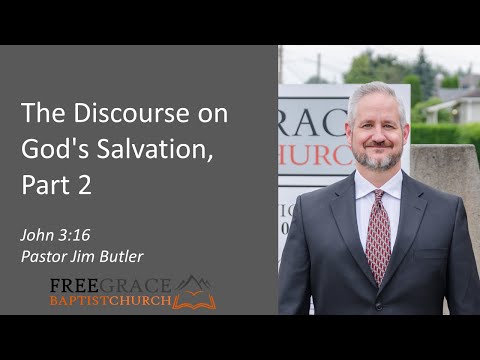
The Discourse on God's Salvation, Part 2
John 3:16 — Luther called it 'the Bible in miniature,' and this exposition treats it as precisely that: a compressed statement of the whole Christian gospel. The sermon moves through three divisions of the verse — the declaration of God's love, the demonstration of that love in the gift of the only begotten Son, and the description of those who receive God's redemptive love through faith. Central to the argument is the insistence that God's love is the source, not the consequence, of the atonement, and that 'the world' in John's vocabulary denotes persons from every tribe and tongue without ethnic distinction, not every individual without exception — a conclusion that grounds particular redemption in the wider theology of John's writings. The sermon closes with a direct appeal to unbelievers: the one way of salvation is to believe on Jesus Christ alone, whose active obedience supplies the righteousness that sinners need and whose substitutionary death removes the condemnation they deserve.

The Discourse on God's Salvation, Part 1
Jesus answers Nicodemus's question — 'How can these things be?' — by pointing to three realities: his own incarnation as the one who descended from heaven, the Old Testament typology of the bronze serpent in Numbers 21, and the necessity of his crucifixion as the antitype to whom sinners must look in faith. The sermon works through John 3:11–15, examining Christ's authority to speak of heavenly things, the doctrine of the hypostatic union and the communication of idioms, and the parallel between Israel's look-and-live prescription in the wilderness and saving faith in the crucified Son of Man. The application is direct: the antidote to sin is not moral reformation but faith in the lifted-up Christ, who alone secures justification and eternal life for believing sinners.

The Meeting with Nicodemus, Part 2
John 3:4–10 confronts every hearer with the absolute necessity of regeneration before any entrance into the kingdom of God. Working through Nicodemus's proud misunderstanding and Christ's patient explanation, this exposition argues that the new birth is entirely God's sovereign work — initiated by the Holy Spirit, prefigured in Ezekiel 36 and Deuteronomy 30, and entirely prior to saving faith. The sermon also draws out the Trinitarian theology embedded in Christ's wind analogy, showing that the Spirit's sovereign, effectual work in regeneration reveals who God is, not merely what He does.
The Meeting with Nicodemus
John 3:1–10 presents Jesus confronting Nicodemus — a ruler of the Sanhedrin sent by the Jerusalem religious leadership — with the doctrine of regeneration: that a man must be born again, born from above, before he can see or enter the kingdom of God. The sermon argues that the new birth is entirely a sovereign act of God Most High, not a command for the sinner to obey by his own power, and that regeneration logically precedes and produces saving faith rather than following it. Those born of God will evidence that new life through faith in Christ, a practice of righteousness, love for the brethren, and an overcoming of the world.

The Antitype of the Temple
John 2:18–25 presents Jesus as the antitype of the Old Testament temple — the reality to which the type pointed and in which it finds its fulfillment and realization. The Jews' demand for a sign of his authority after the temple cleansing is answered by the one definitive sign: the death and resurrection of Christ, which the apostle John interprets for the reader in verses 21–22. The sermon also treats the omniscience of Christ as evidence of his divinity, demonstrated in his refusal to entrust himself to those whose belief was superficial and temporary. Hearers are called to flee to Christ in genuine faith and repentance, receiving both forgiveness of sin and the imputed righteousness of Christ that avails before the Father.

The Cleansing of the Temple
Jesus' cleansing of the temple in John 2:13–17 is not an aberration from his character but a direct expression of his identity as the Son of God and the antitype of the temple itself. The passage reveals two inseparable realities: the apostasy of first-century Israel's worship and the messianic zeal prophesied in Psalm 69, Malachi 3, and the post-exilic prophets. Christ's authority to purge the temple rests on his sonship by nature, not adoption, and his action announces that the entire Old Covenant sacrificial system finds its fulfillment in him. The sermon calls the church to recover zeal for the purity of God's worship, to identify and resist the defections of contemporary Christendom, and to look in faith to the Lamb who has displaced every animal sacrifice.

The Wedding at Cana of Galilee
John 2:1–12 recounts the wedding at Cana, where Jesus turns water into wine as the first of his public signs. The sermon traces three movements in the passage — the setting, the sign, and the summary — and argues that the miracle is not merely a display of power over nature but a prophetically charged inauguration of new covenant abundance, anticipated by Isaiah, Jeremiah, Joel, Amos, and Zechariah. The water pots of Jewish purification give way to wine that surpasses what came before, signifying that the grace and truth that came through Jesus Christ exceeds the law given through Moses. The closing application presses hearers to heed the one command Mary gives in all of Scripture: whatever Jesus says, do it.

The First Disciples of Jesus
John 1:35–51 records the calling of the first disciples of Jesus — Andrew, Simon Peter, Philip, and Nathanael — and the passage frames their coming to Christ as the inevitable fruit of John the Baptist's preparatory ministry and the sovereign grace of God. The sermon traces how each disciple is drawn to Christ, how each immediately brings another, and how the accumulating titles given to Jesus in this section — Lamb of God, Rabbi, Messiah, Son of God, King of Israel, Son of Man — build a Christological portrait that mirrors the prologue's declaration that the Word was God. Christ's omniscience in knowing Nathanael and his royal authority in renaming Simon Peter underscore that these disciples are not choosing a teacher but being conquered by a divine Savior. The pattern of Andrew fetching Peter and Philip fetching Nathanael becomes the sermon's model for evangelism: those saved by sovereign grace become, without coercion or manipulation, propagators of that same grace.

The Testimony of John the Baptist, Part 3
John 1:30–34 records the Baptist's testimony concerning the dignity of Christ's person — his preeminence as the eternal Word who was before John, his anointing with the Spirit without measure for the work of mediation, and his identity as the natural, essential, and eternal Son of God. The sermon traces the Old Testament prophetic background of the Spirit's descent (Isaiah 11, 42, and 61), the active and passive obedience of Christ as the ground of the believer's acceptance before God, and the Baptist's final declaration that this Jesus is the Son of God. From this foundation the preacher draws an urgent gospel application: the same Lamb who takes away sin will visit unbelief with wrath, and the only fitting response is faith in him now.

The Testimony of John the Baptist, Part 2
John 1:29 records the Baptist's singular declaration — 'Behold the Lamb of God who takes away the sin of the world' — a phrase saturated with the weight of Old Testament redemptive history. This sermon works through the theological freight of that title, tracing the Lamb through Genesis 22, Leviticus 16, and Isaiah 53 to show that Christ's mission is substitutionary blood atonement: he takes up the sin of his people in order to take it away entirely. The 'world' from which sin is removed is not every individual without exception but men and women without ethnic or national distinction, saved by grace alone through faith in Christ alone.

The Testimony of John the Baptist, Part 1
John 1:19–28 records the official interrogation of John the Baptist by a delegation sent from Jerusalem to establish his identity and authority. The Baptist's threefold denial — he is not the Christ, not Elijah bodily returned, not the prophet of Deuteronomy 18 — is matched by his positive confession as the voice of Isaiah 40, the forerunner who prepares the way of Yahweh and thereby implicitly confesses the deity of Jesus. The sermon traces the Baptist's testimony through Luke 1's prophecy of Zacharias, the Transfiguration account in Matthew 17, and the prologue of John 1, showing that the Baptist preached not only repentance but the remission of sins through the coming Messiah — that is, justification by faith alone. The governing application is that Christ's people exist to proclaim His preeminence, following the Baptist's model of humble, courageous, light-and-heat ministry that makes nothing of self and everything of Jesus.

The Incarnation of the Word, Part 2
John 1:15–17 presents the preeminence of the incarnate Word and the fullness of grace and truth that flows from Him to needy sinners. The testimony of John the Baptist — that Christ ranks before him because He was before him — is an affirmation of Christ's co-eternity, distinctness, and consubstantiality with the Father, in accord with the Nicene Creed. Verse 17 is not a sharp antithesis between Moses and Jesus but a contrast in the mode of divine revelation: the law was mediated through Moses, while grace and truth came through the mediator Himself, who is the very embodiment of God's glory. The sermon calls hearers to stand in awe of the preeminent Redeemer, to find every spiritual need met in His inexhaustible fullness, and to close with Christ without delay.

The Incarnation of the Word, Part 1
John 1:14 — 'the Word became flesh and dwelt among us' — is the hinge on which all Christian theology turns. This exposition works through the identification, the incarnation proper, and the indwelling presence of the Word, establishing that the eternal Son assumed a true human nature (body and soul) without ceasing to be the second person of the Trinity — the doctrine the church confesses as the hypostatic union. The sermon draws on the active and passive obedience of Christ to show that the incarnation was not primarily exemplary but redemptive: the Word took flesh to render the perfect obedience sinners owe and to shed the blood that purchases their forgiveness. Hearers are pressed to see Christ not only as Redeemer but as reigning King, and the unbeliever is called to receive, by faith alone, that righteousness which comes from God.

The Mission of the Word, Part 2
John 1:10–13 presents two contrasting responses to the mission of the incarnate Word: the rejection of the world and of Israel, and the reception of those upon whom Christ confers the right to become children of God. The sermon works through the threefold use of 'world' in verse 10, the parallel between Israel's ancient rebellion and their rejection of the Messiah, and the sovereign grace underlying faith and new birth in verses 12–13. Central to the exposition is the Reformed insistence that regeneration precedes faith — those who receive Christ by believing do so because they have first been born of God — against both Pelagian and Arminian construals of conversion.
The Mission of the Word, Part 1
John 1:6–9 introduces John the Baptist not as an independent figure but as a divinely commissioned witness whose entire ministry exists to point to the Word made flesh. This sermon examines the origin, nature, and function of that witness ministry, demonstrating that the Baptist's testimony belongs to a network of overlapping witnesses — Father, Son, Holy Spirit, Scripture, and signs — that ground saving faith in historical reality rather than a blind existential leap. The function of John's witness is inseparable from its purpose: that sinners would believe on Christ as the Lamb of God who takes away the sin of the world, not merely imitate him as a moral example. The sermon closes with a call to keep law and gospel in their proper places, so that sinners driven by the law's killing power may look by grace to the one who is both the true light and the only hope of the world.

The Divinity of the Word, Part 2
John 1:3–5 teaches that the eternal Word is the creator of all things, establishing Christ unmistakably on the divine side of the creator-creature distinction. The sermon works through the Trinitarian doctrines of inseparable operations and appropriations, showing from Genesis 1, Psalm 33, Job 26, Colossians 1, and Hebrews 1 that creation is the undivided act of the one God, yet scripture distinctively attributes it to the Son. Because Jesus is creator, sustainer, and enthroned Lord, his people need not be paralyzed by circumstance — and the darkness, however violently it resists the light, cannot overcome it.

The Divinity of the Word
John 1:1–5 opens not in a Bethlehem stable but in eternity, establishing the Word's co-eternality, personal distinction from the Father, and full consubstantiality with the Father before a single creature existed. This sermon works through the first clause of John's prologue under five sub-points drawn from verse 1: the eternity, distinctiveness, and consubstantiality of the Word with the Father, the repetition of that glory in verse 2, and (deferred to the following week) the Word as creator of all things. The doctrine of the Trinity — one in essence, three in subsistence — is shown to be not an academic luxury but the very foundation of all communion with God and the indispensable framework for understanding why the incarnation is the supreme act of grace.

The Incarnation of the Word
John 1:14 declares that the eternal Word — the second person of the Trinity, who was in the beginning with God and was God — became flesh and dwelt among men. This sermon expounds the incarnation under two heads: first, the identity and reality of the Word taking on true humanity (the hypostatic union of two complete natures in one person), and second, the glory of that Word as the only begotten of the Father, full of grace and truth. The incarnation is shown to be the indispensable ground of redemption — whatever is not assumed is not redeemed — and sinners are urged to flee to a mediator who is full, not miserly, in grace and truth.
The Glory of the Father and the Son
John 17:1–5 opens Christ's high priestly prayer with a petition that the Father glorify the Son so that the Son may glorify the Father — a reciprocal glorification whose goal is the glory of God Most High. The sermon works through three grounds for this petition: the salvation of the elect given to the Son in the covenant of redemption, the accomplishment of Christ's active and passive obedience as the basis of justification, and the restoration of the Son's pre-incarnate glory. The full deity of Christ is defended against subordinationist readings by surveying New Testament texts where the title theos is applied directly to Jesus, and the sermon closes with the call to pursue the knowledge of God and Christ as the very essence of eternal life — through Scripture reading, prayer, and faithful attendance upon the means of grace.
The Royal Purpose in the Incarnation
John 18:37 records Jesus declaring before Pontius Pilate, 'For this cause I was born,' identifying the incarnation with a royal purpose — he entered the world as king. This sermon expounds John 18:33–40, tracing the nature of Christ's kingdom (not originating from this world, yet encompassing it), the method by which that kingdom advances (through truth, not military force), and the prophecy of Isaiah 9:6–7 that illuminates both the king and his everlasting dominion. The listener is called to receive the truth Christ embodies rather than dismiss it as Pilate did.

The Doubter Turned Confessor
Thomas's refusal to believe the disciples' eyewitness testimony of the risen Christ is one of the most emphatic denials of the resurrection in the New Testament — not mere doubt, but obstinate, threefold rejection of Scripture, Christ's own words, and apostolic witness. When Jesus appears and meets Thomas's exact conditions, Thomas confesses 'My Lord and my God,' bookending John's Gospel with the same declaration of Christ's deity found in its opening verse. The sermon expounds John 20:24–31 in two movements: the post-resurrection appearance to Thomas and the stated purpose of John's Gospel — that all who read it might believe and have life in Christ's name. Hearers are urged to stop placing conditions on God, to confess with Thomas that Jesus is Lord and God, and to avail themselves of the church's theological resources to grow beyond a superficial grasp of cardinal doctrines such as the Trinity.