
Scripture
Colossians
42 sermons

Being Strengthened

Colossians 1:11 describes one of four characteristics of a life that pleases God: being strengthened — a passive reception of divine power, not a self-generated act of will. The sermon expounds the action, the gift, the measure of the gift, and the goal of the gift, arguing that God infuses his people with all needed power according to the inexhaustible measure of his own glorious might. This strengthening is the mechanism by which believers endure patience and longsuffering under any and all circumstances of life. Sinners who have not yet come to Christ are invited to the only Savior who both grants entrance into the Christian life and sustains his people all the way to glory.
The Gratitude of God's People

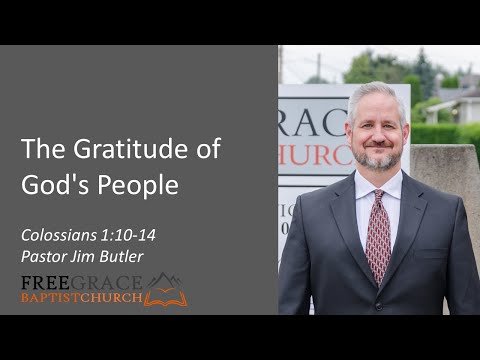
Colossians 1:10–14 presents Paul's apostolic prayer as a template for Christian growth, identifying four marks of a walk worthy of the Lord: fruitfulness in good works, increase in the knowledge of God, divine strengthening for patience and longsuffering, and giving thanks to the Father. The sermon argues that justification by faith alone issues necessarily in sanctification, and that gratitude is not an optional emotional response but the fitting conclusion of a life shaped by the gospel. Believers are called to thankfulness on the basis of three specific gospel realities Paul enumerates: qualification for a heavenly inheritance, deliverance from the dominion of darkness, and transfer into the kingdom of the Son of God's love — all grounded in the redemption accomplished by Christ's blood.

From Alienation to Reconciliation
Colossians 1:21–23 sets the condition of fallen humanity — alienated from God, hostile in mind, and characterised by wicked works — against the sovereign act of divine reconciliation accomplished through the incarnation and substitutionary death of Christ. This sermon works through Paul's three-part description of man's former state before turning to the means and goal of reconciliation: the bodily death of Christ to present his people holy, blameless, and above reproach. The exposition closes with a call to perseverance grounded not in the believer's resolve but in the completed work of the one who reconciles, redeems, and saves to the uttermost.

The Believer's Gratitude toward God
Colossians 1:12–20 presents the believer's gratitude as an essential component of a walk worthy of the Lord — not a sentimental add-on but a theological necessity rooted in what God has actually done. Paul prays that the Colossians would be fruitful, growing, strengthened, and thankful, with gratitude serving as the lens through which sovereign grace becomes visible. This exposition works through two grounds for thanksgiving — inheritance and deliverance — before tracing the movement of Paul's prayer into the great Christological hymn of verses 15–20, where Christ as Creator, Sustainer, and Redeemer becomes the ultimate reason for the believer's praise. The sermon applies throughout with the exhortation to rehearse these redeemed blessings, particularly in the context of the Lord's Supper.

The Faithful Father
Colossians 3:20–21 places two commands at the center of household religion: children are to obey their parents in all things as an act pleasing to the Lord, and fathers are forbidden from provoking their children lest they become discouraged. This exposition traces the negative prohibition of Colossians 3:21 through its Old Testament background in Deuteronomy 21 and its positive counterpart in Ephesians 6:4, examining how unrighteous anger, unbiblical discipline, and passive abdication each provoke children toward despair and rebellion. The fifth commandment functions here both as a mirror to drive children to Christ and as a continuing standard to which the Spirit then empowers obedience. Fathers are called to fear God first, to exercise discipline within an atmosphere of love, and to provide spiritual instruction — in the home and through the church — as their highest earthly stewardship.
Colossians 1:10-14
Paul's prayer in Colossians 1:9–14 reveals what the apostle considered most essential for the people of God: not merely physical welfare, but a walk worthy of the Lord, fully pleasing Him. This study works through the four participial phrases of verses 10–14 — fruitfulness in good works, growth in the knowledge of God, God-wrought patience and long-suffering with joy, and thankfulness — showing how each flows from being filled with the knowledge of God's will. The practical challenge is double: to pray for others in the manner Paul prays, and to examine honestly whether one's own life resembles what Paul prays for.

The Believer's Gratitude toward God
Colossians 1:12–14 presents thankfulness not as a general Christian virtue but as an identifying mark of the believer — the fourth of four participles Paul uses to describe a walk fully pleasing to God. This sermon works through the structure of Paul's prayer in Colossians 1:9–14 before expositing the two great grounds of the believer's gratitude: the inheritance of the saints in the light, and the threefold deliverance from the power of darkness — comprising rescue from spiritual darkness, transfer into the kingdom of the Son of His love, and redemption from bondage through the blood of Christ. The Lord's Supper serves as the sermon's occasion, pressing the congregation to come to the table not as a religious routine but as those who genuinely reckon with what forgiveness, deliverance, and a heavenly inheritance cost the Son of God.
Prayer and Witness
Colossians 4:2–6 calls the Christian to a life of earnest, watchful, and thankful prayer, and to a witness before the world that is wise in conduct and gracious in speech. Working through Paul's four marks of effective prayer — persistence, vigilance, thanksgiving, and petition — the sermon shows that prayer is normal Christian living, not the province of an elite spiritual class. The exposition then turns to the two elements of faithful witness: a walk of wisdom toward outsiders and a conversation seasoned with grace and salt, grounded in the ability to answer the unbeliever with both meekness and clarity.

The Corporate Conduct of the Believer
Colossians 3:12–17 calls the church not merely to private piety but to a corporate conduct befitting those who are elect, holy, and beloved in Christ. This sermon works through the character of the new man — tender mercies, kindness, humility, meekness, long-suffering, and above all love — before turning to the three governing realities of the gathered church: the peace of Christ, the word of Christ, and the name of Christ. The peace that rules in the assembly flows from the prior vertical peace established in justification; the word of Christ must saturate the heart both in public preaching and private study; and every word and deed is to be done in concert with the nature and character of the Lord Jesus. The cumulative application is that sovereign grace is not the enemy of ethical seriousness but its very foundation and motive.

From Alienation to Reconciliation
Colossians 1:21–22 sets the alienation and enmity of sinners against the sovereign, monergistic reconciliation God effects through the incarnate death of His Son. The sermon moves through three aspects of the Colossian believers' transformation: their previous state as those alienated from God, hostile in mind, and outwardly manifesting wicked works; their present status as those God has reconciled through the physical, substitutionary death of Christ; and their future blessedness as those being presented holy, blameless, and above reproach — a goal that is the consequence of reconciliation, never its cause. Communion is the occasion for this exposition, pressing believers to remember the depth of the grace that drew them out of enmity and into fellowship with God.
Colossians 1:9-14
Paul's intercessory prayer in Colossians 1:9–14 sets the pattern for how believers ought to pray for one another: not merely for temporal relief, but for a life that walks worthy of the Lord and fully pleases Him. The sermon works through four participles that Paul uses to describe that worthy walk — fruitfulness in good works, growth in the knowledge of God, strength for patient endurance, and thankfulness — showing these as a unified package rather than a menu of options. The closing verses of the passage (vv. 12–14) then ground that thankfulness in three cosmic realities: qualification for the inheritance of the saints, deliverance from the dominion of darkness, and transfer into the kingdom of Christ, all secured by redemption through His blood.
Colossians 4:2-6
Colossians 4:2–6 closes Paul's extended section on the conduct of the new man in Christ by addressing two inseparable responsibilities: how believers are to speak to God in prayer, and how they are to speak to unbelievers in witness. Four elements of effective prayer are drawn from verse 2 — persistence, vigilance, thanksgiving, and petition — each grounded in the broader Pauline teaching on prayer across the epistles. The sermon then treats faithful witness in terms of conduct (walking in wisdom toward outsiders, redeeming the time) and conversation (speech that is gracious and winsome), calling believers to understand that godly character and well-ordered speech are the ordinary means by which the gospel reaches the world.
The Son-Tilted Focus of All Things
Colossians 1:16 presents the Son of God as the author, agent, and goal of all creation — not merely its first product, but its sovereign Lord. The sermon argues that 'firstborn of all creation' (Col. 1:15) carries the Old Testament sense of preeminence and rank, not ontological origin, so that the Son is the Creator and not a creature. From this text the preacher traces a 'Son-tilted' architecture running through creation, providence, and redemption, showing that all three are oriented toward the glory of the eternal Son. The sermon closes with the gospel call: the same Son who made all things assumed human nature, suffered, rose, and now brings many sons to glory — a glory in which believers will stand blameless before God with great joy, solely on the ground of Christ's righteousness.
Slaves and Masters
Colossians 3:22–4:1 addresses the conduct of bondservants and masters within the Roman imperial context, grounding workplace ethics not in social reform but in the Lordship of Christ over every sphere of life. The passage calls slaves to obey their earthly masters in all lawful things — not with eye-service or people-pleasing, but in sincerity of heart and fear of God — because the ultimate master is Christ, who will reward his servants with an eternal inheritance. Masters are likewise charged to give what is just and fair, knowing they too answer to a heavenly master. The sermon closes with an evangelistic appeal: every person is either a slave to sin or a slave to Christ, and freedom from sin's bondage comes only through faith in the Son.
The Parent/Child Relationship
Colossians 3:20–21 addresses both children and fathers as morally responsible members of the household of faith, calling each to a distinct duty within the domestic sphere. Children are commanded to obey their parents in all things — a command grounded in the moral law written at creation, codified in the Fifth Commandment, and motivated by the pleasure of Christ. Fathers are warned against provoking their children to discouragement, and are exhorted positively — drawing on Ephesians 6:4 — to nourish, instruct, and discipline with love, consistency, and dependence upon God. The sermon presses both charges as inseparable from the new life described throughout Colossians 3: orthodoxy must issue in orthopraxy, beginning in the home.
The Marriage Relationship
Colossians 3:18–19 calls wives to submit to their own husbands and husbands to love their wives without bitterness — two commands that cut precisely against the natural grain of each. This sermon argues that both duties are grounded not in social utility or natural sentiment but in the gospel itself: the wife's submission images Christ's submission to the Father, and the husband's love images Christ's self-sacrificial love for the church. The sermon draws on Ephesians 5, 1 Peter 3, and 1 Corinthians 11 to show that ontological equality between husband and wife is fully compatible with functional differentiation of role, and closes by pressing both commands back onto the cross as the only sufficient motive and resource for obedience.
The Corporate Conduct of the Believer
Colossians 3:15–17 sets out three governing marks of the believer's corporate life in the church: the peace of Christ ruling as referee over all relationships, the Word of Christ dwelling richly as the church's food and curriculum, and every act done in the name of Christ to the Father's glory. The sermon insists that these marks flow not from moral effort but from the gospel itself — from justification by faith, which produces peace with God that must then govern peace among God's people. Believers are exhorted to be gluttons for Scripture, to sing doctrinally sound psalms and hymns that are God-exalting rather than self-centered, and to cultivate gratitude as a constant recognition that all goodness is grace.
True Doctrine, Proper Conduct Part 2
Colossians 3:12–14 calls believers to put on the virtues that characterize the new man in Christ — not as a program of moral self-improvement, but as the necessary outflow of sovereign election, regeneration, and union with Christ. This sermon works through three things concerning the new man: his identity as the elect, holy, and beloved of God; his character as defined by five virtues (tender mercies, kindness, humility, meekness, and longsuffering) expressed in community through forbearance and forgiveness; and his supreme obligation, which is love — the bond that gives luster and coherence to all the other graces. The controlling argument is that conformity to Christ begins not with behavioral resolve but with fixing the mind on Christ seated at the right hand of God, so that mortification of sin and putting on of virtue follow as fruit of knowing him.
True Doctrine, Proper Conduct
Colossians 3:1–11 establishes that right belief and right conduct are inseparable: orthodoxy produces orthopraxy. Working through Paul's commands to seek the things above and to mortify sin, this exposition demonstrates that the theological incentives of union with Christ — past death to the old man, present hiddenness in God, and future appearance in glory — are the only sufficient foundation for holy living. The vice lists of verses 5–11, covering both sins of the flesh and sins of the tongue, are shown to flow from a disordered mind rather than a regenerate one, and behavior modification apart from the new birth is exposed as an inadequate remedy. The sermon closes with a call to look to Christ crucified as the only ground for both justification and transformed conduct.
Paul's Prayer for the Colossians
Paul's prayer in Colossians 1:9–14 sets forth four characteristics of a walk worthy of the Lord: fruitfulness in good works, growth in the knowledge of God, strength for patient endurance, and thankfulness to the Father. The sermon argues that doctrine and practice are inseparable — the knowledge of God fuels the good works God prepared for his people — and that genuine thankfulness flows not from natural disposition but from the Spirit's work in those whom God has qualified, delivered, transferred, and redeemed. The ungodly are marked by ingratitude and failure to glorify God; the converted are called to a daily, Spirit-wrought thankfulness that honors God for every circumstance, not merely the pleasant ones.
From Alienation to Reconciliation
Colossians 1:21–23 sets before the believer a movement from total alienation to gracious reconciliation, and Paul's logic demands that the Lord's Supper be received as a celebration of divine achievement rather than human performance. The sermon examines three realities in the text: the previous state of the Colossians as alienated enemies engaged in wicked works, their present status as those whom God has reconciled through the physical death of Christ, and the future blessedness to which God is bringing them — holy, blameless, and above reproach in his sight. Because reconciliation flows from sovereign election and not from foreseen faith, all glory belongs to God, and the table is rightly approached with awe and worship rather than self-congratulation.
The Christian Father
Colossians 3:21 delivers a single, pointed command to fathers: do not provoke your children, lest they become discouraged. This sermon exposits that verse within the broader household code of Colossians 3:18–4:1, arguing that redemption in Christ does not dissolve familial distinctions but rather furnishes the spiritual capacity to fulfill them rightly. Drawing on positive examples from Abraham and Joshua and the negative example of Eli, the sermon identifies specific forms of provocation — unrighteous anger, unbiblical discipline, favoritism, inconsistency, and gospel-less child-rearing — before turning to the positive exhortation of Ephesians 6:4. The sermon closes with five concrete duties of the Christian father: presence, provision, protection, prayer, and preaching sound doctrine in the home.
Greetings and Final Instructions
Colossians 4:7–18 closes Paul's letter not with abstraction but with names — real men whose faithfulness, failure, restoration, and apostasy illuminate the pastoral realities of gospel ministry. The passage reveals Paul not as a theology machine but as a suffering apostle sustained by the fellowship of Jewish and Gentile brothers alike, directing the advance of Christ's kingdom from a Roman prison cell. The sermon draws from each figure a single defining lesson — faithfulness, restoration, saving grace, apostasy, and strategic kingdom labor — while closing with an exhortation to guard against heresy by making much of the supremacy of Christ.
Slaves and Masters
Colossians 3:22–4:1 addresses the final relationship in the household code — slaves and masters — and Paul's instructions cut against both first-century Aristotelian contempt for slaves and twenty-first-century assumptions about social action. The passage unfolds in three movements: the duty of slaves (obedience in action and sincerity of heart, not eye-service), the incentives for slaves (the promise of an eternal inheritance from the Lord Christ), and the duty of masters (to give what is just and fair, governed by the knowledge that they too answer to a Master in heaven). The governing theological claim is that heavenly-mindedness produces, rather than withdraws from, faithful earthly labor — so every Christian employee and employer is called to work as unto the Lord, fearing God rather than men, whether recognized by their master or not.
The Christian Father
Colossians 3:21 addresses fathers with a single prohibition — do not provoke your children, lest they become discouraged — and the sermon expounds that verse alongside its Ephesians 6:4 parallel to give a full account of fatherly duty. The prohibition is explained through its result (discouragement, the breaking of a child's spirit) and its common causes: unrighteous anger, unbiblical discipline, ungodly inconsistency, and imbalance of law without gospel. The positive exhortation of Ephesians 6:4 is then opened through five practical commitments — presence, provision, protection, prayer, and preaching — each grounded in the father's identity as a new man in Christ whose grace-transformed heart drives active, loving involvement in his children's lives.
The Responsibility of Children
Colossians 3:20 addresses children as responsible members of the covenant community with a specific duty: to obey their parents in all things for the glory of God. This sermon expounds that command under two headings — as a religious commitment rooted in what is well-pleasing to the Lord, and as a requirement of God's moral law grounded in the Fifth Commandment (Exodus 20; Deuteronomy 5; Ephesians 6:1–3). The law's impossible demand is not softened but turned pedagogically toward the cross: children cannot perfectly obey or honor their parents, and that failure is meant to drive them to Christ, whose active obedience fulfilled all righteousness on behalf of sinners. Parents are therefore urged to present the law honestly, presume nothing about their children's regeneration, and cultivate homes where gospel ethics are visibly practiced.
The Defining Characteristic of a Christian Husband
Colossians 3:19 commands husbands to love their wives and prohibits bitterness toward them — a deceptively simple two-part instruction that cuts against both passive abdication and domineering harshness. This sermon works through what that love requires by examining 1 Corinthians 13, Ephesians 5, and 1 Peter 3, showing that Christ's sacrificial, monogamous, intimate, and sanctifying love for the church is the standard and pattern for every Christian husband. Three practical obligations emerge: pray for and with her, provide for her materially and spiritually, and protect her from danger, ungodly influences, and false doctrine. The sermon closes with a gospel appeal, reminding hearers that the active and passive obedience of Christ — not marital performance — is the ground of their standing before God, and that the husband-wife relationship exists as an illustration of Christ's love for his church.
A Word to the Wives
Colossians 3:18 commands wives to submit to their own husbands as is fitting in the Lord — a command that cuts against the grain of contemporary culture and even the instincts of redeemed sinners. This sermon establishes that submission is not demeaning but reflects the eternal pattern of the Son's willing submission to the Father within the equal-in-essence Trinity, and that gospel redemption does not abolish role distinctions in the family but enables their proper functioning. The domestic application works through the lawful target, the universal scope, and the Christological motivation of the command, pressing wives to understand that submitting to their own husbands is primarily a religious duty rendered unto the Lord. The sermon closes by grounding the entire exhortation in the gospel: a wife's standing before God rests not on threads of her own submissive obedience but on the imputed righteousness of Christ, whose active and passive obedience constitute the only robe in which sinners stand justified.
The Christ-Centered Orientation of the New Man
Colossians 3:15–17 presents the new man not as a moralist who earns standing before God by putting off vice and putting on virtue, but as one whose entire life is oriented around the person and work of Christ. The sermon argues that three Christ-centered realities define the new man: the peace of Christ, which is grounded in justification by faith alone and flows from the blood of Calvary; the word of Christ, which is to dwell richly in the heart both for personal transformation and mutual edification in the body; and the name of Christ, under which every word and deed is performed. The practical summons is to let the gospel — not personal performance — be the governing principle of the Christian life, so that the new man is known above all for making much of Christ crucified.
Conduct Becoming a New Man
Colossians 3:12–14 calls the new man in Christ not merely to shed sinful habits but to clothe himself with a definite set of Spirit-wrought virtues: tender mercies, kindness, humility, meekness, longsuffering, forbearance, forgiveness, and above all, love. The passage grounds these graces in the threefold identity of the elect — chosen, holy, and beloved — an identity that derives from God's sovereign election and not from any prior human worthiness. These virtues are not a program of moral self-improvement but the fruit of union with Christ, whose own character they mirror, and the sermon applies them concretely to marriage, the local church, and the workplace. The closing appeal presses the unconverted to flee to Christ alone, since niceness apart from grace saves no one, while calling the church to celebrate the gospel of free and sovereign grace as the only foundation on which any of this obedience stands.