
Topic
Pneumatology
118 sermons · All topics

Ask FGBC Batch 8: Church Planting, Creation, Imprecatory Psalms & More | Reformed Baptist Theology
This Q&A episode addresses ten questions spanning ecclesiology, pneumatology, soteriology, and worship, drawing on confessional Reformed Baptist commitments throughout. Topics range from church planting and confessional subscription to the nature of saving faith versus assurance, the love of God for the non-elect, literal six-day creation, the theology of imprecatory psalms, and the regulative principle of worship as it applies to musical instruments and the offering. The consistent thread is that Scripture and the 1689 London Baptist Confession provide the sufficient framework for answering practical and doctrinal questions facing Reformed Baptist churches today.

A Trinitarian Blessing

What does it mean for a church letter full of conflict, rebuke, and difficult confrontation to close with a sweeping word of blessing? Paul's benediction in 2 Corinthians 13:14 — the most elevated Trinitarian affirmation in the New Testament — does exactly that, pronouncing grace, love, and communion upon a fractious and sinning congregation without exception. The sermon distinguishes the benediction (a word of blessing descending from heaven to God's people) from the doxology (praise ascending from earth to God), tracing how each element of the Trinitarian blessing — the grace of the Lord Jesus Christ, the love of God the Father, and the communion of the Holy Spirit — flows downward from the triune God as spiritual reality, not mere concept. The application is pointed: whatever the believer's besetting sin, weakness of assurance, or relational difficulty, the remedy begins not with human effort but with receiving the grace, love, and fellowship that the triune God lavishes upon his people.

2LBC - Chapter 2 - Of God and the Holy Trinity
What does it mean that God is one, simple, immutable, immense, and triune — and why does any of it matter for Christian worship? This confession study works through the Second London Baptist Confession of Faith Chapter 2 ("Of God and the Holy Trinity"), tracing the three movements of the chapter: God's essential glory in paragraph 1, God's transcendent relations in paragraph 2, and God's triune majesty in paragraph 3. Along the way, foundational interpretive principles for speaking rightly about God are established — the legitimate use of logical consequences from Scripture, the necessity of extra-biblical vocabulary to guard biblical truth, and the reading of anthropomorphic language according to the meaning rather than the letter. The session closes with a direct application: the doctrine of God is not speculative labor but the very foundation of communion with Father, Son, and Holy Spirit, and of the creature's comfortable dependence upon him.
Ask FGBC #39: What Does The Bible Mean By The Unforgiveable Sin?

What is the unforgivable sin, and should a troubled conscience fear having committed it? Drawing on Matthew 12:31-32 and the apostasy warnings of Hebrews 6 and 10, this Q&A response argues that blasphemy against the Holy Spirit is not a momentary verbal offense but a wholesale, persistent rejection of the redemptive work of God in Christ — impugning the Spirit's testimony to Christ's works and glory. The defining mark of a genuine apostate is not anguish or doubt but a hardened, unrepentant contempt, like those who cried 'crucify him.' Anyone asking whether they have committed this sin gives evidence by that very asking that they have not.

Trinitarian Assurance

Ephesians 1:3–14 presents a Trinitarian doxology in which the Father's election and predestination, the Son's redemption through His blood, and the Spirit's sealing together constitute the full ground of the believer's assurance. The passage resists any reduction of the three persons to isolated roles, insisting on inseparable operations even as Paul shines distinct light on each person's work. The sermon argues that the Christian's assurance must be anchored not in self-examination of fruit-bearing but in the objective, Trinitarian work of God accomplished entirely outside of us in Christ.

The Glory of Christ's Departure, Part 2
John 16:29–33 closes the Upper Room Discourse with two movements: the disciples' partial yet progressing confession of Christ's omniscience, authority, and divine origin, and Christ's triumphant declaration that he has overcome the world. The disciples' imperfect understanding — soon to be perfected on the day of Pentecost through the Spirit's coming — is met not with rebuke but with Christ's desire for their peace, even as he foreknows their abandonment of him at the cross. The sermon grounds Christian courage in the face of tribulation not in human resolve but in the objective, accomplished victory of the enthroned Christ, whose current session at the Father's right hand is the only sufficient foundation for the church's advance through suffering.
CTF 2025 - Key Theological Concepts
This conference preview discussion addresses three interconnected concepts in classical Trinitarian theology: inseparable operations, appropriations, and missions. The speaker argues that a basic grasp of six to ten theological concepts drawn from creedal and confessional tradition — concepts the church developed through careful exegesis, not speculative innovation — is sufficient to give a reasoned defense of Trinitarian doctrine against modern deniers, Jehovah's Witnesses, and Arians. The practical exhortation is that every believer, not only the academically trained, owes a coherent account of the Trinity to anyone who asks.

Live Stream - December 15, 2024
John 16:25–28 forms the doctrinal climax of the upper room discourse, where Christ sets before his disciples three interlocking truths: the manner of his instruction through figurative language soon to be illumined by the Spirit, the direct access believers have to the Father through the Son in the new covenant era, and the Christological ground of that access in the Eternal generation, Incarnation, and Ascension of the Son. The sermon presses into the Eternal generation of the Son — his being begotten of the Father before all worlds, not by creation or adoption but by an Eternal relation of origin — and then into the Incarnation as the assumption of human nature without any compromise to his divinity. The unchanging love of the Father for his elect, grounded not in their merit but in sovereign grace and the mediation of Christ, is held out as the sustaining comfort for disciples facing tribulation, and the call to unbelievers is to look to Christ — his blood and righteousness — as the only escape from divine judgment.

The Joy Associated with Christ's Departure
John 16:16–24 records Jesus preparing his disciples for the grief of his death and the joy of his resurrection, framing both under the single announcement 'a little while.' This exposition works through two movements: the announcement of Christ's departure and the disciples' confusion (vv. 16–18), and then the benefits of that departure — lasting joy grounded in the resurrection, and direct access to the Father through prayer in Christ's name (vv. 19–24). The sermon argues that the joy promised here is not the absence of suffering or temporal prosperity, but an indestructible joy rooted in Christ's finished work of life, death, resurrection, and ascension, a joy no adversary can strip from the believer.

Ask FGBC #29: How will we see the Trinity in Heaven?
How will believers see and interact with the three persons of the Trinity in the new heavens and new earth? This question-and-answer episode wrestles with the beatific vision — the blessed sight of God in glory — and what kind of sensible or cognitive interaction redeemed humanity might have with Father, Son, and Holy Spirit in eternity. The discussion grounds its answer in the immutability of God (who does not cease to be spirit), the genuine humanity of the glorified Christ (whose wounds are healed but whose human nature persists), and the Trinitarian structure of all Christian experience, including prayer. The takeaway is that beholding the Lamb in the new earth is not abstract: it is a physical, glorified, sin-free existence in the presence of the God who cannot change.

The Spirit's Ministry to the Apostles
John 16:12–15 presents the Spirit's ministry to the apostles as the continuation and completion of Christ's own self-disclosure to the disciples. The sermon expounds Jesus' promise that the Spirit of Truth will guide the apostles into all truth, situating that promise within the doctrine of the Trinity — specifically the eternal processions of the Son and Spirit and their corresponding temporal missions. The Spirit's 'not speaking on his own authority' is shown to mirror Christ's own language about receiving all things from the Father, testifying not to any inferiority of persons but to the consubstantiality of the three divine persons, each possessing the whole divine essence undivided. The congregation is called to pursue the knowledge of the triune God as the foundation for every other duty of the Christian life.

The Spirit's Conviction of the World
The Holy Spirit's conviction of the world — of sin, of righteousness, and of judgment — is not a promise that every hearer will be saved, but a declaration that the Spirit will confirm the identity and vindication of Jesus Christ through the apostolic proclamation. Drawing on John 16:8–11 alongside Acts 2 and Acts 24, this sermon argues that the Spirit's primary work in the world is to expose unbelief in Christ, to declare the sufficiency of Christ's imputed righteousness, and to announce the judgment already rendered against the ruler of this world at the cross. The church's calling is therefore not to measure success by numerical response but to preach sin, righteousness, and judgment faithfully, trusting the Spirit to do His own sovereign work.

The Spirit's Conviction of the World
Jesus declares to his sorrowing disciples that his departure is to their advantage — not despite the coming persecution, but precisely because it secures the gift of the Holy Spirit. This sermon works through John 16:5–11 under two heads: the departure of Christ (vv. 5–7) and the conviction of the world (vv. 8–11), pausing to develop the first at length. The Trinitarian logic of the temporal missions — the Father sending the Son, the Father and Son sending the Spirit — is shown to be the very theology that sustained the apostles under hostility and that sustains the church today. The sermon closes with a call to rest in the Spirit's power rather than human eloquence or celebrity, because the Paraclete is the disciples' power, protection, and advantage.

The Testimony Concerning Christ
John 15:26–27 presents the Holy Spirit as both sent by the Son in a temporal mission and as one who eternally proceeds from the Father and the Son — the filioque. This sermon works through the distinction between God's eternal processions (theology proper) and his temporal missions (economy), arguing that the Western church's confession of the Spirit's double procession preserves both the consubstantiality and the personal distinction of the three persons of the Trinity. The apostolic witness of verse 27 is grounded in and empowered by that same Spirit, whose singular purpose in both the sending at Pentecost and the inscripturated Word is to testify of Christ — and that testimony calls sinners to receive eternal life by faith in him alone.

The complaint of the people
Numbers 11 records the complaint of Israel in the wilderness — a sin that provokes divine judgment, exposes the limits of Moses as covenant mediator, and points forward to the burden-bearing Christ and the outpouring of the Spirit at Pentecost. The chapter is not a collection of independent narratives but a unified account of complaint (vv. 1–15), the appointment of seventy elders (vv. 16–30), and the execution of God's judgment (vv. 31–35). Israel's craving for meat is not mere hunger but a rejection of Yahweh as their God — an idolatrous longing for Egypt that God answers with poetic justice. The passage calls the new-covenant people of God to replace grumbling with gratitude, recognizing that God is to be valued for his own sake, not merely for what he provides.

August 04, 2024

Paul's salutation to Titus in Titus 1:1–4 is not empty formality but a compressed treasury of apostolic theology. This exposition works through seven elements of the greeting: Paul's identity as bondservant and apostle, the apostolic task of advancing the faith of God's elect through faithful proclamation, the eternal assurance grounded in God's immutable promise before time began, the providential means of preaching, the specific entrustment given to Paul, the recipient Titus as a true son in the common faith, and the benediction of grace, mercy, and peace from the triune God. The sermon calls hearers to slow down at biblical salutations, to prize the heritage of Christian antiquity, and to pray for ministers who proclaim Christ in a God-hating world.

2LCF Chapter 20 - Of the Gospel, and of the Extent of the Grace Thereof
The gospel was not discovered by human reason but revealed by divine initiative — beginning with the protoevangelium of Genesis 3:15 and unfolding through progressive special revelation. This session works through Chapter 20 of the Second London Confession of Faith (1689 LBCF), examining the promise of the gospel, the insufficiency of general revelation for salvation, the sovereign freedom of God in spreading the gospel, and the absolute necessity of the Holy Spirit's effectual work upon sinners dead in trespasses. The doctrinal stakes are practical: a right understanding of general and special revelation is the indispensable foundation for evangelical and missionary enterprise.

The Departure of Christ, Part 2
John 14:29–31 grounds the disciples' faith in Christ's predictive prophecy, his victory over the devil, and his loving obedience to the Father. Jesus announces his departure in advance so that when it comes to pass the disciples will believe — both that he is the object of saving faith and that he is the second person of the triune God. The cross simultaneously displays the Father's love for the world and the Son's love for the Father, and the resurrection and ascension secure every blessing the departing Christ promises his people. The sermon closes with a call to find stability not in practical strategies but in the knowledge of the triune God and the peace Christ himself gives by the Spirit.

Wednesday Night Bible Study - The Ministry in Iconium, Part 2
John 14:25-27 presents Christ's final gifts to his disciples before his departure: the Holy Spirit and his peace. The sermon traces the procession of the Spirit from the Father through the Son, grounding the temporal mission of the Spirit at Pentecost in the eternal procession within the triune life of God, drawing on the Nicene Creed and the 1689 LBCF. The peace Christ bequeaths is distinguished from the world's counterfeit — objective, grounded in justification by faith, and subjectively appropriated through soteriology and theology proper — given precisely so that the disciples, and all who follow them in gospel ministry, would not be paralyzed by fear but would advance the kingdom with boldness.
The Gifts Given by Christ
John 14:25–27 presents two gifts Christ gives his disciples on the eve of his departure: the Holy Spirit and his peace. The sermon expounds the procession of the Spirit from the Father and the Son, the Spirit's specific work of teaching and bringing Scripture to remembrance in the apostles, and the distinction between Christ's objective, lasting peace and the transient peace the world offers. The practical weight falls on the call to displace carnal fear — which the sermon argues signals bad theology, lack of kingdom priority, and ultimately endangers the soul — with the peace that flows from knowing the triune God.

The Ministry in Iconium, Part 2
Acts 14:1–7 records the apostolic ministry in Iconium: bold gospel preaching met by coordinated Jewish opposition, a divided city, a violent plot, and a strategic withdrawal to Lystra and Derbe. This exposition traces the pattern of persistent opposition to the gospel across Acts and the Old Testament, establishing that persecution is not an aberration but the ordinary condition of faithful gospel ministry. The sermon draws four conclusions: the inevitability of persecution for godly living, the perseverance required of gospel ministers, the wisdom to know when to stay and when to flee, and the indispensability of the Holy Spirit for any effectual proclamation of the Word.

The Blessing of Communion with God, Part 2
What does Jesus mean when he promises that the Father and the Son will come and make their home with the one who loves him and keeps his word (John 14:23)? This sermon works through seven observations on that promise, showing that the indwelling of Christ necessarily entails the indwelling of the entire triune God — Father, Son, and Holy Spirit — because the divine persons are inseparable in their operations. The sermon traces the biblical pattern of God dwelling with his people from Eden through the tabernacle and temple to the new covenant, and concludes that union with Christ is union with the triune God, which is both the chief blessing of salvation and the ground of the believer's worship.
May 18 Sanders Holy Spirit and the Father
How does the Holy Spirit relate to God the Father, and what does that relationship mean for Christian worship and prayer? Working through a chapter on the Holy Spirit and the Father, this study traces the biblical pattern of 'from the Father, through the Son, in the Spirit' — and its liturgical reverse, 'in the Spirit, through the Son, to the Father' — as the framework for understanding both Trinitarian processions and the nature of true worship. The discussion addresses the Spirit's work in the old and new covenants, the cessation of the revelatory gifts at the completion of the New Testament canon, and the Spirit's role in empowering prayer, drawing particularly on John Owen's treatment of Ephesians 2:18 and Romans 8:26-27.
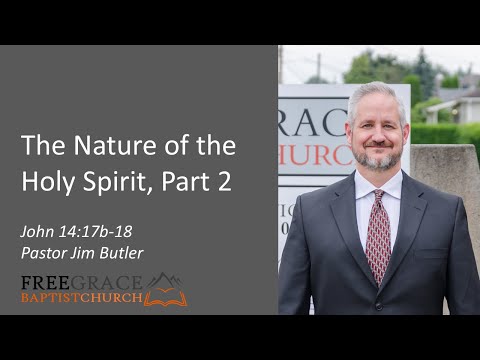
Live Stream - April 21, 2024
John 14:17b-18 confronts the church with two contrasting realities: the world's incapacity to receive the Spirit of Truth, and the disciples' assured possession of him. Working through the upper room discourse, this exposition grounds the church's dependence on the Holy Spirit in the doctrines of divine sovereignty, Trinitarian theology, and the inseparability of the divine operations. The sermon closes with the promise of Christ's permanent presence with his people — by the Spirit, in preaching, in the sacraments, and in discipline — as the antidote to spiritual orphanhood, and with a direct call to sinners to receive justification by faith alone, which brings not only forgiveness but the imputed righteousness of Christ.

The Nature of the Holy Spirit, Part 2
Jesus' promise in John 14:17–18 — that the Spirit of truth cannot be received by the world, yet dwells with and will be in his disciples — grounds the church's dependence on sovereign grace for all gospel ministry. The sermon works through the doctrine of inseparable operations and appropriations to protect both the unity of the Godhead and the distinction of persons, before applying the Spirit's indwelling to the perseverance of the saints and the sufficiency of the gospel. The closing exhortation presses both believers and unbelievers: the Spirit abides forever, justification is by faith alone, and the righteousness of Christ is imputed — not merely forgiveness extended — to all who come to him.

The Nature of the Holy Spirit
How does Jesus comfort his disciples in the upper room by pointing them to the Holy Spirit, and what does that reveal about who God is? Expounding John 14:16–18, this sermon works through four aspects of the Spirit's nature drawn from the text: the distinction of persons in the Godhead, the unity of the Godhead, the world's ignorance of the Spirit, and the believer's knowledge of him. The eternal processions — the Father unbegotten, the Son eternally begotten, the Spirit proceeding from Father and Son — ground the temporal missions in which the Father sends the Son and the Father and Son send the Spirit for the salvation of God's people. The congregation is called to hold fast to the Trinitarian guardrails of the creeds and the 1689 confession, to resist the modalism and Arianism that perennially distort who God is, and to rest in the gospel of free and sovereign grace through faith in the one who declared 'I am.'

The Mission of the Disciples, Part 2
John 14:16–18 presents Christ's promise to send the Holy Spirit as the resource by which the disciples would carry out the greater works of the gospel mission. This sermon works through the foundation of that promise — salvation by grace through faith in Christ alone, the love that flows from justification as the animating power of obedience and mission — before pausing to mount a sustained defense of Trinitarian theology proper. The preacher argues that biblicism without creedal guardrails, anti-intellectualism, and laziness have left the contemporary church vulnerable to the same Trinitarian errors the Nicene and Chalcedonian fathers labored to foreclose, and calls the congregation to pursue the knowledge of the triune God as the very substance of eternal life.

The Mission of the Disciples, Part 1
John 14:12–15 addresses the mission Christ assigns to His disciples and the obedience He requires of them in light of His imminent ascension. The 'greater works' the disciples will perform are not a competition with Christ's own ministry but are the works of the ascended, reigning Christ accomplished through His disciples by the power of the Holy Spirit sent from the Father. Prayer in Christ's name is examined in its tight missional context — the asking that drives the greater works — and is shown to be governed by the will of God rather than functioning as a blank check. The sermon closes by distinguishing loving obedience as the fruit, not the ground, of justification by faith alone, grounding the entire missionary enterprise in the grace that has already been given.

The Revelation of the Father
John 14:7–11 presents Christ's claim that knowledge of the Son is knowledge of the Father, and that the Father dwells in the Son and the Son in the Father — a claim no mere creature could make. The sermon works through three confirmations of this unity: the nature of the Son (his consubstantiality with the Father), the words of the Son (which are the Father's words by virtue of shared essence, not mere instrumentality), and the works of the Son (which the Father performs through the Son as one divine operation). The Trinitarian theology at stake is not speculative — it is the doctrinal ground upon which the disciples, and all believers, stand when the world collapses in on them, because the Son who is God of God, light of light, very God of very God, is the one who came down 'for us and for our salvation.'

The Necessity to Walk in Wisdom, Part 3
What does it mean to be filled with the Holy Spirit, and how does that filling express itself in the life of the church? Expounding Ephesians 5:19–21, this sermon argues that the Spirit's presence produces four concrete effects: mutual instruction through song, praise to the Lord Jesus Christ, gratitude to God the Father, and submissive regard for one another — all of which together constitute Trinitarian Christian worship. A sustained lexical, theological, and contextual case is made that the 'psalms and hymns and spiritual songs' of verse 19 refer to the biblical Psalter as the divinely authorized songbook of the church, and the sermon closes by grounding the call to walk in wisdom in the sufficiency of Scripture and the free grace of God in Christ.