
Topic
Pneumatology
117 sermons · All topics

The Apostolic Sermon

Peter's sermon on the day of Pentecost, recorded in Acts 2:14–41, is the first apostolic proclamation of the risen Christ, and it follows a carefully constructed argument: correcting a false accusation, demonstrating from Old Testament Scripture who the Messiah is, and confronting the hearers with their guilt before the exalted Lord. The sermon examines how Peter builds his case through the life, death, resurrection, and ascension of Christ, drawing on Joel 2, Psalm 16, and Psalm 110 to show that every stage of Christ's humiliation and exaltation was foreordained. The hearers' anguished question — 'What shall we do?' — is answered with a call to repentance, faith, and baptism, which Peter grounds not in human decision alone but in the sovereign, effectual call of God. The application presses hearers to submit to Christ as Lord, to feel the weight of sin's horror, and to follow repentance and faith with public baptism and membership in the local church.

The Cessation of Revelatory Gifts

First Corinthians 13:8–13 declares that tongues, prophecy, and words of knowledge have a designed and determined end, giving way to the completed New Testament canon. This sermon argues from Acts 2, 1 Corinthians 13–14, Hebrews 1–2, Ephesians 2, and Daniel 9 that the revelatory gifts were temporary, apostolic, and tied to the first advent of Christ and the foundational era of the church. The 'perfect' of 1 Corinthians 13:10 refers not to the eschatological consummation but to the inscripturated fullness of divine revelation in the New Testament scriptures. Christians today are called to glory in the completed Word of God and in the abiding work of the Holy Spirit in regeneration and illumination, rather than seeking gifts that have ceased.

2LCF Chapter 2.3 - The Confessional Doctrine of the Trinity
The doctrine of the Trinity is the capstone of the confession's treatment of God, asserting that the one divine and infinite being eternally exists as Father, Son, and Holy Spirit — three subsistences of one substance, power, and eternity, each possessing the whole divine essence undivided. This session works through six confessional affirmations: that Trinitarian monotheism excludes tritheism; that confessing one God in three persons is no contradiction; that the persons do not collectively comprise God in fractional parts; that the persons are distinguished solely by their eternal relations of origin; that Father, Son, and Holy Spirit are fully co-equal, co-eternal, and consubstantial; and that the doctrine of the Trinity is not a cold academic exercise but the very foundation of all communion with God and comfortable dependence on Him.

The Ministry of Paul in Ephesus

Acts 19:1–10 presents what appears to be a re-baptism of John's disciples by Paul, but a careful reading of the passage's punctuation and structure reveals that verses 4 and 5 record what Paul said — a summary of John's baptism — while verse 6 records what Paul did: lay hands on these men to confer the extraordinary gifts of the Holy Spirit. John's baptism was Christian baptism, requiring repentance and faith in Christ Jesus, and these disciples had already received it. The extraordinary sign gifts of tongues and prophecy that accompanied the Spirit's coming in Acts 2, 8, 10, and 19 were revelatory gifts suited to the first-century church's founding mission and are not normative patterns for all believers in subsequent ages.

The Conduct of the New Man, Part 2
Ephesians 4:29–32 calls believers to put off corrupt speech and bitter dispositions and to put on edifying words and a forgiving heart — not as conditions for salvation, but as conduct that flows necessarily from it. The sermon exposits the structure of Paul's exhortations: a prohibition, a positive exhortation, and a motivation in each subsection. Corrupt speech grieves the Holy Spirit, who has sealed believers for the day of redemption; and bitterness, wrath, clamor, and evil speaking are symptoms of the old man that must be mortified. The sermon closes with the ground of all Christian forgiveness: God in Christ has already forgiven us, and that forgiveness is the cause, not the goal, of our forgiveness toward others.

2LCF 27 - Of the Communion of Saints
The 1689 London Baptist Confession chapter 27 grounds the communion of saints in the prior doctrine of union with Christ and union with one another in love, then draws out the obligations that follow for both local church life and the wider household of faith. The chapter carefully rules out any ontological or hypostatic union between Christ and his saints while affirming that believers genuinely share in his graces, sufferings, death, resurrection, and glory through the indwelling Spirit and the gift of faith. Three constituent elements of that communion are identified — complementary profiting through gifts and graces, spiritual encouragement in gathered worship, and physical provision for those in need — before a closing qualification defends personal property rights against any collectivist or communistic reading of the text.

Livestream - The Basis for Love and Unity
Ephesians 4:4–6 presents seven 'ones' — one body, one Spirit, one hope, one Lord, one faith, one baptism, and one God and Father — as the objective, Spirit-wrought basis for the love and unity to which Paul exhorts believers in verses 1–3. The sermon argues that these seven unities are not aspirational ideals but present realities constituted by the Holy Spirit in the production of the church, and that believers are therefore called to steward, not generate, the unity already given. The practical weight falls on bearing with one another in love, contending for the faith once delivered to the saints, and recognising that the Triune God — not social trinitarianism — is the foundation of all communion and the basis for genuine ecumenism among confessional Christians.
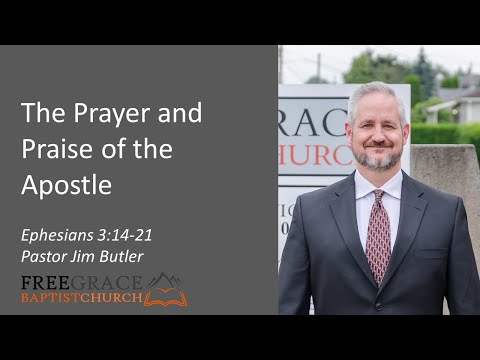
The Prayer and Praise of the Apostle
Ephesians 3:14–21 presents the apostle Paul's prayer for the Ephesian church and a concluding doxology, and this exposition works through the prayer's occasion, posture, and first two petitions. Paul prays from his knees before 'the Father of our Lord Jesus Christ,' drawing on the boundless storehouse of divine glory, for two things treated in this sermon: that believers would be strengthened with might through the Spirit in the inner man so that Christ dwells in their hearts by faith, and that they would comprehend the boundless love of Christ that surpasses knowledge. The sermon grounds both petitions in Trinitarian structure — strength flowing from the Father through the Spirit issues in the presence of the Son — and in the confession that God is 'most loving,' whose love neither increases nor diminishes. Hearers are urged to imitate the apostle by praying not only for temporal needs but for the spiritual strength and knowledge of Christ's love that alone sustains perseverance in a world hostile to the gospel.
Of the Gospel and Extent Thereof (2LCF 20)
2 London Baptist Confession of Faith Chapter 20, 'Of the Gospel and of the Extent of the Grace Thereof,' addresses a chapter absent from the Westminster Confession but added by the Congregationalists in the Savoy Declaration and retained by the Particular Baptists to combat incipient deism and the General Baptist doctrine that sinners may be saved through general revelation alone. The sermon traces the chapter's four paragraphs through Romans 10, Luke 24, John 5, and Psalm 19 to demonstrate that the gospel of Christ has been the sole substance of special revelation since the protevangelium of Genesis 3:15, that general revelation is categorically insufficient to make Christ known, that God distributes gospel light with absolute sovereignty, and that effectual grace is indispensable alongside that revelation for the conversion of dead sinners. The double theme of the chapter — the necessity of special gospel revelation and the necessity of the Spirit's insuperable work — magnifies divine grace, grounds the missionary enterprise, and exposes the doctrine-of-sin deficiencies latent in every scheme that allows salvation apart from hearing Christ proclaimed.

The Feast of Tabernacles, Part 4
On the last and greatest day of the Feast of Tabernacles, Jesus stood and cried out two declarations that divide all of humanity: 'Where I am, you cannot come,' addressed to those who persist in unbelief, and 'If anyone thirsts, let him come to me and drink,' addressed to all who would believe. This sermon expounds John 7:32–39, tracing the murderous intentions of the Pharisees and chief priests, the sovereign rejection of the reprobate by Christ himself, and the astonishing mercy that leads him to offer living water to the very crowd seeking his arrest. The evangelist's commentary in verse 39 is shown to be a post-resurrection theological statement linking the abundant giving of the Holy Spirit to the glorification of Christ, drawing on the Old Testament water-and-Spirit passages and fulfilled at Pentecost according to Joel's prophecy.

Of the Assurance of Grace and Salvation (2LCF 18)
Assurance of salvation is grounded not in the strength of faith or the quality of obedience but in the blood and righteousness of Jesus Christ revealed in the gospel. This exposition of 1689 London Baptist Confession chapter 18 works through the four paragraphs of that chapter: assurance stated, assurance grounded, assurance realized, and assurance disquieted. The objective foundation of assurance is the active and passive obedience of Christ, proclaimed in the gospel and sealed to the believer by the testimony of the Holy Spirit. Believers are called to rest upon Christ alone, to attend the ordinary means of grace, and to resist grounding their hope in their own acts of obedience.

Chap. 14 - Of Saving Faith

Saving faith is the gracious gift of the Holy Spirit, worked in the hearts of the elect through the ministry of the Word, enabling them to trust in Christ alone for justification, sanctification, and eternal life. This study of 1689 London Baptist Confession chapter 14 distinguishes true saving faith from temporary or false faith, establishes that faith is built on knowledge rather than religious emotion or experience, and traces the three classical elements of faith — notitia, assensus, and fiducia — while guarding against both the mysticism that smuggles emotion into the essence of faith and the rationalism that mistakes bare intellectual assent for it. The practical burden throughout is that the proper object of saving faith is Christ and his work alone, and that assurance, while distinct from faith itself, grows through the appointed means of grace.

May 22nd - Sun AM Webcast
John 6:60–71 presents the sharpest crisis of Jesus's Bread of Life discourse: the mass departure of superficial disciples and the steadfast confession of the Twelve. This sermon traces three interrelated truths in Jesus's response — the life-giving Spirit as the sole agent of spiritual understanding, total depravity as the explanation for unbelief, and the sovereign grace of the Father as both the cause of faith and the ground of its perseverance. The application presses the church not to soften biblical truth before a resistant generation, but to press it, trusting that the Spirit alone opens the hearts of the dead to receive the words of eternal life.

The Apostle's Prayer for the Ephesians, Part 1
Paul's prayer in Ephesians 1:15–18 opens a window into apostolic intercession and its theological priorities. The sermon expounds the occasion of Paul's prayer — rooted in the Ephesians' justifying faith and the love that necessarily flows from it — and the content of his first two petitions: that God would give the Holy Spirit as the Spirit of wisdom and revelation, and that the saints would know the hope of God's effectual calling and the riches of the glory of their coming inheritance. Sovereign grace underlies both: the eyes of the Ephesians' understanding had already been enlightened by God at conversion, and Paul's prayer builds on that accomplished work toward ongoing sanctification. The sermon calls believers to reshape their prayer lives after the apostolic pattern, prioritizing growth in the knowledge of God above all other petitions.
The Ministry of the Holy Spirit, Part 2
Ephesians 1:13–14 presents the Holy Spirit as both the seal and the guarantee of the believer's inheritance, grounding the security of salvation not in human performance but in the inseparable operations of the triune God. The sermon traces the instrumentality of the word of truth — showing that sinners must hear the gospel before they can believe — and then expounds the sealing of the Spirit as authentication, ownership, and security. The guarantee of the Spirit is the first installment of a heavenly inheritance that awaits the full redemption of the purchased possession at the consummation of the age. Believers are therefore urged to rest their assurance in the Father who chose, the Son who redeemed, and the Spirit who seals and guarantees.

The Ministry of the Holy Spirit
What is the Holy Spirit's relationship to the Father and the Son, and why does it matter that Christians understand this precisely? Working through Ephesians 1:13–14 as the destination, this sermon first establishes the full personal divinity of the Holy Spirit by tracing his presence and activity across both Testaments — from creation in Genesis 1 through the baptism of Christ, Pentecost, and the apostolic letters — demonstrating that the Spirit is not a force or a lesser deity but the third person of the one undivided triune God. The sermon draws on the 1689 London Baptist Confession chapter 2 paragraph 3, the Nicene Creed, and a wide range of triadic New Testament texts to guard against the heresies of Sabellianism and Arianism. The congregation is called to pursue the knowledge of this triune God as the irreplaceable foundation of assurance, evangelism, and Christian perseverance.
Chapter 10 - Of Effectual Calling
Effectual calling is the first step in the application of redemption — the sovereign act by which God, through His Word and Spirit, brings the elect from a state of total spiritual death into union with Christ. This session works through 1689 London Baptist Confession chapter 10, situating effectual calling within the broader ordo salutis and showing how it alone accounts for the biblical data on God's absolute sovereignty, the total spiritual inability of fallen man, and the uncoerced freedom of the believer's response. The result guards against both the Arminian error of grounding salvation in the foreseen decisions of the creature and the hyper-Calvinist error of denying man's responsibility to repent and believe, while grounding evangelism in confidence that God can revive the deadest of hearts.

The Magnitude of Salvation
1 Peter 1:10–12 raises a question that magnifies the gospel: if the Old Testament prophets searched so carefully for what believers now possess, how great must this salvation be? The sermon traces three witnesses to that greatness — the prophets who inquired but did not receive the full disclosure, the apostles who proclaimed what the Spirit now made plain, and the angels who bend over in perpetual wonder at a redemption they themselves never needed. The pattern of Christ's sufferings followed by glory is shown to be the shape of every believer's life, grounding present endurance in the certainty of future inheritance.

Chapter 2, Para. 3 - The Holy Spirit
The Holy Spirit as the third subsistence of the one divine essence is the subject of this study in Chapter 2, Paragraph 3 of the 1689 London Baptist Confession of Faith. The session traces the Spirit's presence and deity through both Testaments, works through the meaning of eternal procession from the Father and the Son (the filioque), and engages the historical debates at the councils of Nicaea, Constantinople, and Toledo that shaped confessional Trinitarian language. The practical conclusion drawn from the Confession is that the doctrine of the Trinity is not abstract speculation but the foundation of all communion with God and the believer's comfortable dependence upon Him.

The Meeting with Nicodemus, Part 2
John 3:4–10 confronts every hearer with the absolute necessity of regeneration before any entrance into the kingdom of God. Working through Nicodemus's proud misunderstanding and Christ's patient explanation, this exposition argues that the new birth is entirely God's sovereign work — initiated by the Holy Spirit, prefigured in Ezekiel 36 and Deuteronomy 30, and entirely prior to saving faith. The sermon also draws out the Trinitarian theology embedded in Christ's wind analogy, showing that the Spirit's sovereign, effectual work in regeneration reveals who God is, not merely what He does.

Sunday School - Chapter 2.3 - the Trinity
The doctrine of the Trinity is not a mathematical formula but a carefully defined confession of one divine being eternally subsisting as three distinct persons — Father, Son, and Holy Spirit. This session works through 1689 London Baptist Confession of Faith chapter 2, paragraph 3, examining the unity and equality of the persons, their distinction by eternal relations of origin, and the contemporary crisis caused by the abandonment of eternal generation. The denial of threeness is as heretical as the denial of oneness, and a recovery of Nicene Trinitarianism is essential not only for theological orthodoxy but for the health of the soul and the vitality of corporate worship.

The Conversion of Cornelius
Acts 10:34–48 records the official inclusion of Gentiles in the covenant promises of God — a watershed moment in redemptive history. Peter's sermon before Cornelius and his household sets forth the peace, person, work, and prophetic witness of Jesus Christ, culminating in the declaration that through His name, whoever believes will receive remission of sins. The sovereign Holy Spirit falls upon the hearers before Peter has even finished speaking, confirming that salvation is of the Lord and that divine initiative — not human free will — drives the conversion of sinners. The passage concludes with the baptism of the entire household, a commanded public identification with the Triune God that pictures, but does not accomplish, the inward work already wrought by grace through faith.
The Mission of the Word, Part 1
John 1:6–9 introduces John the Baptist not as an independent figure but as a divinely commissioned witness whose entire ministry exists to point to the Word made flesh. This sermon examines the origin, nature, and function of that witness ministry, demonstrating that the Baptist's testimony belongs to a network of overlapping witnesses — Father, Son, Holy Spirit, Scripture, and signs — that ground saving faith in historical reality rather than a blind existential leap. The function of John's witness is inseparable from its purpose: that sinners would believe on Christ as the Lamb of God who takes away the sin of the world, not merely imitate him as a moral example. The sermon closes with a call to keep law and gospel in their proper places, so that sinners driven by the law's killing power may look by grace to the one who is both the true light and the only hope of the world.

The Believer's Response to Trials
James 1:2–8 commands believers to count trials 'all joy' — a disposition that runs counter to every natural instinct. This exposition works through the passage in two movements: the believer's response to trials (vv. 2–4), which establishes the identification, expectation, disposition, and divine purpose of affliction; and the believer's request during trials (vv. 5–8), which calls for the pursuit of wisdom and the exercise of faith. The central burden is that God's redemptive purpose in suffering — conformity to the image of Christ — supplies both the ground for joy and the reason to seek wisdom rather than mere deliverance.

The Third Missionary Journey, Part 2
Acts 19:11–22 presents four movements in Paul's ministry at Ephesus: the unusual miracles God works through him, the humiliating defeat of the itinerant Jewish exorcists who invoke Christ's name without saving faith, the voluntary burning of occult books by Ephesian believers as fruits of genuine repentance, and a Lukan progress report declaring that the word of the Lord grew mightily and prevailed. The sermon argues for cessationism — that the apostolic sign-gifts authenticated the apostles and their message and have ceased with the closing of the canon — while exposing the fraudulence of those who imitate them today. Believers are called to examine all teachers by Scripture, to expect progressive fruits of repentance throughout the Christian life, and to take confident hope from the unstoppable advance of the gospel.

The Third Missionary Journey, Part 1
Acts 19:1–10 opens Paul's extended ministry in Ephesus on the third missionary journey. The sermon works through three exegetical questions: the identity of the disciples Paul encounters (argued to be genuine Christian believers, not pre-Christian inquirers), the relationship between John's baptism and Christian baptism (argued to be one and the same ordinance), and the significance of the Spirit's coming with tongues and prophecy (argued to be a salvation-historical confirmation of Pentecost's fulfillment, not a normative pattern for all believers). The exposition concludes by drawing out Paul's ministry at the school of Tyrannus as a model of bold, reasoned, expositional gospel preaching that God uses to spread the word across an entire province.

The Appearance of the Love of God
Titus 3:4–8 sets the merciful act of divine salvation against the backdrop of human depravity, and this exposition works through that contrast under three heads: the appearance of God's love in verse 4, the application of God's grace in verses 5–7, and the affirmation of God's word in verse 8. The passage is shown to teach that salvation originates entirely in God's kindness and mercy — not in works done before or after conversion — applied through the washing of regeneration and the renewing of the Holy Spirit, and sealed by justification by grace through faith. The sermon closes by pressing the pastoral logic of verse 8: it is precisely the constant preaching of justification by grace, not moralistic exhortation, that empowers the life of good works among God's people.

The Darkness of Depression
Proverbs 15:13 declares that sorrow of heart breaks the spirit, and Scripture is neither silent nor superficial on the darkness of depression. This sermon surveys the presence of depression among the people of God across the canon — from Elijah under the broom tree, to David's lament in the Psalms, to the Man of Sorrows himself — establishing that the condition is real, that it afflicts genuine believers, and that in itself it is not sinful. Practical counsel drawn from both special and general revelation is offered: the physical ABCs of rest, diet, and exercise; the spiritual ABCs of prayer, Scripture, and corporate worship; and careful instruction for those seeking to help the suffering, closing with the reminder that the ground of hope is not gladness of feeling but the imputed righteousness of Christ received by faith alone.

Free Grace Baptist Church - November 10, 2019 AM
Acts 12:25–13:3 grounds a careful examination of the first Christian missionary journey, asking how missionaries are to be called, qualified, and sent. The sermon argues that the Holy Spirit works through the local church — not apart from it — to identify, cultivate, and commission gospel ministers, as demonstrated by the church at Antioch separating Barnabas and Saul. Paul's earlier calling in Acts 9:15–16 frames the entire first missionary journey as the deliberate outworking of Christ's sovereign purpose to bear his name before Gentiles, kings, and Israel. Hearers are pressed to take the centrality of the local church in missions with full seriousness, to pray for qualified men to be raised up, and to trust that Christ is triumphantly advancing his kingdom through these means.
Free Grace Baptist Church - October 6, 2019 AM
Acts 10:44–11:18 records what the preacher calls the 'Gentile Pentecost' — the decisive moment when the Holy Spirit falls upon Cornelius and his household, confirming that God has granted repentance unto life to the Gentiles apart from circumcision or the works of the Mosaic law. The sermon expounds two movements: first, the conversion itself, with its cessationist reading of the tongue-speaking as a corporate, historically unrepeatable sign of Christ's lordship rather than a pattern for individual Christian experience; second, the controversy in Jerusalem, where Peter's defense silences the objectors and causes them to glorify God for Gentile inclusion in the covenant of grace. The practical burden is threefold: cherish the unity of Jew and Gentile in the one body of Christ, submit to immediate believers' baptism as the New Testament pattern, and rest in justification by faith alone in Christ alone, which excludes every form of faith-plus-works soteriology.