
Topic
Apologetics
374 sermons · All topics

August 18, 2024 AM

Paul's ministerial character and doctrinal legacy in Philippians 3:1–11 are examined through four defining characteristics: his zeal for the centrality of Christ crucified, his ardent defense of the truth, his strong opposition to error, and his earnest desire for the salvation of both Jew and Gentile. The juxtaposition between Paul's former confidence in fleshly privilege and his post-conversion boast solely in Christ exposes the bankruptcy of all self-righteousness before the alien righteousness received through faith. The sermon closes with a Spurgeon quotation calling every Christian — not only ministers — to have the cross as their philosophy, tradition, gospel, and glory.

Live Stream - June 9, 2024

John 14:28 — 'the Father is greater than I' — is one of the most frequently deployed anti-Trinitarian proof texts, yet its meaning is resolved by a hermeneutical principle the church has employed since Augustine: partitive exegesis, the practice of predicating statements of the one Christ according to either his divine or his human nature. This sermon works through the three movements of John 14:28–31 — the exhortation to rejoice at Christ's departure, the confirmation of the divine plan, and the expectation of triumph — demonstrating that the Father's greatness over the Son refers exclusively to Christ's assumed humanity and mediatorial office under the Covenant of Redemption, not to any inequality within the one divine essence. The congregation is exhorted to recover the confessional and creedal guardrails — the Nicene settlement, the Chalcedonian definition, and the Second London Confession — that protect Trinitarian orthodoxy, and to rest in the peace and Spirit Christ has sent to his people precisely because his departure leads to exaltation, intercession, and reign.

The Departure of Christ
John 14:28–31 presents Christ's departure not as cause for sorrow but as grounds for rejoicing, because it leads through the cross to his exaltation at the right hand of the Father. The sermon gives sustained attention to the clause 'my Father is greater than I,' defending Trinitarian orthodoxy against Arian misreading by deploying two hermeneutical guardrails: the consubstantiality of the divine persons (each having the whole divine essence undivided) and partitive exegesis (predicating statements of Christ according to whichever nature is in view). The Father is not greater than the Son in respect of the divine nature, but is greater with respect to the Son's assumed humanity and mediatorial office in the covenant of redemption. Believers are called to rejoice in Christ's departure, to stand in awe that the Spirit has been sent so they are not left as orphans, and to receive the peace Christ bequeaths as their stable foundation for mission.

The Ministry in Lystra
Acts 14:8–18 presents Paul and Barnabas in Lystra, where the healing of a man crippled from birth provokes the surrounding pagans to identify the apostles as Zeus and Hermes come in human form. Paul's corrective address to the Lystrans teaches the non-divinity of creatures and, by implication, the sharp ontological distinction between the living God and all that he has made. The study moves from the healing account into a substantial exposition of divine impassibility and simplicity, grounding those doctrines in the phrase 'of like passions' and tracing them through the confession, Scripture, and the Reformed theological tradition.

Paul in Athens
Paul's encounter with the philosophers and council of Athens in Acts 17:16–34 exposes the persistent and universal nature of idolatry, the sufficiency of general revelation to render all men without excuse, and the necessity of special revelation for salvation. The sermon traces Paul's Mars Hill address to show how the apostle grounds his proclamation in the doctrines of creation, providence, and divine aseity before pressing the call to repentance and warning of coming judgment. Where idolatry blurs the Creator-creature distinction, the gospel restores it — and the varied responses of the Athenians (mockery, curiosity, and saving faith) remind the church that conversion belongs to the Spirit of God, not to the eloquence of the preacher.

CTF 2024 Session 4: The Uniting Power of our Reformed Confessions
The ecumenical creeds of the first five centuries — the Apostles' Creed, the Nicene Creed, the Chalcedonian Definition, and the Athanasian Creed — form the doctrinal bedrock upon which the Reformation confessions, including the Westminster Confession, the Savoy Declaration, and the Second London Confession of Faith, were deliberately built. This address traces the historical controversies (Arianism, Eutychianism, Monophysitism, Monothelitism) that provoked each creed, demonstrates the precise linguistic dependence of the 1689 LBCF upon creedal formulations, and argues that this shared inheritance constitutes genuine theological unity among confessional Reformed and Reformed Baptist churches. The practical conclusion is that ministers must teach these creeds and their underlying doctrines — Trinitarian theology, the hypostatic union — as the bedrock of Christian comfort, not merely as academic curiosity.

CTF 2024 Session 3: A Robust Defense of the Scriptures
Creeds and confessions are not supplements to Scripture but summaries of its central propositional content, necessary for intelligent faith, faithful evangelism, and the defense of orthodoxy. Drawing on Romans 12:1-2, James Renihan argues that right living always flows from right believing, and that the theological, ethical, and redemptive-historical dimensions of Scripture all demand that Christians be able to articulate the facts of the faith. Confessions function positively to state the contents of the faith and connect believers across time and place, and negatively to identify error and mark the boundaries of true Christianity. The session closes with a survey of confessional language embedded in the New Testament itself — from the Shema to the apostolic christological summaries — demonstrating that creeds are not a human invention imposed on Scripture but a distillation of what Scripture already teaches.

Ask FGBC #7 - How do you explain that God is real to an athiest?
When confronted by a convinced atheist, should a Christian lead with personal religious experience or with the objective truth-content of Christianity? Drawing on Romans 1, Acts 14, Acts 17, 1 Peter 3, and John 9, this conversation argues that general revelation establishes the existence of the Creator while special revelation identifies who that Creator is and what he has done in Christ. The ethical dimension of unbelief — that sin, not merely intellectual inquiry, drives resistance to the gospel — must not be overlooked. Rather than prescribing a single apologetic method, the speakers commend flexible, gospel-centered engagement rooted in knowing the faith well and living it openly before a watching world.

Ask FGBC #6 - Why is historical confessional Christianity important?
The question of why historical confessional Christianity matters is addressed by examining what Scripture itself says about the gifts Christ gives to his church. Drawing on Ephesians 4 and Matthew 28, the argument is made that creeds and confessions are the accumulated fruit of those gifts — the best doctrinal articulation the church has produced across centuries of theological controversy, from Nicaea and Chalcedon through the Second London Confession. To reject them in favor of a 'no creed but the Bible' posture is not humility but a subtle repudiation of the very ecclesiology the Bible commands, and it leaves individuals without the guardrails that preserve orthodox Christianity.
Ask FGBC #5 - Are people who “chose” for Jesus actually saved?
A listener asks whether people who speak of 'choosing Jesus' or 'accepting Christ' are necessarily unsaved because of that language, and whether such language betrays a works-based understanding of salvation. The response distinguishes between imprecise theological vocabulary and a genuinely defective view of salvation, arguing that God's grace saves people who may articulate that grace poorly. The answer touches on the relationship between sloppy speech, theological precision, and the question of perseverance implicit in how one frames conversion.

The Triumph of the Church
What is the church, who builds it, and can anything destroy it? Expounding Matthew 16:13–18, this sermon works through Peter's confession of Christ as the Messiah and Son of the living God, traces the promise of the Davidic Covenant in 2 Samuel 7 to its fulfilment in Christ's declaration to build His church, and refutes the Roman Catholic claim that Peter is the rock upon which the church rests. The sermon closes with the triumph of the church: Christ owns it, Christ builds it, and the gates of Hades shall not prevail against it.

The Great Commission
Matthew 28:11–20 presents two responses to the resurrection of Christ: the fraudulent suppression of the evidence by the chief priests and elders, and the Great Commission given by the risen Lord to his disciples. The passage exposes the lie concocted by the Sanhedrin as historically incoherent and theologically revealing — a judgment of God upon covenant-breaking Israel. The Great Commission is then unfolded through its four-fold use of 'all': Christ's absolute authority as mediator grounds the command to go, make disciples, baptize believers as new covenant members, and teach them to observe all that he has commanded.

The Empty Tomb and the Risen Lord
The empty tomb of Matthew 28:1–10 is not a symbol or a felt experience but a historical event on which the entire Christian gospel stands or falls. Working through the arrival of the women, the descent of the angel, and the appearance of the risen Lord, this exposition shows that the resurrection was predicted by Christ, attested by angels, and confirmed by the physical presence of the one who holds his disciples as brethren even after their desertion. The sermon closes by grounding the believer's freedom from fear, confidence in advocacy, and obligation to proclamation in the fact that Jesus was raised for our justification.

Ask FGBC #5 - Are people who “chose” for Jesus actually saved?
This pastoral Q&A addresses whether Christians who use Arminian or synergistic language — 'I chose Jesus,' 'I accepted Jesus' — are genuinely saved, or whether such language betrays a fatal misunderstanding of the gospel. The response distinguishes sloppy speech from substantive doctrinal error, urging a judgment of charity toward those lacking theological precision while insisting that doctrinal faithfulness is essential to Christian identity. The episode closes with a call for patience with new believers growing in understanding and for the importance of sound preaching and good church membership as the ordinary means by which precision is cultivated over time.

What is Hyper-Calvinism?
Hyper-Calvinism so elevates the sovereignty of God that it cancels out the responsibility of man, producing a fatalism that paralyses sinners rather than calling them to repentance and faith. Over against both hyper-Calvinism and Arminianism, apostolic gospel preaching holds divine sovereignty and human responsibility as 100% true simultaneously — friends, not rivals requiring balance. The gospel is propositional revelation concerning Christ's life of perfect obedience, substitutionary death, and bodily resurrection, and sinners are commanded to believe and repent on the authority of that word alone. The brazen serpent of Numbers 21 illustrates the point: the remedy is look and live, not first examine yourself and then look.

2024 Conference Theme - Of the Holy Scriptures
This brief conference introduction previews a study of the Second London Baptist Confession of Faith (1689), Chapter 1, 'Of the Holy Scriptures.' The discussion covers the authority, canon, sufficiency, and interpretation of Scripture, with particular attention to the confessional principle that Scripture interprets Scripture (analogia scripturae). Two scholars — one specializing in historical theology and one in hermeneutics — will situate Chapter 1 in its seventeenth-century context and apply its interpretive principles to the contemporary church.
Live Stream - February 25, 2024
Jesus prepares his troubled disciples for his imminent departure by directing their faith toward two great realities: the Father's house with its many mansions, and his own identity as the exclusive and accessible way to the Father. Working through John 14:1–6, this sermon traces the exhortation against soul-trouble to its remedy in believing on God and on Christ as the equal object of saving faith, the preparation of heaven through the cross, resurrection, and ascension, and the surpassing claim that Christ himself — as the way, the truth, and the life — is both the sole path to the Father and the ground of the believer's unshakeable comfort in every trial.

Book recommendations related CTF 2024 and the Holy Scriptures
Two teachers discuss book recommendations for those preparing for or following up on a conference treating the Holy Scriptures, with particular focus on expositions of the relevant confession chapter and works on the doctrine of Scripture. Recommendations span classical Reformed confession commentaries, treatments of divine inspiration and inerrancy, and a sixteenth-century disputation on Scripture by William Whitaker. The conversation is a brief supplementary resource guide rather than an expository sermon.

The Defense of the Faith
Jude 3 commands every believer — not merely clergy or scholars — to contend earnestly for the faith once for all delivered to the saints. This sermon expounds the exhortation, its rationale in the infiltration of ungodly men who pervert grace and deny Christ, and the practical readiness required: remembering apostolic warnings, building on Scripture, praying in the Spirit, and looking for the mercy of Christ at His return. The defence of the faith is not optional, not confined to specialists, and not finally dependent on human faithfulness — it is God's fight, and He keeps those who contend.

11/26 AM
Psalm 19 is read not merely as a declaration of general and special revelation but as a prophetic anticipation, interpreted by the Apostle Paul in Romans 10, of the apostolic proclamation of the gospel of Jesus Christ. Working through seven points across the psalm's three movements, the sermon traces the symbol, referent, and message of each image: heavens and firmament pointing to the apostles, the sun pointing to Christ the Bridegroom and Son of Righteousness, and the law, testimony, statutes, and judgments pointing to the gospel itself. The Word of God is shown to be perfect, sure, right, pure, clean, true, and righteous — qualities that belong to the gospel, not the Mosaic law — and its effects of conversion, wisdom, rejoicing, and enlightenment call both believer and unbeliever to rest in Christ, the Son of Righteousness, whose glory has gone out to the ends of the earth.

Death Penalty, Part 3
Romans 13:1–7 furnishes the New Testament's clearest warrant for civil government bearing the sword, including capital punishment — yet common objections, both biblical and pragmatic, continue to challenge this teaching. This third installment of a study arising from Leviticus 20 addresses the two most significant biblical objections: the pacifist misreading of Matthew 5:38–42 and the attempt to leverage John 8:1–11 against lawful execution. The sermon argues that Jesus in the Sermon on the Mount is correcting the misapplication of the lex talionis to personal relationships, not dismantling civil jurisprudence, and that his handling of the woman caught in adultery actually upholds Mosaic evidentiary law rather than nullifying capital punishment. Five pragmatic objections — that the death penalty is incompatible with Christian forgiveness, lacks mercy, risks executing the innocent, fails to deter, and forecloses salvation — are each answered from Scripture and reason.

Live Stream - November 19, 2023
John 12:42–43 records that many among the Jewish rulers believed in Jesus yet would not confess him publicly, fearing expulsion from the synagogue and craving the praise of men over the praise of God. This sermon examines why that belief — whether temporary or merely historical — cannot be saving faith, using three diagnostic marks drawn from the text: absence of public confession, fear of consequences, and love of human approval above divine honour. The congregation is called to contrast these rulers with Shadrach, Meshach, and Abednego, whose defiance of Nebuchadnezzar models the courage, wisdom, and faith the church in every generation must seek; genuine saving faith, granted by God's grace alone, will confess Christ even at cost.

Leviticus 20 - the Death Penalty
Leviticus 20 catalogues capital offenses under the Mosaic law — idolatry, witchcraft, adultery, incest, homosexuality, and bestiality — and provides the occasion for a sustained biblical-theological treatment of the death penalty across the covenants. The study traces the authorization of capital punishment from the Noahic Covenant in Genesis 9 through the Mosaic legislation and into the New Covenant via Acts 25 and Romans 13, arguing that the death penalty remains a binding obligation upon civil magistrates. Romans 13 is read as the New Testament's clearest statement that the sword entrusted to the civil magistrate is God's instrument for executing wrath upon evildoers in history, not merely a sign of general authority. Hearers are called to think biblically about the proper and limited role of civil government, to resist the conflation of civil submission with capitulation to tyranny, and to uphold the abiding moral normativity of capital punishment for murder and other heinous crimes.
A Psalm of the Cross
Psalm 22 is a psalm of David written under prophetic inspiration, its true subject not David himself but his greater Son, the Lord Jesus Christ — who took its opening words upon his lips from the cross. The sermon works through verses 1–21a under three headings: the distress of the Messiah (the cry of dereliction rightly understood), the suffering of the Messiah at the hands of beastly men, and the confidence of the Messiah who never ceases to affirm the holiness, faithfulness, and presence of God even under the weight of divine wrath. The cry 'My God, my God, why have you forsaken me?' signifies not a rupture within the Trinity nor a dissolution of the hypostatic union, but the withdrawal of the Father's favor from the Son as our penal substitute — the Son receiving in himself the punishment due to sinners while continuing to petition the Father who heard him. Believers are exhorted to read the Old Testament through New Covenant eyes, singing the Psalms as words that belong to Christ and reveal dimensions of his suffering that even the Gospel narratives do not supply.

Sunday School Confession Study - Oct 15, 2023
The 1689 London Baptist Confession of Faith, chapter 5, 'Of Divine Providence,' paragraphs 2–7 sets the agenda for this study. After reviewing paragraph 1's foundational statement that God upholds, directs, and governs all creatures by his most wise and holy Providence, the study works through the confession's treatment of second causes, the ordinary use of means, the relation of Providence to sin (both in its general scope and in the specific cases of believers and unbelievers), and the special providential care God exercises over his church. The central concern throughout is theodicy properly grounded: that God's absolute sovereignty over first and second causes does not make him the author or approver of sin, while also refusing the weak refuge of 'bare permission.' The study closes with the encouragement that whatever befalls the elect is by God's appointment for his glory and their good, and that Providence's ultimate telos is the perfecting of the church as the bride of the Lamb.
Sunday School - Oct 1, 2023 - Pastor Ogallo's Presentation
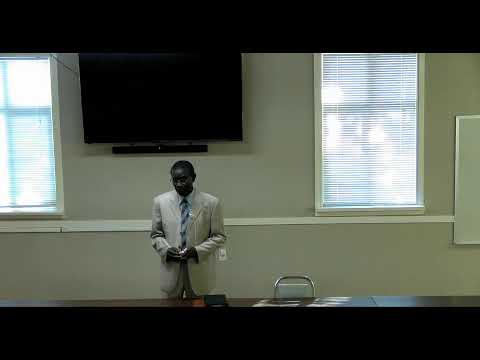
Pastor Napthally Ogallo of Grace Baptist Church in Eldoret, Kenya presents a photographic and narrative report of the church's history, ministry, and ongoing needs to a supporting congregation. He traces the church's origins in the aftermath of Kenya's 2007–2008 post-election violence, its years of one-to-one evangelism, the gradual acquisition and development of church property, the loss of funds to a dishonest contractor, and the current state of an unfinished but usable building. The presentation closes with a candid account of challenges — extreme charismatic neighbours, widespread false gospels, theft, urban poverty, and drug use — set against the encouragement of baptisms, elder development, two church plants, a regional theological school, and a growing student ministry.

The Triumph of the Church
Matthew 16:13–18 presents three interlocking realities about Christ and his church: the identity of Christ confessed by Simon Peter, the divine source of that confession, and the indestructible promise Christ appends to his church. The rock upon which the church is built is not Peter's person but the Christ Peter confessed — the second person of the triune God who assumed humanity, died, and rose for his people. Christ himself is the builder, foundation, and protector of the church, which means the gates of Hades assault the church not as a conquering force but as a defensive one being overrun by the church's gospel advance. The practical summons is for the church to fulfil her three marks — the preaching of the word, the administration of the sacraments, and the exercise of discipline — with the confidence that Christ's triumphant headship guarantees the church's survival into the eschaton.

Live Stream - August 13, 2023
The contest at Mount Carmel in 1 Kings 18 sets the living God of Israel against the false prophets of Baal and Asherah, exposing the utter futility of idolatry and demanding undivided allegiance to Yahweh. Elijah's brief, confident prayer stands in deliberate contrast to the frenzied, all-day invocations of Baal's prophets, demonstrating that God is not manipulable by human religious technique. The fire that falls from heaven is not merely a proof of Yahweh's power but a display of his grace, confirming that he receives sinners through the sacrifice he himself ordains. The sermon closes with a direct call: halt no longer between two opinions, but come to the Lord Jesus Christ, in whom alone there is justification, peace with God, and every spiritual blessing.
The Contest at Carmel
Elijah's confrontation with the prophets of Baal on Mount Carmel exposes the absolute futility of idolatry and the exclusive sovereignty of Yahweh. Set against the backdrop of Ahab's state-sponsored Baalism and a three-year drought, the passage drives a direct challenge: total allegiance belongs to the living God alone, with no syncretistic middle ground. The sermon traces the contest from Elijah's gauntlet through the false prophets' frenzied failure to God's decisive, fire-bearing answer, arguing that the same God who consumed the sacrifice at Carmel receives sinners today through the atoning blood of Christ. The application is direct: those who still halt between two opinions are called to repent and look to Christ in faith, while believers are charged to hold fast to God Most High without divided allegiance.

Sunday School Confession Study - 2LCF 2.2
God's external relations to the created order — his independence, omniscience, holiness, and the creature's obligation to him — are the subject of 2LCF Chapter 2, Paragraph 2. The confession's insistence that God is entirely self-sufficient and derives no glory from creatures corrects any notion that God created the world out of need or incompleteness. The omniscience of God is infinite, infallible, and independent of the creature, so that nothing is contingent or uncertain to him. The study closes by grounding the creature's obligation of worship, service, and obedience in what God is — holy in all his counsels, works, and commands.