
Topic
Apologetics
374 sermons · All topics

The Triumph of Samson at Gaza

Judges 16 records the final chapter of the Samson cycle, moving from the removal of Gaza's city gates through Samson's betrayal by Delilah to his death in the destruction of the temple of Dagon. Against readings that reduce Samson to a figure of ungoverned sexual appetite, this exposition argues that Samson is a faithful judge of Israel, Spirit-empowered and strategically purposeful, whose every encounter with the Philistines is ordered by divine providence toward the deliverance of God's people. The departure of Yahweh from Samson is traced not to moral degeneracy but to Samson's disclosure of the sign of his Nazirite vow, which jeopardized the mission for which he was set apart. Throughout, Samson is presented as a type of the Lord Jesus Christ, whose greater deliverance through death saves more than his life alone could accomplish.

2LCF Chapter 2 - Theology Proper, Part I

Eternal life consists in knowing the only true God and Jesus Christ whom he has sent (John 17:3), which means the knowledge of God is not optional for Christians but is the very substance of their salvation. This session opens a multi-week confession study of 2LCF Chapter 2 (Of God and of the Holy Trinity) by establishing what theology proper is — the study of the being, attributes, and works of the triune God — and why it is primary: it is grounded in God's creative purpose, commanded in Scripture, promised in the New Covenant (Jeremiah 31:31-34), and urgently needed in the face of false religion and bad theology. Six preliminary interpretive helps are then introduced to prepare the mind for rigorous and reverent engagement with the doctrine of God, including the necessity of recognising the ontological chasm between Creator and creature, God's revelatory condescension, and the joint propriety of affirmations and denials.

2LCF Chapter 1:5-10 - Hermeneutics
Paragraphs 5–10 of the Second London Confession's first chapter contain an implicit hermeneutical program that governs all responsible reading of Scripture. This session works through those paragraphs to identify six distinct interpretive principles: the Christocentric scope of all Scripture, the extent and finality of Scripture's sufficiency, the perspicuity of Scripture for salvation, the availability of Scripture through faithful translation, the analogy of Scripture and faith as the rule of interpretation, and the supreme judicial authority of Scripture over all human councils and traditions. The practical thrust is that every reader, learned or unlearned, is equipped by ordinary means and the Spirit's illumination to understand what God has revealed — and that bad presuppositions inevitably produce bad theology.
2LCF Chapter 1.1 - The Necessity of Scripture
The necessity of Holy Scripture, as confessed in 2LCF Chapter 1, paragraph 1, arises from the insufficiency of general revelation to communicate saving knowledge. While creation and providence manifestly display God's goodness, wisdom, and power — leaving all men without excuse — they do not and cannot reveal blood atonement, the incarnation, or justification by faith alone. It therefore pleased God to commit His will to writing, producing a Scripture that is the only sufficient, certain, and infallible rule of all saving knowledge, faith, and obedience. The session closes with extended discussion of cessationism, the distinction between inerrancy and infallibility, and the hermeneutical principle that Scripture interprets Scripture.

The Good Shepherd, Part 1
John 10:1–10 stands in direct continuity with John 9: having healed and saved the man born blind, Jesus turns to indict the Pharisees as thieves and robbers who exercised illegitimate authority over the sheepfold of God. The sermon works through Jesus' parabolic illustration in verses 1–6, showing that the true shepherd enters by the door (granted access by God the Father), calls his own sheep by name with a specific and effectual summons, and leads them out — while the sheep, made alive by the Spirit in regeneration, hear and follow his voice and flee the stranger's. The application is double: believers are called to seek the shepherd's voice in Scripture, family worship, and the preaching of the Word, and the unconverted are called to ask with the blind man, 'Who is he, Lord, that I may believe in him?'

The Healing of a Blind Man, Part 3
John 9:35–41 records the climax of the healing of the man born blind: not the restoration of his physical sight, but his salvation through faith in the Son of God. This sermon argues that providence and miracles do not save — only grace through faith in Christ does — and that Christ's coming pronounces both salvation on the spiritually blind who see their need and judgment on the self-righteous who claim to see but remain in their sin. The exposition closes with a direct appeal: the self-righteous require both the law, to expose the bankruptcy of their works-confidence, and the gospel, to offer the righteousness of Christ received by faith alone.

The Healing of a Blind Man, Part 2
John 9:13–34 records the formal interrogation of a man born blind by the Pharisees following his healing by Jesus. The passage exposes the willful unbelief of Israel's religious leadership — men who suppress plain evidence, commit perjury, and wield coercion against a helpless witness — while simultaneously tracing the healed man's growing confession of Christ, from 'he is a prophet' to 'if this man were not from God, he could do nothing.' The sermon argues that opposition to the Son of God is always opposition to the Father who sent him, and that the courage to confess Christ in the face of exclusion and shame is the mark of genuine discipleship.

The Healing of the Blind Man
John 9:1–12 presents the healing of a man born blind as a sign that Jesus is the light of the world — not merely a title (John 8:12) but a function he enacts in restoring both physical and spiritual sight. The sermon addresses the disciples' question about the cause of the man's blindness by distinguishing between suffering that is a direct consequence of particular sin and suffering that is ordained by God's sovereign providence to display his works. God's absolute sovereignty over all creatures and all their actions — including congenital affliction — is defended from Scripture and the 1689 LBCF chapter on providence, with Job, Paul, and the man born blind as converging witnesses that God's people walk by faith in Romans 8:28 when affliction comes. The sermon closes with an evangelistic appeal drawn from John's stated purpose: that readers believe Jesus is the Christ, the Son of God, and have everlasting life.

Live Stream - February 12, 2023
The cross of the Lord Jesus Christ is not a symbol or a bare historical fact but, as John Gill defined it, theological shorthand for the sacrificial, substitutionary, atoning death of Christ for his people. This exposition of the cross in the book of Acts traces six divine dimensions: purpose (the cross was decreed in eternity), promise (foretold by all the prophets), providence (carried out through the lawless hands of wicked men), power (accomplished by the divine Son who laid down his life voluntarily), proclamation (heralded by apostolic messengers to Jew and Gentile alike), and proficiency (effectually applied to all whom the Father gave to the Son). The closing exhortation calls believers to restore the art of marveling in Christ crucified — not as an occasional Sunday exercise but as the first motion of every morning.

2LCF 26 - Of the Church, Part I
What is the church, and who governs it? This confession study works through 2LCF Chapter 26, paragraphs 1–4, examining the universal (catholic) church: its election-grounded identity, its visible and invisible dimensions, the perpetuity of Christ's kingdom despite the inevitable mixture and error found in even the purest churches, and the exclusive headship of the Lord Jesus Christ over his body. The session challenges both Landmark Baptist denials of a universal church and Roman Catholic claims to papal headship, grounding ecclesiology in the confession of Christ as Son of the living God as articulated in Matthew 16.

The Sixth Commandment
Exodus 20:13 — 'You shall not murder' — receives a full exposition covering the Hebrew term ratza, the threefold division of law, the three uses of the law, the internal dimensions of the commandment, the three biblically warranted exceptions to the prohibition against killing, and the theological foundation of all human life in the imago Dei. The sermon moves from careful lexical and exegetical analysis to a sustained application across abortion, capital punishment, just war, self-defense, and the protection of every stage of human life from womb to grave. Hearers are called to pray for civil government, preach the law as a tutor to the cross, and hold fast to a biblical anthropology in a culture that systematically devalues image-bearers of God.
2LCF24 - Of the Civil Magistrate
Civil government is divinely ordained, not diabolical — a claim the Second London Baptist Confession of Faith (1689) sets out in chapter 24 and grounds in Romans 13:1–7 and the Noahic covenant. This study works through the confession's three paragraphs to establish the divine origin of the magistrate's authority, the lawfulness of Christian participation in civil office, and the Christian's duty of submission and prayer toward governing authorities. Against both Anabaptist withdrawal and statist overreach, the confession teaches that the magistrate is under God and over the people for God's glory and the public good — charged with maintaining justice and peace, wielding the sword against criminals and foreign aggressors, and accountable to God and the governed alike. Christians must yield subjection in all lawful things, yet obey God rather than men when civil law transgresses divine law.

The Children of the Devil, Part 3
John 8:44–47 records Christ's unflinching indictment of the unbelieving Jewish religious leaders as children of the devil, a verdict he confirms by exposing three marks of their paternity: they reject the truth he speaks precisely because it is truth, they cannot convict him of a single sin, and they do not hear God's words because they are not of God. The sermon draws out the theological weight of each mark — the devil as murderer and father of lies in contrast to Christ as life and truth — and applies these diagnostic tests to the question of assurance: those who are of God love Christ and love the Word. The exposition closes with a call to both the congregation and the unconverted to rest in the imputed righteousness of Christ, received by faith alone, as the only ground of a right relationship with God the Father.

2LCF 23 - Of Lawful Oaths and Vows
Second London Confession of Faith chapter 23 treats the doctrine of lawful oaths and vows, distinguishing Reformed Baptist practice from the Anabaptist rejection of oath-taking and from Roman Catholic monastical vows. The sermon argues that swearing by God's name is itself an act of religious worship — acknowledging his omniscience, omnipresence, and vindictive justice — and that Scripture warrants oaths in matters of weight and moment while condemning their careless everyday use. Matthew 5:33–37 is shown to address the abuse of casual, trivial oath-making rather than solemn oaths before lawful authority, as confirmed by Christ's own oath before the Sanhedrin, God's oath to Abraham, and Paul's repeated appeals to God as witness. The sermon closes by exposing popish monastical vows of celibacy, poverty, and obedience as superstitious devices of men that contradict Scripture's positive assessment of marriage, honest labor, and just remuneration.

The Emphasis on Justice for All
Exodus 23:1–9 sets out the judicial law's demand for impartial, honest justice within the covenant community — a demand binding not merely on courts but on every member of the body politic. The passage divides into three subsections: general principles of justice for the people (vv. 1–3), the requirement of common decency even toward enemies (vv. 4–5), and specific warnings to judges against partiality, false accusation, bribery, and oppression of strangers (vv. 6–9). The confession's principle that the judicial law has expired as a binding institution yet retains general moral equity frames the exposition throughout. The sermon closes with two applications: the necessity of personal courage and grace-enabled obedience, and the dependence of any stable civil order on individual integrity, honest testimony, righteous judges, due process, and equal protection under the law.

A Defense of Self-Defense
Matthew 5:38–42, the fourth antithesis of the Sermon on the Mount, is frequently invoked to condemn self-defense, capital punishment, and military service — yet a careful reading reveals that Jesus is not contradicting the lex talionis of the Mosaic civil code but rather correcting the Pharisaic habit of applying that courtroom principle to personal, day-to-day relationships. The contrast is not Jesus versus Moses but Jesus versus bad hermeneutics: what the civil magistrate is authorized to do with the sword (Romans 13:1–4) stands entirely intact, and Exodus 22:2–3's legitimization of self-defense is nowhere repealed. The sermon works through Jesus' four illustrations — insult, property disputes, conscription, and benevolence — to show that Christ is calling his disciples to a disposition of patience and forbearance in ordinary life, not to a pacifism that would render them incapable of functioning in civil society.
Of the Gospel and Extent Thereof (2LCF 20)
2 London Baptist Confession of Faith Chapter 20, 'Of the Gospel and of the Extent of the Grace Thereof,' addresses a chapter absent from the Westminster Confession but added by the Congregationalists in the Savoy Declaration and retained by the Particular Baptists to combat incipient deism and the General Baptist doctrine that sinners may be saved through general revelation alone. The sermon traces the chapter's four paragraphs through Romans 10, Luke 24, John 5, and Psalm 19 to demonstrate that the gospel of Christ has been the sole substance of special revelation since the protevangelium of Genesis 3:15, that general revelation is categorically insufficient to make Christ known, that God distributes gospel light with absolute sovereignty, and that effectual grace is indispensable alongside that revelation for the conversion of dead sinners. The double theme of the chapter — the necessity of special gospel revelation and the necessity of the Spirit's insuperable work — magnifies divine grace, grounds the missionary enterprise, and exposes the doctrine-of-sin deficiencies latent in every scheme that allows salvation apart from hearing Christ proclaimed.
The Laws Concerning Homicide and Bodily Injury, Part 3
Exodus 21:33–22:15 sets out Israel's case laws governing property damage, animal theft, and home defense — laws designed not as an exhaustive legal code but as representative principles equipping judges to adjudicate equitably. Three features of biblical law emerge with force: the pervasive principle of restitution (the offender must make the victim whole, not merely 'pay a debt to society'), the absence of a prison system in the Mosaic economy, and the explicit legitimacy of lethal self-defense when a thief breaks in under cover of darkness. The sermon calls hearers to appreciate the pro-victim orientation of God's law and to think biblically about criminal justice, property rights, and self-defense in the present civil order.

The Truthful Testimony of the Lord
John 8:13–20 records the Pharisees' flat rejection of Christ's self-testimony — 'your witness is not true' — and his threefold response: the intrinsic truthfulness of his witness grounded in his divine origin and destination, the confirming unity he shares with the Father, and the law of two witnesses satisfied by Father and Son together. The passage closes with the Pharisees demanding to see the Father, only to be told that their ignorance of the Son proves their ignorance of the God they claim to worship. The sermon presses upon the hearer that to receive or reject Christ is to receive or reject the Father, and calls unbelievers to look in faith to the one mediator between God and men.

Live Stream - September 25, 2022
John 8:12 presents one of the most contested 'I am' declarations in the Fourth Gospel: Jesus identifies himself as 'the light of the world,' a claim that provokes murderous opposition because his hearers understood its full theological weight. The sermon traces the Old Testament background of the divine name 'I am' (Exodus 3:14) and the Messianic light imagery of the prophets (Isaiah 9, 42, 49) to show that Jesus is asserting consubstantiality with the Father — not sonship by creation or adoption, but by eternal nature. The 'I am' statements throughout John's Gospel (John 1:1; 4:26; 6:20; 8:58; 18:5–6; 20:28) collectively demonstrate John's controlling purpose: to establish the full deity of Christ. Those who follow this Christ by grace through faith are transferred from the ethical darkness of sin and judgment into the light of life, which carries immediate implications for Christian witness in a morally disordered world.

The Light of the World
In John 8:12, Jesus declares 'I am the light of the world,' a claim that situates him within the great 'I Am' tradition of Exodus 3:14 and the Isaianic servant songs, asserting both his full deity as the eternal Son and the universal scope of his messianic mission to Jew and Gentile alike. The sermon traces the 'I Am' statements across John's Gospel, showing that Jesus consciously identifies himself with Yahweh and that the light-imagery of the Old Testament finds its fulfillment in his person and work. Darkness in John is not physical but ethical — the guilt, depravity, and rebellion of a world that hates the light — and the follower of Christ, by grace through faith, passes from that darkness into the light of life. The church is therefore called to hold forth the word of the gospel as light in a morally darkened age, trusting that God is able to transfer sinners from the kingdom of darkness into the kingdom of his Son.

The Law Concerning Servants
Exodus 21:1–11 opens what is commonly called the Book of the Covenant, the concrete judicial application of the Ten Commandments to Israel's civil life. The sermon situates this passage within the threefold division of the law — moral, ceremonial, and judicial — explaining why the judicial law expired with the Israelite commonwealth while its general equity retains moral use, and why the theonomic demand that modern civil magistrates enforce the Mosaic penal code lacks New Testament warrant. Working through three features of the law concerning servants — the limitation on service, the acquisition of a family during service, and the protection of female servants — the sermon argues that far from being barbaric, these laws reveal God's wisdom and kindness in restraining exploitation and protecting the vulnerable in a post-fall world.

The Feast of Tabernacles, Part 1
John 7:1–13 presents the Feast of Tabernacles as the backdrop for intensifying hostility toward Jesus, whose unbelieving half-brothers urge Him to seek public exposure — a suggestion rooted in a man-centered, politically distorted messianic expectation. Christ refuses to act on their counsel, insisting instead on the divine timetable that governs every movement of His redemptive mission. The passage confronts two errors simultaneously: the assumption that physical proximity to Jesus produces saving faith, and the temptation to shrink from confessing Christ under social pressure — both of which the text answers by pointing to sovereign grace and the covenant community as God's appointed means of steadying His people.

The Arrest of Peter and John
Acts 4:1–12 presents the arrest of Peter and John by the Sanhedrin and Peter's Spirit-filled defense before the council, in which he declares Jesus of Nazareth — crucified and risen — as the sole name under heaven by which men must be saved. The sermon traces two movements: the sovereign advance of God's word despite the imprisonment of its preachers (the number of believers growing to five thousand), and the christological and soteriological content of Peter's address, which grounds salvation exclusively in Christ's active obedience, atoning death, and resurrection. The stone rejected by the builders has become the chief cornerstone, and those who refuse him will ultimately be crushed by him. The sermon applies these realities to the perpetual persecution of the church, the exclusivity of the gospel, and the urgent call to believe on Christ alone for salvation.
God the Righteous Judge

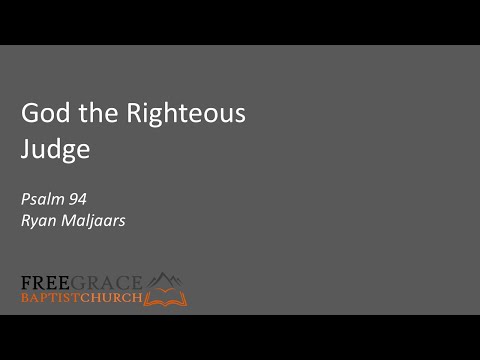
Psalm 94 presents God as the righteous judge who hears the cry of His oppressed people, sees the wickedness of their persecutors, and will not ultimately abandon His inheritance. This expository treatment works through the chiastic structure of the psalm, showing how the cry for justice (vv. 1–3) is answered by justice administered (vv. 20–23), and how the folly of those who deny God's omniscience mirrors the divinely-given wisdom of His people. The sermon draws out the covenant comfort of God's chesed — His steadfast faithfulness to those He has chosen — as the ground of peace in the midst of affliction, and closes with a direct call to repentance for any who remain outside of Christ.

Live Stream - June 12, 2022
Psalm 29 presents Yahweh's sovereign majesty over creation through the imagery of a Mediterranean storm tracking north to south across the land of Israel. The psalm functions as a polemic against Baal, the Canaanite weather god, demonstrating that Yahweh alone is the uncreated Creator while all rival 'gods' are derivative, created beings. The sermon draws this ancient conflict forward into the present spiritual warfare Paul describes in Ephesians 6, calling believers to neither panic nor despair at the apparent power of the kingdom of darkness, because the same God who sent Baal fleeing sits enthroned above every principality and power. The concluding application warns that a coming storm of divine wrath is approaching, from which only the righteousness of Christ provides shelter.

The Sovereignty of Yahweh of Israel
Psalm 29 is a polemic against the Canaanite storm god Baal, written by David to demonstrate that Yahweh alone is Creator and sovereign King over all powers—heavenly and earthly. The seven-fold repetition of 'the voice of the Lord' traces a storm from the Mediterranean through Lebanon, the supposed abode of Baal, into the wilderness of Kadesh, showing at each point that Baal is no rival but a fleeing creature before the Creator. The same sovereignty that sent Baal running and that enthroned God over Noah's flood is the ground of the church's peace amid the spiritual and geopolitical chaos of the present age. Those outside Christ are warned that a greater storm—the wrath of God—is coming, and the only shelter is repentance and faith in the Lord Jesus Christ.
Clip: Theology is crucial for every church and believer
Theology proper — the knowledge of who God is as Father, Son, and Holy Spirit — is not an academic luxury but the essential foundation of Christian life, worship, and witness. This sermon clip from an exposition of Ephesians 1:3–14 argues that the church's tendency to rush past doxological passages to practical ethics has left believers spiritually thin, prone to a mercenary relationship with God rather than one grounded in the infinite riches of his grace. The preacher calls the congregation to disciplined study of the Trinity, warning that without it believers become vulnerable to ancient heresies and lose the impetus to proclaim Christ to a lost world.

The 8th Commandment, Part 2 & Economic Theory
The Eighth Commandment's prohibition against theft carries positive moral obligations — diligent labor, charitable giving, and biblical contentment — and provides the scriptural framework for evaluating economic and political systems. Drawing on the Mosaic law, the apostolic letters, and historical narrative, the sermon argues that socialism and communism are founded upon institutionalised theft and therefore stand under divine condemnation, while capitalism, for all its imperfections, respects the God-given right to private property. Israel's demand for a king in 1 Samuel 8 and Ahab's seizure of Naboth's vineyard in 1 Kings 21 are presented as biblical case studies in governmental confiscation. Hearers are exhorted to cultivate contentment, labor faithfully, give charitably, and judge all economic theory by the standard of Exodus 20:15.

The Prophecy Concerning the Resurrection
Peter's Pentecost sermon in Acts 2:24–32 anchors the resurrection of Jesus Christ not in apostolic invention but in the prophetic word of Psalm 16, written by David nearly a millennium before the event. Working through Peter's appeal to and interpretation of that psalm, this exposition traces four aspects of the Messiah's disposition before His death — His focus, joy, confidence, and dependence upon the Father — and demonstrates that David, writing as a prophet under the Davidic covenant of 2 Samuel 7, could not have been describing his own resurrection since his tomb remained occupied. The resurrection is therefore the Father's public vindication that divine justice has been fully satisfied by Christ, the ground of the believer's justification, and the fulfillment of the Davidic covenant promise that one from David's line would build an eternal house for God. The sermon closes by calling sinners — however guilty — to call upon the risen Lord Jesus, the one on the middle cross who alone can grant everlasting life.