
Topic
Soteriology
2,239 sermons · All topics

The Third Missionary Journey, Part 7

Acts 20:32–38 concludes Paul's farewell address to the Ephesian elders at Miletus, functioning as a pastoral charge that moves from doctrinal grounding to ethical example to affectionate departure. The sermon treats three movements: Paul's commendation of the elders to God and the Word of His grace as the only sufficient resource for long-term ministry, Paul's example of non-covetousness and manual labor as a rebuke against ministerial greed, and the tearful parting as a model of godly gratitude for the instruments of grace. A sustained excursus defends the biblical warrant for paying pastors from 1 Corinthians 9, 1 Timothy 5, and 2 Timothy 2, establishing that Paul's voluntary self-support was the exercise of a right, not the abolition of one. The sermon closes with a call to pray for faithful ministers and to value the means God ordains for the salvation of sinners.

Bible Study - Exodus 4
Exodus 4 continues the call narrative begun in chapter 3, tracing Moses' repeated reluctance to accept the commission to deliver Israel from Egypt and God's patient, sovereign response to each objection. God confirms Moses' authority through three authenticating signs — the rod becoming a serpent, the leprous hand, and water turned to blood — not as ends in themselves but as instruments to authenticate Moses as God's spokesman, consistent with the function of signs throughout Scripture. The chapter's second half traces Moses' return to Egypt, including the judicial hardening of Pharaoh's heart as an act of divine justice rather than injustice, Israel's identification as God's firstborn, and the concluding scene of Israel's elders bowing in worship upon receiving Moses and Aaron's testimony. The sermon calls hearers to find comfort in the absolute sovereignty of God over nature, disease, human speech, and pagan rulers, and to let that knowledge shape reverent, joyful corporate and private worship.

Sunday School - Biblical view of self-defense, part 2
Matthew 5:38–42 is frequently misread as a blanket prohibition against self-defense, capital punishment, and just war — three instances of justifiable homicide that Scripture plainly upholds. This exposition argues that Jesus is not contradicting the lex talionis (the law of retribution found in Exodus, Leviticus, and Deuteronomy) but is correcting the Pharisaic misapplication of a civil-judicial principle to everyday interpersonal conduct. The passage addresses four specific situations — insult, litigation, conscription, and benevolence — and calls believers to a disposition of forbearance in personal relations, while leaving entirely untouched the legitimacy of lawful self-defense, just war, and capital punishment as administered by the civil magistrate.

The Rejection of Saul by the Lord, Part 2
The rejection of Saul in 1 Samuel 15:24–35 exposes the anatomy of false repentance, the character of a reprobate, and the nature of a God who does not change. The sermon works through Saul's admission of guilt, Samuel's execution of Agag, and the theological tension between God's expressed regret and his immutability, resolving that tension through the doctrines of divine impassibility and anthropopathism. The justice of God in dispatching the wicked is shown to be a cause for righteous rejoicing, not moral discomfort, as texts from Judges 4–5 and Proverbs 11 confirm. Saul's downward trajectory — blame-shifting, false piety, delusion, fake repentance, and apostasy — is held up as a warning that great privilege does not equal saving grace, while Christ's imputed righteousness is offered as the only ground of true standing before God.

The Third Missionary Journey, Part 6
Acts 20:28–31 records the Apostle Paul's pastoral charge to the Ephesian elders at Miletus — a charge that functions as the first pastors' conference in the new covenant era. The passage demands that elders take heed to themselves and to all the flock, that they shepherd the blood-bought church of God, and that they remain vigilant against both external persecution and internal doctrinal corruption. The theological weight of the phrase 'the church of God which He purchased with His own blood' opens into a precise treatment of the communication of idioms, establishing that the divine and human natures of the one person of Christ are the ground on which Scripture can speak of God's own blood. Ministers are called to feed the flock with the whole counsel of God, warned that savage wolves and ambitious false teachers will arise, and exhorted to watch and warn with the same tear-stained fidelity that marked Paul's three years in Ephesus.

The Third Missionary Journey, Part 5
Acts 20:17–27 records the Apostle Paul's address to the Ephesian elders at Miletus — the only extended speech in Acts directed specifically to Christian leaders. The sermon examines Paul's review of his own apostolic ministry as a model for pastoral faithfulness, tracing his humility and tears, his unflinching proclamation of repentance toward God and faith in Christ, and his resolve to press toward Jerusalem despite the Spirit's testimony of chains and tribulations ahead. Paul's declaration of innocence in verse 27 — grounded in his refusal to shun the whole counsel of God — is pressed as the standard against which every gospel minister will stand accountable before God.

The Rejection of Saul by the Lord
1 Samuel 15 recounts the Lord's rejection of Saul as king over Israel following his disobedience in the matter of the Amalekites. The passage raises searching questions about the nature of obedience, the seriousness of presumption before God, and the character of true repentance. This exposition examines what Saul's failure and the Lord's verdict reveal about the covenant demands placed on Israel's king and, by extension, on all who stand before a holy God.

The Lord's Betrayal in the Garden
Matthew 26:47–50, read alongside John 18:1–11, presents the betrayal of the Son of God in Gethsemane as the arrival of the cup of divine wrath — the hour for which he came. The sermon traces three aspects of the betrayal: its significance as the fulfillment of prophecy and the onset of Messianic suffering, the diabolical plan coordinated by Judas and the religious leaders, and the execution of that plan through a hypocritical kiss. The exposition then turns to John 18 to show that even as Christ surrendered, he revealed his divine identity by the words 'I Am,' causing the armed mob to draw back and fall to the ground — a display of the glory that will be fully manifested at his return. The central application is twofold: believers are called to stand in awe of the active obedience and voluntary self-surrender of Christ whose righteousness is imputed to them, and unbelievers are warned that the only preparation for facing that glory is faith in the Lord Jesus Christ.

The Third Missionary Journey, Part 4
Acts 20:1–16 narrates Paul's closing movements on his third missionary journey — through Macedonia and Greece, into Troas where Eutychus falls to his death and is raised, and then south toward Jerusalem. The passage is used to argue that the early church's pattern of worship is not merely descriptive but carries prescriptive force: the Lord's Day (the first day of the week), corporate assembly, the Lord's Supper, and the preaching of God's Word are the God-ordained elements of Christian worship, regulated by Scripture alone. Cessationist and confessional commitments frame the reading throughout, and the sermon closes with a direct call to sinners to trust in Christ's imputed righteousness and atoning blood as the only ground of salvation.

The Problem Worse than Paralysis
The healing of the paralytic in Matthew 9:1–8 exposes a problem far deeper than physical disability: the guilt of sin before a holy God. Jesus pronounces forgiveness before He commands the man to rise, revealing that the greater miracle is not restored limbs but a cleansed soul — and that the Son of Man possesses divine authority on earth to forgive sins. The physical healing serves as demonstrable evidence of the greater, invisible reality: that Christ accomplished what His name declared He would do, saving His people from their sins. The right response to such power is not mere wonder but the fear-and-joy that drives genuine worship and sustains the believer's cheer through every temporal affliction.

The Whole Armor of God
Ephesians 6:10–20 calls the people of God to don the whole armor of God — not as an invitation to physical combat, but as a summons to faithful spiritual warfare against the devil and his hosts. The sermon works through three movements: the commands to be strong in the Lord and to put on the armor, the reasons rooted in the nature of the spiritual enemy, and a pastoral survey of each piece of armor from the belt of truth to the sword of the Spirit and prayer. The controlling emphasis falls on standing — not heroics, but covenantal steadfastness in union with Christ, who is already exalted far above all principalities and powers.
Stewards of the Mystery

1 Corinthians 4:1–5 presents ministers of Christ not as celebrities or gurus but as servants and stewards entrusted with the mystery of the gospel — a role demanding faithfulness, not worldly success. Against the backdrop of the factionalism at Corinth, where worldly wisdom had infiltrated the church's evaluation of apostles, Paul asserts that the only judge competent to assess a steward's motives is the Lord himself. The sermon traces three movements: the nature of the steward's calling, the irrelevance of human verdict, and the eschatological praise that awaits the faithful at Christ's return.
Nations Rage, God Mocks
Psalm 2 confronts the rage of earthly rulers against God and His anointed with a sober theological question: why do the nations engage in so futile an endeavor? The sermon expounds the psalm under three headings — the rebellion of earthly kings, the reign of the heavenly king, and the recognition of the true king — tracing the Davidic covenant through its fulfillment in the resurrection and exaltation of Christ. The Covenant of Redemption grounds the certainty of Christ's present reign at the right hand of the Father, and that certainty is the sole comfort available to God's people as nations continue to rage and the history of the church runs red with the blood of martyrs. Hearers are called either to kiss the Son in filial fear and find blessing, or to perish in the way of the ungodly.

Pressing On In Christ for Sanctification

Philippians 3:10–21 sets out the doctrine of sanctification as the necessary and purposeful continuation of justification — not its cause. The justified believer, having been conformed to Christ's death by the Spirit's regenerating work (Romans 6), is called to press forward in mortification of the old nature and vivification of the new, never resting in past attainments. Christ's purpose in saving sinners is not merely to deliver them from hell but to conform them to his image for the glory of God — the ordo salutis moving through justification and sanctification toward final glorification. The sermon calls believers to disciplined, Christ-dependent pressing on through Word, prayer, church attendance, and zealous good works, while warning that those who corrupt the gospel by mingling works with grace are enemies of the cross whose end is destruction.

All Of Christ For Justification
Philippians 3:1–9 presents the apostle Paul's radical revaluation of every religious credential he possessed, moving them all from the gain column to the loss column so that Christ alone might occupy the place of righteousness before God. This sermon expounds what it means to have no confidence in the flesh: that justification rests on Christ's perfect active obedience imputed to the believer, not on any combination of works, faith, and sincere effort. The loss column of sin is dealt with equally fully — Christ bearing the certificate of debt and nailing it to the cross, cancelling the debt in its entirety. Hearers are called to count all self-generated merit as rubbish and to rest, passively and completely, in Christ's righteousness received through faith alone.

Excerpt: One insurrectionist saved, so that no sinner might despair
The dying thief on the cross confessed Christ as Lord not amid miracles and abundance but amid gore, agony, and apparent defeat — which is why Calvin called it the most remarkable example of faith since the creation of the world. This sermon examines the thief's faith in its two inseparable dimensions: seeing Jesus as the Lord who possesses a kingdom even from the cross, and casting himself upon the mercy of Christ rather than resting on any work, righteousness, church attendance, or catechetical knowledge. Justification is by faith alone in the suffering Savior, and the gospel is good news precisely because God demands nothing from the sinner but that he look and live.

Excerpt: If I come to Jesus, will He save me?
The gospel offer is genuinely free: Jesus stands ready and willing to save every sinner who comes to Him, without preparation, merit, or prior self-reformation. Drawing on John 6:37 and the parable of the prodigal son, this excerpt refutes the lie that Christ might refuse or be unwilling to receive a sinner who comes to Him. The dying thief on the cross is the paradigm case — he brought nothing but himself, and grace was sufficient.

The Salvation of Zacchaeus
Luke 19:1–10 presents the salvation of Zacchaeus as a concrete demonstration of sovereign, irresistible grace applied to an utterly unworthy sinner. The sermon traces two movements: first, the description of Zacchaeus as a chief tax collector — condemned before God, rich through corruption, possessing nothing to commend him to divine favor — and second, the mission of Christ, who sovereignly summons Zacchaeus from the tree and brings salvation to his house. The crowd's complaint that Christ eats with sinners is shown to be, unwittingly, the very proclamation of the gospel, while Christ's own declaration — 'the Son of Man has come to seek and to save that which was lost' — is set forth as the irreducible statement of His redemptive purpose. Hearers are exhorted to find their hope not in moral accomplishment but in the seeking and saving God who invades the lives of sinners they have given up on.

The Believer's Response to Trials
James 1:2–8 commands believers to count trials 'all joy' — a disposition that runs counter to every natural instinct. This exposition works through the passage in two movements: the believer's response to trials (vv. 2–4), which establishes the identification, expectation, disposition, and divine purpose of affliction; and the believer's request during trials (vv. 5–8), which calls for the pursuit of wisdom and the exercise of faith. The central burden is that God's redemptive purpose in suffering — conformity to the image of Christ — supplies both the ground for joy and the reason to seek wisdom rather than mere deliverance.

The Lord's Prayer in Gethsemane
What does the agony of Christ in Gethsemane reveal about who He is and what He accomplishes? Expounding Matthew 26:36–46, this sermon traces the Savior's three prayers against the disciples' repeated failure to watch, showing that Christ's soul-sorrow is perfectly consistent with His true humanity, while His unwavering resolve to drink the cup of divine wrath flows from His eternal commitment as covenant mediator. The cup is not metaphor for mere suffering but the concentrated fury of God upon a sinless substitute — which explains both why martyrs die differently than Christ and why the imputation of His active obedience is as necessary as the forgiveness of sins. Believers are called to marvel at His sufficiency, to watch and pray with sobriety about their own weakness, and to rest entirely on the righteousness of Another.

The Thief on the Cross
What does the conversion of a man guilty of insurrection and murder on the day of his execution reveal about the grace of God? This exposition of Luke 23:39–43 traces the marks of sovereign grace in the dying thief — his fear of God, his ownership of personal guilt, his acknowledgment of Christ's sinlessness, and his faith cast entirely upon a crucified Lord — before turning to the willing and able Savior who, in the extremity of his own suffering, assures a notorious criminal of immediate paradise. The sermon argues that justification is by faith alone, apart from works, baptism, or religious knowledge, and that the distinguishing mercy shown to one thief and withheld from the other is the clearest emblem of sovereign grace. Hearers are pressed not to presume on a deathbed conversion but to cast themselves now, by grace, upon the mercy of Christ.

The Victory of Samson at Jawbone Height
Judges 15 recounts Samson's victory over the Philistines at Jawbone Height, but the chapter's deepest scandal is not the enemy outside — it is the cowardice of the covenant tribe of Judah, who bind their own deliverer and surrender him to those he was sent to destroy. This sermon traces three movements in the text: the betrayal by Samson's father-in-law, the treachery of Judah's three thousand men, and the Spirit-empowered defeat of a thousand Philistines with a fresh jawbone. Throughout, Samson emerges as a type of Christ — delivered by his own people into enemy hands, yet vindicated by God — and the lesson pressed upon the hearer is that God's grace delivers a people who neither cry out for deliverance nor deserve it.

The Third Missionary Journey, Part 3
Acts 19:21–41 records Paul's final days in Ephesus, culminating in a riot instigated by the silversmith Demetrius, whose financial interests were threatened by the gospel's advance against idolatry. The passage is examined under four headings: Paul's strategic plans for further ministry, the anger of the silversmiths rooted in profit dressed as piety and patriotism, the confused uproar in the theater, and the intervention of the city clerk whose cool legal reasoning protected the church. The exposition draws out the apologetic purpose of Luke's account — demonstrating that Roman civil authority found no legal fault with Christianity — and closes with an urgent call to forsake every idol and trust the righteousness of Christ alone.

The Third Missionary Journey, Part 2
Acts 19:11–22 presents four movements in Paul's ministry at Ephesus: the unusual miracles God works through him, the humiliating defeat of the itinerant Jewish exorcists who invoke Christ's name without saving faith, the voluntary burning of occult books by Ephesian believers as fruits of genuine repentance, and a Lukan progress report declaring that the word of the Lord grew mightily and prevailed. The sermon argues for cessationism — that the apostolic sign-gifts authenticated the apostles and their message and have ceased with the closing of the canon — while exposing the fraudulence of those who imitate them today. Believers are called to examine all teachers by Scripture, to expect progressive fruits of repentance throughout the Christian life, and to take confident hope from the unstoppable advance of the gospel.

The Messiah, The Baptist, And The Kingdom
Matthew 11:2–15 presents three interlocking questions: who is Jesus the Messiah, who is John the Baptist, and what is the nature of the kingdom of heaven? The sermon works through John's imprisoned inquiry — not as rank unbelief but as a struggle with the shape of the messianic agenda — and Christ's answer, which grounds assurance in fulfilled Old Testament prophecy rather than in political deliverance. John is then assessed by Christ himself as more than a prophet, the very subject of Malachi's covenant-messenger prophecy, a man of unflinching courage who stands as a model for preachers and all believers. The enigmatic kingdom-violence saying of verse 12 is read as a positive-negative pairing: the kingdom forcefully advances through proclamation and regeneration, but violent men persist in opposing and plundering it until Christ's enemies are made his footstool.
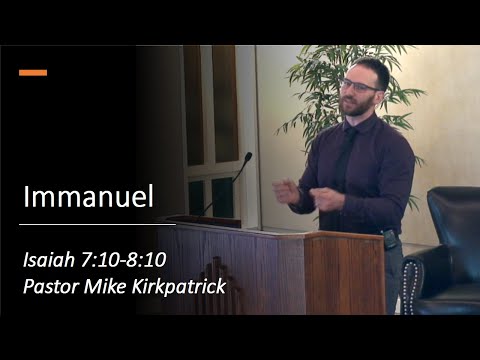
Immanuel
Isaiah 7:10–8:10 presents the Immanuel prophecy not as a comfortable seasonal text but as a word of judgment against Ahaz's faithless trust in Assyria and a word of hope for the covenant remnant. The sermon traces two contrasting realities: 'Assyria with us,' the consequence of royal unbelief, and 'God with us,' the promise that anchors the remnant through exile and desolation. The Immanuel sign finds its definitive fulfillment in Matthew 1, where the virgin-born Son saves his people from sin rather than merely political oppression — a truth that remains the ground of steadfastness for the church in every era of suffering and exile.

Waging the Good War
First Timothy 1:18–20 charges Timothy to wage the good warfare of the Christian faith, grounded in faith and a good conscience. This exposition identifies two weapons of the faithful minister—trust in the living God and a conscience calibrated by sound doctrine—set against the backdrop of false teachers who have shipwrecked the faith by rejecting the gospel of free and sovereign grace. The sermon then turns to the solemn consequence of neglecting that warfare, tracing the excommunication of Hymenaeus and Alexander as a case study in church discipline executed for the purity of the church and the potential restoration of the offender. Hearers are pressed to examine whether they possess genuine discernment regarding the gospel and genuine sensitivity toward sin, waging the warfare not to earn salvation but in response to the grace already secured in Christ.

The Prediction of Desertion and Denial
Matthew 26:31–35 records Jesus predicting both the desertion of all His disciples and the specific denial of Peter on the night of His arrest. The passage demonstrates that the salvation accomplished at the cross was entirely the work of Christ alone — His friends fled, leaving no horizontal assistance — and that Scripture, citing Zechariah 13:7, had appointed this scattering from eternity. The sermon draws out the persistent problem of remaining corruption in the regenerate: the pride, self-confidence, and lofty self-assessment that Peter epitomizes are not unique to him but are symptomatic of all God's people. The remedy is not stronger resolution but a biblical self-assessment that drives the believer away from confidence in the flesh and toward continual dependence on the grace and Spirit of God.

The Third Missionary Journey, Part 1
Acts 19:1–10 opens Paul's extended ministry in Ephesus on the third missionary journey. The sermon works through three exegetical questions: the identity of the disciples Paul encounters (argued to be genuine Christian believers, not pre-Christian inquirers), the relationship between John's baptism and Christian baptism (argued to be one and the same ordinance), and the significance of the Spirit's coming with tongues and prophecy (argued to be a salvation-historical confirmation of Pentecost's fulfillment, not a normative pattern for all believers). The exposition concludes by drawing out Paul's ministry at the school of Tyrannus as a model of bold, reasoned, expositional gospel preaching that God uses to spread the word across an entire province.

The Ministry of Apollos
Acts 18:24–28 introduces Apollos of Alexandria as a case study in what faithful gospel ministry requires. Six marks characterize this man — eloquence grounded in scriptural mastery, accurate instruction in the way of the Lord, fervency of spirit governed by knowledge, precise teaching, bold proclamation, and humble openness to correction — and these same marks should shape the church's prayers for and training of men for public ministry. Luke's phrase 'believed through grace' discloses the ordo salutis: saving faith is itself the gift of God's sovereign grace to dead sinners. The sermon closes by pressing both the need for trained, bold preachers and the equally urgent need for obedient hearers, applying the gospel of justification by faith alone to any who have not yet come to Christ.