
Topic
Soteriology
2,239 sermons · All topics

Aug 15

Ruth 4 culminates the book's central theme of redemption, showing how Boaz's costly love for Ruth and Naomi foreshadows the costlier love of Christ for his unlovely people. The kinsman-redeemer who willingly takes on an obligation he was not bound to fulfill — redeeming land, line, and a Moabite widow — points forward through the Davidic genealogy to the King who identifies with sinners and purchases his bride at the price of his own blood. God's sovereign providence moves through unsavory sinners and hopeless circumstances to build the royal line, a pattern that should silence despair among God's people in every age. The sermon calls believers to find their only settled hope in Christ the King, and invites the unbeliever to look to that same King and live.
The Departure of Paul

Paul's farewell words in 2 Timothy 4:6–8 — poured out as a drink offering, having fought the good fight, finished the race, and kept the faith — are examined as a model of faithful perseverance unto death. The sermon argues that the confidence Paul expresses at the 11th hour of his life was inseparable from the faithfulness he exercised throughout every preceding hour, and that the crown of righteousness he anticipates is entirely a gift of God's grace, not a payment for services rendered. Believers are called to examine whether they are now fighting, running, and keeping the faith so that they may, by grace, make the same confession at the end of their days; and unbelievers are warned to consider the infinite worth of Christ, the certainty of judgment, and the righteousness the righteous Judge freely offers in the gospel.

The First Disciples of Jesus
John 1:35–51 records the calling of the first disciples of Jesus — Andrew, Simon Peter, Philip, and Nathanael — and the passage frames their coming to Christ as the inevitable fruit of John the Baptist's preparatory ministry and the sovereign grace of God. The sermon traces how each disciple is drawn to Christ, how each immediately brings another, and how the accumulating titles given to Jesus in this section — Lamb of God, Rabbi, Messiah, Son of God, King of Israel, Son of Man — build a Christological portrait that mirrors the prologue's declaration that the Word was God. Christ's omniscience in knowing Nathanael and his royal authority in renaming Simon Peter underscore that these disciples are not choosing a teacher but being conquered by a divine Savior. The pattern of Andrew fetching Peter and Philip fetching Nathanael becomes the sermon's model for evangelism: those saved by sovereign grace become, without coercion or manipulation, propagators of that same grace.
1689 2LBC - Chapter 1 - Hermeneutical Principles
Hermeneutics — the science of biblical interpretation — stands at the center of this study through paragraphs 5 to 10 of Chapter 1 of the 1689 London Baptist Confession of Faith. The session works through five principles: the scope of Scripture (Christ as its organizing center), the sufficiency of Scripture (including good and necessary consequences), the perspicuity of Scripture, the availability of Scripture through faithful translation, and the two classical interpretive rules — the analogy of Scripture and the analogy of faith. The study closes by defending the proper use of creeds, confessions, and the writings of faithful theologians as gifts Christ has given to his church, while insisting that Holy Scripture alone is the supreme and final judge in all controversies of religion.

The Crucifixion of Jesus, Part 1
Matthew 27:32–38 records the crucifixion of the Lord Jesus Christ with studied brevity, and this expository sermon works through each verse to show that every detail — from the place called Golgotha to the division of garments and the charge above his head — is the deliberate fulfillment of Old Testament Scripture, not an accident or afterthought in the plan of God. The sermon traces the thread from the proto-gospel of Genesis 3:15 through the typological head-wounds of Israel's enemies to Christ's death blow against the devil at the place of the skull. Three concluding applications draw out the pastoral weight: the unwitting testimony of Pilate, the triumph of the skull-crushing seed of the woman, and the immeasurable love of the Savior who was stripped naked, numbered with transgressors, and crucified so that his people might be clothed with his righteousness, received in glory, and given everlasting life.

The Testimony of John the Baptist, Part 3
John 1:30–34 records the Baptist's testimony concerning the dignity of Christ's person — his preeminence as the eternal Word who was before John, his anointing with the Spirit without measure for the work of mediation, and his identity as the natural, essential, and eternal Son of God. The sermon traces the Old Testament prophetic background of the Spirit's descent (Isaiah 11, 42, and 61), the active and passive obedience of Christ as the ground of the believer's acceptance before God, and the Baptist's final declaration that this Jesus is the Son of God. From this foundation the preacher draws an urgent gospel application: the same Lamb who takes away sin will visit unbelief with wrath, and the only fitting response is faith in him now.

The Neglect of Weighty Matters
Jesus condemns the scribes and Pharisees in Matthew 23:23–24 not for tithing mint, anise, and cumin, but for doing so while neglecting the weightier matters of the law: justice, mercy, and faith. The Pharisaic imbalance is neither ancient nor extinct — the same tendency to obsess over religious minutiae while bypassing the moral and covenantal substance of God's law persists in the church today. Drawing on Micah 6:8, Hosea 6:6, and the broader prophetic tradition, this exposition argues that genuine obedience to God is universal and balanced, not selective and performative.

The Testimony of John the Baptist, Part 2
John 1:29 records the Baptist's singular declaration — 'Behold the Lamb of God who takes away the sin of the world' — a phrase saturated with the weight of Old Testament redemptive history. This sermon works through the theological freight of that title, tracing the Lamb through Genesis 22, Leviticus 16, and Isaiah 53 to show that Christ's mission is substitutionary blood atonement: he takes up the sin of his people in order to take it away entirely. The 'world' from which sin is removed is not every individual without exception but men and women without ethnic or national distinction, saved by grace alone through faith in Christ alone.

2nd London Baptist Confession of Faith (1689) - Sunday School Study - July 18, 2021
The self-authenticating authority of Scripture cannot be separated from sound principles for reading it. This 1689 London Baptist Confession of Faith Sunday school study works through chapter one, paragraphs five through ten, drawing out the hermeneutical principles the divines embedded there: the scope of Scripture (all glory to God through Christ), the sufficiency of Scripture (confined to God's glory, man's salvation, faith, and life), the perspicuity of Scripture (salvation truths are plain even to the unlearned), and the availability of Scripture in translation. The session also addresses textual criticism, the transmission history of the biblical manuscripts, and the distinction between necessary inference and explicit statement as sources of scriptural authority. Hearers are called to come to the biblical text with humility, the illumination of the Spirit, and a due use of ordinary means rather than intellectual pride or lazy avoidance.

Live Stream - July 18, 2021
John 1:19–28 records an official delegation from the Pharisees interrogating John the Baptist about his identity. He denies being the Christ, Elijah in bodily form, or the promised Prophet of Deuteronomy 18, and instead confesses himself to be the voice crying in the wilderness of Isaiah 40 — the forerunner sent to prepare the way of Yahweh, who is Jesus. The sermon draws from Zechariah's Lucan prophecy in Luke 1 to show that John's preparatory ministry announced not merely the arrival of a king but justification by faith alone through the remission of sins. The application presses the church to imitate John's humility, courageous preaching, and singular aim: to make Christ preeminent rather than themselves.

The Defense of the Faith
Jude 3 commands every believer — not merely pastors or theologians — to contend earnestly for the faith once for all delivered to the saints. This sermon examines the exhortation itself, the internal threat posed by sneaky, ungodly apostates who pervert grace and deny Christ, and the practical preparedness Jude prescribes: remembering apostolic warning, building up on the most holy faith through Scripture and prayer, and resting in the assurance that God himself preserves his people. The defense of the faith is not pessimistic trench-holding but confident advance grounded in Christ's promise to build his church against which the gates of Hades shall not prevail.

The Testimony of John the Baptist, Part 1
John 1:19–28 records the official interrogation of John the Baptist by a delegation sent from Jerusalem to establish his identity and authority. The Baptist's threefold denial — he is not the Christ, not Elijah bodily returned, not the prophet of Deuteronomy 18 — is matched by his positive confession as the voice of Isaiah 40, the forerunner who prepares the way of Yahweh and thereby implicitly confesses the deity of Jesus. The sermon traces the Baptist's testimony through Luke 1's prophecy of Zacharias, the Transfiguration account in Matthew 17, and the prologue of John 1, showing that the Baptist preached not only repentance but the remission of sins through the coming Messiah — that is, justification by faith alone. The governing application is that Christ's people exist to proclaim His preeminence, following the Baptist's model of humble, courageous, light-and-heat ministry that makes nothing of self and everything of Jesus.

Live Stream - July 11, 2021
John 1:18 presents two inseparable doctrines: the invisibility and incomprehensibility of God, and the revelation of that invisible God through the incarnate Word. The sermon works through the prologue of John's Gospel to show that while no creature has ever perceived the essential glory of God — not Abraham, not Moses, not Isaiah — the only begotten Son, who exists eternally in the bosom of the Father as a distinct yet consubstantial person of the Trinity, has exegeted the Father to us. The practical burden is that saving knowledge of God is not merely knowledge about the economy of redemption but knowledge of the Redeemer himself — Father, Son, and Holy Spirit — and that the chief end of man is to glorify and enjoy this triune God forever.

The Ministry of the Word
What is the basis and method of God's ordained means for saving sinners? This sermon on 2 Timothy 4:2 argues that the preaching of the Word stands as the primary instrument through which God saves the lost and builds his church, grounding that claim in the logical chain of Romans 10, the divine pleasure announced in 1 Corinthians 1, and the final apostolic charge of Paul to Timothy. The sermon challenges the contemporary drift toward audience-driven church strategies, calling both preachers and hearers to fidelity to the proclaimed Word as the irreplaceable means of grace.

Live Stream - July 04, 2021
Matthew 27:27–31 records the malicious mockery of Roman soldiers against the already-scourged and sleep-deprived Christ — a scene of savage psychological and physical abuse that simultaneously fulfills the prophetic servant songs of Isaiah and reveals the gravity of human sin and the inconceivable mercy of God. The sermon works through the participants in the crime (the governor, the cohort, and the conspiring Jewish leaders) and the specific elements of the mockery (mock homage, violent abuse, and the preparation for crucifixion), before turning to the irony that what soldiers performed in contempt — the royal robe, the crown, the scepter, the homage — is precisely what Revelation declares of Christ in truth. Believers are called to respond to Christ's vicarious sufferings not with detached admiration but with the crown-him-lord gratitude that the soldiers' counterfeit homage unwittingly foreshadowed, and the Lord's Supper is administered as the appointed means by which the congregation proclaims his death until he comes.

The Conversion of Cornelius
Acts 10:34–48 records the official inclusion of Gentiles in the covenant promises of God — a watershed moment in redemptive history. Peter's sermon before Cornelius and his household sets forth the peace, person, work, and prophetic witness of Jesus Christ, culminating in the declaration that through His name, whoever believes will receive remission of sins. The sovereign Holy Spirit falls upon the hearers before Peter has even finished speaking, confirming that salvation is of the Lord and that divine initiative — not human free will — drives the conversion of sinners. The passage concludes with the baptism of the entire household, a commanded public identification with the Triune God that pictures, but does not accomplish, the inward work already wrought by grace through faith.

The Soldiers Mock Jesus
The mockery of Jesus by the Roman soldiers in Matthew 27:27–31 is examined as a Lord's Supper meditation, tracing the psychological and physical brutality inflicted on the Son of God after Pilate's verdict. The scene is read through the lens of fulfilled prophecy — Isaiah 50:6 and Isaiah 53 — and the covenant of redemption, in which Christ willingly undertook every indignity as the surety and substitute for his people. The sermon closes by turning to the book of Revelation to show that what the soldiers performed in jest — robing, crowning, and hailing a king — Christ possesses in eternal reality, and calls believers to respond with the genuine homage these soldiers withheld.

The Hope of the Nations
Psalm 67 frames both the church's need for God's mercy and the church's missionary calling to the nations as inseparable realities. The psalmist's threefold petition — mercy, blessing, and communion with God for the church — is the ground from which prayer for the salvation, worship, and righteous governance of the nations flows. Drawing on the Aaronic blessing, the Abrahamic covenant, and the New Testament's Great Commission, the sermon argues that the church's received grace creates an inescapable obligation to proclaim that grace to the ends of the earth. The closing application calls the congregation to corporate prayer, support of the missionary enterprise, and fidelity to the gospel message as the only means God has ordained for the hope of the nations to be realized.

The Incarnation of the Word, Part 2
John 1:15–17 presents the preeminence of the incarnate Word and the fullness of grace and truth that flows from Him to needy sinners. The testimony of John the Baptist — that Christ ranks before him because He was before him — is an affirmation of Christ's co-eternity, distinctness, and consubstantiality with the Father, in accord with the Nicene Creed. Verse 17 is not a sharp antithesis between Moses and Jesus but a contrast in the mode of divine revelation: the law was mediated through Moses, while grace and truth came through the mediator Himself, who is the very embodiment of God's glory. The sermon calls hearers to stand in awe of the preeminent Redeemer, to find every spiritual need met in His inexhaustible fullness, and to close with Christ without delay.
Wednesday Night Bible Study (Exodus 11:1-10) - June 23, 2021
Exodus 11 presents the announcement of the tenth and decisive plague upon Egypt, the death of the firstborn, through which God simultaneously crushes Egyptian tyranny and liberates his covenant people Israel. The chapter is examined in three movements: the announcement of the plague with its accompanying promises of liberty and prosperity (vv. 1–3), the description of the plague emphasising God's immediate and sovereign action (vv. 4–8), and the rebellion of Pharaoh as the occasion for the multiplication of God's wonders (vv. 9–10). The sermon presses beyond the historical narrative to show how the destruction of God's enemies is inseparable from the blessing of God's people — a pattern running from Exodus through Joshua to Revelation — and grounds both divine sovereignty and human responsibility in the theological framework of the 1689 Second London Confession chapters 3 and 5.

2nd London Baptist Confession (Chapter 1) - June 20th
What makes Christian faith in the Bible something more than a blind leap? Working through the first five paragraphs of Chapter 1 of the 1689 London Baptist Confession of Faith, this exposition unpacks Sola Scriptura under three headings drawn from the Confession's opening line: the certainty, sufficiency, and infallibility of Holy Scripture as 'the only sufficient, certain, and infallible rule of all saving knowledge, faith, and obedience.' The sermon establishes that the Bible's authority rests on God himself as its author — not on church tradition, human reason, or self-referential claim — and that full persuasion of its divine origin comes through the inward testimony of the Holy Spirit (2LCF 1.5). Rational evidences — manuscript attestation, historical reliability, eyewitness testimony to the resurrection, and the fulfillment of prophecy — are presented not as the ground of faith but as means to bolster the believer's confidence and equip him to give a reasoned defense of the hope within him.

The Elements of Family Worship
Deuteronomy 6:6–7 commands parents to teach God's word diligently to their children in every season of daily life, and this sermon traces that mandate across both Testaments — from Abraham's household religion in Genesis 18, through the Psalms and Proverbs, to Paul's charge in Ephesians 6:4 and the example of Timothy's mother and grandmother. The preacher argues that family worship is a clear biblical obligation whose specific form is left to the conscience, and that failure to instruct children in the fear of God — illustrated negatively by Eli and Samuel's sons — leaves them unguarded against a culture actively hostile to Christ. Fathers and mothers are exhorted to commit first to public Lord's Day worship, to honour the sanctification of the Sabbath, and then to establish a family altar consisting of Scripture reading, prayer, and singing — scaled appropriately for their household — as the primary means of passing covenant knowledge to the next generation.

Psalm 24

Psalm 24 asks who may ascend into the hill of the Lord and stand in his holy place — a question that exposes the impossibility of any sinner approaching a holy God on the basis of personal merit. The psalm is expounded in three movements: the sovereign lordship of Yahweh the Creator over all the earth, the covenant conditions of holy hands and a pure heart that no creature can meet in himself, and the triumphal ascension of the King of Glory who alone meets those conditions and leads his redeemed captives into the presence of God. The righteousness required to enter God's presence is not achieved but received by faith, given freely by the God of salvation through the obedient life, atoning death, and victorious resurrection of the Lord Jesus Christ.
The Lord Jesus and the Demoniacs
Matthew 8:28–34 presents Christ's authority over demonic powers as a ground for confident trust in him as the Son of God. The demons' own confession — 'You Son of God' — exposes what the disciples have not yet grasped: that Jesus holds sovereign dominion over every spiritual power, including the devil himself. The exorcism at Gerasa is set within Matthew's sustained demonstration, across chapters 8–9, that the one who teaches with authority also acts with authority. If Christ has conquered death and the devil, every lesser affliction that threatens the people of God lies well within his sovereign reach.

The Incarnation of the Word, Part 1
John 1:14 — 'the Word became flesh and dwelt among us' — is the hinge on which all Christian theology turns. This exposition works through the identification, the incarnation proper, and the indwelling presence of the Word, establishing that the eternal Son assumed a true human nature (body and soul) without ceasing to be the second person of the Trinity — the doctrine the church confesses as the hypostatic union. The sermon draws on the active and passive obedience of Christ to show that the incarnation was not primarily exemplary but redemptive: the Word took flesh to render the perfect obedience sinners owe and to shed the blood that purchases their forgiveness. Hearers are pressed to see Christ not only as Redeemer but as reigning King, and the unbeliever is called to receive, by faith alone, that righteousness which comes from God.

The Call to Faithfulness in Perilous Times
Paul's warning in 2 Timothy 3:1–9 concerns not pagan opposition but a more dangerous internal threat: professing Christians within the local church who bear the outward form of godliness while denying its power. The sermon works through the passage in four movements — recognising the danger of 'the last days,' identifying the vice list under categories of pride, lovelessness, disobedience, slander, and treachery, heeding the exhortation to withdraw from such persons, and receiving encouragement that their folly will be publicly exposed. The congregation is called to maintain vigilant, doctrinally grounded churchmanship, to agonise over the church's internal corruptions as Ezekiel's faithful remnant did, and to resist both despair and naivety, trusting Christ's promise that the gates of Hades shall not prevail against his church.

The Trial Before Pilate, Part 3
Matthew 27:24–26 records the sentencing of Jesus by Pontius Pilate — the culmination of a trial in which the governor thrice declared the accused innocent yet delivered him to crucifixion anyway. The sermon examines Pilate's hypocritical self-absolution by the washing of hands, the crowd's willing acceptance of blood-guilt and its ominous extension to their children, and the formal scourging and condemnation of Christ. Throughout, the exposition presses the double benefit of the gospel: the forgiveness of sins and the imputation of Christ's righteousness received by faith alone, both grounded in the penal substitutionary atonement symbolised by Barabbas going free while the just one goes to the cross.
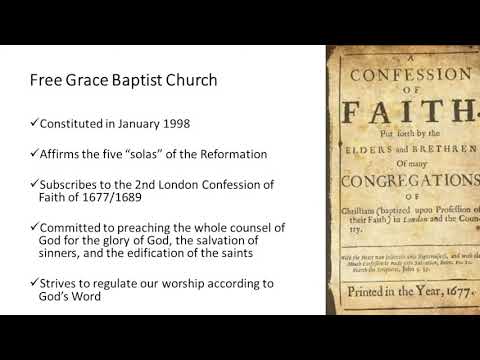
Introduction to the 2nd London Baptist Confession 1677/1689
Why should a church bind itself to a confession of faith? This introductory lesson on the Second London Baptist Confession of 1677/1689 grounds the answer exegetically in Ephesians 4 — where Christ gives gifted men to the church so that the body attains doctrinal unity and is no longer tossed about by every wind of teaching — and then traces the historical origins of the 1689 among the Particular Baptists, distinguishing them from Anabaptists, Presbyterians, and Congregationalists. Four functions of a confession are developed: defining, defending, discriminating, and disciplining with reference to the doctrine of the church. The lesson closes by distinguishing Reformed theology (Calvinism plus covenant theology plus the regulative principle) from mere five-point Calvinism, and by defending the confession's silence on matters of Christian liberty as a feature, not a defect.

Introduction to the book of Exodus
The book of Exodus, whose Hebrew title derives from its opening words ('these are the names'), sets forth the foundational redemptive act of the Old Testament — God's deliverance of Israel from Egyptian bondage in fulfillment of the Abrahamic covenant promise of Genesis 15. This session surveys the book's structure, authorship, and theological themes, including the threefold division of the law (moral, judicial, and ceremonial), the typological relationship between Moses and Christ, and the Baptist confessional distinction that identifies the Mosaic covenant as a covenant of works rather than an administration of the covenant of grace. The study closes by tracing how Exodus functions as a foundational template for redemptive history across both Testaments, climaxing in the antitypical work of the Lord Jesus Christ as the true Passover lamb and covenant mediator.

The Royal Wedding
Psalm 45 presents a royal wedding between the divine-human Messiah and his church, and the sons of Korah compose it as a song of love that the New Testament apostles and the entirety of the Old Testament prophetic witness sustain. The sermon works through the psalm's four sections — the psalmist's intention, the perfections and person of King Messiah, the instruction to the bride, and the closing declaration — demonstrating that a divine Messiah was not a novelty invented by John or Paul but was anticipated in the Hebrew Scriptures. Christ is celebrated as fairer than the sons of men, committed to truth and righteousness, triumphant over his enemies, fully God and fully man in the hypostatic union, and the one who clothes his bride in imputed righteousness received through faith alone. The appropriate response of the church is repentance, exclusive allegiance, worship, and gladness before her great King.