
Topic
Church Government
16 sermons · All topics

The Qualifications for Elders, Part 1

What qualifies a man to lead Christ's church as an elder, and how is a genuine call to ministry recognized? Expounding 1 Timothy 3:1, this sermon works through four elements of a man's call to eldership drawn from Albert N. Martin's Pastoral Theology: the desire of the man, the graces of the man, the gifts of the man, and the opportunity for the man. The internal, subjective desire for ministry must be checked by external, objective criteria — the qualifications of verses 2–7 and the common suffrage of the local church as confessed in the Second London Baptist Confession, chapter 26. The sermon closes with exhortations to the congregation to pray for gospel laborers and to take the qualification process seriously, and with a call to unbelievers to trust the Christ whom these ambassadors proclaim.

The Introduction to First Timothy
What does it mean for a letter written to one man in one city to carry the authority of God himself? This introductory sermon on 1 Timothy 1:1–2 traces the post-prison ministry of the Apostle Paul, establishes the historical occasion of the letter, and unpacks the significance of Paul's self-description as 'an apostle of Jesus Christ by the commandment of God our Savior.' The greeting's three blessings — grace, mercy, and peace — are shown to be not mere formalities but the divinely appointed means by which Timothy could wage war against the false teaching overtaking Ephesus. The sermon closes with an appeal to sinners: the entire infrastructure of apostolic authority, qualified elders, and sound doctrine exists so that God might effectually call the lost through the foolishness of preaching.

2LCF Chapter 26 – Of the Church

What is the church, who belongs to it, and how is it governed? Working through 2LCF Chapter 26, this session surveys the doctrine of the church from its universal and invisible reality in Christ to its visible, local expression — arguing that the church is constituted exclusively of regenerate believers, is headed solely by the Lord Jesus Christ, and is rightly governed by elders and deacons within an independently organized yet associationally connected congregation. The session highlights the sharp departure from the Westminster Confession's inclusion of covenant children in the visible church, grounding the Baptist position in a proper doctrine of covenant theology, baptism, and regenerate church membership.
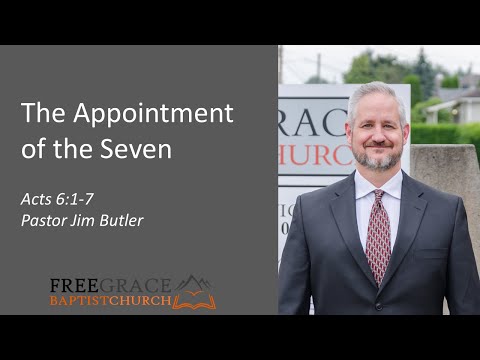
The Appointment of the Seven
Acts 6:1–7 records the Jerusalem church's response to a logistical crisis that threatened to pull the apostles away from prayer and the ministry of the Word. The passage establishes the diaconate in seed form: men of good reputation, full of the Holy Spirit and wisdom, appointed to serve the practical needs of the congregation so that those charged with preaching and teaching may be undistracted. Expounding 1 Timothy 3:8–13 alongside the Acts text, this sermon examines the qualifications, function, and appointment of deacons, and the connection between a biblically ordered church — with both elders and deacons — and the advance of the gospel.

The Qualifications of Elders, Part 2
What does Scripture require of those who lead and teach the church? Expounding 1 Timothy 3:1–7, this sermon works through the apostle Paul's qualifications for the elder-bishop-pastor office, arguing that these standards are not perfectionist ideals but demonstrated graces and virtues that the church must require of any man considered for gospel ministry. The qualifications are examined under four heads: the man's desire and its right motives, his personal conduct, his domestic faithfulness, and his testimony among outsiders, with particular attention given to the distinction between blamelessness and sinlessness, the meaning of 'husband of one wife,' and the danger of a Gnostic misreading of the prohibition on wine. The sermon closes with a call to churches to pursue both the edification of the saints and the evangelistic mission that God ordained through the office of pastor-teacher.

The Qualifications for Elders
What qualifications does Scripture require of a man before he may serve as an elder in a local church? Expounding 1 Timothy 3:1–7, this sermon establishes that the elder, overseer, and pastor are three terms for one office, and that the qualifications Paul lists are not recommendations but binding mandates. The sermon works through the first qualification — a genuine, rightly-motivated desire for the office — and frames it within four criteria for evaluating a call to ministry: right motives, graces indicating genuine Christian experience, gifts indicating divine provision (especially aptness to teach), and providential opportunity. The congregation is exhorted to apply these standards carefully and not to install any man, however virtuous or personable, who lacks the God-given ability to preach and teach the word.

The Appointment of Elders
Titus 1:5–9 gives the apostolic mandate for appointing elders in every city, a task Paul left Titus to complete on the young and unstructured island churches of Crete. The sermon works through two main divisions: the purpose of Titus's ministry as setting things in order (v. 5), and the qualifications for elders in terms of domestic faithfulness, personal faithfulness, and the gift of sound teaching (vv. 6–9). Elders are not essential to the existence of a church but are essential to its well-being, and their appointment must involve the common suffrage of the congregation under the direction of existing leadership. The sermon closes with a call to pray for a plurality of qualified elders, to enforce the qualifications without compromise, and to trust in a willing Savior who gathers a great multitude from every nation.

The Qualifications for Elders, Part 2
What does Scripture require of a man before a church installs him as an elder? Expounding 1 Timothy 3:1–7 alongside Titus 1:5–9, this sermon completes a two-part treatment of the biblical qualifications for elders, focusing on the elder's maturity in the faith, his good testimony before outsiders, and his indispensable ability to teach. The danger of rushing a novice into office is pressed from multiple angles — pride, the church's welfare, and the man's own protection — before the sermon closes with practical exhortations to the congregation on praying for, identifying, examining, and where necessary excluding candidates for eldership.
The Qualifications for Elders (Part 1)
What qualifies a man to serve as an elder in the church of Jesus Christ? Expounding 1 Timothy 3:1–7 as an excursus from a series through Acts, this sermon establishes that the New Testament uses 'elder,' 'overseer,' and 'pastor' as synonymous titles for one office, and then works through five of the six qualifications Paul sets out for that office: the man's desire, his personal holiness, and his domestic faithfulness. The sermon is equally concerned with what these qualifications are not — they are not a standard of sinless perfection, nor a popularity contest, nor a direct transfer of worldly competence — and applies the passage by urging the church to vet candidates by Scripture alone, not by affection or likability.
The Appointment of the Seven
Acts 6:1–7 presents the early Jerusalem church navigating a threat not of persecution or corruption but of distraction — the risk of the apostles being pulled from prayer and the ministry of the Word to adjudicate a dispute over the daily distribution to widows. The passage reveals two offices in the church, each with distinct responsibilities: those called to preach and pray, and those appointed to serve. The sermon traces the problem, the apostles' proposal of qualified men to oversee the practical need, and the resulting provision — a gospel that spreads and even inveterate priestly enemies who are overcome by efficacious grace.

Free Grace Baptist Church - January 6, 2019 AM
Acts 6:1–7 confronts the Jerusalem church's first internal crisis: the Hellenistic widows were being overlooked in the daily distribution, threatening to pull the apostles away from prayer and the Ministry of the Word. The sermon expounds the apostles' response as a model of church government — the division of labor between those called to preach and those appointed to serve — demonstrating that the two offices of elder and deacon are the Spirit's provision for a church that will inevitably face persecution, corruption, and distraction. The passage closes with a progress report showing that when the Word is freed to go forth, disciples multiply and even inveterate enemies of the gospel are brought to saving faith by efficacious grace. The central application is a call to pray for biblically qualified, praying and preaching men in every congregation.

The Qualifications for Elders
What qualities must a man possess before a church installs him as an elder? Expounding 1 Timothy 3:1–7, this sermon works through six categories of qualification: the man's desire for the office, his personal holiness, his domestic faithfulness, his spiritual maturity, his testimony among outsiders, and his aptness to teach. The three New Testament terms — elder, overseer, and pastor — are shown to be synonymous, describing one office whose governing instrument is the preached Word. The congregation is pressed to apply these qualifications rigorously, to test aspiring men through faithful churchmanship, and to resist the twin errors of setting the bar so low that unfit men enter and so high that no man can qualify.

The Instruction on Marriage
Titus 1:1–9 provides Paul's instructions to Titus for establishing gospel order on the island of Crete, centering on the appointment of qualified elders. The sermon works through the twofold purpose of Titus's ministry — setting things in order and appointing elders in every city — before examining the elder's domestic faithfulness (blamelessness, sexual fidelity, faithful children) and personal faithfulness (five vices to avoid, six virtues to exemplify). The exposition closes with the elder's indispensable giftedness: holding fast sound doctrine so as to both exhort the people of God and silence those who contradict. The whole is applied to the congregation as a call to pray for qualified men, to know the qualifications, and to insist that the church install only those who demonstrably meet them.

The Duties Toward Elders: Honor
The church's duty to honor elders who rule well, as commanded in 1 Timothy 5:17–18, centers on financial remuneration — not merely esteem or respect. The sermon establishes that 'double honor' carries the same economic weight as 'honor' in 1 Timothy 5:3 (the support of widows), and that the laboring elder who works hard in the Word and doctrine has a legitimate claim on the church's material provision. Paul seals the command with a double appeal to Scripture — Deuteronomy 25:4 and Luke 10:7 — demonstrating canon-consciousness in the early church and the co-equal authority of Old and New Testament texts. The congregation is called to count itself blessed when God grants it men who preach faithfully, to honor them materially and with esteem, and to see their ministry as a divinely ordained means for the salvation of sinners.
The Qualifications for Deacons
What qualifies a man to serve as a deacon in the church of Christ? Expounding 1 Timothy 3:8–13 in the context of Acts 6 and Philippians 1:1, this sermon argues that the diaconate is a divinely instituted office of service whose holders must meet specific biblical qualifications — not merely be willing volunteers or practically skilled men. Five categories of qualification are examined in sequence: personal character, doctrinal conviction, proven faithfulness, domestic situation, and the promised standing and boldness that belong to those who serve well. The sermon closes with a call for every Christian, not only aspiring deacons, to pursue the virtues Paul sets forth here.
The Qualification for Elders
What does Scripture require of a man before he can lawfully serve as an elder in Christ's church? Working through 1 Timothy 3:1–7, this exposition first establishes five elements of a genuine call to the ministry — desire born of right motives, graces indicating genuine Christian experience, gifts indicating divine provision, providential opportunity, and recognition by the local church — before moving through the text's qualifications under five headings: personal holiness, domestic faithfulness, experience in the faith, testimony toward outsiders, and the one indispensable gift of being able to teach. Throughout, the point is pressed that these virtues are not merely a checklist for candidates but the standard of godliness every Christian man and woman ought to be pursuing.