
Topic
Bibliology
415 sermons · All topics

The Meeting with Nicodemus, Part 2

John 3:4–10 confronts every hearer with the absolute necessity of regeneration before any entrance into the kingdom of God. Working through Nicodemus's proud misunderstanding and Christ's patient explanation, this exposition argues that the new birth is entirely God's sovereign work — initiated by the Holy Spirit, prefigured in Ezekiel 36 and Deuteronomy 30, and entirely prior to saving faith. The sermon also draws out the Trinitarian theology embedded in Christ's wind analogy, showing that the Spirit's sovereign, effectual work in regeneration reveals who God is, not merely what He does.

The Testimony of John the Baptist, Part 3
John 1:30–34 records the Baptist's testimony concerning the dignity of Christ's person — his preeminence as the eternal Word who was before John, his anointing with the Spirit without measure for the work of mediation, and his identity as the natural, essential, and eternal Son of God. The sermon traces the Old Testament prophetic background of the Spirit's descent (Isaiah 11, 42, and 61), the active and passive obedience of Christ as the ground of the believer's acceptance before God, and the Baptist's final declaration that this Jesus is the Son of God. From this foundation the preacher draws an urgent gospel application: the same Lamb who takes away sin will visit unbelief with wrath, and the only fitting response is faith in him now.
1689 2LBC - Chapter 1 - Hermeneutical Principles
Hermeneutics — the science of biblical interpretation — stands at the center of this study through paragraphs 5 to 10 of Chapter 1 of the 1689 London Baptist Confession of Faith. The session works through five principles: the scope of Scripture (Christ as its organizing center), the sufficiency of Scripture (including good and necessary consequences), the perspicuity of Scripture, the availability of Scripture through faithful translation, and the two classical interpretive rules — the analogy of Scripture and the analogy of faith. The study closes by defending the proper use of creeds, confessions, and the writings of faithful theologians as gifts Christ has given to his church, while insisting that Holy Scripture alone is the supreme and final judge in all controversies of religion.

2nd London Baptist Confession of Faith (1689) - Sunday School Study - July 18, 2021
The self-authenticating authority of Scripture cannot be separated from sound principles for reading it. This 1689 London Baptist Confession of Faith Sunday school study works through chapter one, paragraphs five through ten, drawing out the hermeneutical principles the divines embedded there: the scope of Scripture (all glory to God through Christ), the sufficiency of Scripture (confined to God's glory, man's salvation, faith, and life), the perspicuity of Scripture (salvation truths are plain even to the unlearned), and the availability of Scripture in translation. The session also addresses textual criticism, the transmission history of the biblical manuscripts, and the distinction between necessary inference and explicit statement as sources of scriptural authority. Hearers are called to come to the biblical text with humility, the illumination of the Spirit, and a due use of ordinary means rather than intellectual pride or lazy avoidance.

The Defense of the Faith
Jude 3 commands every believer — not merely pastors or theologians — to contend earnestly for the faith once for all delivered to the saints. This sermon examines the exhortation itself, the internal threat posed by sneaky, ungodly apostates who pervert grace and deny Christ, and the practical preparedness Jude prescribes: remembering apostolic warning, building up on the most holy faith through Scripture and prayer, and resting in the assurance that God himself preserves his people. The defense of the faith is not pessimistic trench-holding but confident advance grounded in Christ's promise to build his church against which the gates of Hades shall not prevail.

Live Stream - July 11, 2021
John 1:18 presents two inseparable doctrines: the invisibility and incomprehensibility of God, and the revelation of that invisible God through the incarnate Word. The sermon works through the prologue of John's Gospel to show that while no creature has ever perceived the essential glory of God — not Abraham, not Moses, not Isaiah — the only begotten Son, who exists eternally in the bosom of the Father as a distinct yet consubstantial person of the Trinity, has exegeted the Father to us. The practical burden is that saving knowledge of God is not merely knowledge about the economy of redemption but knowledge of the Redeemer himself — Father, Son, and Holy Spirit — and that the chief end of man is to glorify and enjoy this triune God forever.

The Ministry of the Word
What is the basis and method of God's ordained means for saving sinners? This sermon on 2 Timothy 4:2 argues that the preaching of the Word stands as the primary instrument through which God saves the lost and builds his church, grounding that claim in the logical chain of Romans 10, the divine pleasure announced in 1 Corinthians 1, and the final apostolic charge of Paul to Timothy. The sermon challenges the contemporary drift toward audience-driven church strategies, calling both preachers and hearers to fidelity to the proclaimed Word as the irreplaceable means of grace.

The Incarnation of the Word, Part 2
John 1:15–17 presents the preeminence of the incarnate Word and the fullness of grace and truth that flows from Him to needy sinners. The testimony of John the Baptist — that Christ ranks before him because He was before him — is an affirmation of Christ's co-eternity, distinctness, and consubstantiality with the Father, in accord with the Nicene Creed. Verse 17 is not a sharp antithesis between Moses and Jesus but a contrast in the mode of divine revelation: the law was mediated through Moses, while grace and truth came through the mediator Himself, who is the very embodiment of God's glory. The sermon calls hearers to stand in awe of the preeminent Redeemer, to find every spiritual need met in His inexhaustible fullness, and to close with Christ without delay.

2nd London Baptist Confession (Chapter 1) - June 20th
What makes Christian faith in the Bible something more than a blind leap? Working through the first five paragraphs of Chapter 1 of the 1689 London Baptist Confession of Faith, this exposition unpacks Sola Scriptura under three headings drawn from the Confession's opening line: the certainty, sufficiency, and infallibility of Holy Scripture as 'the only sufficient, certain, and infallible rule of all saving knowledge, faith, and obedience.' The sermon establishes that the Bible's authority rests on God himself as its author — not on church tradition, human reason, or self-referential claim — and that full persuasion of its divine origin comes through the inward testimony of the Holy Spirit (2LCF 1.5). Rational evidences — manuscript attestation, historical reliability, eyewitness testimony to the resurrection, and the fulfillment of prophecy — are presented not as the ground of faith but as means to bolster the believer's confidence and equip him to give a reasoned defense of the hope within him.
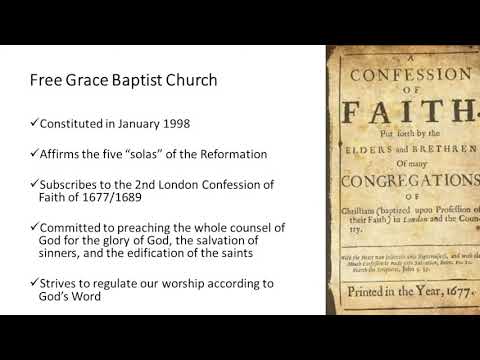
Introduction to the 2nd London Baptist Confession 1677/1689
Why should a church bind itself to a confession of faith? This introductory lesson on the Second London Baptist Confession of 1677/1689 grounds the answer exegetically in Ephesians 4 — where Christ gives gifted men to the church so that the body attains doctrinal unity and is no longer tossed about by every wind of teaching — and then traces the historical origins of the 1689 among the Particular Baptists, distinguishing them from Anabaptists, Presbyterians, and Congregationalists. Four functions of a confession are developed: defining, defending, discriminating, and disciplining with reference to the doctrine of the church. The lesson closes by distinguishing Reformed theology (Calvinism plus covenant theology plus the regulative principle) from mere five-point Calvinism, and by defending the confession's silence on matters of Christian liberty as a feature, not a defect.

The Mission of the Word, Part 2
John 1:10–13 presents two contrasting responses to the mission of the incarnate Word: the rejection of the world and of Israel, and the reception of those upon whom Christ confers the right to become children of God. The sermon works through the threefold use of 'world' in verse 10, the parallel between Israel's ancient rebellion and their rejection of the Messiah, and the sovereign grace underlying faith and new birth in verses 12–13. Central to the exposition is the Reformed insistence that regeneration precedes faith — those who receive Christ by believing do so because they have first been born of God — against both Pelagian and Arminian construals of conversion.

The Divinity of the Word, Part 2
John 1:3–5 teaches that the eternal Word is the creator of all things, establishing Christ unmistakably on the divine side of the creator-creature distinction. The sermon works through the Trinitarian doctrines of inseparable operations and appropriations, showing from Genesis 1, Psalm 33, Job 26, Colossians 1, and Hebrews 1 that creation is the undivided act of the one God, yet scripture distinctively attributes it to the Son. Because Jesus is creator, sustainer, and enthroned Lord, his people need not be paralyzed by circumstance — and the darkness, however violently it resists the light, cannot overcome it.

The Divinity of the Word
John 1:1–5 opens not in a Bethlehem stable but in eternity, establishing the Word's co-eternality, personal distinction from the Father, and full consubstantiality with the Father before a single creature existed. This sermon works through the first clause of John's prologue under five sub-points drawn from verse 1: the eternity, distinctiveness, and consubstantiality of the Word with the Father, the repetition of that glory in verse 2, and (deferred to the following week) the Word as creator of all things. The doctrine of the Trinity — one in essence, three in subsistence — is shown to be not an academic luxury but the very foundation of all communion with God and the indispensable framework for understanding why the incarnation is the supreme act of grace.

The Christian Sabbath, Part 3
Three passages in the New Testament — Romans 14, Galatians 4, and Colossians 2 — are commonly marshalled against the abiding validity of the Fourth Commandment, but careful exegesis reveals that none of them address the weekly Lord's Day Sabbath. Romans 14 concerns Christian liberty over matters indifferent, principally Jewish dietary laws and Israel's feast calendar; Galatians 4 rebukes the Judaizers' demand that calendar observance supplement faith in Christ for justification; and Colossians 2 warns against a syncretistic heresy that mingled Christ, Judaism, and angel worship. In each case Paul is dealing with Israel's ceremonial calendar, not the moral Sabbath commandment rooted in creation and redemption, which remains binding on the new covenant people of God and is observed on the first day of the week in light of Christ's resurrection.

The Empty Tomb and the Risen Lord
Matthew 28:1–10 narrates not the resurrection itself but the discovery of the empty tomb and Christ's first post-resurrection appearance — and the distinction matters theologically. This sermon works through the arrival of the women, the descent of the angel, the angelic announcement, and Christ's own greeting, demonstrating that the resurrection is attested historical fact whose denial collapses justification, undermines the prophetic witness, and renders the Christian hope pitiable. The risen Christ's address to the women — calling the disciples 'my brethren' despite their desertion — is shown to be a concentrated display of the grace and advocacy that sustains every believer who has sinned against the Lord he professes to love.

The Second Commandment
The Second Commandment (Deuteronomy 5:8–10) does not merely forbid the worship of false gods — it forbids the worship of the true God in a false manner, a distinction that carries enormous weight for how the church orders its worship today. The sermon works through the commandment's prohibition against idols and images (including pictorial representations of Christ), the theological rationale grounded in God's jealousy and immutability, the transgenerational consequences of false worship understood not as a hereditary curse but as the imitation of godlessness, and the promise of mercy to those who love and obey God. The positive application is the Regulative Principle of Worship: only what God has commanded is acceptable, and anything beyond or contrary to that command — however sincere the motive — constitutes the offering of strange fire to Yahweh.

The Utility of Confessions and Introduction to the Second London Baptist Confession
Confessions of faith are not competitors to Scripture but are faithful summaries of biblical doctrine, and the church has historically depended on them for good reason. This address introduces the Second London Baptist Confession of 1689, tracing its historical origins among the Particular Baptists of the 17th century and its relationship to the Westminster Confession and the Savoy Declaration. Five interlocking uses of a confession are then examined: defining church doctrine, defending it against error, discriminating between members and officers on doctrinal grounds, disciplining departures from orthodoxy, and distinguishing confessed doctrine from matters of Christian liberty. The goal is not confessional enslavement but confessional clarity — guardrails that protect the church and free her members to worship and grow in the grace and knowledge of Christ.
Exodus 3
Exodus 3 records the theophany at the burning bush, God's commission of Moses, the revelation of the divine name 'I AM WHO I AM,' and the detailed instructions for the approach to Pharaoh. This study examines how God's self-disclosure as Yahweh — the eternally self-existent one — grounds Moses's authority and the certainty of Israel's deliverance from Egypt. The divine name is not merely biographical information but a theological foundation: God's faithfulness to the covenant of Abraham, Isaac, and Jacob is the warrant for every promise he makes to his people.

Sunday School - Sept 6 - Self-Defense, Part 1/2
What does Scripture teach about the right of individuals to use lethal force in self-defense? Working through Exodus 22:2–3, a range of Old Testament illustrations, and the teaching of Jesus in the Gospels, this study argues that defensive homicide is not murder and is consistent with the whole counsel of God's law. The session also draws on Francis Turretin's four conditions for lawful self-defense and the Westminster Larger Catechism's treatment of the sixth commandment, situating the biblical case within the broader Reformed and historic Christian tradition. The study closes by distinguishing private revenge — which Scripture forbids — from necessary defense of life, family, and property, which Scripture assumes and authorizes.

The Believer's Response to Trials
James 1:2–8 commands believers to count trials 'all joy' — a disposition that runs counter to every natural instinct. This exposition works through the passage in two movements: the believer's response to trials (vv. 2–4), which establishes the identification, expectation, disposition, and divine purpose of affliction; and the believer's request during trials (vv. 5–8), which calls for the pursuit of wisdom and the exercise of faith. The central burden is that God's redemptive purpose in suffering — conformity to the image of Christ — supplies both the ground for joy and the reason to seek wisdom rather than mere deliverance.

The Ministry of Apollos
Acts 18:24–28 introduces Apollos of Alexandria as a case study in what faithful gospel ministry requires. Six marks characterize this man — eloquence grounded in scriptural mastery, accurate instruction in the way of the Lord, fervency of spirit governed by knowledge, precise teaching, bold proclamation, and humble openness to correction — and these same marks should shape the church's prayers for and training of men for public ministry. Luke's phrase 'believed through grace' discloses the ordo salutis: saving faith is itself the gift of God's sovereign grace to dead sinners. The sermon closes by pressing both the need for trained, bold preachers and the equally urgent need for obedient hearers, applying the gospel of justification by faith alone to any who have not yet come to Christ.

Exodus 1
Exodus 1 traces the rapid shift from Israel's prosperity under Joseph to their brutal subjugation under a new Pharaoh who knew nothing of the covenant arrangement his predecessors had honored. The chapter moves in two broad movements: the origin of the oppression in the multiplication of Israel, which paradoxically fulfilled God's Abrahamic promise of seed and land, and the gravity of that oppression as Pharaoh escalated from forced labor to state-sponsored infanticide. The defiance of the Hebrew midwives Shiphrah and Puah, grounded in the fear of God rather than the fear of man, illustrates the Reformed conviction that civil obedience finds its limit where God's law begins. The sermon closes by drawing three contemporary applications: vigilance against the gradual escalation of tyranny, confidence in the sovereign providence of God who keeps his covenant promises even through suffering, and the call to Spirit-wrought courage that refuses to silently deny Christ.

The Rejection of Heretics
Titus 3:9–15 closes Paul's letter to Titus with a sharp command to avoid unprofitable disputes and to reject the divisive man — a command the broader pastoral epistles and the apostolic witness consistently reinforce. The sermon distinguishes heresy from damnable heresy, identifying denial of the Trinity, the hypostatic union, and justification by faith alone as the errors that condemn, while pressing the church not to confuse the struggling saint with the proud, self-serving false teacher. Church discipline for doctrinal error is treated with the same gravity as discipline for moral sin, and the concluding emphasis on good works is grounded in the confession that such works are the fruits and evidences of a true and lively faith, not the grounds of justification.

The Second Missionary Journey, Part 5
Acts 17:10–15 records the ministry and departure of Paul and Silas at Berea, where the Jewish hearers were commended as 'more noble-minded' than those in Thessalonica because they received the word with readiness and examined the Scriptures daily to verify Paul's proclamation of Jesus as the Christ. The sermon expounds three movements in the text — the perseverance of the missionaries, the tenacity of unbelieving opposition, and the noble-mindedness of the Bereans — and draws sustained application from Nehemiah 8 and the parable of the sower in Luke 8 on the right reception of God's word. The Berean example is pressed as a standing model for the church: Scripture is sufficient and self-evidencing, and the truth has nothing to hide and everything to gain by investigation. Hearers are exhorted to come to the word with expectancy, attentiveness, reverence, and responsiveness, since faith comes by hearing and hearing by the word of God.
The Introduction to the Book of Titus
Titus 1:1–4 contains one of Paul's longer epistolary introductions, and the reason is pastoral and strategic: Paul is authenticating the ministry of Titus among a difficult, newly-planted congregation on Crete by anchoring his own apostolic authority in the eternal decree of God. The sermon surveys the historical and biographical background of the pastoral epistles before working through Paul's self-designation as bondservant and apostle, his two-fold apostolic purpose (the salvation and sanctification of God's elect), and the grounding of that purpose in the covenant of redemption purposed before time began. The greeting's triad of grace, mercy, and peace — flowing from both God the Father and the Lord Jesus Christ, each called 'Savior' — opens a rich vein of covenant theology, Christology, and soteriology that will run through the entire book.

The Bible and Abortion
Abortion is not a political issue but a theological and ethical one — a violation of the Sixth Commandment against murder and a direct assault on the image of God borne by every human being from conception. This sermon works through Exodus 21:22–25 to demonstrate that the Mosaic case law governing accidental injury to a pregnant woman treats the pre-born child as a full person, applying the lex talionis — life for life — when the child is killed. Supporting passages from Genesis, Job, Psalms, Jeremiah, Luke, and Paul establish the biblical case for the personhood and sanctity of the pre-born. The sermon closes by calling the church to preach the whole counsel of God on this subject, to pursue sexual fidelity, to pray for the end of abortion, and to proclaim the gospel's mercy to all who have sinned in this way.

The Fourth Commandment, Part 3
Romans 14, Galatians 4, and Colossians 2 are frequently cited as evidence that no special day of worship remains for the people of God, but a careful exegesis of each passage shows they address Jewish ceremonial observances and food laws — not the moral, Decalogical Sabbath. The argument of Romans 14 concerns Christian liberty in matters of diet and ethnic calendar practices, not the abrogation of the Lord's Day; Galatians 4 condemns the Judaizing of salvation by attaching religious merit to ceremonial observances; and Colossians 2:16-17 targets the 'sabbaths' that functioned as shadows alongside new moons and festivals — a grouping the Old Testament itself consistently distinguishes from the weekly Sabbath. The Christian Sabbath, grounded in creation, codified at Sinai, prophesied for the new covenant era, and transposed by Christ's resurrection to the first day of the week, remains binding on the people of God — kept not as a means of justification but as a fruit of it.
The First Missionary Journey, Part 5
Paul's sermon in Pisidian Antioch moves from historical exposition to urgent exhortation: forgiveness of sins comes not through moral effort, law-keeping, or any human merit, but through this man, the Lord Jesus Christ, and is received by faith alone. Drawing on Psalms 25, 32, 51, 130, Isaiah 43 and 45, Micah 7, and the recurring apostolic pattern in Acts, the sermon traces how the forgiveness of sins is the central remedy for mankind's fundamental problem of transgression against a holy God. Faith itself is a divine gift, grounded in a God who delights in mercy, and the proper response to the gospel is to look to Christ alone — accepting, receiving, and resting upon Him for justification, sanctification, and eternal life.

The Fourth Commandment
The Fourth Commandment's call to observe the Sabbath is not a Mosaic innovation for Israel alone but a creation ordinance rooted in God's own rest and ratified across redemptive history. This sermon surveys Old Testament Sabbath theology — from Genesis 2 through the prophets Isaiah and Jeremiah — arguing that the Ten Commandments carry trans-covenantal moral force and that the Sabbath commandment retains binding validity for New Covenant Christians. Christ's defense of Sabbath in Mark 2 is shown to confirm rather than abolish the commandment, clearing away Pharisaic distortion while pointing back to the creational gift given for man as man, not Jew as Jew. Hearers are called to call the Sabbath a delight, to work diligently the six days, and to gather with the covenant community on the Lord's Day in holy worship.

The Second Commandment
The second commandment forbids both the manufacture of idols and the worship of the true God by means of visible representations — a distinction the first commandment does not address. Working through Deuteronomy 5:8–10, this sermon grounds the regulative principle of worship in the doctrine of God: because God is incorporeal, incomprehensible, and infinite, any attempt to represent Him in image or statue is a theological assault on His nature, not merely a liturgical irregularity. The sermon applies this principle to Roman Catholic image-veneration, depictions of the Lord Jesus Christ (including the 'Jesus film' and similar media), and the broader failure of evangelical worship to ask what God has actually commanded.