
Topic
Apologetics
374 sermons · All topics

The 6th Command, Part 2

The sixth commandment's prohibition against murder extends far beyond the physical act of killing to encompass the internal disposition of the heart — unwarranted anger, bitterness, and character assassination. Drawing from Exodus 20:13, Matthew 5:21-26, Leviticus 19:17-18, and the Westminster Larger Catechism, this study traces the biblical distinctions between murder and lawful homicide (capital punishment, just war, and self-defense), demonstrates that all human beings at every stage of life bear the image of God and therefore possess inviolable dignity, and applies the commandment's positive duty to preserve life. Hearers are called to deal faithfully with relational sin rather than harbor grudges, to resist the culture of abortion and euthanasia as violations of the image of God, and to understand the civil use, pedagogical use, and normative use of this commandment.

The Introduction to Ephesians
Ephesians 1:1–2 introduces one of the richest doctrinal letters in the New Testament canon, and this sermon surveys the authorship, historical context, and theological purpose of the epistle before examining Paul's greeting to the saints. The apostle's self-identification as one sent by Christ 'by the will of God' grounds his authority not in self-appointment but in sovereign divine commission, while his description of the recipients as 'saints' and 'faithful in Christ Jesus' defines sainthood in purely biblical terms — all who are justified by grace alone through faith alone in Christ alone. The sermon traces Paul's founding ministry in Ephesus through Acts 18–19, showing how the gospel's triumph over witchcraft, idolatry, and the cult of Diana provides the backdrop for the letter's emphasis on Christ's supremacy over all powers. The epistle is previewed as a two-part structure — doctrinal foundation (chapters 1–3) followed by practical application (chapters 4–6) — aimed at grounding believers in both the indicatives and imperatives of redemption.
Live Stream - March 13, 2022
John 5:41–47 presents Jesus in direct confrontation with the religious leaders of Israel, closing a sustained legal defense of his equality with the Father. This exposition works through two movements: the rejection of the Son by those who lack both love for God and love for the glory he alone can give, and the accusation that Moses himself stands against those who profess loyalty to his writings while refusing the one of whom he wrote. The sermon presses the theological reality that rejection of Christ is simultaneously a rejection of the Father who sent him, a rejection of the Scriptures that testify of him, and a manifestation of pride that seeks the honor of men over the honor of God. Hearers are called to receive Christ by faith, for it is only in believing on the Son that one has the Father and life everlasting.

The Denial of the Resurrection
Matthew 28:11–15 records the fabrication of the lie that Christ's disciples stole his body — the original counter-narrative to the resurrection. This sermon exposes the willful unbelief of the Jewish religious leaders, tracing their conspiracy as one episode in a sustained, devil-driven war against the truth of the gospel. The implausibility of the theft narrative is examined on apologetic grounds, and the sermon closes by contrasting the Counter Great Commission of bribe-funded deception with the Great Commission of Christ's abiding-presence-powered truth.

The Witnesses for the Defense
In John 5:31–40, Jesus faces charges of blasphemy and Sabbath-breaking and responds not by deflecting but by calling four corroborating witnesses to establish his consubstantiality with the Father: John the Baptist, his own works, the Father's testimony, and the Scriptures themselves. The sermon traces each witness in turn, showing that Christ's equality with God is not a later theological invention but the central claim of his own ministry, attested by every strand of divine revelation. The passage culminates in a sobering indictment: those who search the Scriptures seeking eternal life while refusing to come to Christ have missed the entire point of revelation, for Christ is the telos of all Scripture. Hearers are called to reckon with the gravity of sin and to come to Christ by grace through faith as the only ground of everlasting life.
Clip: The Hyper-Calvinism Lie
Peter's Pentecost sermon in Acts 2 simultaneously affirms God's comprehensive sovereignty over the crucifixion and demands personal repentance from those who crucified Christ. Hyper-Calvinism distorts both truths by collapsing human responsibility into divine decree, leaving sinners with no reason to repent. The sermon argues that Scripture holds divine sovereignty and human accountability together without theodicy or apology, and calls every hearer to repent and believe the gospel.

The Empty Tomb and the Risen Lord
The resurrection of Jesus Christ is the crowning proof that the Father accepted the Son's atoning work as a full satisfaction for sin. Expounding Matthew 28:1–10, this sermon works through the discovery of the empty tomb — the arrival of the women, the descent of the angel, and the commission given to the first witnesses — and then the appearance of the risen Lord to those same women. The resurrection is not myth or fable but attested history, with details such as the folded burial cloth, the terrified guards, and the forthright identification of women as the primary witnesses all serving the integrity of the gospel record. The empty tomb grounds the Christian's confidence in the forgiveness of sins and the imputed righteousness of Christ, and it calls every hearer to seek the risen Lord without fear.

If you aborted your baby, there is hope!
Abortion is a violation of the sixth commandment, but the blood of Christ cleanses from all sin — including this one. Preaching the law faithfully means following it immediately with the gospel, offering the forgiveness and rest Christ promises to every sinner who comes to him. The church's duty is not only to resist abortion politically and socially but to herald the sovereign grace of God to those broken by guilt and regret. There is hope in the person and work of the Lord Jesus Christ.
Clip: If you aborted your baby, there is hope!
The sixth commandment exposes abortion as a grievous violation of God's law, but the law's condemnation does not have the final word. This clip applies the gospel directly to those who have participated in abortion, grounding the offer of forgiveness in the atoning blood of Christ, the faithfulness of God to cleanse all unrighteousness, and the universal call of Christ to come to him. The church's responsibility is to preach both law and gospel together — the law that wounds and the gospel that heals.

The Depravity of Man
Romans 1:18–32 presents the universal human condition as one of willful suppression of God's self-disclosure in creation, resulting in inexcusability before a holy God. The sermon traces three movements in the passage: the revelation of divine wrath, the reason for that wrath in humanity's idolatrous exchange of the Creator for the creature, and the nature of God's judgment as a punitive giving-over of sinners to the very sins they pursued. The sermon argues that the preaching of the law — including the full weight of human depravity — is indispensable to the proclamation of the gospel, because sinners must understand their ruin before they will look to the remedy of blood atonement in Christ alone.

The Seventh Commandment
The seventh commandment, 'You shall not commit adultery' (Deuteronomy 5:18), governs not merely the act of adultery but the full range of sexual conduct God defines in Scripture. Preached against the backdrop of Canada's Bill C-4, this sermon grounds sexual ethics in the creation order of Genesis 2, expounds twelve prohibited acts — from adultery and fornication through homosexuality, transgenderism, and pornography — and confronts the state's attempt to criminalise biblical teaching on sexuality. The law is preached so that sinners will see their need for Christ, whose blood alone washes, sanctifies, and justifies those who come to Him in faith.

Clip: God isn't crippled, hindered, silent, or absent
The sovereignty of God over creation and providence is the proper ground of confident, bold prayer. Drawing on Acts 4 and Psalm 2, this excerpt shows how the apostolic church prayed not to a God diminished by circumstance but to the God who made and governs all things — including the threats of the Sanhedrin against the early church. The vantage point of God's absolute sovereignty is what makes petition coherent and emboldening rather than desperate.
The Burial of Jesus
The burial of Jesus in Matthew 27:57–66 is examined across two movements: the burial proper (vv. 57–61) and the security measures taken at the tomb (vv. 62–66). Against both the swoon theory and ancient Jewish counter-testimony that the disciples stole the body, the sermon marshals the apologetic force of the sealed, guarded, newly-hewn tomb to demonstrate that the resurrection overcame every human precaution. The burial also carries weight in four theological categories: it confirms the reality of Christ's death, marks the final act of his humiliation as the last Adam, demonstrates his conquest of death, and strips the grave of its paralyzing power for all who belong to him.

December 15, 2021 - Wednesday Night Bible Study - Exodus 20:7 & 3rd Commandment
The third commandment — 'You shall not take the name of the Lord your God in vain' — is examined through its prohibition, its rationale, and its positive demands. The names of God in Scripture are not arbitrary labels but revelatory vehicles disclosing his being, perfections, and covenant faithfulness; to misuse them is therefore to assault God himself. The sermon surveys specific violations — blasphemy, unlawful oaths, the manipulation of God's name for personal ends, misapplication of providence, and doctrinal heresy — before turning to the positive uses Scripture requires: reverent prayer, lawful oaths, proper worship, and a life of sincere profession that does not give occasion to the enemies of the Lord to blaspheme.

2LBC Chapter 5 - Divine Providence
The 1689 London Baptist Confession of Faith, Chapter 5, on Divine Providence, teaches that God upholds, directs, disposes, and governs all creatures and all their actions from the greatest to the least — not by blind fate or fortune, but according to his infinite power and wisdom, his infallible foreknowledge, and the free and immutable counsel of his will. The chapter unfolds in seven paragraphs, moving from the general definition of providence (paragraph 1) through its relation to second causes, ordinary means, miracles, the fall, remaining sin in believers, the hardening of unbelievers, and finally the special care God exercises over his church. God's sovereignty does not make him the author of sin nor does it remove human responsibility; first causality establishes rather than annuls second causality. The doctrine is a source of deep comfort: whatever befalls the elect is by God's appointment for his glory and their good.

Introduction to the Decalogue
Exodus 20:1–2, the preface to the Decalogue, reveals God as the sovereign Lawgiver who redeems before He commands — a pattern in which grace precedes obligation that runs from Sinai through the new covenant. The sermon examines three classical uses of the Ten Commandments (civil, pedagogical, and normative) and the threefold division of the law (moral, ceremonial, judicial), demonstrating that the moral law alone abides in its full binding force for all people and all ages. Believers are not justified by the law but are directed by it as the objective standard of sanctification, so that love for God and neighbor is never left undefined or sentimental.

The Church's Compassion for Sufferers
Hebrews 13:3 commands believers to remember imprisoned and mistreated Christians not merely as a cognitive acknowledgment but as an active, embodied solidarity — 'as if chained with them.' The sermon expounds the duty, the objects, and the reason for this command, tracing the antithesis between the seed of the woman and the seed of the serpent from Genesis 3:15 through the New Testament persecution accounts. Drawing on 1 Peter 4, Hebrews 11, and Acts 12, the preacher grounds the church's compassion for sufferers in the one-body reality of 1 Corinthians 12, calling believers to importunate intercession for the persecuted church worldwide and to trust that God gives sustaining grace in the moment of trial.

Exodus 18 - Jethro
Exodus 18 presents two interconnected events: the conversion of Jethro, priest of Midian, and his practical counsel to Moses on delegating judicial authority. The conversion of Jethro follows the pattern of one called out of polytheistic darkness into the knowledge of the true and living God — marked by joy, praise, confession of Yahweh's supremacy, and worship through sacrifice. The passage further grounds civil government in the fear of God and the rule of law, teaching that qualified civil rulers must be able, God-fearing, truthful, and free from covetousness — qualities that remain the standard for righteous governance in any age.

Exodus 17
Exodus 17 presents Israel's double failure at Rephidim: a murmuring complaint against Moses for lack of water, and then the subsequent victory over the Amalekites through Moses's upraised rod and Joshua's sword. The murmuring is exposed not merely as weakness but as theological insult — the question 'Is the Lord among us or not?' impugns the faithfulness of a God who has already split the sea, rained bread from heaven, and sworn to bring His people to the land of promise. The sermon draws out two counterbalancing lessons: the unrelenting faithfulness of God despite His people's unbelief, and the Reformed doctrine that divine sovereignty does not eliminate the use of means — Israel must both hold up the rod in dependence on God and swing the sword in disciplined obedience.

Sunday School - Chapter 2.3 - the Trinity
The doctrine of the Trinity is not a mathematical formula but a carefully defined confession of one divine being eternally subsisting as three distinct persons — Father, Son, and Holy Spirit. This session works through 1689 London Baptist Confession of Faith chapter 2, paragraph 3, examining the unity and equality of the persons, their distinction by eternal relations of origin, and the contemporary crisis caused by the abandonment of eternal generation. The denial of threeness is as heretical as the denial of oneness, and a recovery of Nicene Trinitarianism is essential not only for theological orthodoxy but for the health of the soul and the vitality of corporate worship.

LBC - Chapter 2 - Of God and the Trinity
What does Scripture reveal about God's relationship to his creation, and how does that shape the creature's obligation to the Creator? Working through paragraphs two and three of Chapter 2 of the 1689 London Baptist Confession of Faith, this study expounds three perfections of God in his external relations: his aseity (independence and self-sufficiency), his omniscience, and his holiness. From Acts 17, 1 Kings 8, Psalm 113, Psalm 115, Daniel 4, Ephesians 1, and Romans 9, the instructor demonstrates that God is the sole fountain of all being, exercises most sovereign dominion over all creatures, and is morally pure in all his counsels, works, and commands — and that these perfections ground the creature's comprehensive obligation of worship, service, and obedience to the Creator.

2nd London Baptist Confession of Faith (1689) - Sunday School Study - August 29, 2021
What does it mean that God is 'without body, parts, or passions'? This study works through Chapter 2, Paragraph 1 of the Second London Baptist Confession of 1689, examining the perfections of God under three classical categories: divine incorporeality (God has no body), divine simplicity (God is not composed of parts), and divine impassability (God does not undergo emotional change). By grounding each doctrine in Scripture and the church's historic theological grammar — including the distinction between proper and improper predication, accommodation, and anthropomorphism — the exposition argues that God's transcendence over every creaturely category is not a cold abstraction but the very foundation of confident worship and unshakeable assurance for his people.
1 Peter 1:3-5

The believer's hope of glory, grounded in 1 Peter 1:3–5, is not a vague aspiration but a certain inheritance secured by God's sovereign mercy and the resurrection of Christ. Peter's doxology unfolds the doctrine of salvation under three headings: God the Father as its author, the nature of that salvation as a living hope pointing to a new creation, and the certainty of preservation by divine power. Because both the inheritance and the heirs are kept — the one reserved in heaven, the other shielded by omnipotence through faith — believers facing trial are called to reorient every earthly sorrow toward the glory that is to come.

Live Stream - August 15, 2021

Drawing from 2 Timothy 1:8–12, this sermon confronts the church's tendency to romanticize suffering in the abstract while shrinking from it in practice. The gospel of Christ is inherently shameful by the world's measure — Christ died as a condemned man, bearing public disgrace — and those who hold to it will face ridicule, social pressure, and even imprisonment. The only ground for standing firm under such conditions is not personal resolve but the power of God, who purposed salvation in Christ before time began, abolished death through his appearing, and promises to preserve his gospel and his church until the last day.

The Defense of the Faith
Jude 3 commands every believer — not merely pastors or theologians — to contend earnestly for the faith once for all delivered to the saints. This sermon examines the exhortation itself, the internal threat posed by sneaky, ungodly apostates who pervert grace and deny Christ, and the practical preparedness Jude prescribes: remembering apostolic warning, building up on the most holy faith through Scripture and prayer, and resting in the assurance that God himself preserves his people. The defense of the faith is not pessimistic trench-holding but confident advance grounded in Christ's promise to build his church against which the gates of Hades shall not prevail.

2nd London Baptist Confession (Chapter 1) - June 20th
What makes Christian faith in the Bible something more than a blind leap? Working through the first five paragraphs of Chapter 1 of the 1689 London Baptist Confession of Faith, this exposition unpacks Sola Scriptura under three headings drawn from the Confession's opening line: the certainty, sufficiency, and infallibility of Holy Scripture as 'the only sufficient, certain, and infallible rule of all saving knowledge, faith, and obedience.' The sermon establishes that the Bible's authority rests on God himself as its author — not on church tradition, human reason, or self-referential claim — and that full persuasion of its divine origin comes through the inward testimony of the Holy Spirit (2LCF 1.5). Rational evidences — manuscript attestation, historical reliability, eyewitness testimony to the resurrection, and the fulfillment of prophecy — are presented not as the ground of faith but as means to bolster the believer's confidence and equip him to give a reasoned defense of the hope within him.
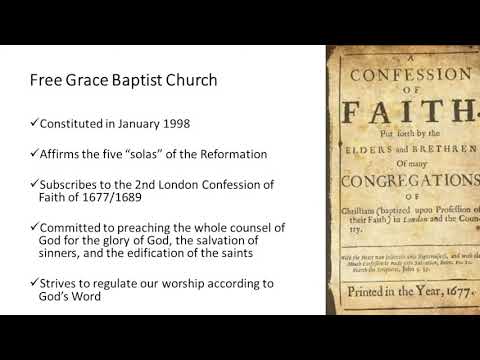
Introduction to the 2nd London Baptist Confession 1677/1689
Why should a church bind itself to a confession of faith? This introductory lesson on the Second London Baptist Confession of 1677/1689 grounds the answer exegetically in Ephesians 4 — where Christ gives gifted men to the church so that the body attains doctrinal unity and is no longer tossed about by every wind of teaching — and then traces the historical origins of the 1689 among the Particular Baptists, distinguishing them from Anabaptists, Presbyterians, and Congregationalists. Four functions of a confession are developed: defining, defending, discriminating, and disciplining with reference to the doctrine of the church. The lesson closes by distinguishing Reformed theology (Calvinism plus covenant theology plus the regulative principle) from mere five-point Calvinism, and by defending the confession's silence on matters of Christian liberty as a feature, not a defect.

The Call to Faithfulness in Perilous Times
Paul's warning in 2 Timothy 3:1–9 concerns not pagan opposition but a more dangerous internal threat: professing Christians within the local church who bear the outward form of godliness while denying its power. The sermon works through the passage in four movements — recognising the danger of 'the last days,' identifying the vice list under categories of pride, lovelessness, disobedience, slander, and treachery, heeding the exhortation to withdraw from such persons, and receiving encouragement that their folly will be publicly exposed. The congregation is called to maintain vigilant, doctrinally grounded churchmanship, to agonise over the church's internal corruptions as Ezekiel's faithful remnant did, and to resist both despair and naivety, trusting Christ's promise that the gates of Hades shall not prevail against his church.
The Mission of the Word, Part 1
John 1:6–9 introduces John the Baptist not as an independent figure but as a divinely commissioned witness whose entire ministry exists to point to the Word made flesh. This sermon examines the origin, nature, and function of that witness ministry, demonstrating that the Baptist's testimony belongs to a network of overlapping witnesses — Father, Son, Holy Spirit, Scripture, and signs — that ground saving faith in historical reality rather than a blind existential leap. The function of John's witness is inseparable from its purpose: that sinners would believe on Christ as the Lamb of God who takes away the sin of the world, not merely imitate him as a moral example. The sermon closes with a call to keep law and gospel in their proper places, so that sinners driven by the law's killing power may look by grace to the one who is both the true light and the only hope of the world.

The Trial before Pilate, Part 2
Matthew 27:15–23 records Pilate's attempt to grant amnesty to Jesus through the Passover prisoner-release custom, a device that exposes the cowardice of the Roman governor, the envious malice of the Jewish religious leaders, and the terrifying moral bankruptcy of mob rule. The passage is expounded under five heads — the custom of amnesty, the leaders' motivation of envy, the warning of Pilate's wife, the demand of the multitudes, and Pilate's cross-examination — each of which illuminates the comprehensive reach of human depravity. The substitution of Barabbas for Jesus is treated as emblematic of definite atonement: the just going to the cross in the place of the unjust, securing both the forgiveness of sins and the imputed righteousness of Christ received by faith alone. Hearers are urged not to be carried along by ungodly leaders, to flee to Christ without delay, and to eat the Lord's Supper as a memorial of the blood atonement and active obedience of the Second Person of the Trinity wrought entirely on behalf of his people.