
Speaker
Unknown
216 sermons · All speakers

Hyper-Calvinism's Root Error
Hyper-Calvinism and Arminianism are identified as mirror-image errors: Arminianism over-weights human agency, while Hyper-Calvinism rests on a false conception of God and his ways in the world. The root error of Hyper-Calvinism is traced to speculation about what God has not revealed, producing conclusions that contradict Scripture.

Ask FGBC Batch 8: Church Planting, Creation, Imprecatory Psalms & More | Reformed Baptist Theology
This Q&A episode addresses ten questions spanning ecclesiology, pneumatology, soteriology, and worship, drawing on confessional Reformed Baptist commitments throughout. Topics range from church planting and confessional subscription to the nature of saving faith versus assurance, the love of God for the non-elect, literal six-day creation, the theology of imprecatory psalms, and the regulative principle of worship as it applies to musical instruments and the offering. The consistent thread is that Scripture and the 1689 London Baptist Confession provide the sufficient framework for answering practical and doctrinal questions facing Reformed Baptist churches today.

Testimony, confession, and baptism: Hans
A baptismal service in which a new believer makes public profession of faith through immersion, grounded in the 1689 London Baptist Confession's teaching on baptism as a sign of union with Christ through his death and resurrection. The candidate recounts a providential journey from Eastern mysticism and Stoic philosophy to Scripture, tracing his conversion to a sermon on Matthew 24:15 and the destruction of Jerusalem in 70 AD as the demonstration of God's simultaneous justice and mercy. The confession of faith is administered through four credal questions, after which the candidate is baptized as a public declaration of a grace already received.

CTF 2026 - Dr Richard Barcellos Book Presentation - A Faithful Steward
At a seminary conference, colleagues and friends present Dr. Richard Barcellos with a festschrift titled 'A Faithful Steward,' compiled in his honor. The presentation draws on 1 Corinthians 4:2 — 'it is required of stewards that they be found faithful' — as the governing theme of his decades of ministry in preaching, writing, and theological education. John Gill's exposition of that verse is read as a description of Barcellos's own ministry: preaching the pure gospel without human mixture, declaring the whole counsel of God, seeking the honor of Christ rather than the applause of men.

Chapter 22 - Of Religious Worship and the Sabbath Day
What is the acceptable way to worship the triune God, and who determines it? Working through paragraphs 1–6 of chapter 22 of the Second London Baptist Confession of 1689, this study establishes that while the light of nature discloses that God exists and is owed reverence, only special revelation determines how he is to be worshiped — the regulative principle. Religious worship belongs to the triune God alone, comes through the sole mediation of Christ since the fall, and consists of elements appointed by God himself, not devised by men. The Roman Catholic errors of saint-veneration, Marian intercession, and priestly mediation are examined and refuted at length, with particular application to the first element of worship: prayer offered in a known tongue, in the name of Christ, by the help of the Spirit.

November 30, 2025
Galatians 3:26-28 grounds the sonship of all believers not in ethnic descent, Mosaic observance, or social standing, but exclusively in faith in Christ Jesus. Working through Paul's argument against the Judaizers, this exposition distinguishes redemptive adoption from creative, national, and theocratic sonship, showing that union with Christ — signified in baptism — clothes every believer in Christ's righteousness without distinction of Jew or Greek, slave or free, male or female. The sermon closes with a call to rejoice in the alien righteousness of Christ and to walk worthy of the grace that transfers sinners from the family of the devil to the family of God.

Live Stream October 19
Philippians 3:10-11 declares that justifying faith is never alone but is always accompanied by all other saving graces — sanctification and glorification being necessary consequences of justification by faith alone. This sermon expounds Paul's threefold description of sanctification in verse 10: the experiential knowledge of Christ generally, the powerful effects of his resurrection on the believer (newness of life, union with Christ, definitive breach with sin), and the fellowship of his sufferings as an inevitable consequence of siding with a crucified Savior. The cross always precedes the crown, and the 'if by any means' of verse 11 does not express uncertainty about Paul's justification but rather underscores the perseverance required through internal corruption, external opposition, and ministerial faithfulness before the resurrection of the righteous.

June 15, 2025
What does God require of Christian husbands and fathers? Drawing from Proverbs 3–6, 12–13, 18–19, 22–23, 27–29, and 31, this sermon argues that the fear of the Lord is the indispensable foundation for a man's calling in the home — governing his love for his wife, his provision and protection, his sexual fidelity, and his faithful instruction and discipline of his children. The sermon addresses the transgenerational character of biblical Christianity, insisting that fathers who neglect to instruct and discipline their children not only harm their households but contribute to civilizational moral decay. Men are called to see their wives as gifts from God, to deal honestly with their own sin before their families, and to raise children who are shaped by law and gospel rather than left to their Adamic nature.

Julian and Raelene's Wedding
A Reformed Baptist wedding homily expounds the institution of marriage in Genesis 2:18-25, the fall into sin in Genesis 3, and the first gospel promise of Genesis 3:15 as the theological ground on which Christian marriage stands. The sermon traces how the Apostle Paul's teaching in Ephesians 5:22-33 — the husband to lovingly lead, the wife to honor and submit — flows from the creation order and points beyond itself to Christ and his church. The homily closes by calling every attendee, believer and unbeliever alike, to look to the Lord Jesus Christ, whose obedient life, atoning death, and resurrection are the only answer to the sin that corrupts marriage and every human relationship.

Live Stream - May 4, 2025
Isaiah 55:10–11 sets forth the certain efficacy of God's word, both written and incarnate. The sermon exposition moves in two parts: first, the power of the written word of God, which—like rain and snow—never returns to the Lord void but accomplishes precisely what he purposes; second, the glory of the incarnate Word, the eternal Son who is himself sent forth from the Father and whose redemptive work—incarnation, active obedience, passive obedience, resurrection, and session—is no less certain in its accomplishment. The doctrine of eternal generation is traced through the Old Testament (Genesis 1, Psalm 2, Psalm 45, Psalm 110, Psalm 130, Proverbs 8, Micah 5, Isaiah 9) before the sermon applies both truths to unbelievers (urgency of gospel response) and believers (covenant renewal at the Lord's Supper).

ARBCWC Update
Pastors and church planters from Reformed Baptist congregations across Western Canada and the northern United States gather to report on the state of their churches, the progress of a newly formalized association, and the ordinary and extraordinary work of God in their respective communities. Reports come from Grace Reformed Baptist Church in Regina, Grace Family Reformed Baptist Church in Medicine Hat, Trinity Reformed Baptist Church in Armstrong, Gospel of Grace Fellowship in Weyburn, a Lethbridge congregation in the process of deeper confessional alignment, Moose Mountain Reformed Baptist Church, Trinity Reformed Baptist Church in Dryden Ontario, and the Reformed Baptist Church of Tiama Iowa. Common threads include the challenges and encouragements of church planting, the use of the 1689 London Baptist Confession as a unifying standard, growth through evangelism and baptism, and the value of associational fellowship among confessional Reformed Baptist churches in a broadly evangelical landscape.
Live Stream - April 27, 2025
Psalm 90, the only psalm of Moses in the psalter, confronts a rootless and ruined people with the brevity of life, the severity of divine wrath against sin, and the sufficiency of God himself as the only eternal dwelling place. Moses moves through an eternal dwelling (vv. 1–2), a brief journey (vv. 3–6), a hard journey (vv. 7–11), and the way back home (vv. 12–17), showing that death is not a natural development of human nature but a judicial sentence executed by God upon sinners in Adam. The psalm's petitions find their definitive answer in Christ, whose baptism fulfills Isaiah's cry that God would rend the heavens and come down, and in whom God once again dwells with his people. Those who number their days wisely will seek to be rich toward God, labor heartily unto him, and anticipate the endless joy that far outweighs this brief and difficult sojourn.

Live Stream - April 27, 2025
Psalm 131 is a three-verse psalm of ascent in which David describes three things he did not do — lift up his heart in pride, raise his eyes in defiance, or occupy himself with matters too great and too marvelous — and one thing he did do: calm and quiet his soul like a weaned child beside its mother, in a silence of trust rather than fear. The sermon expounds all three verses, identifying hope in the Lord — grounded in who Yahweh is and in the promises of the new covenant secured by Jesus Christ, the faithful Son of David — as the active disposition that produces that inner calm. Three closing applications warn that we will lose our hope if we refuse to humble ourselves, if we expect what God has not promised, and if we place our hope in anything or anyone other than God through Jesus Christ.

The Necessity of Faithful Obedience - Deuteronomy 4:1-49
What is the gospel of Jesus Christ? Expounding 1 Corinthians 15:1–4, this sermon argues that the death, burial, and resurrection of Christ constitute the indispensable content and ground of Christian faith. The necessity of the gospel is traced through five considerations — from the Christian's proneness to forget, to the apostolic authority behind its proclamation, to its primacy of place in Christian witness. The essential content is then unfolded in Christ's atoning death for sins, the theologically rich significance of his burial as reversal of Adam's curse, and the resurrection as vindication of his completed work and guarantee of the believer's own resurrection.
2LCF Chapter 1: Of the Holy Scriptures, Paragraphs 1-3
Philippians 2:8 presents Christ's humiliation as a twofold act: the declaration that he humbled himself voluntarily, and the demonstration that this humility extended from the womb to the cross through entire, exact, and perpetual obedience. The sermon carefully distinguishes the obedience rendered according to Christ's humanity as covenant mediator from any eternal subordination within the Godhead, rejecting eternal functional subordination as a departure from classical theism. The active obedience of Christ — his positive fulfilment of God's law throughout his life — and his passive obedience in his atoning death together constitute the sole ground of justification, which believers receive by faith alone and commemorate in the Lord's Supper.

Baptism and testimony: Janelle Neels
A brief baptismal testimony in which the speaker recounts her conversion in September 2018, tracing God's providential drawing of her through faithful Christian friends, the preaching of the gospel, and a decisive moment of repentance and faith. She describes the assurance that followed — sin forgiven, fear of death removed, adoption into God's family — and anchors her ongoing Christian life in Galatians 2:20.

Ask FGBC - Dec 2024 Podcast with Pastors Butler and Porter, Batch 4
A panel of two pastors works through a batch of listener-submitted questions spanning baptism and the Lord's Supper, the eternity of hell, church membership, faith and fear, the unpardonable sin, images of Christ, dry preaching, and extra-biblical theological vocabulary. Across each topic the answers are grounded in Scripture and the 1689 London Baptist Confession, with particular attention to second-commandment concerns, the nature of saving faith, and the perseverance of the saints. Listeners are urged to anchor their assurance not in the strength of their own grip on Christ but in the immutable decree of election and the intercession of the Triune God.

CTF 2025: What Are the Modern Day Issues With the Trinity?
Two ministers survey the modern doctrinal errors threatening a right understanding of the Trinity, contrasting them with the robust trinitarianism of the Second London Baptist Confession of Faith (1689 LBCF) Chapter 2. The discussion identifies the eternal subordination of the Son controversy, Arianism, Sabellianism, and social trinitarianism as recurring and contemporary departures from orthodox Trinitarian confession. Particular attention is given to the Confession's insistence on the one will and one operation of God, against models that fracture the divine unity by assigning separate wills or discrete percentages of action to each person.
CTF 2025: Conference Details
A brief logistical announcement for the 2025 Confessing the Faith conference, covering the two-day schedule, dinner arrangements, Q&A format, and available resources. The conference centers on the attributes and perfections of God, culminating in a Friday evening keynote lecture.

Ask FGBC - July 2024 Podcast with Pastors Butler and Kirkpatrick
Two pastors work through a wide-ranging set of questions submitted by listeners, covering the Reformed doctrine of the will, repentance and faith, holy days, Christian political engagement, believers' baptism, the New Covenant, forgiveness of unrepentant offenders, ongoing confession of sin, witnessing to homosexual neighbors, the Sabbath shift from Saturday to Sunday, the day of the Lord, the beatific vision, common grace, saving versus temporary faith, and the holy walk. Throughout, the answers are grounded in the 1689 London Baptist Confession and exposit the relevant biblical texts, consistently distinguishing the Reformed Baptist position from Arminian, dispensationalist, and paedobaptist alternatives. The session serves as accessible catechetical instruction for believers at all stages while modeling how confessional Reformed Baptist theology addresses both doctrinal and practical questions.

CTF 2025: Why This Conference?
This recorded conversation introduces a Reformed Baptist theological conference structured around a chapter-by-chapter study of the 1689 London Baptist Confession of Faith. The speakers explain that the conference was conceived to promote edification among pastors and laypeople alike by gathering around the central doctrines summarized in the confession. The format draws on the pattern of a long-running Southern California Reformed Baptist conference that worked through confession chapters progressively over successive years. The vision is explicitly confessional: to equip God's people to know what Scripture teaches and to receive faithfully the theological heritage passed down through the Reformed Baptist tradition.

Ask FGBC #21: Is baptism in the new covenant the new circumcision?
Is baptism the new covenant counterpart to circumcision? This episode argues the answer is no: the type-antitype relationship runs from circumcision to the circumcision of the heart, not to water baptism. Colossians 2:11-12 is examined closely to show that baptism in that passage is connected to the circumcision made without hands — an inward, heavenly work — rather than to physical circumcision. The Old Testament ritual washings and purity system are identified as the proper typological background for baptism, and Acts 22:16 is discussed as evidence that baptism signifies the washing away of sins as an outward sign of inward cleansing.

The Wedding Of Lucas Hall & Ellis Suhertan
Marriage is ordained by God for mutual companionship, chaste living, and child rearing, but its deepest meaning is as a gospel mystery: a sign of Christ's sacrificial love for his unlovely bride, the church. Expounding Ephesians 5:22–33, the sermon sets forth two headings — the sacrifice of the Groom, who gave himself to cleanse and sanctify an undeserving people, and the Splendor of the Bride, who is made holy and without blemish through faith in Christ alone. Earthly weddings are a foretaste of the marriage supper of the Lamb, when the church will be presented perfect before her Bridegroom. Lucas and Ellis are charged to image this covenant reality: the husband to die for his wife as Christ died for the church, and the wife to submit to her husband as the church submits to Christ.
May 18 Sanders Holy Spirit and the Father
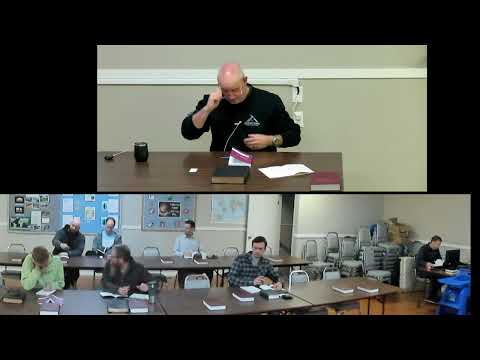
How does the Holy Spirit relate to God the Father, and what does that relationship mean for Christian worship and prayer? Working through a chapter on the Holy Spirit and the Father, this study traces the biblical pattern of 'from the Father, through the Son, in the Spirit' — and its liturgical reverse, 'in the Spirit, through the Son, to the Father' — as the framework for understanding both Trinitarian processions and the nature of true worship. The discussion addresses the Spirit's work in the old and new covenants, the cessation of the revelatory gifts at the completion of the New Testament canon, and the Spirit's role in empowering prayer, drawing particularly on John Owen's treatment of Ephesians 2:18 and Romans 8:26-27.

Ask FGBC - Podcast with Jim Butler, Dr James Renihan, Dr Richard Barcellos
This roundtable conversation between three pastors and theologians addresses a wide range of questions submitted by church members, covering biblical theology, covenant theology, baptism, eschatology, and Christian living. The discussion moves from how Christ fulfills Old Testament Israel, through the covenantal basis for believers' baptism, to the nature of the eternal state, the hermeneutics of applying Old Testament promises, the place of ethnic Israel in relation to the church, and the means of grace for raising covenant children. Throughout, the speakers return to a consistent Reformed hermeneutic: Christ is the true and greater fulfillment of all Old Testament promise, the church is the eschatological Israel of prophetic expectation, and the ordinary means of grace — Word, prayer, and faithful worship — remain God's appointed instruments for the conversion and nurture of his people.

Ask FGBC #5 - Are people who “chose” for Jesus actually saved?
This pastoral Q&A addresses whether Christians who use Arminian or synergistic language — 'I chose Jesus,' 'I accepted Jesus' — are genuinely saved, or whether such language betrays a fatal misunderstanding of the gospel. The response distinguishes sloppy speech from substantive doctrinal error, urging a judgment of charity toward those lacking theological precision while insisting that doctrinal faithfulness is essential to Christian identity. The episode closes with a call for patience with new believers growing in understanding and for the importance of sound preaching and good church membership as the ordinary means by which precision is cultivated over time.

Book recommendations related CTF 2024 and the Holy Scriptures
Two teachers discuss book recommendations for those preparing for or following up on a conference treating the Holy Scriptures, with particular focus on expositions of the relevant confession chapter and works on the doctrine of Scripture. Recommendations span classical Reformed confession commentaries, treatments of divine inspiration and inerrancy, and a sixteenth-century disputation on Scripture by William Whitaker. The conversation is a brief supplementary resource guide rather than an expository sermon.

CTF - Introducing Chilliwack
This brief recording is a logistical introduction to a conference hosted in Chilliwack, British Columbia, covering travel directions, airport options, ground transportation, and accommodation arrangements for attendees. No Scripture is expounded and no theological content is presented. The recording does not constitute a sermon.

Baptisms
Two believers are baptized by immersion, following the confessional Baptist conviction that baptism is the outward sign of an inward work of grace belonging to professing believers alone. The service includes brief exposition of the mode and subjects of baptism drawn from the 1689 London Baptist Confession, with reference to Romans 6 as the apostolic grounding for immersion as a depiction of death, burial, and resurrection with Christ. A testimony from one of the candidates reflects on the call to follow Christ in believer's baptism as the completion of a public profession of faith.

November 19, 2022 - Wedding Stream
A wedding homily grounding the institution of marriage in the creation account of Genesis 2 and the redemptive promise of Genesis 3:15. The sermon traces God's good gift of companionship in creation, the disruption of the fall, and the protoevangelium as the first announcement of the gospel — that Christ, born of a woman, would crush the serpent's head through substitutionary suffering and resurrection. The couple is charged to embody in their Christian marriage the relationship between Christ and his church as depicted in Ephesians 5, and all hearers are called to trust in Christ's righteousness received by faith alone.