
The Regulative Principle of Worship, Part 2

What authorizes the church to add, subtract, or substitute elements in corporate worship? Tracing the divine appointment of worship from Exodus and Leviticus through Deuteronomy 12:32 and into the books of Chronicles, this sermon demonstrates that Old Covenant Israel worshiped according to explicit divine command — not human creativity, cultural accommodation, or felt need. The same God who consumed Nadab and Abihu for offering strange fire, who filled Solomon's temple with his glory when worship was ordered according to his word, has not relaxed his standard in the New Covenant. The regulative principle is not a straitjacket but a guard against idolatry, and the New Covenant church is called to the same obedience: asking King Jesus what he has commanded, and doing that.
May 18 Sanders Holy Spirit and the Father
How does the Holy Spirit relate to God the Father, and what does that relationship mean for Christian worship and prayer? Working through a chapter on the Holy Spirit and the Father, this study traces the biblical pattern of 'from the Father, through the Son, in the Spirit' — and its liturgical reverse, 'in the Spirit, through the Son, to the Father' — as the framework for understanding both Trinitarian processions and the nature of true worship. The discussion addresses the Spirit's work in the old and new covenants, the cessation of the revelatory gifts at the completion of the New Testament canon, and the Spirit's role in empowering prayer, drawing particularly on John Owen's treatment of Ephesians 2:18 and Romans 8:26-27.

Paul in Athens
Paul's encounter with the philosophers and council of Athens in Acts 17:16–34 exposes the persistent and universal nature of idolatry, the sufficiency of general revelation to render all men without excuse, and the necessity of special revelation for salvation. The sermon traces Paul's Mars Hill address to show how the apostle grounds his proclamation in the doctrines of creation, providence, and divine aseity before pressing the call to repentance and warning of coming judgment. Where idolatry blurs the Creator-creature distinction, the gospel restores it — and the varied responses of the Athenians (mockery, curiosity, and saving faith) remind the church that conversion belongs to the Spirit of God, not to the eloquence of the preacher.

The Regulative Principle of Worship
The regulative principle of worship holds that only what God explicitly commands in Scripture is acceptable in corporate worship — nothing may be added, altered, or subtracted. This sermon works through the Old Testament foundation of that principle, tracing the divine appointment of worship through the moral law of Exodus 20, the ceremonial law governing the tabernacle and priesthood, and the stark warning of Deuteronomy 12:32. The contrast between Nadab and Abihu's condemned "strange fire" and the fire of divine approval in Leviticus 9 illustrates that God judges the manner of worship, not only its object. The congregation is exhorted to approach the living God obediently rather than creatively, recognizing that the same consuming fire who regulated Old Covenant worship governs New Covenant worship unchanged.

2LCF Chapter 13 - Of Sanctification
Second London Confession of Faith Chapter 13 examines sanctification as an inseparable fruit of justification, rooted entirely in the sovereign grace of God rather than human merit or striving. The confession teaches that sanctification is real and personal moral transformation wrought by the Holy Spirit through the Word, yet remains imperfect in this life — a continual war between flesh and Spirit in which remaining corruption may at times prevail. The critical distinction between justification (Christ's forensic work for us) and sanctification (the Spirit's transforming work in us) guards against both Roman Catholic conflation and Protestant antinomianism, keeping Christ's righteousness alone as the ground of acceptance before God.

The Theological Basis for Motherhood
Titus 2:3–5 grounds the calling of older and younger women not in cultural expectation but in the gospel of grace. The passage moves from the virtues older women must embody, to the domestic relationships and personal character younger women are to cultivate, to the theological warrant undergirding all of it: a woman who professes saving faith yet neglects these duties brings reproach upon the very word of God she claims to believe. Salvation is by grace alone through faith alone in Christ alone, and the imperatives of Titus 2 describe the life of sanctification that flows from that redemption, not the means of obtaining it.

2LBC Chapter 17 - of the Perseverance of the Saints (part 2)
The 1689 London Baptist Confession's seventeenth chapter on the perseverance of the saints is honest about the real threats that confront the believer: the devil, the world, and the remaining corruption of the flesh, compounded by neglect of the means of grace. The life of David—adultery, murder, temporal judgments, and the sword that never departed from his house—is held up as a biblical case study for every consequence the confession names. Yet the chapter does not end in the catalogue of ruin: repentance itself is an evangelical grace given by God, and the preservation of God's elect is grounded not in their free will but in the immutability of election, the intercession of Christ, and the nature of the covenant of grace. The practical force of the doctrine is a call to use the ordained means—word, prayer, baptism, the Lord's Supper, corporate worship—as God-given instruments for persevering to the end.

Ask FGBC - Podcast with Jim Butler, Dr James Renihan, Dr Richard Barcellos
This roundtable conversation between three pastors and theologians addresses a wide range of questions submitted by church members, covering biblical theology, covenant theology, baptism, eschatology, and Christian living. The discussion moves from how Christ fulfills Old Testament Israel, through the covenantal basis for believers' baptism, to the nature of the eternal state, the hermeneutics of applying Old Testament promises, the place of ethnic Israel in relation to the church, and the means of grace for raising covenant children. Throughout, the speakers return to a consistent Reformed hermeneutic: Christ is the true and greater fulfillment of all Old Testament promise, the church is the eschatological Israel of prophetic expectation, and the ordinary means of grace — Word, prayer, and faithful worship — remain God's appointed instruments for the conversion and nurture of his people.

Live Stream - May 05, 2024
Ephesians 1:19–23 grounds the apostle Paul's prayer that believers would know 'the exceeding greatness of God's Almighty power.' This sermon argues that divine omnipotence is not merely an abstract attribute but is concretely demonstrated in the resurrection and exaltation of Jesus Christ, who now reigns as head over all things for the benefit of his church. The three movements examine the supremacy of God's power as infinite, self-existent, and uncaused; its historical demonstration in Christ's resurrection and session at the Father's right hand; and the immensity of Christ's exaltation as universal Lord and federal head of his people. The believer's assurance rests not in personal strength but in the same almighty power that raised Christ from the dead, which also preserves, calls, and will finally resurrect all who are united to him.
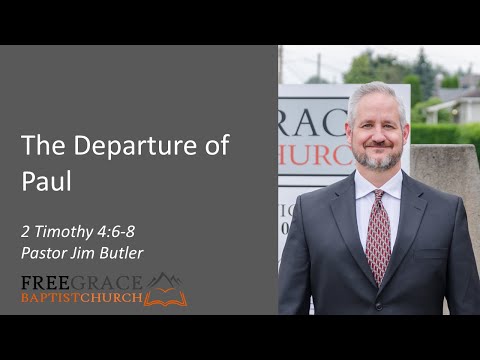
The Departure of Paul
Paul's final written words in 2 Timothy 4:6–8 disclose the mind of a man at the eleventh hour of his life: conscious of imminent martyrdom, yet unshaken in confidence. The sermon works through three movements — the apostle's present situation as a drink offering poured out (v. 6), his past perseverance in fight, race, and faith (v. 7), and his future hope in the crown of righteousness (v. 8). Central to the exposition is the insistence that the crown of righteousness is not a reward for performance but a confirmation of justification by faith alone, the imputed righteousness of Christ conveyed freely by the righteous judge. The application presses every believer to live now in such a way that the eleventh hour may be faced with the same God-graced confidence Paul displays here.

The Exceeding Greatness of God's Almighty Power
Paul's prayer in Ephesians 1:19–23 that believers would know the exceeding greatness of God's almighty power raises the question of what that power actually is and what it has accomplished. This sermon works through three interlocking realities: the supremacy of God's omnipotence as a timeless, self-existent, and inexhaustible divine attribute; its decisive demonstration in the resurrection and exaltation of Christ; and the immensity of that exaltation, whereby Christ reigns as head over all creation and over his church. The practical weight falls on believers — the same power that raised Christ from the dead is the power that calls, regenerates, preserves, and will finally resurrect all who are united to him.

CTF 2024: Welcome and opening
This is the welcome and opening session of the 'Confessing the Faith' conference, an inaugural annual gathering structured around working through successive chapters of the Second London Confession of 1689. The speaker introduces the conference's purpose — fostering fellowship and doctrinal fidelity among Second London Confession churches, particularly in western Canada — reads Psalm 133, leads in prayer, and introduces the guest speakers. The session includes housekeeping announcements, a congregational hymn, and a commendation of the conference's primary resource: an exposition of the Second London Confession of Faith.

Chapter 17 - of the Perseverance of the Saints (part 1)
The 1689 London Baptist Confession chapter 17 on the perseverance of the saints is examined through its first two paragraphs, grounding the doctrine in the preserving power of the triune God rather than in the free will of the believer. The Confession is shown to be both rigorously doctrinal and remarkably practical, acknowledging the storms, unbelief, and apparent withdrawal of God that saints genuinely experience while insisting that these cannot sever the elect from grace. The foundation of perseverance is traced through the immutability of the decree of election, the merit and intercession of Christ, the abiding of the Spirit, and the nature of the covenant of grace — directly opposing both Roman Catholic and Arminian accounts that make final salvation contingent on human cooperation. Believers are exhorted to feed their souls on the promises of the covenant of grace precisely because perseverance is secured by God's unchangeable love, not by their performance.

Live Stream - April 28, 2024
Psalm 88 is the most sorrowful of all the Psalms, the honest cry of a believer named Heman the Ezrahite who describes his suffering in terms of an oubliette — a medieval dungeon of utter darkness and forgetfulness — yet never ceases to call upon the LORD. This expository sermon on Psalm 88 argues that profound suffering is a genuine and expected part of the Christian life, not an indication of sin, and that the Psalm itself is divinely provided as a vehicle of prayer for God's people in their darkest moments. The sermon traces the Psalm's place in the third book of the Psalter, examines its theological force for suffering believers, and then reads the Psalm as a window into Christ's own agony in Gethsemane and at Calvary, concluding that believers may come boldly to a sympathetic High Priest who has endured deeper darkness than any of his people will face.
Live Stream - April 28, 2024
John 12:27-28 presents the inner state of Christ's human soul at the approach of his atoning death — 'Now my soul is troubled' — and demands theological reckoning rather than easy comfort. Working through four movements in the text (the troubled soul, the rejected petition, the committed purpose, and the prayer for the Father's glory), the sermon argues that the Son of God, as very man, experienced genuine anguish of soul without sin, bearing our griefs and procuring righteousness precisely by passing through every stage and trial of human experience without transgressing the law of God. The pastoral summons is to rest assurance of salvation not on personal performance but entirely on the blood and righteousness of the incarnate Mediator who, at the very crucible of temptation, obeyed for us and said, 'Father, glorify your name.'
A Cry from God's Oubliette
Psalm 88 is the most sorrowful psalm in the entire Psalter — a cry from one whom God has placed in what the preacher calls an 'oubliette,' the lowest and most forgotten prison in a medieval dungeon. Heman the Ezraite, whose name means 'faithful,' addresses the covenant LORD from the depths of unrelieved affliction, offering no tidy resolution but only the continued cry of faith in darkness. The sermon argues that this psalm validates the reality of deep suffering among God's faithful people, calls the church to companionship with those who suffer, and ultimately points to the Lord Jesus Christ, who descended into a darker oubliette than any of his people will ever know — and who therefore sympathizes with and intercedes for all who cry out to God in their trouble.

CTF 2024 Session 5 - Confessional Guidelines for Scripture Interpretation

Christ is the scopus scripturae — the bullseye around which the entire canon coheres. Drawing on Luke 24, John 5, and Acts 2, this lecture argues that the Old Testament was a messianic document independent of Christ's own self-witness, and that the apostles, particularly Peter, interpreted Scripture exactly as Jesus taught them: finding the sufferings and glory of Christ throughout the law, prophets, and writings. The session establishes that when Scripture cites and explains Scripture, the explanatory words need not appear in the cited text — a pattern that legitimates expository preaching and creedal formulation alike.
Very man: “Now my soul is troubled”
John 12:27–28 records the Son of God incarnate declaring 'Now my soul is troubled' — words that are simultaneously a window into his true humanity and a display of his sinless obedience at the threshold of Calvary. This sermon works through the four clauses of those verses, arguing that Christ's soul-trouble was real and holy, arising not from cowardice before mere bodily suffering but from his contemplation of the divine wrath he would bear as the substitute for sinners. Drawing on Cyril of Alexandria's principle that 'what is not assumed is not healed,' the sermon shows that Christ's sinless experience of grief, agitation, and soul-anguish recapitulates every stage of fallen human experience so that he might procure both the forgiveness of guilt and the positive righteousness his people need in every circumstance of life. The congregation is called to rest its entire confidence — prayer life, grief, daily obedience — in the blood and righteousness of the one who said 'For this purpose I came to this hour.'

CTF 2024 Session 6: Further Explorations in Scripture Interpretation
Christ is the scope of the whole of Scripture — this is the claim Peter makes in Acts 3 and unpacks theologically in 1 Peter 1:10–12, and it is the claim this session presses upon interpreters of the Bible today. Beginning with Peter's sermon in Acts 3 and moving to his mature reflection in 1 Peter 1, the lecture traces how God spoke through the writing prophets from Moses onward concerning the sufferings and glory of Christ, how those prophets studied one another's writings in search of a fuller understanding, and how the coming of Christ together with the New Testament's explanatory revelation made explicit what was implicit in the Old Testament all along. The session closes with several hermeneutical implications: the analogy of Scripture is not a Reformation invention but a prophetic practice; the Old Testament contains a surplus of divinely embedded meaning that awaits later revelation to unveil; and subsequent revelation does not reinterpret the Old Testament but fulfils and illuminates the meaning that was always there.

CTF 2024 Session 7 - Q&A Panel Discussion
A conference Q&A panel addresses a wide range of confessional, theological, and pastoral questions arising from lectures on the 1689 Second London Baptist Confession and its relationship to broader Reformed orthodoxy. Topics range from the nature of creedal subscription and what it means to be Reformed, to the hermeneutics of typology, the mystery language of Ephesians 3, the humanity and knowledge of Christ, divine immutability and impassibility, and the differences between the Second London Confession and the Three Forms of Unity. The panel consistently grounds its answers in the churchly authority of confessions over individual interpretation, the centrality of the means of grace for generational faithfulness, and the necessity of theological humility before the accumulated witness of the church.

CTF 2024 Session 2: Jesus Christ as the Scope of Scripture
What does the 1689 Second London Baptist Confession mean when it says 'the scope of the whole is to give all glory to God'? This lecture argues that Christ — specifically his incarnation, sufferings, and entrance into glory — is the scopus scripturae, the bullseye to which every part of Scripture aims. Drawing on the First Helvetic Confession, William Ames, John Owen, and Luke 24, the speaker demonstrates that Jesus himself read the entire Old Testament canon as pointing to his own sufferings and resurrection glory, and that the apostles after Pentecost interpreted Scripture in precisely the same way. The governing hermeneutical principle is that subsequent revelation often makes explicit what is implicit in antecedent revelation, so that Scripture is organically unified, self-interpreting, and consummated in the person and work of the Son of God.

CTF 2024 Session 4: The Uniting Power of our Reformed Confessions
The ecumenical creeds of the first five centuries — the Apostles' Creed, the Nicene Creed, the Chalcedonian Definition, and the Athanasian Creed — form the doctrinal bedrock upon which the Reformation confessions, including the Westminster Confession, the Savoy Declaration, and the Second London Confession of Faith, were deliberately built. This address traces the historical controversies (Arianism, Eutychianism, Monophysitism, Monothelitism) that provoked each creed, demonstrates the precise linguistic dependence of the 1689 LBCF upon creedal formulations, and argues that this shared inheritance constitutes genuine theological unity among confessional Reformed and Reformed Baptist churches. The practical conclusion is that ministers must teach these creeds and their underlying doctrines — Trinitarian theology, the hypostatic union — as the bedrock of Christian comfort, not merely as academic curiosity.

CTF 2024 Session 3: A Robust Defense of the Scriptures
Creeds and confessions are not supplements to Scripture but summaries of its central propositional content, necessary for intelligent faith, faithful evangelism, and the defense of orthodoxy. Drawing on Romans 12:1-2, James Renihan argues that right living always flows from right believing, and that the theological, ethical, and redemptive-historical dimensions of Scripture all demand that Christians be able to articulate the facts of the faith. Confessions function positively to state the contents of the faith and connect believers across time and place, and negatively to identify error and mark the boundaries of true Christianity. The session closes with a survey of confessional language embedded in the New Testament itself — from the Shema to the apostolic christological summaries — demonstrating that creeds are not a human invention imposed on Scripture but a distillation of what Scripture already teaches.

CTF 2024 Session 1: An Engaging Overview of the Second London Confession of Faith
The Second London Confession of Faith (1689) did not arise in a vacuum but was forged in response to specific doctrinal crises and pastoral needs within the 17th-century particular Baptist churches. This address traces the historical circumstances behind the Confession's 1677 publication — including the Christological heresies of Thomas Collier and Matthew Caffin, the threat of Quaker mysticism, fear of Roman Catholic resurgence, and the pastoral concern for family catechesis. The speaker then surveys the Confession's 32 chapters as a coherent theological architecture, showing how its structure reflects the covenant of grace viewed from both divine and human perspectives. Listeners are urged to recover the Confession as a living instrument of orthodoxy, protection, instruction, and proclamation for the church today.

Ask FGBC #8 - How could one man pay for the sins of the world in 36 hours?
How could one man's death over a finite span of time pay for the sins of billions who deserve eternal punishment? The answer turns on two doctrines: federal headship and the infinite dignity of Christ's person. As Adam stood as covenant head for his posterity, so Christ — the eternal Son of God united to human nature in one person — stands as the last Adam, whose active and passive obedience together provide both forgiveness and a righteousness imputed to all who believe. The infinite nature of the sin and the infinite nature of the person who bears it are the key to understanding why the atonement is sufficient.

Ask FGBC #7 - How do you explain that God is real to an athiest?
When confronted by a convinced atheist, should a Christian lead with personal religious experience or with the objective truth-content of Christianity? Drawing on Romans 1, Acts 14, Acts 17, 1 Peter 3, and John 9, this conversation argues that general revelation establishes the existence of the Creator while special revelation identifies who that Creator is and what he has done in Christ. The ethical dimension of unbelief — that sin, not merely intellectual inquiry, drives resistance to the gospel — must not be overlooked. Rather than prescribing a single apologetic method, the speakers commend flexible, gospel-centered engagement rooted in knowing the faith well and living it openly before a watching world.
Live Stream - April 21, 2024
John 14:17b-18 confronts the church with two contrasting realities: the world's incapacity to receive the Spirit of Truth, and the disciples' assured possession of him. Working through the upper room discourse, this exposition grounds the church's dependence on the Holy Spirit in the doctrines of divine sovereignty, Trinitarian theology, and the inseparability of the divine operations. The sermon closes with the promise of Christ's permanent presence with his people — by the Spirit, in preaching, in the sacraments, and in discipline — as the antidote to spiritual orphanhood, and with a direct call to sinners to receive justification by faith alone, which brings not only forgiveness but the imputed righteousness of Christ.

The Regulation of the Church's Worship, Part 2
What right does a congregation have to alter, add to, or subtract from the worship God has ordained for His house? Expounding 1 Timothy 3:14–16, this sermon establishes that Paul's instructions carry divine necessity — the church is the house of God, the pillar and ground of the truth, governed by Christ its head — and that the church's common confession centres on the person and work of the Lord Jesus Christ: His incarnation, vindication, proclamation, and the faith He sovereignly produces in the world. The regulative principle of worship follows directly: only what God commands in Holy Scripture is acceptable worship, a principle demonstrated from the Decalogue, Deuteronomy 12:32, Leviticus 10, 1 Samuel 13, and Hebrews 12, and confessionally formulated in chapter 22 of the 1689 London Baptist Confession of Faith.

The Nature of the Holy Spirit, Part 2
Jesus' promise in John 14:17–18 — that the Spirit of truth cannot be received by the world, yet dwells with and will be in his disciples — grounds the church's dependence on sovereign grace for all gospel ministry. The sermon works through the doctrine of inseparable operations and appropriations to protect both the unity of the Godhead and the distinction of persons, before applying the Spirit's indwelling to the perseverance of the saints and the sufficiency of the gospel. The closing exhortation presses both believers and unbelievers: the Spirit abides forever, justification is by faith alone, and the righteousness of Christ is imputed — not merely forgiveness extended — to all who come to him.

Ask FGBC #6 - Why is historical confessional Christianity important?
The question of why historical confessional Christianity matters is addressed by examining what Scripture itself says about the gifts Christ gives to his church. Drawing on Ephesians 4 and Matthew 28, the argument is made that creeds and confessions are the accumulated fruit of those gifts — the best doctrinal articulation the church has produced across centuries of theological controversy, from Nicaea and Chalcedon through the Second London Confession. To reject them in favor of a 'no creed but the Bible' posture is not humility but a subtle repudiation of the very ecclesiology the Bible commands, and it leaves individuals without the guardrails that preserve orthodox Christianity.