
Topic
Soteriology
2,239 sermons · All topics

CTF 2025 - Why Attend the Conference?

Two pastors offer reasons to attend a confessional Reformed Baptist conference centred on the knowledge of God. Drawing on John 17:3 and Jeremiah 9, they argue that knowing the triune God — his being, his perfections, and his works in redemption — is the supreme good, surpassing riches, strength, and worldly wisdom. The conference is commended not as an academic exercise but as a gathering for instruction, corporate worship, and the mutual encouragement of the saints.

Live Stream - December 15, 2024
John 16:25–28 forms the doctrinal climax of the upper room discourse, where Christ sets before his disciples three interlocking truths: the manner of his instruction through figurative language soon to be illumined by the Spirit, the direct access believers have to the Father through the Son in the new covenant era, and the Christological ground of that access in the Eternal generation, Incarnation, and Ascension of the Son. The sermon presses into the Eternal generation of the Son — his being begotten of the Father before all worlds, not by creation or adoption but by an Eternal relation of origin — and then into the Incarnation as the assumption of human nature without any compromise to his divinity. The unchanging love of the Father for his elect, grounded not in their merit but in sovereign grace and the mediation of Christ, is held out as the sustaining comfort for disciples facing tribulation, and the call to unbelievers is to look to Christ — his blood and righteousness — as the only escape from divine judgment.

The Conduct of the Believer
Philippians 1:27–30 presents a twofold exhortation to the church: that believers conduct themselves in a manner worthy of the gospel, and that they do so with courage in the face of adversaries. The sermon expounds the Greek word for citizenship as the governing concept of verse 27, grounding the call to worthy conduct in the reality of justification by faith — the life of sanctification flows necessarily from what God has graciously accomplished in the believer. Corporate unity in striving together for the faith of the gospel, and undaunted boldness before enemies, are shown to be not optional virtues but demonstrable proofs of sovereign grace at work in God's people.

The Glory of Christ's Departure, Part 1
John 16:25–28 records the climactic doctrinal statement of the Upper Room Discourse, in which Christ declares His eternal generation from the Father, His incarnation into the world, and His impending ascension back to the Father. The sermon works through three heads: the manner of Christ's instruction in figurative language and the Spirit's coming role in illuminating the disciples; the access believers have to the Father through the Son in prayer; and the doctrinal creed embedded in verse 28, treating eternal generation, incarnation, and ascension in sequence. The unchanging love of the Father for those who are in Christ by grace through faith is held out both as the chief encouragement for disciples going into a world of tribulation and as the ground of the gospel call to sinners to look to Christ for blood and righteousness.

The Wars of the LORD
Numbers 21 traces Israel's journey through military victory over the Canaanites, the punishment and grace of the bronze serpent, and the conquest of the Amorite kings Sihon and Og. The bronze serpent — condemned people bitten by fiery serpents, healed only by looking in faith to the remedy God prescribed — is taken up by Jesus in John 3:14 as a type of his own crucifixion, teaching that salvation comes by divine initiative alone, received through faith, not works. The same recurring sins of complaint, lack of faith in providence, and idolatry that marked the first generation persist in the second, warning the church that these corruptions follow the sin nature across every generation. The chapter closes with God's sovereign hardening of Sihon and the defeat of the giant Og, both down payments on the promised conquest and demonstrations of God's faithfulness, sovereignty, and goodness to his people.

The Future Prospect of the Apostle, Part 2
Philippians 1:21–26 presents Paul's conviction and anticipation as an apostle facing imprisonment and the real prospect of execution. The sermon works through Paul's declaration 'for to me to live is Christ, and to die is gain,' showing that his union with Christ in life and his glory with Christ in death make it impossible for any earthly power to harm or stop him. The intermediate state — the soul's immediate presence with Christ at death — is set against the benefit of continued gospel ministry, and Paul's others-minded anticipation of release grounds his confidence that the Philippians' progress in faith and joy will abound. The sermon closes by pressing the question whether each hearer can say with honest self-examination that Christ is their all in life and death.

The Joy Associated with Christ's Departure
John 16:16–24 records Jesus preparing his disciples for the grief of his death and the joy of his resurrection, framing both under the single announcement 'a little while.' This exposition works through two movements: the announcement of Christ's departure and the disciples' confusion (vv. 16–18), and then the benefits of that departure — lasting joy grounded in the resurrection, and direct access to the Father through prayer in Christ's name (vv. 19–24). The sermon argues that the joy promised here is not the absence of suffering or temporal prosperity, but an indestructible joy rooted in Christ's finished work of life, death, resurrection, and ascension, a joy no adversary can strip from the believer.

2LCF Chapter 29 - Of Baptism, Part 1

Reformed Baptists administer baptism only to professing believers — but why? This confession study works through 2LCF Chapter 29 on baptism by examining the two foundational theological arguments that undergird credobaptism: covenant theology and federal headship. The covenant of grace and the new covenant are shown to be identical in substance, not merely different administrations of one covenant, meaning that only regenerate, believing covenant members are proper recipients of the covenant sign. The argument from federal headship reinforces this conclusion: since baptism signifies union with Christ as covenant head, it cannot rightly be administered to those still under the federal headship of Adam.

Ask FGBC #31: What is the difference between saving and common grace?
Common grace and saving grace are distinct but related aspects of God's goodness. Common grace is God's non-redemptive kindness extended to all mankind and creation — including the restraint of sin, fruitful seasons, and the capacity for civic good among unbelievers — while saving grace is God's particular redemptive work in the hearts of sinners through the preaching of the gospel. Understanding this distinction shapes how Christians relate to the world, how they pray for unbelievers, and how they understand the church's mission without compromising it.

Baptism - Shannon
Baptism is an ordinance of the New Covenant ordained by Jesus Christ, administered by immersion to those who actually profess repentance, faith, and obedience to the Lord Jesus Christ. Drawing from chapter 29 of the 1689 London Baptist Confession of Faith, this administration of the ordinance situates believer's baptism within the broader Reformed confessional tradition, noting the Baptists' deliberate alignment with Presbyterian and Congregationalist Brethren on the doctrines of justification, the Trinity, and much else, while differing on the proper subjects and mode of baptism. The outward sign of immersion into water visibly expresses Christ's death, burial, and resurrection, grounded in Romans 6, as the candidate publicly professes faith in Christ alone for salvation.

The Salvation of Sinners on Pentecost
Peter's sermon on the day of Pentecost (Acts 2:22–42) declares the life, death, resurrection, and exaltation of Jesus Christ as the exclusive ground of salvation, and calls sinners to repentance and faith. The sermon examines what genuine repentance means — a change of mind inseparable from faith, not a prior moral reformation — and argues that baptism is the sign of what God has already accomplished internally, not the instrument of forgiveness. Acts 2:39 is addressed directly against paedobaptist appeals, with the promise of the Spirit shown to belong to all who are effectually called, not to the physical infants of believers. The sermon closes with an exhortation to follow the Pentecost pattern: preach the gospel, baptize disciples, and teach them in the church.

The Covenant Ceremony With Abraham
Genesis 15 records the covenant ceremony by which God confirmed his promises of seed and land to Abram — not with a bilateral oath, but with a unilateral, self-maledictory act in which God alone passed between the divided animals. The sermon traces Abraham's justification by faith alone in verse 6, examines the ancient covenant-ratification ritual as a type of Christ bearing the covenant curse, and shows that the smoking oven and burning torch passing through the pieces preaches the substitutionary atonement of the Lord Jesus Christ. The application presses believers to rest their assurance not in their own covenant faithfulness but in the faithfulness of the God who swore by himself and sealed that oath in the blood of his Son.

Ask FGBC #30: What does a holy walk look like in a Christian?
What does a holy walk look like for the Christian? This Q&A response argues that holiness is neither mystical nor monastic but is concretely shaped by three coordinates: conformity to Christ, regulation by the law of God, and the practice of ordinary good works in every sphere of life. The discussion draws on Romans 8, Romans 12–13, 1 Peter 1–2, and Galatians 5 to show that holy living begins with the renewal of the mind and expresses itself in the dignity of daily work, household relationships, and engagement with the world as pilgrims and sojourners.

2LCF Chapter 28 - Of Baptism and the Lord's Supper
2LCF Chapter 28 presents baptism and the Lord's Supper as two ordinances of positive and sovereign institution appointed by the Lord Jesus Christ, the only lawgiver, to be continued in His church until the end of the age. This session traces the confessional groundwork laid in 2LCF chapters 8, 14, 17, 22, and 26 before examining Chapter 28's two brief paragraphs in detail. The particular Baptist choice of 'ordinance' over 'sacrament,' the exclusion of 'seal,' and the inclusion of 'positive' are each shown to be polemically deliberate — asserting that baptism and the Lord's Supper are divine commands to be obeyed only by those who can render obedience, that is, regenerate believers. The session closes by grounding lawful administration of the ordinances in Matthew 28 and the commission given to qualified, called ministers of the gospel.

The Spirit's Ministry to the Apostles
John 16:12–15 presents the Spirit's ministry to the apostles as the continuation and completion of Christ's own self-disclosure to the disciples. The sermon expounds Jesus' promise that the Spirit of Truth will guide the apostles into all truth, situating that promise within the doctrine of the Trinity — specifically the eternal processions of the Son and Spirit and their corresponding temporal missions. The Spirit's 'not speaking on his own authority' is shown to mirror Christ's own language about receiving all things from the Father, testifying not to any inferiority of persons but to the consubstantiality of the three divine persons, each possessing the whole divine essence undivided. The congregation is called to pursue the knowledge of the triune God as the foundation for every other duty of the Christian life.

Sons and Daughters of God
What does it mean that sinners dead in trespasses can be called children of God? Expounding 1 John 3:1, this sermon works through five elements of the verse: the imperative weight of 'behold,' the immeasurable and immutable love of God rooted in his own essential being, the unmerited bestowal of that love upon the undeserving, the Christian's status as adopted sons and daughters in union with Christ, and the world's consequent ignorance and enmity toward believers. The sermon grounds adoption in the eternal predestinating love of the Father, the incarnation and obedience of the Son, and the indwelling of the Spirit — and closes with a call to behold these realities with eyes of faith as the only ground of encouragement for a church opposed by the world.

The Vindication of the Aaronic Priesthood
Numbers 16:41–17 records the immediate aftermath of Korah's rebellion: Israel accuses Moses and Aaron of murder, God's wrath breaks out in a plague, and Aaron runs into the congregation with a censer to make atonement, standing between the dead and the living until the plague stops. Chapter 17 then confirms the Aaronic priesthood definitively when Aaron's rod alone buds, blossoms, and produces ripe almonds, functioning as a perpetual sign against any future usurper of the priestly office. The typological weight of Aaron's intercession in verse 48 points forward to Christ, who stands between dead sinners and the wrath of God, propitating that wrath by his blood. The sermon calls hearers to recognize both the sinfulness of Israel's hasty accusation and the glory of the priestly atonement that alone grants the unholy access to a holy God.

Ask FGBC #25: How do I handle family members, friends, etc, not believing?
A questioner is grieved by family members and friends who refuse to believe the gospel, citing a theology that demands a prolonged crisis of sin and misery before conversion is credible. The response addresses both the pastoral burden of watching loved ones reject Christ and the theological confusion that treats immediate repentance and faith with suspicion. Practical counsel includes persisting in prayer, reading Scripture together rather than arguing theology, and pointing to the diverse conversion experiences in the New Testament and in works such as Pilgrim's Progress to show that Scripture nowhere requires a prescribed experiential cycle before a sinner may come to Christ.
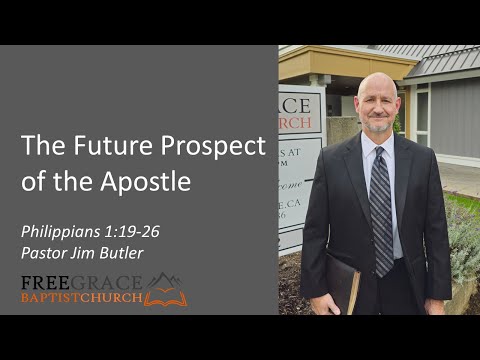
The Future Prospect of the Apostle
Philippians 1:19–21 presents the apostle Paul's future prospect from a Roman prison cell, where he faces the real possibilities of release or execution. The sermon works through Paul's expectation of deliverance and vindication (vv. 19–20), grounded not in his own stature but in the prayers of the Philippian church and the power of the Spirit of Christ, and then turns to the great conviction of verse 21: 'For to me, to live is Christ and to die is gain.' The union Paul has with Christ in the present makes life a sustained magnification of the Savior, while death is simply the gaining of more Christ — a logic that dismantles every threat his persecutors could level against him. The congregation is called to the same orientation: to fight the good fight now, so that whether in life or in death, Christ is magnified in the body.

The Spirit's Conviction of the World
The Holy Spirit's conviction of the world — of sin, of righteousness, and of judgment — is not a promise that every hearer will be saved, but a declaration that the Spirit will confirm the identity and vindication of Jesus Christ through the apostolic proclamation. Drawing on John 16:8–11 alongside Acts 2 and Acts 24, this sermon argues that the Spirit's primary work in the world is to expose unbelief in Christ, to declare the sufficiency of Christ's imputed righteousness, and to announce the judgment already rendered against the ruler of this world at the cross. The church's calling is therefore not to measure success by numerical response but to preach sin, righteousness, and judgment faithfully, trusting the Spirit to do His own sovereign work.

Ask FGBC #24: Why is it important for a Christian to continually confess his sins?
Why must a Christian continue to confess sins after justification? This question-and-answer session draws on 1 John 1:9, 1 John 2:1, and several Psalms to distinguish between the believer's unchanging forensic standing before God and the ongoing maintenance of relational fellowship with the Father. Justification secures the status; confession restores the communion that sin fractures. The priestly intercession of Christ at the Father's right hand is the ground of that ongoing access, and all confession is ultimately designed to locate glory upon the Savior.
The Priority of the Gospel for the Apostle
Paul's imprisonment in Rome, far from silencing the gospel, became the occasion for its advance — to the Praetorian Guard, and through the emboldened preaching of the wider brotherhood. Philippians 1:12–18 presents a progress report that reveals Paul's singular priority: the proclamation of Christ, regardless of the motives of those who preach him or the circumstances that surround the preacher. The sermon works through the paradox of fruitful suffering, the anatomy of bad and good ministerial motivation, and the theology of providence that sustains both. The congregation is called to the same pattern — faithfulness and perseverance to the end, interpreting all circumstances through the lens of God's sovereign purpose for the gospel.

2LCF Chapter 27 – Of the Communion of Saints
The communion of saints, as confessed in 2LCF Chapter 27, is grounded in the believer's union with Christ by the Spirit and through faith — a union that conveys participation in His graces, sufferings, death, resurrection, and glory without any divinization of the creature or diminishment of Christ's divinity. From that vertical union flows a horizontal obligation: holy fellowship in corporate worship, mutual edification through rightly ordered spiritual gifts, and material relief distributed according to ability and necessity. A necessary qualification guards the confession against both spiritual individualism and collectivist error: the communion of saints neither licenses neglect of public worship nor grants any person a right to another's private property, placing both socialism and communism in direct conflict with the Eighth and Tenth Commandments.

The Spirit's Conviction of the World
Jesus declares to his sorrowing disciples that his departure is to their advantage — not despite the coming persecution, but precisely because it secures the gift of the Holy Spirit. This sermon works through John 16:5–11 under two heads: the departure of Christ (vv. 5–7) and the conviction of the world (vv. 8–11), pausing to develop the first at length. The Trinitarian logic of the temporal missions — the Father sending the Son, the Father and Son sending the Spirit — is shown to be the very theology that sustained the apostles under hostility and that sustains the church today. The sermon closes with a call to rest in the Spirit's power rather than human eloquence or celebrity, because the Paraclete is the disciples' power, protection, and advantage.
The Requirements for Religious Life
Numbers 15 interrupts the narrative of Israel's rebellion in chapters 11–14 with renewed covenant obligations — laws of offerings, provisions for unintentional sin, and the command to wear tassels. The placement is deliberate: faithfulness to God's ordained means of grace is the proper remedy for the kind of corporate collapse just witnessed. The sermon traces how God's judgment on one generation does not exhaust His covenant mercy, and draws a typological line from Mosaic sacrifice and priesthood through to the once-for-all offering of Christ and the believer's advocate before the Father.

The Requirements for Priesthood and Sacrifice
Leviticus 21–22 sets out strict requirements for both the priests who offer sacrifice and the animals brought to the altar: wholeness, purity, and freedom from defect. These ceremonial regulations are not arbitrary exclusions but typological anticipations of the one perfect High Priest and the one perfect sacrifice that God himself would provide in the person and work of the Lord Jesus Christ. The sermon works through the four sections of the passage — practical restrictions on priests, physical requirements for priests, regulations concerning priestly food, and physical requirements for sacrificial animals — before turning to Hebrews 7–10 to show how Christ fulfills and surpasses everything the Levitical system could only shadow. The conclusion calls the congregation to the Lord's Supper with eyes fixed not on themselves but on the one who offered himself once for all and sat down.

Baptism service
A baptism service in which three candidates — one raised in the congregation from birth, and a married couple — publicly profess repentance toward God and faith in Jesus Christ alone and are baptized by immersion. Each candidate gives a brief testimony of conversion: one through Isaiah 55 and the finished work of Christ on the cross, another through a sermon on Mark 5:36 following years of grief over a father's death. The service rehearses the 1689 LBCF paragraphs on the significance, proper subjects, outward element, and mode of baptism, anchoring the visible ordinance in the gospel it pictures.

The Baptism of Saul of Tarsus
The baptism of Saul of Tarsus in Acts 9:17–25 demonstrates the proper order of Christian baptism: conversion precedes the ordinance, which then publicly marks the believer as a disciple of Christ. The passage is treated as a direct answer to Stephen's dying prayer in Acts 7:60, with Saul's transformation from chief persecutor to chief preacher serving as a vivid display of sovereign, redeeming grace. The sermon draws out three observations from Saul's early ministry — the immediacy, the effects, and the hostility of his preaching — and closes with the baptism of three new believers, each of whom gives a brief testimony of their own conversion.

The Gospel’s Irreplaceable Value
Galatians 1:6–10 confronts every generation with the irreplaceable value of the gospel by exposing three responses to its perversion: astonishment, abhorrence, and anathema. The Judaizers who troubled the Galatian churches were not offering a different gospel but no gospel at all — a metastrophe that renders God less holy than he is, man less sinful than he is, and Christ inglorious and his work useless. Justification is by grace alone, through faith alone, in Christ alone, or there is no justification before the God of heaven and earth. The sermon closes with a call to Pauline vigilance in protecting gospel purity and to seek God's approval rather than man's.

2LCF Chapter 26 – Of the Church
What is the church, who belongs to it, and how is it governed? Working through 2LCF Chapter 26, this session surveys the doctrine of the church from its universal and invisible reality in Christ to its visible, local expression — arguing that the church is constituted exclusively of regenerate believers, is headed solely by the Lord Jesus Christ, and is rightly governed by elders and deacons within an independently organized yet associationally connected congregation. The session highlights the sharp departure from the Westminster Confession's inclusion of covenant children in the visible church, grounding the Baptist position in a proper doctrine of covenant theology, baptism, and regenerate church membership.