
Topic
Missions
15 sermons · All topics

Christ's Precious Gem Collection

What does it mean that believers are 'living stones' built into a spiritual house? This sermon traces a single biblical-theological theme from Genesis 2 to Revelation 21: God gathering his elect — his precious gems — out of the scattered nations to build a temple where he will dwell with his people forever. The identity of those gems (God's chosen people), their location (scattered among every nation under the dominion of spiritual darkness), and the means of their gathering (Christ's victory over the strong man, and the church's commission to carry the gospel-light into the darkness) are each examined in turn. The sermon presses its hearers toward a missional 'spiritual gold fever' — a willingness to spend and be spent in the divine treasure hunt Christ has commissioned.
The Ministry in Iconium, Part 1

Acts 14:1–7 records the ministry of Paul and Barnabas in Iconium during the first missionary journey, and this exposition focuses on God's blessing in verse 1 — specifically the sovereignty of God in salvation and the instrumentality of gospel preaching. Drawing on Acts 13:48, Acts 16:14, Romans 10, 1 Corinthians 1, and 2 Timothy 4, the sermon argues that while God alone opens hearts, He ordains the foolishness of preaching as the ordinary means of saving sinners. The sermon closes by examining the relationship between faith and repentance in Acts, contending that the two are inseparable sides of the same coin and that repentance must never be preached as a work the sinner performs before coming to Christ.
Sunday School - Oct 1, 2023 - Pastor Ogallo's Presentation
Pastor Napthally Ogallo of Grace Baptist Church in Eldoret, Kenya presents a photographic and narrative report of the church's history, ministry, and ongoing needs to a supporting congregation. He traces the church's origins in the aftermath of Kenya's 2007–2008 post-election violence, its years of one-to-one evangelism, the gradual acquisition and development of church property, the loss of funds to a dishonest contractor, and the current state of an unfinished but usable building. The presentation closes with a candid account of challenges — extreme charismatic neighbours, widespread false gospels, theft, urban poverty, and drug use — set against the encouragement of baptisms, elder development, two church plants, a regional theological school, and a growing student ministry.

The Refuge for God's People
Psalm 46 sets the doctrine of God's sovereign presence as the only sufficient ground for courage in affliction. The psalm's threefold refrain — 'The Lord of hosts is with us; the God of Jacob is our refuge' — anchors the people of God against both natural catastrophe and the rage of hostile nations. Drawing on Job, the upper room discourse, Acts 14, and the letters to the seven churches in Revelation, this exposition argues that suffering is the normative texture of the Christian life, not an anomaly to be explained away. The command of verse 10 — 'Be still and know that I am God' — is not passive fatalism but a call to steady, covenant confidence in the God whose justice, power, and faithfulness guarantee the final exaltation of Christ among the nations.

A Harvest from an Unlikely Place
John 4:7–42 records Jesus crossing deep cultural, ethnic, and religious barriers to bring the gospel to a Samaritan woman and, through her testimony, to an entire village. The sermon works through three movements in the passage: Jesus sowing gospel seed by patiently steering the conversation from physical water to living water and then to his own messianic identity; Jesus reorienting his horizontally focused disciples to see the spiritual harvest already approaching; and Jesus and his disciples reaping that harvest among the despised Samaritans. The passage is applied as a missionary mandate — to cross ethnic and cultural boundaries, to address sin honestly, to keep Christ as the centre of every gospel presentation, and to lift our eyes to the 'Samaritans' in our own communities and the changing demographics of our cities.

The Refuge for God's People
Psalm 46 sets the people of God in the midst of cosmic and political chaos and calls them to find their sole refuge in the Lord of hosts. This exposition works through four movements in the psalm — the assurance of God's presence, the demonstration of his power over creation and the nations, the invitation to rehearse his past works in redemptive history, and the command to be still and know that he is God. The sermon argues that Reformed Christians who rightly confess God's sovereignty in salvation must equally rest in that sovereignty under tyranny, pandemic, and war. The chief application is that the church must know God — his perfections, his names, his covenant fidelity — because it is the knowledge of God, not practical principles, that steadies the soul and fuels missionary confidence in the darkest of times.

The Third Missionary Journey, Part 8
Acts 21:1–16 concludes Paul's third missionary journey with his determined journey to Jerusalem in the face of repeated prophetic warnings and the tearful pleas of fellow believers. The passage grounds Paul's resolve not in stoic courage but in his consuming vision of the gospel: men and women under God's wrath and curse, and Christ alone as the remedy. The sermon draws out Paul's love for the gathered people of God, his complementarian ecclesiology (defending male leadership in church office from 1 Timothy 2 and the cessation of revelatory gifts), and his example of a missionary strategy that planted self-governing, elder-led churches across the Roman Empire.

The First Missionary Journey, Part 2
Acts 13:4–12 records the opening episode of Paul and Barnabas's first missionary journey: their arrival in Cyprus, their preaching in the synagogues of Salamis, and the dramatic confrontation at Paphos with Bar-Jesus, a Jewish sorcerer and false prophet who attempted to prevent the proconsul Sergius Paulus from hearing the gospel. The sermon examines three movements — the journey to Cyprus, the arrival at Salamis, and the confrontation at Paphos — with extended attention to Paul's Spirit-empowered rebuke of Elymas and the resulting judgment miracle. Central to the exposition is the insistence that the Word of God preached is the irreplaceable means of salvation, that Satan's primary strategy is to obstruct its reception, and that divine sovereignty rather than human merit accounts for every conversion, including that of a powerful Roman official.

Free Grace Baptist Church - November 10, 2019 AM
Acts 12:25–13:3 grounds a careful examination of the first Christian missionary journey, asking how missionaries are to be called, qualified, and sent. The sermon argues that the Holy Spirit works through the local church — not apart from it — to identify, cultivate, and commission gospel ministers, as demonstrated by the church at Antioch separating Barnabas and Saul. Paul's earlier calling in Acts 9:15–16 frames the entire first missionary journey as the deliberate outworking of Christ's sovereign purpose to bear his name before Gentiles, kings, and Israel. Hearers are pressed to take the centrality of the local church in missions with full seriousness, to pray for qualified men to be raised up, and to trust that Christ is triumphantly advancing his kingdom through these means.
The First Missionary Journey, Part 1
Acts 12:25–13:3 marks the launch of the first missionary journey and the pivotal moment when the church at Antioch, directed by the Holy Spirit, formally separates Barnabas and Saul for organised gospel mission to the Gentiles. The sermon traces this appointment back to the divine plan announced in Acts 9:15–16, showing that Paul's calling, suffering, and relentless preaching were purposed by Christ from the moment of his conversion on the road to Damascus. A sustained application argues that the local church — not parachurch agencies, mission boards operating independently, or individual self-appointment — is the proper centre for identifying, qualifying, and sending missionaries. The sermon closes with an appeal grounded in covenant theology: God's promise to Abraham that all nations would be blessed through his seed is the very engine driving the missionary enterprise recorded in Acts.
The Conversion of Cornelius, Part 1
Acts 10:1–8 records the opening of the Cornelius narrative, which Luke presents as the pivotal, formal inclusion of Gentiles in the covenant of grace. This sermon examines Cornelius's identity and his preparatory vision, arguing from five lines of evidence within Acts 10–11 that Cornelius was not yet saved before Peter's arrival — his devout almsgiving, prayer, and God-fearing religion notwithstanding. The passage is set against contemporary Catholic and Protestant inclusivism, which the sermon rejects in favour of the exclusive claim that remission of sins comes only through conscious faith in Christ. The practical call is to refuse the delusion that religious conduct commends a sinner to God, and to rest instead in the blood and righteousness of Jesus Christ alone.

The Extension of Christ's Kingdom
Christ's sovereignty over persecution is the controlling theme of Acts 8:1b–4, where the martyrdom of Stephen triggers a great dispersion that advances the very mission Christ commissioned in Acts 1:8. The sermon traces the programmatic geography of Acts — Jerusalem, Judea, Samaria, the ends of the earth — and shows that the scattering of the disciples, far from being a setback, was the means by which Christ extended his kingdom. Particular attention is given to Saul of Tarsus as the chief persecutor whose subsequent conversion illustrates that no human opposition can thwart the sovereign purposes of Christ. Hearers are called to pray earnestly for gospel preachers to be raised up, to commit to biblical churchmanship with perseverance, and to hold fast to the confidence that Christ must reign until all his enemies are made his footstool.
The Lord's Prayer, Part 2
How does the first petition of the Lord's Prayer — 'hallowed be your name' — actually shape the daily life of a believer, a family, a church, and a missionary enterprise? This Bible study on Matthew 6:9 works through the meaning of God's name (his essence, attributes, titles, and word), explains what the petition is actually asking (not that God become holy, but that his existing holiness be recognized and exalted), and applies it in four concentric spheres: personal discipleship, household religion, corporate worship, and global missions. The study draws on the Westminster Larger Catechism, Calvin, Spurgeon, Thomas Watson, and John Owen to show that praying 'hallowed be thy name' commits the petitioner to a life of knowing, professing, depending on, esteeming, and actively promoting that name.
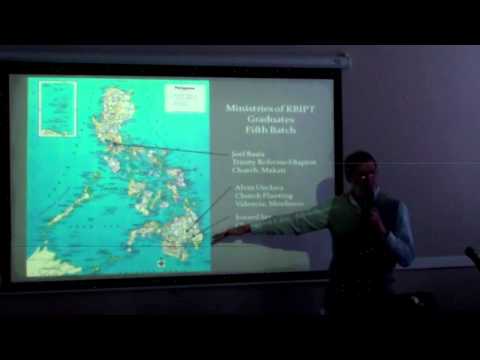
Free Grace Baptist Church - March 21 Missions Event
A Reformed Baptist missionary with thirty years of service in the Philippines presents an overview of the work in Metro Manila and beyond: church planting, a three-year pastoral training institute covering biblical languages and systematic theology, and itinerant teaching among pastors in remote provinces. The presentation is grounded in Revelation 5 and Romans 10 — Christ has purchased a people from every tribe, tongue, and nation, and messengers must be sent to gather them. The evening closes with prayer requests for the elders of Moonwalk Community Bible Church, the graduates scattered across the Philippine islands, and the ongoing effort to bring the gospel to Roman Catholics, Muslims, and those ensnared in health-and-wealth Christianity.
Prayer for Gospel Missions
Psalm 67 is a prayer for gospel missions structured around six petitions — three for the church and three for the world — and a two-fold promise of temporal and spiritual blessing. The church's mission to the nations flows necessarily from her own reception of divine mercy, blessing, and the manifest presence of God; a church that has not received these cannot rightly propagate them. The sermon argues that worship is the ultimate end of missions and evangelism, which are themselves the means by which God populates eternity with worshippers from every nation. Believers are exhorted to pray with this psalm regularly, interceding for the missionary enterprise and for the extension of Christ's kingdom to the uttermost parts of the earth.