
Topic
Ecclesiology
1,163 sermons · All topics

The Warning Against Judaizers

Philippians 3:1–3 contains the only sustained polemical section in the epistle, and the apostle Paul deploys it as a warning against Judaizers — those who insisted that faith in Christ must be supplemented by Mosaic ceremonies such as circumcision for acceptance with God. Working through Paul's strategy in verse 1, his three-fold warning in verse 2, and his corrective in verse 3, the sermon demonstrates that the Judaizing error — whether in its first-century form, in Roman Catholicism, or in modern movements such as the New Perspective on Paul and Federal Vision — nullifies the grace of God by refusing to let Christ be a whole Savior. The church's only boast, identity, and worship are grounded in Christ alone, received through faith alone, apart from any confidence in the flesh.
The Commendation of Epaphroditus
Philippians 2:25–30 presents Epaphroditus as a model of Christian ministry and other-mindedness, embodying the very exhortation Paul gave in Philippians 2:3–4 to esteem others above oneself. The sermon examines the three titles Paul assigns Epaphroditus in relation to himself — brother, fellow worker, fellow soldier — and his two roles in relation to the Philippian church — messenger and minister. The Christian life, and pastoral ministry in particular, is shown to be genuine warfare requiring devotion, discipline, and diligence. The church is called to receive and esteem men who hazard their lives for the work of Christ, recognising that to neglect such men is to demean the ascended Christ who gives them as gifts to his church.
Redemption, Restoration, and Righteousness

Isaiah 61 presents the anointed Messiah declaring his own mission of redemption, restoration, and righteousness for his people. The sermon works through all eleven verses, arguing that Christ alone — anointed by the Spirit without measure as prophet, priest, and king — fulfils the role foreshadowed by every Old Covenant anointing and reverses the covenantal curses of Deuteronomy 28. His saving work springs up the church, the true Zion, from the ruins of Old Covenant desolation, and clothes her not in her own merit but in the imputed righteousness of the Mediator. The sermon closes with the church's response of rejoicing and a call to the unbeliever to believe on Christ and receive everlasting life.

The Commendation of Timothy
Paul's brief commendation of Timothy in Philippians 2:19–24 reveals the qualities that distinguish a genuine gospel minister from those who seek their own interests. The sermon examines Timothy's like-mindedness with Paul, his sincere concern for the church's welfare rather than his own, and his proven character demonstrated through sacrificial service alongside the apostle. The exposition draws out the contrast between Timothy-like ministers — doctrinally sound, sincerely devoted, and servant-hearted — and those who treat ministry as an occasion for personal advancement, with direct application to how churches ought to identify and receive men for the eldership.

June 15, 2025
What does God require of Christian husbands and fathers? Drawing from Proverbs 3–6, 12–13, 18–19, 22–23, 27–29, and 31, this sermon argues that the fear of the Lord is the indispensable foundation for a man's calling in the home — governing his love for his wife, his provision and protection, his sexual fidelity, and his faithful instruction and discipline of his children. The sermon addresses the transgenerational character of biblical Christianity, insisting that fathers who neglect to instruct and discipline their children not only harm their households but contribute to civilizational moral decay. Men are called to see their wives as gifts from God, to deal honestly with their own sin before their families, and to raise children who are shaped by law and gospel rather than left to their Adamic nature.

2LCF Chapter 5, Of Divine Providence
Divine providence — God's upholding, directing, disposing, and governing of all creatures and all their actions — is the subject of 2LCF Chapter 5. The chapter moves from a general statement of providence in paragraph 1 through the relationship of first and second causes, the use of means, and the hardest pastoral question: how God's sovereign decree relates to sin in general, in believers, and in unbelievers. The session closes by grounding the doctrine in the particular care God exercises over his church, whose history is the key to all human history.

The Christian Husband and Father
Proverbs 4:1–9 opens a sermon that traces the pattern of transgenerational wisdom-transmission from David to Solomon to Solomon's children, and uses it as the framework for a thorough biblical account of what faithfulness looks like for a Christian husband and father. Drawing extensively from Proverbs, the sermon argues that a godly husband fears the Lord, deals honestly with his sin, loves his wife as a gift, provides for and protects her, communicates with kindness, and maintains sexual fidelity; and that a godly father extends that same godliness toward his children through love, instruction, and both verbal and corporal discipline exercised within an orbit of affection. The sermon is marked throughout by a Reformation soteriology — salvation is by grace through faith in Christ alone, not by exemplary parenting — and closes with direct exhortations to fathers, mothers, and young men preparing for marriage.

The Believer in a Sinful Generation
Philippians 2:14–18 grounds the believer's daily conduct in a theology of sanctification and election: the command to do all things without complaining or disputing flows from the purpose of God to make his people blameless and harmless, validating their identity as children of God in a crooked and perverse generation. Drawing on the wilderness generation of Numbers and the Deuteronomy 32 backdrop Paul himself invokes, the sermon traces the catastrophic pattern of grumbling as a failure to submit to divine providence, and contrasts it with the church's calling to shine as lights and hold forth the word of life. The commendation of joy in verses 17–18 is grounded in Paul's readiness for martyrdom and his deep pastoral investment in the Philippians' growth, showing that the minister's eschatological joy is bound up with his people's faithful walk. The concrete application is simple: be blameless in yourself, peaceable toward the church, and a shining light in the world by faithful presence and gospel proclamation rather than withdrawal.

The Trial Before Pilate, Part 2
Standing before Pontius Pilate, Jesus affirms His kingship while making clear that His kingdom does not originate from this world and poses no military threat to Rome — it advances solely through the proclamation of truth. The sermon works through John 18:33–40 under two heads: Pilate's examination of Jesus (vv. 33–38) and Pilate's cowardly compromise (vv. 39–40), drawing in the parallel account in Luke 23 to trace Jesus' transfer to Herod and back. Pilate's threefold declaration of innocence, Herod's contemptuous mockery, and the crowd's demand for Barabbas together underscore the great exchange: the just for the unjust, the holy Lamb standing in the place of guilty, vile, helpless sinners.

Julian and Raelene's Wedding
A Reformed Baptist wedding homily expounds the institution of marriage in Genesis 2:18-25, the fall into sin in Genesis 3, and the first gospel promise of Genesis 3:15 as the theological ground on which Christian marriage stands. The sermon traces how the Apostle Paul's teaching in Ephesians 5:22-33 — the husband to lovingly lead, the wife to honor and submit — flows from the creation order and points beyond itself to Christ and his church. The homily closes by calling every attendee, believer and unbeliever alike, to look to the Lord Jesus Christ, whose obedient life, atoning death, and resurrection are the only answer to the sin that corrupts marriage and every human relationship.
The Hope of the Nations
Psalm 67 is a missionary psalm in which the psalmist first petitions God on behalf of the church — for mercy, blessing, and the communion of God's presence — and then turns those blessings outward, praying that the nations would be saved, become worshipers of the true God, and come under His righteous rule. The Aaronic blessing of Numbers 6 stands behind verse 1, and the 'that' of verse 2 reveals the logic of all divine blessing: the church is enriched by God in order to become a conduit of His saving way to the ends of the earth. The sermon closes by calling the congregation to pray with the confident expectation of verses 6 and 7 — that God shall bless His people and all the ends of the earth shall fear Him — tying the psalm's vision directly to Christ's Great Commission.

The Faithful Christian Mother
Proverbs 31:28–30 grounds this sermon on the faithful Christian mother in four doctrinal categories: her condition before God, her influence over her children, her authority over her children, and her responsibility toward her children. The fear of the Lord that marks the virtuous woman is not a natural disposition but a new-covenant gift of sovereign grace, as Jeremiah 32:40 and Romans 3:18 together demonstrate. Because salvation is by grace alone through faith alone, the mother's instruction, example, discipline, and love flow from a regenerate heart rather than from moralism. Mothers are exhorted to maintain dependence on God, to ground child-rearing in Scripture rather than cultural trends, and to persevere in a calling that is high, demanding, and ultimately accountable to God.

The biggest benefit of church associations
Church associations among Reformed Baptist congregations find their deepest rationale not in organizational efficiency but in the mutual burden-bearing and intercessory prayer that Scripture commands. Drawing on 2 Corinthians 1:11 and Colossians 4:12, this address argues that prayer is the primary and most transferable form of help one congregation can render another, even across great distances. The sermon proper expounds Psalm 131 as the theological and devotional ground for the humility that makes genuine association life possible.

The Necessity of Faithful Obedience, Part 2
Moses concludes the historical prologue of Deuteronomy with a programmatic warning to the second generation of Israel: idolatry will bring exile, but repentance will meet a merciful God. The sermon expounds Deuteronomy 4:25–49, tracing the consequences of covenant-breaking, the grounds of covenant mercy, and the incomparability of Israel's God as the only legitimate basis for obedience. The practical application presses the necessity of self-government, the danger of forgetfulness, and the trans-covenantal obligation of parents to pass covenant instruction to their children.

ARBCWC Update
Pastors and church planters from Reformed Baptist congregations across Western Canada and the northern United States gather to report on the state of their churches, the progress of a newly formalized association, and the ordinary and extraordinary work of God in their respective communities. Reports come from Grace Reformed Baptist Church in Regina, Grace Family Reformed Baptist Church in Medicine Hat, Trinity Reformed Baptist Church in Armstrong, Gospel of Grace Fellowship in Weyburn, a Lethbridge congregation in the process of deeper confessional alignment, Moose Mountain Reformed Baptist Church, Trinity Reformed Baptist Church in Dryden Ontario, and the Reformed Baptist Church of Tiama Iowa. Common threads include the challenges and encouragements of church planting, the use of the 1689 London Baptist Confession as a unifying standard, growth through evangelism and baptism, and the value of associational fellowship among confessional Reformed Baptist churches in a broadly evangelical landscape.
ARBCWC - Pastors' Updates April 2025
Pastors and church leaders from Reformed Baptist congregations across Western Canada and beyond gather to report on the state of their churches and give thanks to God for his faithfulness. The reports span church plants in Regina, Medicine Hat, Armstrong, Weyburn, Lethbridge, Moose Mountain, Dryden (Ontario), and Tama (Iowa), with recurring themes of slow but steady growth, the challenges of introducing confessional Reformed Baptist practice in broadly evangelical contexts, the encouragement of associational fellowship, and shared prayer for gospel advance, church planting, and the conversion of souls.
CTF 2025 - Session 7 - Pastoral Reflections on Classical Theism
The prologue of John's Gospel (1:1–18) discloses both the divine perfections and the eternal relations of the divine persons — the very realities that classical theism and the Second London Confession articulate in Chapter 2. This address draws that exegetical foundation into pastoral practice, arguing that a robust theology proper is not abstract speculation but the necessary ground for faithful ministerial function and focus. The preacher identifies six areas — the salvation of sinners, the catechesis of children, the perseverance of the saints, assurance of salvation, communion with God, worship, and the knowledge of God — each of which depends inextricably on a well-formed doctrine of God.

Live Stream - April 13, 2025
Philippians 2:9–11 sets forth the exaltation of Christ as the direct consequence and divine vindication of his humiliation. The sermon works through three considerations in the nature of that exaltation — the consequences of Christ's humiliation for the sinner (freedom from sin's penalty and power, from Satan's bondage, from the law's curse, and free access to God), the Father's approbation of the Son's finished work, and the manifestation of Christ's divine identity in the name given above every name. The significance of the exaltation presses toward a universal, unavoidable submission: every knee will bow and every tongue confess, whether in saving faith now or in compelled acknowledgment on the last day. The sermon closes by pressing sinners to confess Christ willingly in the present day and by reminding believers that the pattern of Christ's humiliation leading to exaltation both grounds their salvation in his active and passive obedience and shapes their life of humble, others-centered love in the church.

The High Priestly Prayer, Part 8
John 17:21–23 records Christ's high priestly petition for the unity of all believers across every age — a unity patterned on the mutual indwelling of the Father and the Son. The sermon works through the petition ('that they all may be one'), the divine paradigm (the perichoretic union of the Father and Son as the exemplar for creaturely unity), and the missional purpose (a unified church publishes to the world the reality of the Incarnation and the love of the Father). Believers are called to pursue a common faith, a common orientation, and a common goal — the glory of God — knowing that their corporate life is itself a testimony to the mission of the sent Son.
Deuteronomy 1
Deuteronomy 1 opens Moses' first address to the second generation of Israel on the plains of Moab, a historical review designed to prepare the people for the conquest of the promised land. Moses rehearses four episodes: God's command to advance from Horeb, the appointment of judges, the rebellion at Kadesh Barnea rooted in unbelief, and the punishment that fell on the first generation. The central diagnostic is verse 32 — 'you did not believe the Lord your God' — which exposes unbelief as the taproot of Israel's grumbling, refusal, and covenant faithlessness. The sermon calls the New Covenant congregation to dwell on this history so as to be steadfast in the future, trusting the same God whose promises are yes and amen in Christ.

The High Priestly Prayer, Part 7
John 17:20 records Christ's intercession extending beyond the apostles to all who would believe through their word — a prayer that excludes the world and encompasses the elect of every age. The verse yields five doctrinal implications: justification is by faith alone; the apostolic word is the ordained instrument of that faith; Christ assumes gospel advance and missions; sovereign election and predestination undergird the certainty that there will be believers; and the world possesses a solidarity in enmity against God that mirrors, and indicts, the disunity too common among God's people. Practically, the sermon calls the church to gospel-centred ministry, qualified and instructional preaching, the earnest pursuit of unity, and calls the unconverted to believe on the Lord Jesus Christ without delay.

The High Priestly Prayer, Part 6
John 17:17–19 records Christ's priestly petition that the Father sanctify the apostles by the truth — consecrating them, as the Old Testament priests were consecrated, for the specific mission of preaching and writing to which He was sending them. The instrument of that sanctification is the truth: the incarnate Word who is truth, the Spirit of truth, and the written Word breathed out by that Spirit. Christ's own sanctification in verse 19 is not a prayer for personal holiness but His self-consecration as the high priest who offers Himself as sacrifice, and that priestly self-offering is the very foundation on which the apostles — and all believers — are set apart. The practical summons is plain: growth in grace and conformity to Christ come through the ordinary means of God's truth, not through experience, emotion, or entertainment, and the church's fidelity to that pattern depends on elders who are devoted to teaching it.
The Use of the 2nd London Confession
A confession of faith is not a human addition to Scripture but a tool the church uses to define, defend, discriminate, discipline, and delimit its doctrine. Drawing on passages from the Pastoral Epistles, Jude, and Ephesians 4, this Sunday School address argues that the Second London Baptist Confession of 1689 serves the local church in six concrete ways: it establishes doctrinal boundaries, equips members for apologetics, vets candidates for ministry, grounds church discipline, protects Christian liberty by identifying what lies outside its purview, and anchors the church in the catholicity of the Reformed tradition. The session closes with a call to reject autonomous biblicism in favour of confessional theology understood as the fruit of the Spirit's ongoing work in the teaching ministry of Christ's church.

The High Priestly Prayer, Part 5
Christ's high priestly prayer in John 17:11–16 reveals two central petitions: that the Father would preserve the disciples by His name, and that He would protect them from the evil one — not by removing them from the world, but by keeping them within it. The sermon traces three arguments for preservation: Christ's own keeping of the disciples during His earthly ministry, His impending physical departure, and the world's settled hatred of those who belong to Him. Against this backdrop, the interceding Christ prays not merely for survival but for joy — that His people would suffer without losing sight of the strength that joy in God provides. The application is direct: Christians are left in the world for a reason, and the mission of gospel proclamation gives meaning to every trial they endure.

The High Priestly Prayer, Part 4
What grounds the prayers Jesus offers for his people, and why does he explicitly exclude the world from his intercession? Working through John 17:9–11a, this sermon examines the focus and rationale of Christ's high priestly intercession: he prays specifically for the elect whom the Father gave him, not for the reprobate world, and he does so as the mediating priest who both sacrifices and intercedes on behalf of his own. The mutual possession declared in verse 10 — 'all mine are yours and yours are mine' — establishes the full equality of the Son with the Father, while 'I am glorified in them' frames the church as a trophy case of divine grace displayed before angels and nations. The sermon closes with an exhortation to treasure the blessedness of election: a Savior who intercedes, a triune God who is known, and a security that nothing can sever.

The Example of the Savior, Part 1
Philippians 2:5–6 presents both a profound Christological confession and a direct ethical demand: the church is to pursue unity and love by imitating the mind of Christ. This sermon expounds the divinity of the Son — his eternal existence in the form of God and his equality with the Father — as the theological foundation for Paul's call to selflessness and others-mindedness in the local church. Christ's equality with God was not seized by usurpation, as Adam and Lucifer attempted, but was his by eternal generation and consubstantiality with the Father. Because the superior condescended to serve the inferior, those who are inferior to one another have every reason to renounce selfish ambition and conceit.
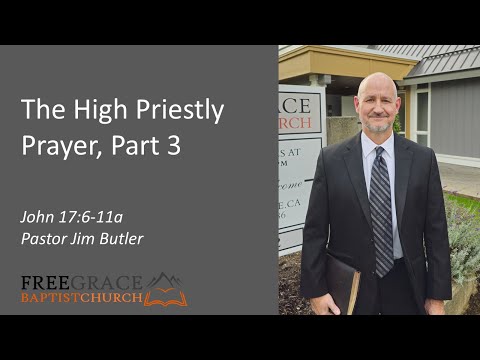
The High Priestly Prayer, Part 3
Jesus intercedes for his apostles in John 17:6–11a, and this sermon examines who those men are, what qualifies them as objects of his high priestly prayer, and why he prays for them rather than for the world. The exposition grounds the disciples' identity in the Father's sovereign, electing gift of them to the Son within the eternal covenant of redemption, their reception of the words the Father gave to the Son, and their growing recognition that the Son is one in being with the Father. The preacher draws out the implication that faithful gospel ministry, like the ministry of Christ himself, must declare only what has been received from God, without accommodation to cultural pressure or the demand for entertainment.

2LCF, Introduction and Preface to the 1689 Second London Baptist Confession
The Second London Baptist Confession of Faith (1689) did not arise in a vacuum — it was forged under persecution, shaped by theological antiquity, and published to correct misrepresentations of Particular Baptist doctrine. This study introduces the Confession through its original preface, examining the necessity and utility of creeds and confessions, the historical context of 17th-century England, and the specific additions, changes, and deletions the Particular Baptists made to the Westminster Confession and Savoy Declaration. The Confession stands as a faithful summary of biblical doctrine and a demonstration that Particular Baptists stood firmly within the stream of historic Protestant orthodoxy, differing from their Presbyterian and Congregationalist brethren only on baptism, church polity, and certain covenant theology distinctions.

Spurgeon & Open Air Preaching

Drawing on Hebrews 13:7's command to remember and follow faithful ministers, this lecture examines the life, preaching, and open-air ministry of Charles Haddon Spurgeon as a model for gospel proclamation. The speaker presents material from his published doctoral dissertation on Spurgeon's open-air preaching, working through three open-air sermons and Spurgeon's own pedagogy for street evangelism. A recurring application presses the listener — whatever their theological sophistication — to proclaim the excellencies of Christ to all people, including the lowest and most despised.

Ask FGBC #37: Why join a church?
Church membership is not optional for the Christian: Scripture commands gathering together, pastoral ministry presupposes a definable flock, and the means of grace — preaching, baptism, the Lord's Supper, mutual accountability, and church discipline — are administered within the bounds of a local, covenanted congregation. The question of why one should formally join a church is answered first by the authority of God's command, and then by the necessarily local character of the duties owed between members and their pastors. Those who have been hurt by church abuse are exhorted not to abandon the institution but to find a congregation where they can commit themselves as members.