
Topic
Christology
1,353 sermons · All topics

The Victory of David Over Goliath, Part 1

1 Samuel 17:1–37 is not a psychological self-help story about facing personal obstacles; it is a narrative of the glory of God. Goliath defies the armies of the living God, and David — a type of Christ — meets that defiance not with natural courage but with faith grounded in the proven faithfulness of Yahweh. The sermon traces the contrast between Israel's faithless paralysis and David's God-centred confidence, showing that apostasy produces cowardice while faith in the living God produces boldness. The practical summons is to walk by faith rather than by sight, to serve faithfully in ordinary providential callings, and to draw confidence for present trials from remembered past mercies.

The Lord's Arrest in the Garden
Matthew 26:50–56 records the arrest of Jesus in Gethsemane, and this exposition works through four movements in the passage: Peter's misguided sword-stroke, Christ's rebuke concerning the nature of the messianic kingdom, his rhetorical indictment of the mob's hypocrisy, and the disciples' desertion. The sermon shows that Christ's surrender was entirely voluntary, governed by the covenant of redemption and the fulfillment of prophetic Scripture, not by any inability to resist. Hearers are warned against mistaking external proximity to Christ for saving grace, called to zeal tempered by theological knowledge, and directed to the Lord's Supper as an occasion to 'kiss the Son' in faith rather than in the betrayal of a Judas.

The Anointing of David
God's rejection of Saul and anointing of David in 1 Samuel 16 sets the stage for one of the richest typological passages in the Old Testament. The sermon traces two movements — God's sovereign selection of David at Bethlehem and David's providential entry into Saul's court — to establish that God judges by the heart rather than outward appearance, that the reception of the Spirit precedes conflict rather than eliminating it, and that David's entire narrative points forward to his greater Son, the Lord Jesus Christ. Listeners are called to resist the health-and-wealth error that trials signal divine disfavor, to tend the inner man before God in private, and to rest in the one through whom the righteousness David celebrated by faith is actually accomplished and imputed.

Bible Study - Exodus 4
Exodus 4 continues the call narrative begun in chapter 3, tracing Moses' repeated reluctance to accept the commission to deliver Israel from Egypt and God's patient, sovereign response to each objection. God confirms Moses' authority through three authenticating signs — the rod becoming a serpent, the leprous hand, and water turned to blood — not as ends in themselves but as instruments to authenticate Moses as God's spokesman, consistent with the function of signs throughout Scripture. The chapter's second half traces Moses' return to Egypt, including the judicial hardening of Pharaoh's heart as an act of divine justice rather than injustice, Israel's identification as God's firstborn, and the concluding scene of Israel's elders bowing in worship upon receiving Moses and Aaron's testimony. The sermon calls hearers to find comfort in the absolute sovereignty of God over nature, disease, human speech, and pagan rulers, and to let that knowledge shape reverent, joyful corporate and private worship.

The Third Missionary Journey, Part 6
Acts 20:28–31 records the Apostle Paul's pastoral charge to the Ephesian elders at Miletus — a charge that functions as the first pastors' conference in the new covenant era. The passage demands that elders take heed to themselves and to all the flock, that they shepherd the blood-bought church of God, and that they remain vigilant against both external persecution and internal doctrinal corruption. The theological weight of the phrase 'the church of God which He purchased with His own blood' opens into a precise treatment of the communication of idioms, establishing that the divine and human natures of the one person of Christ are the ground on which Scripture can speak of God's own blood. Ministers are called to feed the flock with the whole counsel of God, warned that savage wolves and ambitious false teachers will arise, and exhorted to watch and warn with the same tear-stained fidelity that marked Paul's three years in Ephesus.

Bible Study - Exodus 3
Exodus 3 presents the burning bush theophany as a revelation of the character of God before it is a commission to Moses. The passage is expounded under three headings: the commission given to Moses (vv. 1–12), the revelation of the divine name Yahweh (vv. 13–15), and the instructions given to Moses concerning Israel and Pharaoh (vv. 16–22). The divine name 'I AM WHO I AM' discloses God's self-existence, eternality, immutability, and covenantal faithfulness — attributes that must frame corporate worship and undergird the believer's confidence in affliction.

The Third Missionary Journey, Part 5
Acts 20:17–27 records the Apostle Paul's address to the Ephesian elders at Miletus — the only extended speech in Acts directed specifically to Christian leaders. The sermon examines Paul's review of his own apostolic ministry as a model for pastoral faithfulness, tracing his humility and tears, his unflinching proclamation of repentance toward God and faith in Christ, and his resolve to press toward Jerusalem despite the Spirit's testimony of chains and tribulations ahead. Paul's declaration of innocence in verse 27 — grounded in his refusal to shun the whole counsel of God — is pressed as the standard against which every gospel minister will stand accountable before God.

The Lord's Betrayal in the Garden
Matthew 26:47–50, read alongside John 18:1–11, presents the betrayal of the Son of God in Gethsemane as the arrival of the cup of divine wrath — the hour for which he came. The sermon traces three aspects of the betrayal: its significance as the fulfillment of prophecy and the onset of Messianic suffering, the diabolical plan coordinated by Judas and the religious leaders, and the execution of that plan through a hypocritical kiss. The exposition then turns to John 18 to show that even as Christ surrendered, he revealed his divine identity by the words 'I Am,' causing the armed mob to draw back and fall to the ground — a display of the glory that will be fully manifested at his return. The central application is twofold: believers are called to stand in awe of the active obedience and voluntary self-surrender of Christ whose righteousness is imputed to them, and unbelievers are warned that the only preparation for facing that glory is faith in the Lord Jesus Christ.

The Problem Worse than Paralysis
The healing of the paralytic in Matthew 9:1–8 exposes a problem far deeper than physical disability: the guilt of sin before a holy God. Jesus pronounces forgiveness before He commands the man to rise, revealing that the greater miracle is not restored limbs but a cleansed soul — and that the Son of Man possesses divine authority on earth to forgive sins. The physical healing serves as demonstrable evidence of the greater, invisible reality: that Christ accomplished what His name declared He would do, saving His people from their sins. The right response to such power is not mere wonder but the fear-and-joy that drives genuine worship and sustains the believer's cheer through every temporal affliction.
Nations Rage, God Mocks

Psalm 2 confronts the rage of earthly rulers against God and His anointed with a sober theological question: why do the nations engage in so futile an endeavor? The sermon expounds the psalm under three headings — the rebellion of earthly kings, the reign of the heavenly king, and the recognition of the true king — tracing the Davidic covenant through its fulfillment in the resurrection and exaltation of Christ. The Covenant of Redemption grounds the certainty of Christ's present reign at the right hand of the Father, and that certainty is the sole comfort available to God's people as nations continue to rage and the history of the church runs red with the blood of martyrs. Hearers are called either to kiss the Son in filial fear and find blessing, or to perish in the way of the ungodly.

Excerpt: One insurrectionist saved, so that no sinner might despair
The dying thief on the cross confessed Christ as Lord not amid miracles and abundance but amid gore, agony, and apparent defeat — which is why Calvin called it the most remarkable example of faith since the creation of the world. This sermon examines the thief's faith in its two inseparable dimensions: seeing Jesus as the Lord who possesses a kingdom even from the cross, and casting himself upon the mercy of Christ rather than resting on any work, righteousness, church attendance, or catechetical knowledge. Justification is by faith alone in the suffering Savior, and the gospel is good news precisely because God demands nothing from the sinner but that he look and live.

Excerpt: If I come to Jesus, will He save me?
The gospel offer is genuinely free: Jesus stands ready and willing to save every sinner who comes to Him, without preparation, merit, or prior self-reformation. Drawing on John 6:37 and the parable of the prodigal son, this excerpt refutes the lie that Christ might refuse or be unwilling to receive a sinner who comes to Him. The dying thief on the cross is the paradigm case — he brought nothing but himself, and grace was sufficient.

The Salvation of Zacchaeus
Luke 19:1–10 presents the salvation of Zacchaeus as a concrete demonstration of sovereign, irresistible grace applied to an utterly unworthy sinner. The sermon traces two movements: first, the description of Zacchaeus as a chief tax collector — condemned before God, rich through corruption, possessing nothing to commend him to divine favor — and second, the mission of Christ, who sovereignly summons Zacchaeus from the tree and brings salvation to his house. The crowd's complaint that Christ eats with sinners is shown to be, unwittingly, the very proclamation of the gospel, while Christ's own declaration — 'the Son of Man has come to seek and to save that which was lost' — is set forth as the irreducible statement of His redemptive purpose. Hearers are exhorted to find their hope not in moral accomplishment but in the seeking and saving God who invades the lives of sinners they have given up on.

The Lord's Prayer in Gethsemane
What does the agony of Christ in Gethsemane reveal about who He is and what He accomplishes? Expounding Matthew 26:36–46, this sermon traces the Savior's three prayers against the disciples' repeated failure to watch, showing that Christ's soul-sorrow is perfectly consistent with His true humanity, while His unwavering resolve to drink the cup of divine wrath flows from His eternal commitment as covenant mediator. The cup is not metaphor for mere suffering but the concentrated fury of God upon a sinless substitute — which explains both why martyrs die differently than Christ and why the imputation of His active obedience is as necessary as the forgiveness of sins. Believers are called to marvel at His sufficiency, to watch and pray with sobriety about their own weakness, and to rest entirely on the righteousness of Another.

The Thief on the Cross
What does the conversion of a man guilty of insurrection and murder on the day of his execution reveal about the grace of God? This exposition of Luke 23:39–43 traces the marks of sovereign grace in the dying thief — his fear of God, his ownership of personal guilt, his acknowledgment of Christ's sinlessness, and his faith cast entirely upon a crucified Lord — before turning to the willing and able Savior who, in the extremity of his own suffering, assures a notorious criminal of immediate paradise. The sermon argues that justification is by faith alone, apart from works, baptism, or religious knowledge, and that the distinguishing mercy shown to one thief and withheld from the other is the clearest emblem of sovereign grace. Hearers are pressed not to presume on a deathbed conversion but to cast themselves now, by grace, upon the mercy of Christ.

The Victory of Samson at Jawbone Height
Judges 15 recounts Samson's victory over the Philistines at Jawbone Height, but the chapter's deepest scandal is not the enemy outside — it is the cowardice of the covenant tribe of Judah, who bind their own deliverer and surrender him to those he was sent to destroy. This sermon traces three movements in the text: the betrayal by Samson's father-in-law, the treachery of Judah's three thousand men, and the Spirit-empowered defeat of a thousand Philistines with a fresh jawbone. Throughout, Samson emerges as a type of Christ — delivered by his own people into enemy hands, yet vindicated by God — and the lesson pressed upon the hearer is that God's grace delivers a people who neither cry out for deliverance nor deserve it.

The Messiah, The Baptist, And The Kingdom
Matthew 11:2–15 presents three interlocking questions: who is Jesus the Messiah, who is John the Baptist, and what is the nature of the kingdom of heaven? The sermon works through John's imprisoned inquiry — not as rank unbelief but as a struggle with the shape of the messianic agenda — and Christ's answer, which grounds assurance in fulfilled Old Testament prophecy rather than in political deliverance. John is then assessed by Christ himself as more than a prophet, the very subject of Malachi's covenant-messenger prophecy, a man of unflinching courage who stands as a model for preachers and all believers. The enigmatic kingdom-violence saying of verse 12 is read as a positive-negative pairing: the kingdom forcefully advances through proclamation and regeneration, but violent men persist in opposing and plundering it until Christ's enemies are made his footstool.
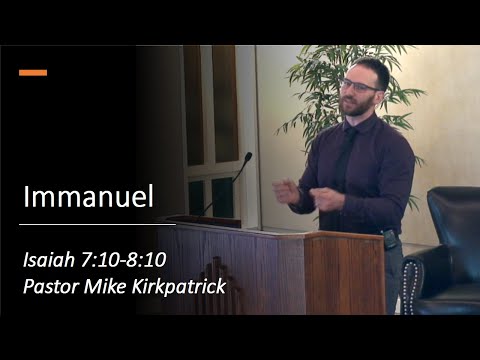
Immanuel
Isaiah 7:10–8:10 presents the Immanuel prophecy not as a comfortable seasonal text but as a word of judgment against Ahaz's faithless trust in Assyria and a word of hope for the covenant remnant. The sermon traces two contrasting realities: 'Assyria with us,' the consequence of royal unbelief, and 'God with us,' the promise that anchors the remnant through exile and desolation. The Immanuel sign finds its definitive fulfillment in Matthew 1, where the virgin-born Son saves his people from sin rather than merely political oppression — a truth that remains the ground of steadfastness for the church in every era of suffering and exile.

The Prediction of Desertion and Denial
Matthew 26:31–35 records Jesus predicting both the desertion of all His disciples and the specific denial of Peter on the night of His arrest. The passage demonstrates that the salvation accomplished at the cross was entirely the work of Christ alone — His friends fled, leaving no horizontal assistance — and that Scripture, citing Zechariah 13:7, had appointed this scattering from eternity. The sermon draws out the persistent problem of remaining corruption in the regenerate: the pride, self-confidence, and lofty self-assessment that Peter epitomizes are not unique to him but are symptomatic of all God's people. The remedy is not stronger resolution but a biblical self-assessment that drives the believer away from confidence in the flesh and toward continual dependence on the grace and Spirit of God.

Introduction to the Book of Exodus
The book of Exodus is not a standalone document but the second movement of the Pentateuch, continuing the story of the covenant people from Genesis through to their deliverance from Egypt, the giving of the law at Sinai, and the construction of the tabernacle. This introductory study surveys the book's structure through three themes — deliverance, demand, and dwelling — and traces how each anticipates Christ: Moses as covenant mediator prefiguring the greater Mediator, the Passover lamb pointing to the sacrifice of Christ, and the tabernacle foreshadowing the incarnation. The threefold division of God's law (moral, judicial, ceremonial) is explained with reference to the 1689 London Baptist Confession of Faith, with particular attention to why the moral law remains perpetually binding while the judicial and ceremonial laws have expired. The study closes by applying the Immanuel principle — that God redeems his people in order to commune with them — to the corporate worship of the New Covenant church.

Genesis 49
Genesis 49 presents Jacob's deathbed blessings and prophetic declarations over each of the twelve tribes of Israel, reaching its theological apex in the Shiloh prophecy of verses 8–12, which identifies the tribe of Judah as the royal line from which Messiah will come. The scepter's promised continuity in Judah until 'Shiloh comes' is shown to anticipate not only David's dynasty but the obedience of all peoples — Jew and Gentile — to the Lord Jesus Christ, the Lion of the tribe of Judah. Jacob's closing instructions concerning his burial in the cave of Machpelah reaffirm Israel's legal title to the promised land and underscore that Egypt is only a sojourn, not a destiny. The chapter closes with a call to confidence in God grounded in a lifetime of witnessed divine faithfulness, expressed in Jacob's peaceful death and his declaration, 'I have waited for your salvation, O Lord.'

The Manifestation of God's Grace
Titus 2:11–15 presents God's grace not merely as the ground of salvation but as the very teacher of holy living. This exposition traces four aspects of grace in the passage: its appearance in the incarnation and atoning work of Christ, its instruction toward denial of ungodliness and worldly lusts and pursuit of sober, righteous, and godly life, its demonstration in the deity of the returning Christ and the definite redemption he accomplished, and its proclamation through authoritative gospel ministry. The controlling hermeneutical key is the grammatical and theological priority of the indicative over the imperative: believers obey not in order to be saved but because they have been saved, and inverting that order collapses the gospel into moralism.

Genesis 48:1-22
Genesis 48 records Jacob's adoption of Joseph's two sons, Ephraim and Manasseh, as tribal heads within Israel, and his deliberate bestowal of the greater blessing on the younger Ephraim — a pattern running throughout Genesis that the covenant blessings are dispensed not by birth order but by sovereign divine election. The chapter's vocabulary of "firstborn" is examined in light of Colossians 1:15, demonstrating that the term denotes preeminence rather than creaturely origin, directly refuting the Arian Christology of Jehovah's Witnesses. Jacob's deathbed testimony — praising God who fed him all his life and whose Angel redeemed him from all evil — is held up as a model for how the people of God should rehearse divine faithfulness at the close of life.

The Second Missionary Journey, Part 4
Acts 16:35–17:9 records Paul's departure from Philippi and his gospel ministry in Thessalonica on the second missionary journey. The passage presents two interlocking lessons: Paul's principled invocation of his Roman citizenship to protect the integrity of gospel ministry, and his rigorous expository method of reasoning, explaining, and demonstrating from the Old Testament Scriptures that Jesus is the Christ who had to suffer and rise. The sermon draws out three grounds on which a Christian may lawfully invoke civil rights — innocence, governmental accountability, and future precedent — while insisting that the efficient power behind every conversion is the sovereign grace of God through the Holy Spirit, not the eloquence of the preacher. Hearers are called to imitate the relentless faithfulness of Paul, Silas, and Jason, and to proclaim the kingship of Jesus regardless of civil hostility.
The Introduction to the Book of Titus
Titus 1:1–4 contains one of Paul's longer epistolary introductions, and the reason is pastoral and strategic: Paul is authenticating the ministry of Titus among a difficult, newly-planted congregation on Crete by anchoring his own apostolic authority in the eternal decree of God. The sermon surveys the historical and biographical background of the pastoral epistles before working through Paul's self-designation as bondservant and apostle, his two-fold apostolic purpose (the salvation and sanctification of God's elect), and the grounding of that purpose in the covenant of redemption purposed before time began. The greeting's triad of grace, mercy, and peace — flowing from both God the Father and the Lord Jesus Christ, each called 'Savior' — opens a rich vein of covenant theology, Christology, and soteriology that will run through the entire book.
The Resurrection and Justification
Romans 4:25 declares that Christ 'was delivered up because of our offenses and was raised because of our justification' — a verse Charles Hodge called a comprehensive statement of the gospel and Matthew Poole called an abridgment of the whole. The sermon works through two inseparable redemptive realities: the substitutionary, particular atonement accomplished in Christ's death, and the five-fold testimony of the resurrection to the validity of that work. The central application is that a robust grasp of justification by faith alone — the imputation of Christ's righteousness received through faith — is the irreplaceable foundation for Christian stability, comfort, and peace with God.

The Empty Tomb and the Risen Lord
The resurrection of Jesus Christ from the dead is not a cunningly devised fable but a historically attested and theologically necessary event that vindicates Christ's person and work. Expounding Matthew 28:1–10, this sermon examines the discovery of the empty tomb — the descent of the angel, the commission to the women, and the flight of the guards — and then the appearance of the risen Lord to the women, who held him by the feet and worshipped him. The hypostatic union underlies that act of worship: they touch his human feet while adoring the second person of the Trinity. Because Christ is risen, believers need not fear, have an advocate with the Father when they sin, and possess a hope that is grounded in historical reality and not mere sentiment.

The Institution of the Lord's Supper
Matthew 26:26–30 records the institution of the Lord's Supper by Christ on the night of Passover, and this sermon works through that text to establish the supper's setting, its elements, and its eschatological horizon. The bread and cup are not transformed in substance — transubstantiation is explicitly repudiated as repugnant to Scripture, reason, and the 1689 confession — but are consecrated from common use to signify Christ's broken body and shed blood. The blood of the new covenant is shed 'for many,' not all without exception, anchoring the supper in the doctrine of particular redemption and the forgiveness of sins as the chief covenantal benefit. Believers are exhorted to receive the supper not as a reward for good behavior but as a means of grace by which God strengthens, fortifies, and confirms the faith of His pilgrim people.
Genesis 44-45
Genesis 44–45 presents the arrest of Joseph's brothers, Judah's substitutionary intercession for Benjamin, and Joseph's dramatic self-disclosure — all framed by a fourfold emphasis on the providence of God. The separation between chapters 44 and 45 artificially interrupts what is one of the most theologically dense scenes in the entire Pentateuch: Judah, the man who once sold Joseph into slavery, now offers himself as a slave in Benjamin's place, functioning as a type of Christ. Joseph's forgiveness of his brothers flows directly from his theological grasp of divine sovereignty, demonstrating that a right understanding of providence is the engine of genuine forgiveness. The sermon closes with the typological significance of both Judah and Joseph as portraits of the Lord Jesus Christ embedded in the redemptive narrative of Scripture.

The Family of Christ
Mark 3:31–35 presents Christ distinguishing his earthly family from his spiritual family, using the arrival of his mother and brothers as a teaching moment about the nature of true belonging to God. The sermon works through two headings — Jesus's earthly family (vv. 31–32) and Jesus's spiritual family (vv. 33–35) — showing that physical descent and bloodlines carry no weight in determining who belongs to Christ. Membership in the family of God is defined by doing the will of God, which is unpacked as faith in Christ — repentance and belief in the gospel — not moral effort or ethnic identity. The hearer is pressed to consider whether they are an insider or an outsider, with the call to draw near to the elder brother through the means of grace.