
Topic
Christian Living
1,140 sermons · All topics

The Preface to the Ten Commandments

Deuteronomy 5:1–6 opens the Ten Commandments not with a command but with a declaration of divine redemption — 'I am the Lord your God, who brought you out of the land of Egypt, out of the house of bondage.' This study works through the summons to covenant obedience, the grace-grounded preface to the Decalogue, and the uniqueness of the moral law as trans-covenantal and abiding. The threefold division of the law — moral, ceremonial, and judicial — is examined through the confession, the prophets, the Gospels, and the epistles, equipping believers to distinguish what abides in the new covenant from what was fulfilled and abrogated in Christ.

Light Prevails Over Darkness
Ephesians 5:13–14 sets before the hearer a decisive confrontation: the light of Christ exposes the darkness of sin, spiritual blindness, and death, and effectually calls sinners to life. The sermon traces the contextual contrast between spiritual darkness and light, the two components by which Christ's light operates (the external word and the internal work of the Spirit), and the gospel call to awake and arise. Justification by faith alone — faith as the sole instrument by which the sinner receives and rests on Christ's imputed righteousness — is the doctrinal center from which applications to the unbeliever, the backslidden, and the walking believer are drawn.

CLIP: The Trinity in 2 Minutes

The doctrine of the Trinity is not a division of the divine essence into three parts, but one infinite and undivided substance eternally subsisting as Father, Son, and Holy Spirit. The confession's language moves deliberately between the oneness and the threeness of God — the Father unbegotten, the Son eternally begotten, the Holy Spirit proceeding from both — holding the unity and the distinction together without confusion. This doctrine is not speculative theology but the very foundation of the Christian's communion with God and the ground of confident, joyful worship.

The biggest benefit of church associations
Church associations among Reformed Baptist congregations find their deepest rationale not in organizational efficiency but in the mutual burden-bearing and intercessory prayer that Scripture commands. Drawing on 2 Corinthians 1:11 and Colossians 4:12, this address argues that prayer is the primary and most transferable form of help one congregation can render another, even across great distances. The sermon proper expounds Psalm 131 as the theological and devotional ground for the humility that makes genuine association life possible.

Hope in the Lord - Psalm 131
Psalm 131 sets before the believer a threefold portrait of the soul at rest: what pride refuses to do, what humble trust actively does, and what Israel is therefore commanded to do. David's calm and quieted soul — like a weaned child beside its mother — is not the product of self-will but of covenant hope directed toward Yahweh and his promises, ultimately fulfilled in Jesus Christ, the great Son of David. The sermon closes with three warnings against losing that hope: refusing to humble the heart, expecting what God has not promised, and fixing hope on anything other than God through Christ.

Live Stream - April 27, 2025
Psalm 131 is a three-verse psalm of ascent in which David describes three things he did not do — lift up his heart in pride, raise his eyes in defiance, or occupy himself with matters too great and too marvelous — and one thing he did do: calm and quiet his soul like a weaned child beside its mother, in a silence of trust rather than fear. The sermon expounds all three verses, identifying hope in the Lord — grounded in who Yahweh is and in the promises of the new covenant secured by Jesus Christ, the faithful Son of David — as the active disposition that produces that inner calm. Three closing applications warn that we will lose our hope if we refuse to humble ourselves, if we expect what God has not promised, and if we place our hope in anything or anyone other than God through Jesus Christ.

Our Eternal Dwelling Place

Psalm 90, the only psalm of Moses in the Psalter, confronts the brevity and bitterness of human life and points the wandering soul to the only dwelling place that neither crumbles nor wears out — God himself. The sermon moves through four movements: God's eternal being as the refuge of his people, the astonishing shortness of every human life, the hard reality that death is not natural entropy but divine judgment upon sin, and finally the hopeful petitions with which the psalm closes. Every petition in the psalm's closing verses finds its definitive answer in the person of Christ, in whom God has once again opened heaven and called sinners to dwell with him in peace.
CTF 2025 - Session 7 - Pastoral Reflections on Classical Theism
The prologue of John's Gospel (1:1–18) discloses both the divine perfections and the eternal relations of the divine persons — the very realities that classical theism and the Second London Confession articulate in Chapter 2. This address draws that exegetical foundation into pastoral practice, arguing that a robust theology proper is not abstract speculation but the necessary ground for faithful ministerial function and focus. The preacher identifies six areas — the salvation of sinners, the catechesis of children, the perseverance of the saints, assurance of salvation, communion with God, worship, and the knowledge of God — each of which depends inextricably on a well-formed doctrine of God.

CTF 2025 - Session 2 - Divine Simplicity
Divine simplicity — the doctrine that God is without parts of any kind, physical or metaphysical — is the necessary precondition for God to be the absolute first cause of all things confessed in Romans 11:36. This lecture, drawn from 2LCF Chapter 2 Paragraph 1, works through the logic of composition and dependence to show that any being composed of parts is doubly dependent: upon those parts and upon whatever unifies them, and is therefore disqualified from being the uncreated Creator. Divine infinity is then treated as a corollary of simplicity: because God has no compositional structure of finitude, his being is actual, unbounded, and without lack, which is the only reliable ground for absolute trust and worship.

The Necessity of Faithful Obedience
Deuteronomy 4 closes Moses' historical prologue with an urgent exhortation to the second generation of Israel on the necessity of faithful covenant obedience before crossing the Jordan. The chapter's three movements — the necessity of obedience (vv. 1–8), the dangers of idolatry (vv. 9–31), and the incomparability of Israel's God (vv. 32–40) — are treated as an impassioned speech by a man who lived the history he recounts. Scripture's sufficiency is defended against every form of addition or subtraction, and the regulative principle of worship is grounded in God's self-revelation at Sinai as a consuming fire who receives no image.

Wilderness wanderings
Deuteronomy 2–3 records Moses rehearsing the wilderness wanderings for the second generation of Israel, poised on the plains of Moab before the conquest of Canaan. God's multinational sovereignty is on display as He assigns territorial boundaries to Edom, Moab, and Ammon, then delivers Sihon and Og into Israel's hands — demonstrating that the God of Israel governs all nations, not merely His covenant people. The historical review functions both as a warning against repeating the unbelief of the first generation and as an encouragement to trust the same God who preserved Israel through forty years of wilderness trudging. New Covenant believers are called to the same posture: to dwell on the record of God's faithfulness in redemptive history so as to remain steadfast through present trials.

The Example of the Savior, Part 3
Philippians 2:8 presents the humility of Christ not as incidental biography but as the doctrinal and ethical foundation for the church's conduct. This sermon examines first the declaration of Christ's humility — that he humbled himself voluntarily, according to his human nature as covenant mediator, in active obedience to every demand of God's law from his mother's womb — and then its demonstration in the extent of that humiliation: even the death of the cross, a death cursed by the law and laden with shame. The active and passive obedience of Christ, taken together, are the sole ground of justification by faith alone, which is why the Lord's Supper is received not as a reward for good conduct but as a proclamation of what the Savior accomplished on behalf of his people.

Ask FGBC #41: Why Does The Devil Hate Women So Much?
The question of why women have historically suffered disproportionate oppression and violence is examined through a biblical theological lens. Two theological threads are drawn out: Satan's covenantal enmity against the woman whose seed would crush him (Genesis 3:15), and the doctrine of total depravity, which explains how sinful men exploit the physically weaker vessel Peter describes in 1 Peter 3. The discussion concludes that the abuse of women is a symptom of human rebellion against God's creational order of male headship and protection.
Deuteronomy 1
Deuteronomy 1 opens Moses' first address to the second generation of Israel on the plains of Moab, a historical review designed to prepare the people for the conquest of the promised land. Moses rehearses four episodes: God's command to advance from Horeb, the appointment of judges, the rebellion at Kadesh Barnea rooted in unbelief, and the punishment that fell on the first generation. The central diagnostic is verse 32 — 'you did not believe the Lord your God' — which exposes unbelief as the taproot of Israel's grumbling, refusal, and covenant faithlessness. The sermon calls the New Covenant congregation to dwell on this history so as to be steadfast in the future, trusting the same God whose promises are yes and amen in Christ.

Ask FGBC #40: Is It Okay to Have Children’s Bibles With Pictures of Jesus?
The second commandment forbids images of God and Christ, including pictures of Jesus in children's Bibles. While children's Bibles without images may serve a limited purpose, parents are called to instruct children directly from Scripture, since it is by the Word — not by pictures — that God saves sinners and edifies his people. Any children's Bible used should accurately represent the sense of Scripture rather than obscure it through paraphrase.

The Priority in the Believer's Life - Matthew 6:25-34
Jesus commands his disciples not to worry about life, body, or tomorrow in Matthew 6:25–34, grounding the prohibition in three realities: God's providential care demonstrated in birds and lilies, the contrast between Gentile obsession and the believer's knowledge of a knowing Father, and the governing priority of verse 33 — seek first the kingdom of God and his righteousness. The sermon argues that carnal anxiety is theologically inconsistent for the Reformed believer: one who confesses God's comprehensive sovereignty in salvation yet surrenders to worry about temporal provision has applied Calvinism selectively. The antidote is not mere positive thinking but the cultivation of contentment rooted in the imputed righteousness of Christ, which grants entrance into the very kingdom we are commanded to seek first.

Live Stream - March 16, 2025
Philippians 2:7 presents four statements concerning the Incarnation of the Son of God: he made himself of no reputation, took the form of a bond servant, came in the likeness of men, and was found in appearance as a man. The sermon works carefully through each phrase to establish true Humanity against kenotic Christology on one side and Docetism on the other, arguing that Christ never ceased to be God but assumed a full human nature into personal union — the hypostatic union confessed at Chalcedon and codified in the 1689 LBCF chapter 8. Paul's purpose is ultimately ethical: the condescension of the eternal Son from the heights of Divinity to the form of a bond servant is the supreme argument against selfish ambition and conceit among believers.
The Woman Who Was a Sinner
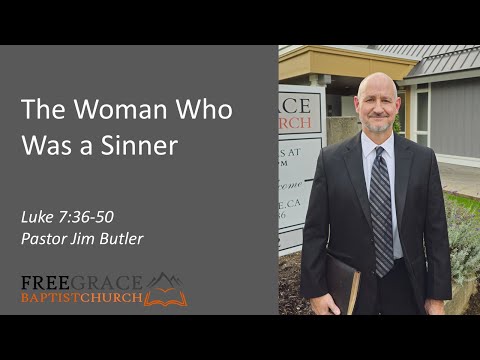
Luke 7:36–50 presents three persons — the woman who was a sinner, the judgmental Pharisee Simon, and the Savior — to demonstrate that Christ freely receives and forgives notorious sinners, and that the devotion the woman shows is not the cause of her forgiveness but the consequence of it. The sermon argues she had already been saved before entering Simon's house, and that her tears, hair, and ointment are the fruit of a faith already given, not works by which she procured salvation. Against the self-righteous contempt of Simon, who mistakes moral superiority for spiritual standing, Christ's declaration 'your faith has saved you' makes plain that free forgiveness is received instrumentally through faith alone and expressed afterward in love. Believers are called to examine whether their own lives reflect the same gratitude this woman showed — not by manufactured effort, but by pondering the greatness of what they have been freely forgiven.

The Believer's Response to Trials
James 1:2–8 addresses the Christian's response to trials — not with grief or complaint, but with counted joy grounded in a clear theological understanding of God's purpose in suffering. The sermon works through two movements: the believer's response to trials in verses 2–4 (identifying, expecting, and rightly receiving them) and the believer's request during trials in verses 5–8 (seeking wisdom from a generous God and coming in faith without double-mindedness). The central application is that Christians must lay up this theology before trials arrive, so that when affliction comes, they are equipped to respond with settledness, faith, and prayer rather than anger or despair.

Ask FGBC #37: Why join a church?
Church membership is not optional for the Christian: Scripture commands gathering together, pastoral ministry presupposes a definable flock, and the means of grace — preaching, baptism, the Lord's Supper, mutual accountability, and church discipline — are administered within the bounds of a local, covenanted congregation. The question of why one should formally join a church is answered first by the authority of God's command, and then by the necessarily local character of the duties owed between members and their pastors. Those who have been hurt by church abuse are exhorted not to abandon the institution but to find a congregation where they can commit themselves as members.
The Law Concerning Offerings and Vows
Numbers 28–30 presents the divinely regulated calendar of offerings and the law governing vows in Old Covenant Israel, both of which underscore that Israel was not merely a migrating people but a covenant community ordered by the worship of God. The offerings — daily, Sabbath, monthly, and the seven yearly feasts — served to remind Israel of their redemptive history, promote joy and community, resist idolatry, and ensure rest in God's presence, all of which find their fulfillment in Christ. The law of vows in chapter 30 teaches the sanctity of truth, the binding nature of solemn commitments made before God, and the complementarian order in which a woman's vow was subject to the authority of her father or husband. Together these chapters call the New Covenant believer to faithful, regulated worship, truthful speech, and lives of sanctification that flow from justification by grace alone through faith alone in Christ alone.

The Idolatry of Solomon
Solomon's reign, celebrated across 1 Kings 3–10 as a golden age of wisdom and divine blessing, collapses in chapter 11 under the weight of multiplied foreign wives and the idolatry they drew him into — a direct violation of the Mosaic prohibitions in Deuteronomy 7 and 17. The sermon traces the idolatry itself (vv. 1–8) and the divine response (vv. 9–13), showing that Solomon's sin was aggravated by his knowledge of the law, the good example of his father David, and two personal appearances of God. From this sobering case the sermon draws eight practical warnings: that experience, godly example, knowledge, and wisdom are not in themselves sufficient to secure present faithfulness, and that the believer's only safeguard is constant dependence on the Holy Spirit and a mind rooted in Scripture.

Baptism and testimony: Janelle Neels
A brief baptismal testimony in which the speaker recounts her conversion in September 2018, tracing God's providential drawing of her through faithful Christian friends, the preaching of the gospel, and a decisive moment of repentance and faith. She describes the assurance that followed — sin forgiven, fear of death removed, adoption into God's family — and anchors her ongoing Christian life in Galatians 2:20.

Baptism - Chauncey Knegt
Three believers are baptized by immersion upon personal profession of faith and repentance, following the pattern of believers' baptism as confessed in the 1689 London Baptist Confession of Faith. Each candidate gives testimony to the sovereign grace of God in their conversion — from effectual calling under the preached word, to assurance grounded in the finished work of Christ, to the covenant obligations of church membership. The service underscores that baptism is a sign of union with Christ in his death and resurrection, a public act of obedience to Christ's command, and the believer's entry into the mutual accountabilities of a local church.

Ask FGBC #35: Believers Baptism Before Communion?
Should believers be baptized by immersion before taking the Lord's Supper? This Q&A exchange addresses the biblical order of the ordinances as established in the Great Commission and reinforced by Paul's teaching in Romans 6, arguing that baptism by immersion properly precedes participation in the Lord's Supper. The discussion also touches on how a local church exercises pastoral grace when visitors from paedobaptist backgrounds present themselves at the table, while maintaining that credobaptism by immersion is the biblical norm.

Ask FGBC #34: How Much Marriage Counselling Should Pastors Provide?
A pastor and elder discuss the appropriate scope of pastoral marriage counselling, framing the pastor's role on the model of a general practitioner who handles common presenting problems but refers complex cases to specialists. Most marital conflict, they argue, traces back to a failure to obey the clear biblical commands of Ephesians 5 — husbands failing to love sacrificially, wives failing to submit willingly — making the pastoral response straightforward in principle even where circumstances are complex. The conversation resists both an over-medicalised model that sidelines the pastor and a naive model that refuses any referral.

The Unity of the Church
Philippians 2:1–4 grounds the church's unity in the Trinitarian realities of consolation in Christ, the comfort of the Father's love, and the fellowship of the Holy Spirit — not in human sentiment. The passage moves through a commendation of unity (vv. 1–2) and a cultivation of unity (vv. 3–4), showing that selfish ambition and conceit are the precise enemies of the love and one-mindedness the apostle commands. The sermon concludes that humility, self-denial, and others-mindedness are not optional graces but the indispensable conditions for a church that advances the cause of Christ — and that none of these can be pursued apart from the ongoing work of the Holy Spirit.

The Sixth Commandment
The Sixth Commandment — 'You shall not murder' (Exodus 20:13) — addresses far more than the physical act of killing; it presupposes the dignity of every human being as an image-bearer of God and condemns unrighteous hatred of the heart. This sermon expounds the Hebrew word for murder, distinguishing it from lawful killing in capital punishment, just war, and self-defense, before pressing the command's indictment of abortion and euthanasia as violations of the sanctity of life. Jesus's teaching in Matthew 5 extends the commandment's reach to unwarranted anger and character assassination, and the three uses of the law — civil, pedagogical, and normative — frame both the church's public witness and the believer's ongoing sanctification. The sermon closes by insisting that the most faithful response to a death culture is to preach both the law and the cross of Christ.

The Free Offer of Eternal Life

Paul's defense of his ministry in 1 Thessalonians 2:1–4 is not merely self-vindication but a demonstration that the gospel he preached is categorically different from the self-serving philosophies of his day — it came without error, without moral corruption, and without deceit. The message cost Paul greatly to deliver, yet it costs the hearer nothing to receive, because Christ paid the full price. God himself, through appointed ambassadors, freely offers eternal life to sinners who will lay aside their rebellion and receive the gift by faith alone.

Ask FGBC - July 2024 Podcast with Pastors Butler and Kirkpatrick
Two pastors work through a wide-ranging set of questions submitted by listeners, covering the Reformed doctrine of the will, repentance and faith, holy days, Christian political engagement, believers' baptism, the New Covenant, forgiveness of unrepentant offenders, ongoing confession of sin, witnessing to homosexual neighbors, the Sabbath shift from Saturday to Sunday, the day of the Lord, the beatific vision, common grace, saving versus temporary faith, and the holy walk. Throughout, the answers are grounded in the 1689 London Baptist Confession and exposit the relevant biblical texts, consistently distinguishing the Reformed Baptist position from Arminian, dispensationalist, and paedobaptist alternatives. The session serves as accessible catechetical instruction for believers at all stages while modeling how confessional Reformed Baptist theology addresses both doctrinal and practical questions.