
Topic
Biblical Theology
1,075 sermons · All topics

The Law Concerning Servants

Exodus 21:1–11 opens what is commonly called the Book of the Covenant, the concrete judicial application of the Ten Commandments to Israel's civil life. The sermon situates this passage within the threefold division of the law — moral, ceremonial, and judicial — explaining why the judicial law expired with the Israelite commonwealth while its general equity retains moral use, and why the theonomic demand that modern civil magistrates enforce the Mosaic penal code lacks New Testament warrant. Working through three features of the law concerning servants — the limitation on service, the acquisition of a family during service, and the protection of female servants — the sermon argues that far from being barbaric, these laws reveal God's wisdom and kindness in restraining exploitation and protecting the vulnerable in a post-fall world.

The Blessings of the Resurrected Christ

Luke 24:36–53 presents the resurrected Christ bestowing concrete blessings upon his disciples before his ascension: peace, bodily proof of his resurrection, exposition of the Old Testament Scriptures, enabling grace for comprehension, and the promise of the Spirit. The physical demonstration Christ offers refutes both ancient Docetism and its modern heirs — if Christ did not truly assume humanity, the unassumed is the unhealed, and salvation itself is a phantom. The sermon calls believers to rest their religious affections upon the crucified, risen, and ascended Christ as the sum and substance of all biblical revelation, finding in him both the ground of present comfort and the power for gospel proclamation.

The Promise of Eternal Life
Isaiah 55 presents God's universal, gracious, and free invitation for sinners to come to Christ for life eternal — an invitation that has never changed from Genesis to Revelation. The sermon expounds the chapter in two movements: the invitation to come (vv. 1–5), grounded in covenant promise and secured by the Davidic king, and the exhortation to believe and repent (vv. 6–13), which calls sinners to faith and a change of mind toward sin. God's thoughts are not man's thoughts precisely because He pardons abundantly where man would not, and His word goes forth with certain efficacy to accomplish all He purposes in the salvation of sinners from every nation.
The Feast of Tabernacles, Part 2
John 7:14–24 presents two confrontations: the Jews question Christ's authority, and Christ in turn questions the Jews' ethical integrity. The sermon works through three grounds of Christ's authority—his unity with the Father, the regenerate hearer's capacity to receive his word, and his mission to glorify the Father rather than himself—before turning to Christ's indictment of the Jews for plotting murder while professing fidelity to the Mosaic law. The exposition closes with Christ's appeal to righteous judgment over mere appearance, and the preacher applies the whole passage as a call to sinners to come and drink from the one who alone satisfies the soul's thirst.

The Feast of Tabernacles, Part 1
John 7:1–13 presents the Feast of Tabernacles as the backdrop for intensifying hostility toward Jesus, whose unbelieving half-brothers urge Him to seek public exposure — a suggestion rooted in a man-centered, politically distorted messianic expectation. Christ refuses to act on their counsel, insisting instead on the divine timetable that governs every movement of His redemptive mission. The passage confronts two errors simultaneously: the assumption that physical proximity to Jesus produces saving faith, and the temptation to shrink from confessing Christ under social pressure — both of which the text answers by pointing to sovereign grace and the covenant community as God's appointed means of steadying His people.

The Problem of Israel's Apostasy
Israel's apostasy in Judges 2:7–3:6 follows a pattern rooted not in ignorance but in a failure to know the Lord experientially — a failure that produced syncretism, Baal worship, and divine chastisement. The sermon traces the root, description, and divine response to Israel's apostasy, showing that God's repeated raising up of judges was not provoked by Israel's repentance but by his own covenant faithfulness and mercy. Samson is presented as a type of Christ, each of the twelve judges pointing typologically to the Savior who would definitively deliver his people from their sins. The church is exhorted to keep herself unspotted from the world, resisting the toleration that leads by degrees to full apostasy.
The Idolatry of Solomon
Solomon's idolatry in 1 Kings 11:1–13 exposes how a man richly blessed by God — with the law, direct divine appearances, a faithful father, and transcendent wisdom — can fall into the grossest sin when he fails to guard his heart. The sermon traces the problem, precedent, and practice of Solomon's idolatry before examining God's just and covenant-shaped response: judgment tempered by the unconditional Davidic covenant that finds its telos in the Lord Jesus Christ. The passage issues sober warnings against the assumption that age, experience, knowledge, or good pedigree secure ongoing faithfulness apart from vigilant dependence on the Holy Spirit.

The Arrest of Peter and John
Acts 4:1–12 presents the arrest of Peter and John by the Sanhedrin and Peter's Spirit-filled defense before the council, in which he declares Jesus of Nazareth — crucified and risen — as the sole name under heaven by which men must be saved. The sermon traces two movements: the sovereign advance of God's word despite the imprisonment of its preachers (the number of believers growing to five thousand), and the christological and soteriological content of Peter's address, which grounds salvation exclusively in Christ's active obedience, atoning death, and resurrection. The stone rejected by the builders has become the chief cornerstone, and those who refuse him will ultimately be crushed by him. The sermon applies these realities to the perpetual persecution of the church, the exclusivity of the gospel, and the urgent call to believe on Christ alone for salvation.

Live Stream - July 03, 2022
Joshua 2 narrates the story of Rahab the Harlot, a Canaanite prostitute who sheltered the Israelite spies and confessed Yahweh as 'God in heaven above and on earth beneath.' This sermon exposits the chapter under three heads — the contact with Rahab, her confession of faith, and the covenant contract made with her — arguing that the chapter interrupts the conquest narrative to magnify the sovereign mercy of God toward an outsider who was utterly without covenant standing. The sermon concludes by tracing Rahab's place in the messianic genealogy and applying her conversion to the gospel call: Christ saves to the uttermost all who come to him, and the church is a refuge for sinners, not a club for the respectable.

The Conversion of Rahab the Harlot
Joshua 2 presents the conversion of Rahab the harlot as a sovereign interruption of divine mercy within the context of holy war and Israelite conquest. Before Israel kills a single Canaanite, the narrative compels the reader to stand in awe of a God who justifies a pagan prostitute by grace through faith alone — faith that is demonstrated by treason against Jericho and the sheltering of two spies. Rahab's confession that Yahweh is God in heaven above and on earth beneath places her alongside the great confessions of Scripture, and her inclusion in the Messianic genealogy of Matthew 1 reveals that the conquest was always inseparable from the redemptive purposes of God. The sermon calls hearers to resist self-righteous judgmentalism, to trust in a Christ who saves to the uttermost, and to marvel that the ancestress of Jesus was the shady lady of Jericho.

Live Stream - June 26, 2022

Isaiah 42:1–13, one of the great servant songs, presents the commissioning, mission, and victory of the Servant of Yahweh—the Lord Jesus Christ. The passage moves from the Servant's humility and compassion toward the bruised and broken, through Yahweh's sovereign upholding of him as Creator, to the certain, universal advance of his spiritual kingdom to the coastlands and ends of the earth. Christ is no meek idealist but a divine warrior who will not fail nor be discouraged until every last one of his people is conquered out of the kingdom of darkness and the kingdom is presented whole to the Father.
June 26, 2022 - Sunday School Confession Study (2LCF 7)
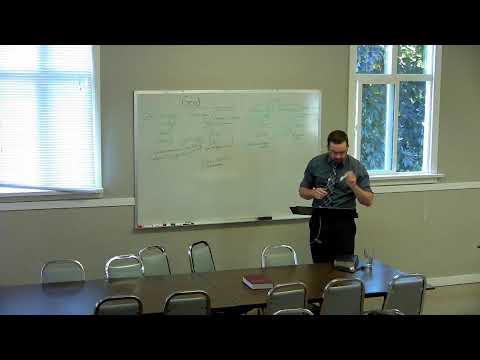
The covenant of works and the covenant of grace are not competing arrangements but sequentially related covenants that together explain why Christ had to become a man, obey the law perfectly, and bear its curse. Working through 2LCF Chapter 7, this study traces the Creator-creature distinction that grounds the covenant of works, the fall that rendered humanity incapable of meeting its terms, and the covenant of grace wherein God freely transfers sinners from Adam's representation to Christ's through spiritual regeneration and faith. The Abrahamic and Mosaic covenants are examined as historical types that reveal but do not constitute the covenant of grace — a distinction with direct bearing on the Reformed Baptist rejection of paedobaptist covenant structures.

Live Stream - June 26, 2022
What does it mean that the church is a 'chosen generation, a royal priesthood, a holy nation, his own special people'? Expounding 1 Peter 2:9–10, this sermon traces those titles through their deep roots in the Abrahamic covenant, the tower of Babel, and Mosaic Israel, arguing that the church is the true Israel of God — the spiritual nation God rescued from the kingdom of darkness to be his special possession. Peter's Jewish audience is shown that their comfort does not rest in a plot of land in the Middle East but in an incorruptible, eternal inheritance secured by Christ the last Adam, the greater Son of David and true cornerstone. The sermon closes by calling believers to rejoice in election, to proclaim the excellencies of Christ to all nations, and to offer spiritual sacrifices as a holy priesthood under their mediator.
An Introduction to Covenant Theology (2LCF7)
Covenant theology stands or falls on the careful distinction between the covenant of works, the covenant of grace, and the historical covenants that progressively reveal it. This lesson works through 2LCF Chapter 7, tracing the terms, parties, and rewards of each covenant from Adam through the Abrahamic and Mosaic administrations, and grounding the whole in the eternal covenant of redemption between the Father and the Son. The controlling argument is that the Abrahamic covenant — entered by natural generation, maintained by works, and breakable — cannot be identified with the covenant of grace, and that this distinction exposes the internal contradictions of paedobaptist covenant structures. The practical takeaway is that salvation has always been by grace through faith alone, because Christ as the second Adam is the only one who has met and can meet the terms of the covenant of works on behalf of the elect.

The Commissioning of the Servant of Yahweh
Isaiah 42:1–13 presents the first servant song of Isaiah as Yahweh's formal commissioning of his servant — the Lord Jesus Christ — to bring righteous rule, freedom from spiritual darkness, and universal dominion to the Gentiles. The sermon traces three movements: the presentation of the servant in his humility, compassion, and unfailing determination (vv. 1–4); the mission given to him by Yahweh the Creator, including the gift of an everlasting righteousness and conquest of the kingdom of darkness (vv. 5–9); and the victorious global praise that flows from his completed mission (vv. 10–13). The listener is called either to look to Christ in faith as the one who will not break a bruised reed, or to reckon soberly with the warrior-king who will prevail against every enemy that remains in rebellion.

The New People of God: Part 2
The titles given to the church in 1 Peter 2:9–10 — chosen generation, royal priesthood, holy nation, and his own special people — are drawn directly from Old Testament Israel typology and applied to all who believe in Christ. Working through Deuteronomy 32, Exodus 19, 2 Samuel 7, and the Abrahamic covenant, the sermon traces how God's act of separating Israel from the nations at Babel prefigures his rescue of the spiritual Israel — the church — from the dominion of darkness into the marvelous light of Christ. The sermon argues that the new covenant fulfils what the old covenant typified: believers now constitute the household of God, the spiritual temple, and a royal priesthood whose commission is to proclaim the excellencies of the one who called them out of darkness. This demands that the church pursue its prophet-priest-king calling not through military or political dominion but through the proclamation of the gospel of King Jesus to every tribe, tongue, people, and nation.
Live Stream - June 19, 2022
What does it mean that Christ is the 'chief cornerstone' laid in Zion, and how does that ancient prophecy from Isaiah 28 apply to the church today? Working through 1 Peter 2:6–8, this sermon grounds the doctrine of the church firmly in the Old Testament by tracing the biblical-theological arc from Adam's failed dominion mandate in Genesis, through Israel's covenantal history as a type of that failure and restoration, to Christ as the one who has come to accomplish what Adam could not — building a global kingdom of redeemed image-bearers out of the darkness of sin and death. The sermon applies the doctrines of God's sovereignty in history, the unity of the biblical storyline, and the believer's unshakeable standing in Christ to encourage the church that those who trust in this cornerstone will never be put to shame, while those who reject him do so to their own ruin.

The New People of God, Part 1
What does it mean for the church to be built on Christ as a living cornerstone, and how does the Old Testament ground that identity? Expounding 1 Peter 2:6–8, this sermon traces the biblical-theological arc from Adam's failed dominion mandate in Genesis through Israel's typological history—law-giving, exile, and restoration—to the fulfilment of Isaiah's cornerstone prophecy in the Lord Jesus Christ. Israel's covenant history is shown to be a historical type of the cosmic reality: the broken covenant of works and its restoration by the Messiah, who is now building a global kingdom of redeemed image-bearers out of every tribe and tongue. Believers are called to marvel at God's sovereignty over history, over the kingdom of darkness, and over the unified message of Scripture that runs from Genesis 3:15 to the church as the true Israel of God.

The Sovereignty of Yahweh of Israel
Psalm 29 is a polemic against the Canaanite storm god Baal, written by David to demonstrate that Yahweh alone is Creator and sovereign King over all powers—heavenly and earthly. The seven-fold repetition of 'the voice of the Lord' traces a storm from the Mediterranean through Lebanon, the supposed abode of Baal, into the wilderness of Kadesh, showing at each point that Baal is no rival but a fleeing creature before the Creator. The same sovereignty that sent Baal running and that enthroned God over Noah's flood is the ground of the church's peace amid the spiritual and geopolitical chaos of the present age. Those outside Christ are warned that a greater storm—the wrath of God—is coming, and the only shelter is repentance and faith in the Lord Jesus Christ.

The Greatest Commandments
Matthew 22:34–40 records a Pharisaic lawyer testing Jesus with the question of which commandment is greatest. Jesus answers by citing the Shema from Deuteronomy 6:4–5 and the neighbor-love command from Leviticus 19:18, thereby summarizing the entire Decalogue under two heads: love to God and love to man. This sermon argues that Christ's endorsement of these two commandments confirms the abiding validity of the moral law for New Covenant believers, who are called to keep it not as a means of justification but as the Spirit-wrought response of those already justified by faith alone. The hearer is pressed to recognize that the law's demand — to love God with the whole self and the neighbor as oneself — drives the believer perpetually to Christ, in whom alone that demand has been perfectly met.

Book introduction: The Mystery of Christ, His Covenant, and His Kingdom
Samuel Renihan introduces his book 'The Mystery of Christ, His Covenant, and His Kingdom,' explaining its origins in his seminary-era dissatisfaction with both pedobaptist and Baptist covenantal literature. He argues that historical particular Baptist covenant theology has been largely forgotten, and that modern Reformed Baptist literature has suffered from poor historical theology, excessive polemicism, and conclusions stated without premises. The book is structured by biblical theology rather than systematic theology, tracing three covenantal kingdoms — creation, Israel, and Christ — and contends that the concept of mystery in Paul is essential to a properly calibrated covenant theology that distinguishes the old covenants from the new covenant without collapsing the progressive development of divine revelation.

The 9th Commandment, Part 2/2
James 1:26 places the ninth commandment's prohibition of false witness directly inside the local church: a professing believer who does not bridle his tongue deceives himself, and his religion is exposed as useless — the same Greek word applied to idolatry. The sermon surveys the tongue's destructive power across James 3–4, Matthew 12 and 15, and a wide range of Proverbs texts, arguing that sins of speech are systematically undertriaged in the church compared to sins of action. Ten practical helps are offered, grounded in the conviction that taming the tongue is a fruit of genuine saving faith and requires the enabling power of the Holy Spirit working through the ordinary means of grace.
The Oppression of Israel by Pharaoh
Exodus 1 records the escalating oppression of Israel in Egypt — from the rise of an ignorant pharaoh, through forced labor, to an explicit policy of infanticide targeting Hebrew male infants. This exposition traces the passage in two movements: the connection between Exodus and the Abrahamic promises of Genesis, and the progressive stages of Pharaoh's tyranny, culminating in a national decree of genocide. The Hebrew midwives Shiphrah and Puah are held up as models of God-fearing civil disobedience, and the whole chapter is read typologically, anticipating the greater deliverance wrought through Moses and ultimately through the seed of Abraham, Jesus Christ. The congregation is called to imitate the courage of the faithful — to obey God rather than men in whatever sphere God has placed them.

The 9th Commandment, Part 1/2
The ninth commandment, 'You shall not bear false witness against your neighbor' (Exodus 20:16), extends far beyond the courtroom to govern all speech — forbidding perjury, lying, slander, gossip, and talebearing. Drawing on the Mosaic law, the Wisdom literature, the Gospels, and the Epistles, this study traces how Scripture consistently condemns every form of false speech as an assault on the image of God, the stability of society, and the character of God himself, who is truth and cannot lie. The passive reception of gossip is indicted alongside its active propagation, and hearers are called to close their ears to talebearers as firmly as they close their mouths to speaking falsehood.

The Prophecy Concerning the Resurrection
Peter's Pentecost sermon in Acts 2:24–32 anchors the resurrection of Jesus Christ not in apostolic invention but in the prophetic word of Psalm 16, written by David nearly a millennium before the event. Working through Peter's appeal to and interpretation of that psalm, this exposition traces four aspects of the Messiah's disposition before His death — His focus, joy, confidence, and dependence upon the Father — and demonstrates that David, writing as a prophet under the Davidic covenant of 2 Samuel 7, could not have been describing his own resurrection since his tomb remained occupied. The resurrection is therefore the Father's public vindication that divine justice has been fully satisfied by Christ, the ground of the believer's justification, and the fulfillment of the Davidic covenant promise that one from David's line would build an eternal house for God. The sermon closes by calling sinners — however guilty — to call upon the risen Lord Jesus, the one on the middle cross who alone can grant everlasting life.
The 8th Command - You shall not steal
Exodus 20:15 — 'You shall not steal' — encompasses far more than common burglary. This study works through the range of sins prohibited by the Eighth Commandment, from robbery and kidnapping to fraud, extortion, the destruction of property, and the robbing of God through withheld tithes, before examining the inner dispositions — covetousness, discontentment, and idolatry — that drive those external violations. The theological grounding for the command rests on three pillars: God's sovereignty as owner of all things, the position of man as steward and vice-regent, and the recognition that an attack on another's property is an indirect attack on the life that property sustains. The study closes with a direct application to civil government, arguing that unjust taxation, inflation, and redistributive economic systems are themselves violations of 'you shall not steal.'

The Bread of Life Discourse, Part 1
John 6:22–34 records the opening exchange of the bread of life discourse, in which Jesus confronts a crowd whose pursuit of Him is driven entirely by physical appetite rather than spiritual need. The sermon works through three movements: the exposed motive of the people (vv. 22–26), the Savior's exhortation to labor for food that endures to everlasting life (vv. 27–29), and the crowd's demand for a sign to rival Moses (vv. 30–34). Central to the exposition is Jesus' declaration that the 'work of God' is faith in the One the Father has sent — a faith that is itself God's gift — and His identification of Himself as the true bread of God who comes down from heaven to give life to the world, surpassing the manna of the wilderness and extending to every tribe, tongue, people, and nation.
The Lord Who Treads the Waves
John 6:16–21 records the fifth of the seven signs in John's Gospel: Jesus walking on the Sea of Galilee toward his storm-tossed disciples. The sermon works through two movements — the disciples' vulnerability in the storm and the Savior's sovereign approach across the water — to establish that Jesus, by treading the waves, enacts what the Old Testament attributes exclusively to Yahweh (Job 9:8; Psalm 77:19; Isaiah 43:16), thereby demonstrating his consubstantiality with the Father and his lordship over the natural order. The divine self-disclosure 'I am' (ego eimi), voiced both here and at key junctures throughout John's Gospel, is shown to be Jesus' deliberate appropriation of the covenant name revealed to Moses in Exodus 3:14. The sermon closes by pressing the theological remedy for the fear that afflicts God's people: a right knowledge of Christ as the great I AM displaces anxiety about trials, persecutions, and earthly circumstances.

Live Stream - March 20, 2022
John 6:1-15 presents the feeding of the five thousand as a sign that discloses the identity and authority of Jesus Christ. This exposition traces the theological architecture John builds around the miracle: a new exodus set against the backdrop of Passover, Jesus as the sovereign provider who surpasses Moses, and the compassion of one who not only wills to meet human need but possesses the omnipotence to do so. The sermon draws a sharp contrast between the crowd's desire to seize a temporal, political messiah and Christ's mission in his first advent to deliver sinners from spiritual bondage, calling hearers to seek the Bread of Life who alone gives everlasting life.

The Feeding of the Five Thousand
John 6:1–15 presents the feeding of the five thousand as a sign — a theological event designed to reveal who Jesus is, not merely a remarkable act of provision. The miracle is set against the backdrop of the Passover and the Mosaic exodus, inviting comparison between the manna in the wilderness and Jesus as the living bread come down from heaven. The crowd's response — declaring him the prophet of Deuteronomy 18 and then attempting to seize him as a political king — exposes the persistent confusion between a physical, temporal messianic expectation and the spiritual, eternal salvation Christ actually came to accomplish. The sermon calls hearers to see in the bread and fish the One who supplies all things abundantly, who has both the compassion and the omnipotence to save every sinner who comes to him in faith.