
Topic
Anthropology
562 sermons · All topics

The Seventh Commandment, Part 3

Deuteronomy 5:18 forbids adultery, but the scope of the Seventh Commandment extends to every form of sexual disorder — from fornication and homosexuality to the surging contemporary phenomenon of transgenderism. Drawing on the Westminster Larger Catechism questions 138 and 139, this study moves from the commandment's prohibitions to its positive duties: the preservation of chastity, watchfulness over the senses, the practice of temperance, the pursuit of biblical marriage, diligence in one's calling, and the rejection of all occasions of uncleanness. The three uses of the law — civil, pedagogical, and normative — frame the closing application: the law exposes the corruption of the heart, drives the sinner to the imputed righteousness of Christ, and then regulates the redeemed life.

The Seventh Commandment Part 2
The seventh commandment's prohibition against adultery extends, by the interpretive principle of the Decalogue, to every form of sexual sin Scripture addresses. This study works through homosexuality, bestiality, unlawful divorce, immodesty, polygamy, prostitution, and lust — demonstrating from the Old and New Testaments that each represents a violation of God's creation ordinance for marriage. The study closes with the recognition that the law's exposure of sexual sin drives the believer back to the cross, where the imputed righteousness of Christ and free and sovereign grace provide both forgiveness and the motive for sanctification.

The Seventh Commandment, Part 1
The seventh commandment — 'You shall not commit adultery' (Deuteronomy 5:18) — presupposes and protects the divinely ordained institution of marriage, which Scripture grounds in three purposes: the mutual help of husband and wife, the increase of mankind through procreation, and the prevention of uncleanness. This study examines the basis of the commandment in the creation ordinance of Genesis 2, the law of God in the Decalogue and apostolic teaching, and the sanctions attached to its violation in Leviticus and Proverbs. The prohibition extends beyond adultery to fornication, incest, rape, and related sexual sins, with particular attention given to the difficult case legislation of Deuteronomy 22 and the critical difference between seduction and rape in that text.

The Sixth Commandment, Part 5
The sixth commandment, 'You shall not murder' (Deuteronomy 5:17), is grounded not in mere legal convention but in the theological reality that man bears the image of God — an image that persists from conception through old age, in sickness and health, in the handicapped and the mentally ill. Drawing on Genesis 1, 5, and 9, alongside Jesus' exposition in Matthew 5:21-22 and John's application in 1 John 3, this study traces the commandment's reach inward to unwarranted anger and character assassination, and outward to the present cultural crises of abortion, euthanasia, and the neglect of capital punishment. Because the image of God is the theological rationale for both the prohibition of murder and the mandate of capital punishment, opposition to abortion and support for the death penalty are not contradictory positions but necessary corollaries of the same conviction about the sanctity of human life.
2LCF Chapter 10, Of Effectual Calling

Effectual calling is the sovereign, gracious act by which God brings those predestinated unto eternal life from spiritual death to faith in Christ, through His word and Spirit, with no contribution from the creature. This lesson works through all four paragraphs of 2LCF Chapter 10, tracing the definition and character of the effectual call, its Trinitarian foundation, the two-fold nature of outward word and inward Spirit, the extraordinary provision for elect infants and those incapable of hearing the word, and the fixed inability of the reprobate. The session closes by pressing the doctrine against Pelagian, Semi-Pelagian, Arminian, Socinian, and Roman Catholic errors, and by insisting that there is no salvation outside of Jesus Christ for those who receive not the Christian religion.

Deuteronomy 5:17 - 6th Commandment Part 4
Deuteronomy 5:17 forbids murder, not all killing, and the Westminster Larger Catechism identifies three exceptions: public justice, lawful war, and necessary defense. This sermon, the fourth in a series on the sixth commandment, examines the scriptural warrant for lawful war, moving from Old Testament legislation governing warfare and holy war through New Testament evidence of a consistently favorable view of the military. The argument concludes that Romans 13 authorizes civil government to wield the sword against both criminal offenders and foreign invaders, that this function is wholly consistent with the personal ethic of Matthew 5 and Romans 12, and that criteria derived from Augustine, Aquinas, and Turretin provide a biblical framework for distinguishing just from unjust war.
The Sixth Commandment, Part 3
The sixth commandment, 'You shall not murder' (Deuteronomy 5:17), prohibits unlawful killing with premeditation and malice, but the Bible distinguishes murder from lawful taking of life in capital punishment, self-defense, and just war. This study works through the Old Testament legal framework for self-defense, particularly Exodus 22:2–3, alongside several narrative examples, to establish that defensive homicide is not forbidden by Scripture. The teaching of Jesus in Matthew 5:38–42 is examined carefully to show that the Sermon on the Mount addresses personal, interpersonal ethics — not a universal prohibition on self-defense — and that Jesus himself assumes people will protect themselves and others. The study concludes with a call to think with biblical clarity on these matters in an age of muddled Christian ethics.
2LCF Chapter 9, Of Free Will
2LCF Chapter 9 ('Of Free Will') presents the doctrine of human will through four covenantal states: innocency, sin, grace, and glory. Reformed Christianity does not deny free will but insists that the will is conditioned entirely by the state in which man finds himself — created upright yet mutable, fallen into total inability, sovereignly freed by effectual grace, and finally made perfectly and immutably free to good alone in glory. The session traces this framework against the errors of Pelagius, Arminius, the Socinians, and the Jesuits, grounding the Reformed Baptist rejection of paedobaptism in the same biblical anthropology: there are only two states for man, dead in Adam or alive in Christ, leaving no room for an external covenant category for the children of believers.

The Sixth Commandment, Part 2
The sixth commandment's prohibition of murder raises pressing questions about the lawfulness of capital punishment — questions this study addresses by examining common objections, both biblical and pragmatic. Working through passages in Genesis 9, Romans 12–13, Matthew 5, and John 8, the study argues that none of these texts undermines the death penalty; rather, each, rightly interpreted, confirms that the civil magistrate is God's ordained avenger, armed with the sword to execute retributive justice. The account of the woman caught in adultery is shown to uphold, not overturn, the law of Moses, since Jesus' appeal to qualified witnesses is itself a requirement of that law. Believers are called to embrace the whole counsel of God on civil justice, including its consistency with — not contradiction of — the free offer of the gospel.

The Sixth Commandment, Part 1
The sixth commandment, 'You shall not murder' (Deuteronomy 5:17), forbids not only the external act of unlawful killing but also the internal dispositions of hatred, unwarranted anger, and the assassination of another's character. The sermon establishes that the Hebrew term rendered 'murder' carries the specific sense of premeditated, intentional killing, thereby distinguishing murder from accidental homicide, negligent homicide, and three categories of lawful killing: capital punishment, just war, and self-defense. The bulk of the study undertakes a biblical theology of the death penalty, tracing it from the Noahic covenant in Genesis 9:6 through the Mosaic legislation and into the New Testament witness of Acts 25 and Romans 13:1–4, arguing that capital punishment is a non-abrogated, common-grace ordinance binding on all civil governments. Christians are called to think biblically about civil government, to pray for just magistrates, and to reject the cultural sentimentalism that has displaced God's revealed standard for the punishment of murderers.

The Commendation of His Spirit
Psalm 31 is a prophetic psalm of Christ, providing the scriptural background to the seventh saying of the Savior from the cross: 'Father, into your hands I commit my spirit' (Luke 23:46). The psalm moves through five sections — petition for deliverance, description of suffering, condemnation of enemies, admiration of the Father, and exhortation to the people — each finding its fullest meaning in the crucified and triumphant Messiah. The sermon draws out three contextual observations from the cross: the sovereign control exercised by the Son in laying down his life willingly, the contrast between the hand of God receiving Christ's spirit and the hand of men seeking to destroy him, and the restoration of communion between the Son and the Father after the cry of dereliction. God's people are called to the same trust and courage that marked the Savior — committing their times and their souls to a faithful Creator in the midst of trial, persecution, and adversity.

The 5th Commandment
The fifth commandment — 'Honor your father and your mother' (Deuteronomy 5:16) — demands far more than a recipe for happy families; it is a covenantal obligation rooted in God's own authority and binding on every generation. This study examines the command under three heads: its explanation (the Hebrew word for 'honor' connoting weightiness and reverence), its scope (extending beyond the family to all superior-inferior relationships in church, workplace, and commonwealth), and its sanction (from the rod of correction in Proverbs to the capital sentence of Deuteronomy 21). The promise appended to the command — long life and general wellbeing — is understood as a principle of divine providence, not an absolute guarantee, and the study closes with the duty of superiors to govern those beneath them in a godly and nurturing way.

2LCF Chapter 8, Of Christ the Mediator, Part 2
The incarnation of the Son of God — his taking to himself a true and complete human nature — is the greatest of all gospel mysteries and the life and soul of the church. Working through paragraphs one, two, three, seven, and nine of the Second London Confession chapter eight, this study examines the timing, manner, and extent of the Son's assumption of humanity, arguing that the incarnation was neither a subtraction from deity nor an addition to it, but a terminative assumption by which the eternal Son united human nature to his own divine person in the hypostatic union. The full extent of that assumption — body, reasonable soul, human will, human affections, and the common sinless infirmities of our nature — is not a speculative nicety but a soteriological necessity: what is not assumed is not healed.
The Commendation of Epaphroditus
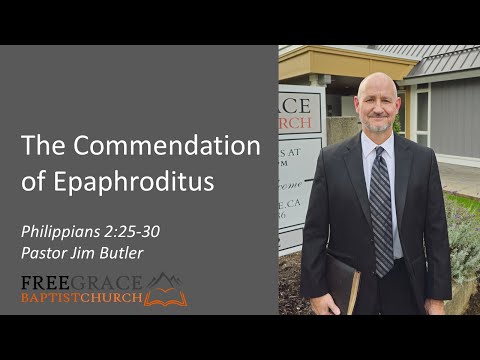
Philippians 2:25–30 presents Epaphroditus as a model of Christian ministry and other-mindedness, embodying the very exhortation Paul gave in Philippians 2:3–4 to esteem others above oneself. The sermon examines the three titles Paul assigns Epaphroditus in relation to himself — brother, fellow worker, fellow soldier — and his two roles in relation to the Philippian church — messenger and minister. The Christian life, and pastoral ministry in particular, is shown to be genuine warfare requiring devotion, discipline, and diligence. The church is called to receive and esteem men who hazard their lives for the work of Christ, recognising that to neglect such men is to demean the ascended Christ who gives them as gifts to his church.
2LCF Chapter 6: Of the fall of man, of sin, and of the punishment thereof
The fall of Adam and Eve was not an unforeseen catastrophe but an event God sovereignly permitted according to his wise and holy counsel to order to his own glory. Working through all five paragraphs of 2LCF Chapter 6, this study traces the anatomy of the fall — from man's original uprightness under the covenant of works, through the willful transgression of the law of their creation, to the imputation of guilt and conveyance of corrupt nature to all of Adam's posterity by ordinary generation. The totality of sin's consequences — total depravity, total inability, spiritual death, and the inheritance of wrath — makes the second and last Adam, Jesus Christ, the only and necessary answer, whose active and passive obedience reverses both the imputation and the inheritance fallen humanity bears in the first Adam.

June 15, 2025
What does God require of Christian husbands and fathers? Drawing from Proverbs 3–6, 12–13, 18–19, 22–23, 27–29, and 31, this sermon argues that the fear of the Lord is the indispensable foundation for a man's calling in the home — governing his love for his wife, his provision and protection, his sexual fidelity, and his faithful instruction and discipline of his children. The sermon addresses the transgenerational character of biblical Christianity, insisting that fathers who neglect to instruct and discipline their children not only harm their households but contribute to civilizational moral decay. Men are called to see their wives as gifts from God, to deal honestly with their own sin before their families, and to raise children who are shaped by law and gospel rather than left to their Adamic nature.
2LCF Chapter 5, Of Divine Providence
Divine providence — God's upholding, directing, disposing, and governing of all creatures and all their actions — is the subject of 2LCF Chapter 5. The chapter moves from a general statement of providence in paragraph 1 through the relationship of first and second causes, the use of means, and the hardest pastoral question: how God's sovereign decree relates to sin in general, in believers, and in unbelievers. The session closes by grounding the doctrine in the particular care God exercises over his church, whose history is the key to all human history.

The Christian Husband and Father
Proverbs 4:1–9 opens a sermon that traces the pattern of transgenerational wisdom-transmission from David to Solomon to Solomon's children, and uses it as the framework for a thorough biblical account of what faithfulness looks like for a Christian husband and father. Drawing extensively from Proverbs, the sermon argues that a godly husband fears the Lord, deals honestly with his sin, loves his wife as a gift, provides for and protects her, communicates with kindness, and maintains sexual fidelity; and that a godly father extends that same godliness toward his children through love, instruction, and both verbal and corporal discipline exercised within an orbit of affection. The sermon is marked throughout by a Reformation soteriology — salvation is by grace through faith in Christ alone, not by exemplary parenting — and closes with direct exhortations to fathers, mothers, and young men preparing for marriage.

2LCF Chapter 4, Of Creation
2LCF Chapter 4 expounds the doctrine of creation across three paragraphs, addressing what creation is, the triune God who creates, the nature and dignity of man as image-bearer, and the covenantal framework that gives creation its redemptive telos. The sermon argues that creation ex nihilo (qualified as God bringing forth all that is not God) and creation ex materia are distinct but complementary categories, and that divine immutability is preserved because no change or new perfection accrues to God through the act of creating. Ultimately, creation serves as the theatre within which God executes His eternal decree of redemption, bringing a multitude of elect sinners to glory through the perfect work of Jesus Christ.

The Importance of Spiritual Exercise
Philippians 2:12–13 is not a self-salvation passage but a call to Spirit-enabled perseverance rooted in the sovereign grace of God. The sermon expounds the believer's responsibility to 'work out' a salvation already given — not to attain it, but to live in conscious, fear-driven obedience to the God who both justifies and sanctifies. Against hyper-Calvinist passivity on one side and Arminian self-effort on the other, the text holds together human duty and divine empowerment: God works in believers both to will and to do according to his good pleasure. The practical summons is to pursue sanctification — the whole of it, fear, trembling, cross-contemplation, and dependence on the Spirit — as those destined for glorification.

Julian and Raelene's Wedding
A Reformed Baptist wedding homily expounds the institution of marriage in Genesis 2:18-25, the fall into sin in Genesis 3, and the first gospel promise of Genesis 3:15 as the theological ground on which Christian marriage stands. The sermon traces how the Apostle Paul's teaching in Ephesians 5:22-33 — the husband to lovingly lead, the wife to honor and submit — flows from the creation order and points beyond itself to Christ and his church. The homily closes by calling every attendee, believer and unbeliever alike, to look to the Lord Jesus Christ, whose obedient life, atoning death, and resurrection are the only answer to the sin that corrupts marriage and every human relationship.

2LCF Chapter 3, Of God's Decree
God's decree — His eternal, immutable purpose to foreordain whatsoever comes to pass — is the subject of 2 London Baptist Confession of Faith Chapter 3. This study works through paragraphs 1–7, establishing that the decree is absolute and unconditional, covers all events including the free and sinful actions of creatures without making God the author of sin, and that election unto life is grounded solely in God's free grace rather than any foreseen condition in the creature. The session addresses the distinction between preterition and double predestination, the infralapsarian and supralapsarian debate, and closes with the confession's insistence that this high doctrine is to be handled with prudence, producing praise, humility, diligence, and abundant consolation in those who sincerely obey the gospel.

The Faithful Christian Mother
Proverbs 31:28–30 grounds this sermon on the faithful Christian mother in four doctrinal categories: her condition before God, her influence over her children, her authority over her children, and her responsibility toward her children. The fear of the Lord that marks the virtuous woman is not a natural disposition but a new-covenant gift of sovereign grace, as Jeremiah 32:40 and Romans 3:18 together demonstrate. Because salvation is by grace alone through faith alone, the mother's instruction, example, discipline, and love flow from a regenerate heart rather than from moralism. Mothers are exhorted to maintain dependence on God, to ground child-rearing in Scripture rather than cultural trends, and to persevere in a calling that is high, demanding, and ultimately accountable to God.

The Necessity of Faithful Obedience, Part 2
Moses concludes the historical prologue of Deuteronomy with a programmatic warning to the second generation of Israel: idolatry will bring exile, but repentance will meet a merciful God. The sermon expounds Deuteronomy 4:25–49, tracing the consequences of covenant-breaking, the grounds of covenant mercy, and the incomparability of Israel's God as the only legitimate basis for obedience. The practical application presses the necessity of self-government, the danger of forgetfulness, and the trans-covenantal obligation of parents to pass covenant instruction to their children.
Live Stream - April 27, 2025
Psalm 90, the only psalm of Moses in the psalter, confronts a rootless and ruined people with the brevity of life, the severity of divine wrath against sin, and the sufficiency of God himself as the only eternal dwelling place. Moses moves through an eternal dwelling (vv. 1–2), a brief journey (vv. 3–6), a hard journey (vv. 7–11), and the way back home (vv. 12–17), showing that death is not a natural development of human nature but a judicial sentence executed by God upon sinners in Adam. The psalm's petitions find their definitive answer in Christ, whose baptism fulfills Isaiah's cry that God would rend the heavens and come down, and in whom God once again dwells with his people. Those who number their days wisely will seek to be rich toward God, labor heartily unto him, and anticipate the endless joy that far outweighs this brief and difficult sojourn.

Live Stream - April 27, 2025
Psalm 131 is a three-verse psalm of ascent in which David describes three things he did not do — lift up his heart in pride, raise his eyes in defiance, or occupy himself with matters too great and too marvelous — and one thing he did do: calm and quiet his soul like a weaned child beside its mother, in a silence of trust rather than fear. The sermon expounds all three verses, identifying hope in the Lord — grounded in who Yahweh is and in the promises of the new covenant secured by Jesus Christ, the faithful Son of David — as the active disposition that produces that inner calm. Three closing applications warn that we will lose our hope if we refuse to humble ourselves, if we expect what God has not promised, and if we place our hope in anything or anyone other than God through Jesus Christ.

Our Eternal Dwelling Place

Psalm 90, the only psalm of Moses in the Psalter, confronts the brevity and bitterness of human life and points the wandering soul to the only dwelling place that neither crumbles nor wears out — God himself. The sermon moves through four movements: God's eternal being as the refuge of his people, the astonishing shortness of every human life, the hard reality that death is not natural entropy but divine judgment upon sin, and finally the hopeful petitions with which the psalm closes. Every petition in the psalm's closing verses finds its definitive answer in the person of Christ, in whom God has once again opened heaven and called sinners to dwell with him in peace.

Live Stream - April 6, 2025
Philippians 2:8 sets forth the humility of Christ as both the ground of the believer's salvation and the supreme example for the church's conduct. The sermon traces Christ's obedience from his mother's womb to the cross, distinguishing the active and passive obedience that together constitute the basis of justification by faith alone. Against the errors of eternal functional subordination, the speaker anchors Christ's submission firmly in his human nature as covenant mediator, not in any hierarchy within the immanent Trinity. The Lord's Supper is then administered as a seal of precisely these twin benefits — the active obedience that clothes the sinner in righteousness and the passive obedience that cleanses from sin.

Ask FGBC #41: Why Does The Devil Hate Women So Much?
The question of why women have historically suffered disproportionate oppression and violence is examined through a biblical theological lens. Two theological threads are drawn out: Satan's covenantal enmity against the woman whose seed would crush him (Genesis 3:15), and the doctrine of total depravity, which explains how sinful men exploit the physically weaker vessel Peter describes in 1 Peter 3. The discussion concludes that the abuse of women is a symptom of human rebellion against God's creational order of male headship and protection.
Deuteronomy 1
Deuteronomy 1 opens Moses' first address to the second generation of Israel on the plains of Moab, a historical review designed to prepare the people for the conquest of the promised land. Moses rehearses four episodes: God's command to advance from Horeb, the appointment of judges, the rebellion at Kadesh Barnea rooted in unbelief, and the punishment that fell on the first generation. The central diagnostic is verse 32 — 'you did not believe the Lord your God' — which exposes unbelief as the taproot of Israel's grumbling, refusal, and covenant faithlessness. The sermon calls the New Covenant congregation to dwell on this history so as to be steadfast in the future, trusting the same God whose promises are yes and amen in Christ.