
Topic
Anthropology
564 sermons · All topics

The Conduct of Women in Corporate Worship (Authority)

First Timothy 2:11–15 contains one of the New Testament's clearest directives on the role of women in corporate worship, and this exposition works through the passage in three movements: the duty of women to receive the Word in silence and submission (v. 11), the apostolic prohibition against women teaching or exercising authority over men (vv. 12–14), and the blessing held out to women in the childbearing (v. 15). The prohibition is grounded not in the culture of first-century Ephesus but in creation order and the fall, the same foundations the apostles consistently invoke across Ephesians 5, Colossians 3, 1 Corinthians 11 and 14, and 1 Peter 3. The messianic reading of verse 15 is defended: 'she will be saved in the childbearing' points to the incarnation of Christ as the hope for Eve and every believing woman, not to physical childbirth as a condition of salvation. Women are called to embrace their creationally ordered role — silent, submissive reception of the Word and the full range of ministry open to them — as the sphere in which they work out their salvation in faith, love, holiness, and self-control.

The Conduct of Women in Corporate Worship (Adornment)
Paul's instruction in 1 Timothy 2:9–10 on the adornment of women in corporate worship is not a blanket condemnation of ornamentation but a call to modesty and moderation governed by the priority of Christ in public worship. A biblical theology of adornment — from Genesis through Revelation — establishes that adorning is assumed and even commanded by God; what Paul prohibits is the ostentatiousness that draws attention to oneself and away from the Lord. The sermon works through four observations: the operating assumption that women will adorn, the general principles of propriety and moderation, the particular prohibitions against elaborate hairdressing, gold, pearls, and costly clothing, and the positive exhortation to adorn with good works befitting a profession of godliness.

The Deliverance of the Psalmist, Part 1
Psalm 18:1–19 presents David's praise to God for deliverance from all his enemies, and the psalm functions typologically: David points forward to his greater Son, the Lord Jesus Christ, whose sufferings, death, and resurrection are the ultimate fulfillment of what the psalmist describes. Working through three divisions — the occasion of praise (the superscription), the declaration of praise (vv. 1–3), and the motivation for praise (vv. 4–19) — the sermon demonstrates that David's deliverance rests not on David's own prowess but on the sovereign power and delight of Yahweh. The sermon calls believers to love God with the love that is the chief fruit of faith, to cry out to God in distress rather than to despair, and to find consolation in the reality that God moves heaven and earth to vindicate his people and vanquish their enemies.

The Instructions of Calvary

Luke 23:32–43 presents, in twelve verses, a concentrated display of the doctrines that define the gospel: total depravity, effectual grace, justification by faith alone, the hypostatic union of Christ's two natures, assurance, and immediate conscious glory at death. The sermon traces seven theological loci arising from the conversion of the penitent thief, demonstrating that the entire redemptive narrative of Scripture converges at Calvary. The penitent thief is not an extreme case or a last-minute exception but a paradigm of every sinner who comes to Christ with nothing in hand and receives everything by sovereign, irresistible grace.

2LBC Chapter 25, Of Marriage
The 1689 London Baptist Confession of Faith chapter 25 offers a concise yet comprehensive definition of marriage as a lifelong covenant between one man and one woman, established by God in creation for companionship, procreation, and the lawful expression of sexual relations. This study works through each paragraph of the confession's chapter on marriage, examining the monogamous nature of marriage, the major purposes for which it was ordained, and the lawful parties who may enter it. The session also draws on Westminster Confession chapters 24, paragraphs 5 and 6, together with Deuteronomy 24, Matthew 5 and 19, and 1 Corinthians 7, to argue that Scripture authorizes divorce on the grounds of porneia and desertion, and that a lawfully divorced innocent party is free to remarry. The Protestant 'permanence view' of marriage is examined and found to be both exegetically deficient and pastorally harmful to innocent parties whom God's own law was designed to protect.

The Psalmist's Description of Depravity
Psalm 14 furnishes a comprehensive doctrine of total depravity, showing that man's rejection of God is not merely intellectual but ethical — a practical atheism that issues in universal corruption and abominable works. The psalmist's two-part structure moves from the description of the ungodly (vv. 1–3) to the deliverance of the godly (vv. 4–7), with Paul amplifying the same argument in Romans 1–3 by citing and structurally imitating the psalm. The only remedy for the corruption of the heart is not behavioral modification but the righteousness of Christ received through faith — the salvation that comes out of Zion — which gives believers both ground for evangelism and comfort in a sin-cursed world.

The Lament of the Psalmist
Psalm 13 is a lament psalm of David that moves through raw grief — the perceived forgetfulness of God, the daily sorrow of the soul, and the threat of encroaching enemies — to a resolved trust in the covenant mercy of God. The sermon traces this trajectory through the true humanity of Christ, who himself prayed lamentingly in Gethsemane and on the cross, establishing lament as a legitimate and God-given vehicle of prayer for his people. Lament is distinguished sharply from whining: whining refuses to petition God and ends in despair, while biblical lament drives the soul toward God and terminates in doxology. The congregation is called to bring their distress boldly to the throne of grace, resting in the hesed of God covenanted to all who are found in Christ.
Ask FGBC #64: Who Should Catechize Your Children?
Deuteronomy 6 and Ephesians 6:4 establish the family — and the father in particular — as the primary locus of catechetical responsibility for children, not the church, the school, or civil government. The church's role is complementary: it equips parents, and through preaching, catechism classes, and Sunday school it instructs children alongside the home. Rote memorization of a catechism plants doctrinal truth that takes deep root at conversion, making faithful repetition a discipline as foundational as teaching a child to read or to do arithmetic.

CTF 2026: Q&A Panel Discussion
A panel of Reformed Baptist and Reformed theologians fields audience questions on some of the most demanding loci in Reformed theology: federal headship and the fall, God's effective and permissive will in the hardening of Pharaoh's heart, the mystery of the first sin, free will as acting according to nature, hyper-Calvinism, the infralapsarian and supralapsarian debate, and the legitimacy of the free offer of the gospel under God's exhaustive decree. The discussion is frank about the limits of creaturely knowledge on questions the secret will of God has not resolved, while insisting that doctrinal humility and ordinary means of grace—not cage-stage polemics or churchless social media—are the proper context for growth in these truths.

CTF 2026 - Session 3: Is God the Author of Sin?

Two difficult theological questions frame this conference session: Is God the author of sin, and do a believer's sins work together for good? Drawing on 1689 LBCF 3.1, Acts 2:23, Acts 17:28, and Romans 8:28, the session argues that God's comprehensive, eternal decree encompasses all things — including sin — without making God personally culpable for evil, because sin is a privation of good rooted in the creature's deformed nature rather than in God's infinitely good being. The session closes by showing from Romans 8:28, with support from Robert Haldane and Genesis 50:20, that God's overruling providence turns even the believer's own sins toward their ultimate good and his glory — not as license to sin, but as ground for humility, dependence, and hope.

CTF 2026 - Session 2: Introducing “Of God’s Decree”
What does it mean that God has decreed whatsoever comes to pass, and how should that staggering claim be approached without either flattening its force or drawing false conclusions from it? This lecture introduces 1689 London Baptist Confession chapter three ('Of God's Decree'), establishing three guiding principles for the study: the decree is not our duty to obey, it remains largely veiled in mystery despite its scriptural attestation, and it demands a robust creator-creature distinction throughout. Working through 2LCF chapters two through five as a unified doctrinal unit, the lecture distinguishes God's imminent work of decreeing from his transitive works of creation and providence, and sets up the question — to be addressed in the following session — of whether God's comprehensive decree makes him the author of sin.

The Theater of His Glory

Psalm 19 sets creation and Scripture side by side as God's two books of revelation: the heavens declare His glory in every language to every people, while the Word of God converts the soul and opens eyes to see what unbelief cannot perceive. The sermon works through the psalm to show that general revelation leaves all people without excuse before God, yet only the regenerate, illumined by the Spirit through Scripture, properly receive the theater of God's glory. The three closing applications call Christians to train their children in a Christ-centered view of both books of revelation, to cultivate daily awareness of God's hand in creation, and above all to prize the Word of God as the supreme gift that leads to life and holiness.

The Challenge and Confidence of the Psalmist - Psalm 10:1-18
Psalm 10 presents a twofold movement: the challenge of the psalmist in verses 1–11, and the confidence of the psalmist in verses 12–18. The sermon argues that this psalm is not primarily about David's historical circumstances but about the earthly ministry of the Lord Jesus Christ — his humanity, his experience of apparent divine withdrawal, and his witness to the wickedness of those who conspired against him. The church, as joined to Christ, prays these words as her own, setting the promises of God against the troubled testimony of sense and experience, and resting in the certain reign of the Lord who will one day cause the man of the earth to oppress no more.

The Believer's Contentment
Philippians 4:10–13 presents the contentment of the Apostle Paul not as an innate virtue but as a learned conviction forged through diverse and often severe circumstances. Working through Paul's expression of gratitude to the Philippians, his present situation, his learned conviction, his diverse circumstances, and his source of strength, this sermon argues that Christian contentment is utterly independent of circumstances because it is grounded in union with Christ — in justification, sanctification, and promised glorification. The practical exhortation confronts the common error of tying contentment to circumstances ('when I get married, then I will be content') and calls believers instead to submit sweetly to divine providence, rejoice in God's sovereign ownership of all things, and find their settled rest in Christ alone.

Ask FGBC #59: What is Faith?
Faith is defined in two senses in Scripture: as the objective content of the Christian religion (the propositions of the gospel to be believed) and as the subjective act of believing. In its saving sense, faith is the Spirit-given, empty-handed instrument by which a sinner rests upon and receives the Lord Jesus Christ and all the redemptive benefits secured by His obedient life, atoning death, and resurrection. Because regeneration precedes faith and faith itself is a divine gift, the strength of one's faith — or the feelings accompanying it — is never the ground of salvation; Christ alone is that ground. The discussion warns against distortions that load faith with feelings, smuggle faithfulness or love into its definition, or ground justification in evangelical obedience rather than in Christ received through faith alone.

The Authority of Christ Over the Demons
Matthew 8:28–34 records Christ's encounter with two demon-possessed men whose condition — violence, self-destruction, nakedness, and ceaseless torment among the tombs — exposes the wretchedness of Satan's kingdom and the glamorization of the occult as godless deception. The passage stands within Matthew's sustained demonstration in chapters 8–9 that the same authority with which Christ taught is confirmed in His works: one word, 'Go,' expels a legion. The city's request that Jesus depart reveals that the fear of God drives men either toward Him or away from Him, never to indifference. The sermon closes with the application of 1 Timothy 1:15 — that these two men are exhibit A that Christ Jesus came into the world to save even the chiefest of sinners — and an exhortation to parents to raise children who flee to the cross rather than to self-righteousness or the occult.

The Dominion of the Incarnate Son
Psalm 8 is not merely a meditation on creation but a messianic prophecy concerning the dominion of the incarnate Son of God. The sermon traces the psalm's double register — the glory of God manifest in the created order and the glory of God manifest in the incarnation — grounding that interpretation in the two New Testament passages where Jesus and the Apostle Paul explicitly apply Psalm 8 to Christ: Matthew 21 and Hebrews 2. The exaltation of the God-man at the right hand of the Father, his conquest of the devil through death, and his propitiation for the sins of his people are shown to be the true fulfillment of the dominion language of verses 4–8. Believers are exhorted to silence the enemy's accusations against them by invoking the blood and righteousness of Christ, which is the ground of both justification and assurance.

The Presence of the God of Peace
Philippians 4:8–9 presents two inseparable imperatives — meditate on whatever is true, noble, just, pure, lovely, and of good report, and then do what has been learned, received, heard, and seen in the Apostle Paul — with the promise that the God of peace will be with those who obey. The sermon argues that orthodoxy and orthopraxy are not alternatives but are inextricably bound: the failure to practice truth indicts the practitioner, not the doctrine. The source of right thinking is both the light of nature (general revelation accessible to all men) and the special revelation of Scripture, which governs and clarifies all truth. The hearer is called to fill the mind with God's word, live consistently with it in a pagan society, and trust that the grace which saves also teaches and equips for godly conduct.

Getting the Garden Right — Dr. Richard Barcellos | Why Genesis 1–3 Matters for Everything
Genesis 1–3 is not merely the Bible's opening chapter but the theological foundation upon which the covenant of works, the divine rest, and the entire eschatological structure of Scripture are built. Richard Barcellos surveys the argument of his book 'Getting the Garden Right,' contending that New Covenant theology and progressive covenantalism go wrong precisely where they fail to reckon with Adam's probationary status under the covenant of works and the eschatological significance of God's Sabbath rest as a state into which the obedient image-bearer was to enter. The discussion ranges from hermeneutical method — the necessity of allowing the New Testament to illuminate the Genesis narrative — to the typological continuity of the Sabbath from creation ordinance through the resurrection of Christ to the weekly Lord's Day. Listeners are pressed to take the primary sources of the Reformed tradition seriously and to see that whatever Adam failed to attain, Christ secured, bringing many sons to the glory that is better than the beginning.

The Dangers and Precautions for Israel
Deuteronomy 6:10–25 addresses the second generation of Old Covenant Israel on the plains of Moab with warnings and precautions before they enter the Promised Land. Three dangers threaten covenant loyalty: forgetting God in prosperity, forsaking God through idolatry, and testing God under hardship. The precautions against these dangers are diligent obedience to the commandments and faithful covenant succession — passing the knowledge of God's redemptive acts to the next generation. These dangers are not merely ancient; they press upon the New Covenant church with equal force, and the remedies remain the same: fear God, keep His word, and rehearse His faithfulness to your children.

The Power of the Peace of God
Philippians 4:6–7 contains both a prohibition and a promise: Paul commands believers to be anxious for nothing and promises that the peace of God, which surpasses all understanding, will guard the heart and mind through Christ Jesus. The sermon examines the prohibition against carnal anxiety, the corrective of prayer offered with thanksgiving, and the promise of divine peace — arguing that prayer is not a formula for instant relief but the ordained means by which God's people cast their burdens on God and receive the peace that flows from justification and the indwelling Spirit. The congregation is called to pray with right motivation, godly manner, and kingdom-oriented priorities as modeled in Christ's own teaching on prayer.
The Propagation of Israel's Faith
Deuteronomy 6:6–9 commands Israel not merely to profess allegiance to the one true God but to propagate that truth — first by internalizing it personally, then by transmitting it diligently to children and grandchildren in both formal and informal settings. The passage is read against the wider covenantal structure of Deuteronomy and set in parallel with Ezra 7:10, Psalm 119, and Ephesians 6:4 to show that receiving, doing, and teaching God's word are inseparable obligations running across both covenants. The sermon presses home that teaching children the law and the gospel is not a specialist calling for the especially devout but a natural reflex of redemptive grace, as ordinary and non-negotiable as providing food and shelter. Parents are urged to establish modest, consistent patterns of family worship — Scripture reading, catechism, prayer, and informal covenantal conversation — as the primary means of inoculating children against the idolatry of the surrounding world.
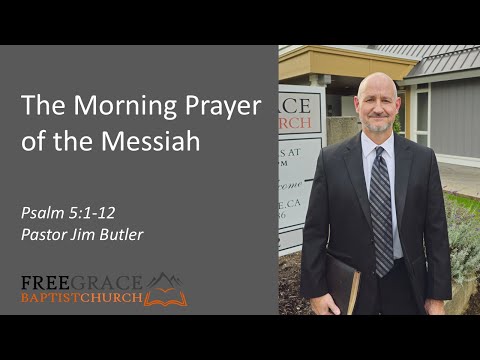
The Morning Prayer of the Messiah
Psalm 5 is the morning prayer of the Messiah — not merely a psalm David wrote, but a prophetic window into the prayer life of the incarnate Son of God as he faced bloodthirsty and deceitful enemies throughout his earthly ministry. The sermon works through four movements: Christ's appeal to the hearing God, his comfort in the divine perfections of holiness, justice, and mercy, his petitions for the guidance of the godly and the condemnation of the godless, and his confidence in the protecting God. Because the righteousness that qualifies the pray-er is Christ's own imputed righteousness received by faith alone, Psalm 5 becomes the possession of every believer in the new covenant, a daily call to pray dependently, joyfully, and with full confidence in the God who hears.

The Central Confession of Israel's Faith
The Shema of Deuteronomy 6:4 — 'Hear, O Israel, the Lord our God, the Lord is one' — is examined as the central confession of Old Covenant Israel's faith, carrying both theological and polemical force for a people about to enter a land saturated with polytheism and syncretism. The sermon traces the purpose of God's commandments (obedience secured tenure in the land), the theological content of the Shema (divine unity of singularity and simplicity, and its compatibility with Trinitarian confession), and the fitting response of wholehearted love toward the one living and true God. The application presses New Covenant believers to the same totality of devotion — presenting themselves as living sacrifices — grounded in the redemption God has accomplished in Christ, the true Israel who kept the covenant His people perpetually broke.

The Conclusion of the Decalogue
Deuteronomy 5:22–33 records Moses rehearsing the original giving of the law at Sinai, and this exposition draws out the divine origin, authority, comprehensiveness, finality, and permanence of the Decalogue as the trans-covenantal moral law of God binding on all men in every age. The threefold use of the law — civil, pedagogical, and normative — is traced through the New Covenant, with the imputed righteousness of Christ received by faith as the only ground of justification. The people's terror at the theophany on Sinai is commended as the proper response to God's majesty, and the sermon presses the distinction between slavish fear that flees from God and filial fear that flees to Him, urging the congregation to recover a robust doctrine of divine transcendence in their worship.

Fearfully and Wonderfully Made
Psalm 139:13–16 declares that the formation of every human being in the womb is an act of God's immediate, intimate providence — the divine Weaver knitting together image-bearers for His own glory. The sermon argues that human dignity is grounded not in sentiment or politics but in divine authorship: God knows each person's substance before conception, fashions every inward part, and has decreed their days in His eternal book. The Incarnation deepens rather than evacuates this ethical claim, for the Son of God assumed embryonic and fetal life, passing through every stage of human existence to redeem a multitude of sinners. The congregation is called to tremble before the God who sees in secret, to defend the sanctity of life from conception to death, and to rest in the omnipotent providence of the One who has numbered both our members and our days.

The Tenth Commandment
The Tenth Commandment's prohibition against coveting addresses not the external act but the internal disposition of the heart, making it the capstone over all the other commandments. Covetousness — the inordinate desire for anything belonging to one's neighbor — is at root an act of discontentedness with God's sovereign allotment and a form of idolatry, placing the creature above the Creator. The sermon works through the threefold use of the moral law: its civil function, its pedagogical role in driving sinners to the cross, and its normative function in calling the redeemed to diligent watchfulness over heart and soul.

The Believer and Trials
James 1:1–8 confronts believers with a counterintuitive command: count trials as pure joy. This exposition works through the believer's required response to trials (vv. 2–4) and the believer's required request during trials (vv. 5–8), grounding both in the theological truth that the testing of faith produces endurance and conformity to Christ. The sermon argues that ignorance of God's remedial purposes in affliction is the root cause of disordered responses — panic, complaint, and double-mindedness — and calls believers to ask God for wisdom to navigate suffering in faith, confidence resting on the character of a God who gives liberally and without reproach.

The Darkness of Depression
Proverbs 15:13 identifies the broken spirit as a genuine human affliction, and the broader witness of Scripture — from Elijah under the broom tree to the weeping prophet Jeremiah to the Saviour himself as a man of sorrows — confirms that depression and melancholy are realities in the lives of God's people, not marks of spiritual failure. This sermon works through the reality of depression, its manifold causes (physical, psychological, circumstantial, spiritual, and diabolical), and practical strategies for those who suffer and those who come alongside sufferers. The controlling remedy throughout is the means of grace: rest, diet, exercise, prayer, Scripture, and the gathered worship of God's people — with the warning that singing songs to a heavy heart, after the manner of Job's friends, is a pastoral failure Scripture explicitly condemns.

The Ninth Commandment: Part 2
The Ninth Commandment forbids not only perjury in a criminal court but all forms of lying, backbiting, slander, and gossip — sins Paul identifies as grieving the Holy Spirit within the church. The positive duty of the commandment requires active preservation of a neighbor's good name, charitable restraint of the tongue, and a settled love of truth grounded in the nature of God himself, who is the Lord God of truth, in contrast to the devil, who is a liar from the beginning. The threefold use of the law applies directly: the civil use restrains society from complete moral collapse, the pedagogical use exposes the sinner's need for Christ, and the normative use directs the redeemed — justified freely by grace through faith — in godly conduct toward one another. Every idle word will be accounted for on the day of judgment, making disciplined speech not optional but integral to the Christian life.