

2,047 sermons · All speakers

The Crucifixion of Jesus, Part 1
Matthew 27:32–38 records the crucifixion of the Lord Jesus Christ with studied brevity, and this expository sermon works through each verse to show that every detail — from the place called Golgotha to the division of garments and the charge above his head — is the deliberate fulfillment of Old Testament Scripture, not an accident or afterthought in the plan of God. The sermon traces the thread from the proto-gospel of Genesis 3:15 through the typological head-wounds of Israel's enemies to Christ's death blow against the devil at the place of the skull. Three concluding applications draw out the pastoral weight: the unwitting testimony of Pilate, the triumph of the skull-crushing seed of the woman, and the immeasurable love of the Savior who was stripped naked, numbered with transgressors, and crucified so that his people might be clothed with his righteousness, received in glory, and given everlasting life.

The Testimony of John the Baptist, Part 3
John 1:30–34 records the Baptist's testimony concerning the dignity of Christ's person — his preeminence as the eternal Word who was before John, his anointing with the Spirit without measure for the work of mediation, and his identity as the natural, essential, and eternal Son of God. The sermon traces the Old Testament prophetic background of the Spirit's descent (Isaiah 11, 42, and 61), the active and passive obedience of Christ as the ground of the believer's acceptance before God, and the Baptist's final declaration that this Jesus is the Son of God. From this foundation the preacher draws an urgent gospel application: the same Lamb who takes away sin will visit unbelief with wrath, and the only fitting response is faith in him now.

The Testimony of John the Baptist, Part 2
John 1:29 records the Baptist's singular declaration — 'Behold the Lamb of God who takes away the sin of the world' — a phrase saturated with the weight of Old Testament redemptive history. This sermon works through the theological freight of that title, tracing the Lamb through Genesis 22, Leviticus 16, and Isaiah 53 to show that Christ's mission is substitutionary blood atonement: he takes up the sin of his people in order to take it away entirely. The 'world' from which sin is removed is not every individual without exception but men and women without ethnic or national distinction, saved by grace alone through faith in Christ alone.

The Neglect of Weighty Matters
Jesus condemns the scribes and Pharisees in Matthew 23:23–24 not for tithing mint, anise, and cumin, but for doing so while neglecting the weightier matters of the law: justice, mercy, and faith. The Pharisaic imbalance is neither ancient nor extinct — the same tendency to obsess over religious minutiae while bypassing the moral and covenantal substance of God's law persists in the church today. Drawing on Micah 6:8, Hosea 6:6, and the broader prophetic tradition, this exposition argues that genuine obedience to God is universal and balanced, not selective and performative.

The Defense of the Faith
Jude 3 commands every believer — not merely pastors or theologians — to contend earnestly for the faith once for all delivered to the saints. This sermon examines the exhortation itself, the internal threat posed by sneaky, ungodly apostates who pervert grace and deny Christ, and the practical preparedness Jude prescribes: remembering apostolic warning, building up on the most holy faith through Scripture and prayer, and resting in the assurance that God himself preserves his people. The defense of the faith is not pessimistic trench-holding but confident advance grounded in Christ's promise to build his church against which the gates of Hades shall not prevail.

The Testimony of John the Baptist, Part 1
John 1:19–28 records the official interrogation of John the Baptist by a delegation sent from Jerusalem to establish his identity and authority. The Baptist's threefold denial — he is not the Christ, not Elijah bodily returned, not the prophet of Deuteronomy 18 — is matched by his positive confession as the voice of Isaiah 40, the forerunner who prepares the way of Yahweh and thereby implicitly confesses the deity of Jesus. The sermon traces the Baptist's testimony through Luke 1's prophecy of Zacharias, the Transfiguration account in Matthew 17, and the prologue of John 1, showing that the Baptist preached not only repentance but the remission of sins through the coming Messiah — that is, justification by faith alone. The governing application is that Christ's people exist to proclaim His preeminence, following the Baptist's model of humble, courageous, light-and-heat ministry that makes nothing of self and everything of Jesus.

Live Stream - July 11, 2021
John 1:18 presents two inseparable doctrines: the invisibility and incomprehensibility of God, and the revelation of that invisible God through the incarnate Word. The sermon works through the prologue of John's Gospel to show that while no creature has ever perceived the essential glory of God — not Abraham, not Moses, not Isaiah — the only begotten Son, who exists eternally in the bosom of the Father as a distinct yet consubstantial person of the Trinity, has exegeted the Father to us. The practical burden is that saving knowledge of God is not merely knowledge about the economy of redemption but knowledge of the Redeemer himself — Father, Son, and Holy Spirit — and that the chief end of man is to glorify and enjoy this triune God forever.

The Ministry of the Word
What is the basis and method of God's ordained means for saving sinners? This sermon on 2 Timothy 4:2 argues that the preaching of the Word stands as the primary instrument through which God saves the lost and builds his church, grounding that claim in the logical chain of Romans 10, the divine pleasure announced in 1 Corinthians 1, and the final apostolic charge of Paul to Timothy. The sermon challenges the contemporary drift toward audience-driven church strategies, calling both preachers and hearers to fidelity to the proclaimed Word as the irreplaceable means of grace.

The Conversion of Cornelius
Acts 10:34–48 records the official inclusion of Gentiles in the covenant promises of God — a watershed moment in redemptive history. Peter's sermon before Cornelius and his household sets forth the peace, person, work, and prophetic witness of Jesus Christ, culminating in the declaration that through His name, whoever believes will receive remission of sins. The sovereign Holy Spirit falls upon the hearers before Peter has even finished speaking, confirming that salvation is of the Lord and that divine initiative — not human free will — drives the conversion of sinners. The passage concludes with the baptism of the entire household, a commanded public identification with the Triune God that pictures, but does not accomplish, the inward work already wrought by grace through faith.

The Soldiers Mock Jesus
The mockery of Jesus by the Roman soldiers in Matthew 27:27–31 is examined as a Lord's Supper meditation, tracing the psychological and physical brutality inflicted on the Son of God after Pilate's verdict. The scene is read through the lens of fulfilled prophecy — Isaiah 50:6 and Isaiah 53 — and the covenant of redemption, in which Christ willingly undertook every indignity as the surety and substitute for his people. The sermon closes by turning to the book of Revelation to show that what the soldiers performed in jest — robing, crowning, and hailing a king — Christ possesses in eternal reality, and calls believers to respond with the genuine homage these soldiers withheld.

The Hope of the Nations
Psalm 67 frames both the church's need for God's mercy and the church's missionary calling to the nations as inseparable realities. The psalmist's threefold petition — mercy, blessing, and communion with God for the church — is the ground from which prayer for the salvation, worship, and righteous governance of the nations flows. Drawing on the Aaronic blessing, the Abrahamic covenant, and the New Testament's Great Commission, the sermon argues that the church's received grace creates an inescapable obligation to proclaim that grace to the ends of the earth. The closing application calls the congregation to corporate prayer, support of the missionary enterprise, and fidelity to the gospel message as the only means God has ordained for the hope of the nations to be realized.

The Incarnation of the Word, Part 2
John 1:15–17 presents the preeminence of the incarnate Word and the fullness of grace and truth that flows from Him to needy sinners. The testimony of John the Baptist — that Christ ranks before him because He was before him — is an affirmation of Christ's co-eternity, distinctness, and consubstantiality with the Father, in accord with the Nicene Creed. Verse 17 is not a sharp antithesis between Moses and Jesus but a contrast in the mode of divine revelation: the law was mediated through Moses, while grace and truth came through the mediator Himself, who is the very embodiment of God's glory. The sermon calls hearers to stand in awe of the preeminent Redeemer, to find every spiritual need met in His inexhaustible fullness, and to close with Christ without delay.

The Elements of Family Worship
Deuteronomy 6:6–7 commands parents to teach God's word diligently to their children in every season of daily life, and this sermon traces that mandate across both Testaments — from Abraham's household religion in Genesis 18, through the Psalms and Proverbs, to Paul's charge in Ephesians 6:4 and the example of Timothy's mother and grandmother. The preacher argues that family worship is a clear biblical obligation whose specific form is left to the conscience, and that failure to instruct children in the fear of God — illustrated negatively by Eli and Samuel's sons — leaves them unguarded against a culture actively hostile to Christ. Fathers and mothers are exhorted to commit first to public Lord's Day worship, to honour the sanctification of the Sabbath, and then to establish a family altar consisting of Scripture reading, prayer, and singing — scaled appropriately for their household — as the primary means of passing covenant knowledge to the next generation.

The Lord Jesus and the Demoniacs
Matthew 8:28–34 presents Christ's authority over demonic powers as a ground for confident trust in him as the Son of God. The demons' own confession — 'You Son of God' — exposes what the disciples have not yet grasped: that Jesus holds sovereign dominion over every spiritual power, including the devil himself. The exorcism at Gerasa is set within Matthew's sustained demonstration, across chapters 8–9, that the one who teaches with authority also acts with authority. If Christ has conquered death and the devil, every lesser affliction that threatens the people of God lies well within his sovereign reach.

The Incarnation of the Word, Part 1
John 1:14 — 'the Word became flesh and dwelt among us' — is the hinge on which all Christian theology turns. This exposition works through the identification, the incarnation proper, and the indwelling presence of the Word, establishing that the eternal Son assumed a true human nature (body and soul) without ceasing to be the second person of the Trinity — the doctrine the church confesses as the hypostatic union. The sermon draws on the active and passive obedience of Christ to show that the incarnation was not primarily exemplary but redemptive: the Word took flesh to render the perfect obedience sinners owe and to shed the blood that purchases their forgiveness. Hearers are pressed to see Christ not only as Redeemer but as reigning King, and the unbeliever is called to receive, by faith alone, that righteousness which comes from God.

Exodus 10
Exodus 10 records the eighth plague of locusts and the ninth plague of darkness, both of which expose Pharaoh's hardened pride and vindicate the sovereignty of God over Egypt, its rulers, and its gods. The hardening of Pharaoh's heart is examined not as a capricious act but as a judicial act of divine justice against a man and a dynasty already guilty of enslaving and murdering God's people. The passage carries forward two covenantal purposes: the public declaration of God's supremacy and the transmission of that knowledge to successive generations within the covenant community. Believers are called to pray for God's glory above all earthly concerns, to refuse embarrassment over God's justice, and to trust his sovereignty even in prolonged seasons of affliction.
Introduction to the 1689 Second London Baptist Confession of Faith
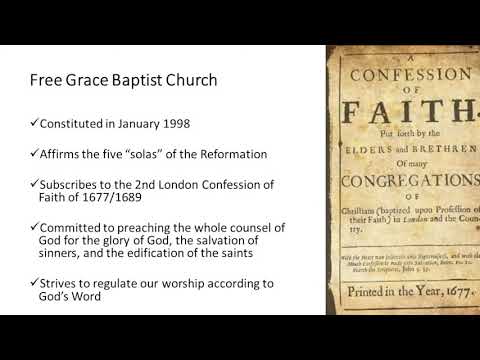
Why should a church bind itself to a confession of faith? This introductory lesson on the Second London Baptist Confession of 1677/1689 grounds the answer exegetically in Ephesians 4 — where Christ gives gifted men to the church so that the body attains doctrinal unity and is no longer tossed about by every wind of teaching — and then traces the historical origins of the 1689 among the Particular Baptists, distinguishing them from Anabaptists, Presbyterians, and Congregationalists. Four functions of a confession are developed: defining, defending, discriminating, and disciplining with reference to the doctrine of the church. The lesson closes by distinguishing Reformed theology (Calvinism plus covenant theology plus the regulative principle) from mere five-point Calvinism, and by defending the confession's silence on matters of Christian liberty as a feature, not a defect.

The Trial Before Pilate, Part 3
Matthew 27:24–26 records the sentencing of Jesus by Pontius Pilate — the culmination of a trial in which the governor thrice declared the accused innocent yet delivered him to crucifixion anyway. The sermon examines Pilate's hypocritical self-absolution by the washing of hands, the crowd's willing acceptance of blood-guilt and its ominous extension to their children, and the formal scourging and condemnation of Christ. Throughout, the exposition presses the double benefit of the gospel: the forgiveness of sins and the imputation of Christ's righteousness received by faith alone, both grounded in the penal substitutionary atonement symbolised by Barabbas going free while the just one goes to the cross.

The Call to Faithfulness in Perilous Times
Paul's warning in 2 Timothy 3:1–9 concerns not pagan opposition but a more dangerous internal threat: professing Christians within the local church who bear the outward form of godliness while denying its power. The sermon works through the passage in four movements — recognising the danger of 'the last days,' identifying the vice list under categories of pride, lovelessness, disobedience, slander, and treachery, heeding the exhortation to withdraw from such persons, and receiving encouragement that their folly will be publicly exposed. The congregation is called to maintain vigilant, doctrinally grounded churchmanship, to agonise over the church's internal corruptions as Ezekiel's faithful remnant did, and to resist both despair and naivety, trusting Christ's promise that the gates of Hades shall not prevail against his church.

Introduction to the Book of Exodus
The book of Exodus, whose Hebrew title derives from its opening words ('these are the names'), sets forth the foundational redemptive act of the Old Testament — God's deliverance of Israel from Egyptian bondage in fulfillment of the Abrahamic covenant promise of Genesis 15. This session surveys the book's structure, authorship, and theological themes, including the threefold division of the law (moral, judicial, and ceremonial), the typological relationship between Moses and Christ, and the Baptist confessional distinction that identifies the Mosaic covenant as a covenant of works rather than an administration of the covenant of grace. The study closes by tracing how Exodus functions as a foundational template for redemptive history across both Testaments, climaxing in the antitypical work of the Lord Jesus Christ as the true Passover lamb and covenant mediator.

The Mission of the Word, Part 2
John 1:10–13 presents two contrasting responses to the mission of the incarnate Word: the rejection of the world and of Israel, and the reception of those upon whom Christ confers the right to become children of God. The sermon works through the threefold use of 'world' in verse 10, the parallel between Israel's ancient rebellion and their rejection of the Messiah, and the sovereign grace underlying faith and new birth in verses 12–13. Central to the exposition is the Reformed insistence that regeneration precedes faith — those who receive Christ by believing do so because they have first been born of God — against both Pelagian and Arminian construals of conversion.

The Lord's Assessment of John the Baptist - Matthew 11:2-15
Matthew 11:2-15 presents Christ's own assessment of John the Baptist, and this exposition works through two movements: the question John sends from prison concerning the Messiah's identity, and the Lord's threefold commendation of John as no mere reed, no court prophet, but the greatest born of women and the anti-typical Elijah. The sermon argues that John's struggle was not with who Jesus was but with the implications of the messianic reign — why the herald of judgment should languish in prison while the Messiah's full justice remained deferred — a tension the church in every age must learn to hold without abandoning confidence in God's sovereign timetable. Listeners are called to pray for and expect ministers who combine the light of sound exegesis with the heat of genuine conviction, men who, like John, neither fear nor flatter any flesh.

The Royal Wedding
Psalm 45 presents a royal wedding between the divine-human Messiah and his church, and the sons of Korah compose it as a song of love that the New Testament apostles and the entirety of the Old Testament prophetic witness sustain. The sermon works through the psalm's four sections — the psalmist's intention, the perfections and person of King Messiah, the instruction to the bride, and the closing declaration — demonstrating that a divine Messiah was not a novelty invented by John or Paul but was anticipated in the Hebrew Scriptures. Christ is celebrated as fairer than the sons of men, committed to truth and righteousness, triumphant over his enemies, fully God and fully man in the hypostatic union, and the one who clothes his bride in imputed righteousness received through faith alone. The appropriate response of the church is repentance, exclusive allegiance, worship, and gladness before her great King.

The Mission of the Word, Part 1
John 1:6–9 introduces John the Baptist not as an independent figure but as a divinely commissioned witness whose entire ministry exists to point to the Word made flesh. This sermon examines the origin, nature, and function of that witness ministry, demonstrating that the Baptist's testimony belongs to a network of overlapping witnesses — Father, Son, Holy Spirit, Scripture, and signs — that ground saving faith in historical reality rather than a blind existential leap. The function of John's witness is inseparable from its purpose: that sinners would believe on Christ as the Lamb of God who takes away the sin of the world, not merely imitate him as a moral example. The sermon closes with a call to keep law and gospel in their proper places, so that sinners driven by the law's killing power may look by grace to the one who is both the true light and the only hope of the world.

The Divine Savior and His Afflicted People
Matthew 14:22–33 confronts the church with the Christological reality that the presence of Christ does not guarantee the absence of trial. Working through the storm on the Sea of Galilee, Christ walking on the water, Peter's sinking, and the disciples' confession of Christ as the Son of God, this exposition presses the claim that the 'I Am' of Exodus and the Psalms is the same Lord who meets his afflicted people in the middle of their storm-tossed sea. The sermon closes with a direct rebuke of health-and-wealth theology and a call to displace the fear of man with a robust fear of God grounded in Christ's sovereign lordship over creation.

The Divinity of the Word, Part 2
John 1:3–5 teaches that the eternal Word is the creator of all things, establishing Christ unmistakably on the divine side of the creator-creature distinction. The sermon works through the Trinitarian doctrines of inseparable operations and appropriations, showing from Genesis 1, Psalm 33, Job 26, Colossians 1, and Hebrews 1 that creation is the undivided act of the one God, yet scripture distinctively attributes it to the Son. Because Jesus is creator, sustainer, and enthroned Lord, his people need not be paralyzed by circumstance — and the darkness, however violently it resists the light, cannot overcome it.

The Ethics of Motherhood
Titus 2:3–5 sets older women in the church as instructors of younger women in the domestic virtues that honor the created order and adorn the doctrine of God. Against a cultural moment that treats the word 'mother' as offensive and obliterates God-wrought gender distinction, the passage calls women to love husbands and children, to exercise discretion, chastity, and diligence in the home, and to submit to their own husbands — not as cultural accommodation but as a reflection of the eternal created order grounded in Genesis and reaffirmed by Christ's redemption. The overarching rationale Paul supplies is theological: the conduct of women in household and church either blasphemes or adorns the Word of God before a watching world. The sermon closes by grounding every duty in grace alone through faith alone in Christ alone, warning that no degree of faithful motherhood constitutes grounds for justification.

The Divinity of the Word
John 1:1–5 opens not in a Bethlehem stable but in eternity, establishing the Word's co-eternality, personal distinction from the Father, and full consubstantiality with the Father before a single creature existed. This sermon works through the first clause of John's prologue under five sub-points drawn from verse 1: the eternity, distinctiveness, and consubstantiality of the Word with the Father, the repetition of that glory in verse 2, and (deferred to the following week) the Word as creator of all things. The doctrine of the Trinity — one in essence, three in subsistence — is shown to be not an academic luxury but the very foundation of all communion with God and the indispensable framework for understanding why the incarnation is the supreme act of grace.

The Trial before Pilate, Part 2
Matthew 27:15–23 records Pilate's attempt to grant amnesty to Jesus through the Passover prisoner-release custom, a device that exposes the cowardice of the Roman governor, the envious malice of the Jewish religious leaders, and the terrifying moral bankruptcy of mob rule. The passage is expounded under five heads — the custom of amnesty, the leaders' motivation of envy, the warning of Pilate's wife, the demand of the multitudes, and Pilate's cross-examination — each of which illuminates the comprehensive reach of human depravity. The substitution of Barabbas for Jesus is treated as emblematic of definite atonement: the just going to the cross in the place of the unjust, securing both the forgiveness of sins and the imputed righteousness of Christ received by faith alone. Hearers are urged not to be carried along by ungodly leaders, to flee to Christ without delay, and to eat the Lord's Supper as a memorial of the blood atonement and active obedience of the Second Person of the Trinity wrought entirely on behalf of his people.

The Practice of the Church
Acts 2:41–47 describes the first-century church's response to apostolic preaching and, when read in light of the whole New Testament, is prescriptive for churches today. The sermon traces two main movements: the power of the gospel that produces faith, repentance, and baptism, and the fourfold practice of the church — steadfast continuation in the apostles' doctrine, fellowship, the breaking of bread, and prayer. Cessationism is applied to the signs and wonders of the apostolic era, while the ongoing marks of the church are drawn from the Belgic Confession's articles on the true church and the obligations of her members. The practical burden is that believers must resist both the reduction of church life to entertainment and the temptation to substitute online participation for embodied, corporate worship.