
Topic
Worship
962 sermons · All topics

The Soldiers Mock Jesus

The mockery of Jesus by the Roman soldiers in Matthew 27:27–31 is examined as a Lord's Supper meditation, tracing the psychological and physical brutality inflicted on the Son of God after Pilate's verdict. The scene is read through the lens of fulfilled prophecy — Isaiah 50:6 and Isaiah 53 — and the covenant of redemption, in which Christ willingly undertook every indignity as the surety and substitute for his people. The sermon closes by turning to the book of Revelation to show that what the soldiers performed in jest — robing, crowning, and hailing a king — Christ possesses in eternal reality, and calls believers to respond with the genuine homage these soldiers withheld.

The Hope of the Nations
Psalm 67 frames both the church's need for God's mercy and the church's missionary calling to the nations as inseparable realities. The psalmist's threefold petition — mercy, blessing, and communion with God for the church — is the ground from which prayer for the salvation, worship, and righteous governance of the nations flows. Drawing on the Aaronic blessing, the Abrahamic covenant, and the New Testament's Great Commission, the sermon argues that the church's received grace creates an inescapable obligation to proclaim that grace to the ends of the earth. The closing application calls the congregation to corporate prayer, support of the missionary enterprise, and fidelity to the gospel message as the only means God has ordained for the hope of the nations to be realized.

The Incarnation of the Word, Part 2
John 1:15–17 presents the preeminence of the incarnate Word and the fullness of grace and truth that flows from Him to needy sinners. The testimony of John the Baptist — that Christ ranks before him because He was before him — is an affirmation of Christ's co-eternity, distinctness, and consubstantiality with the Father, in accord with the Nicene Creed. Verse 17 is not a sharp antithesis between Moses and Jesus but a contrast in the mode of divine revelation: the law was mediated through Moses, while grace and truth came through the mediator Himself, who is the very embodiment of God's glory. The sermon calls hearers to stand in awe of the preeminent Redeemer, to find every spiritual need met in His inexhaustible fullness, and to close with Christ without delay.

2nd London Baptist Confession (Chapter 1) - June 20th
What makes Christian faith in the Bible something more than a blind leap? Working through the first five paragraphs of Chapter 1 of the 1689 London Baptist Confession of Faith, this exposition unpacks Sola Scriptura under three headings drawn from the Confession's opening line: the certainty, sufficiency, and infallibility of Holy Scripture as 'the only sufficient, certain, and infallible rule of all saving knowledge, faith, and obedience.' The sermon establishes that the Bible's authority rests on God himself as its author — not on church tradition, human reason, or self-referential claim — and that full persuasion of its divine origin comes through the inward testimony of the Holy Spirit (2LCF 1.5). Rational evidences — manuscript attestation, historical reliability, eyewitness testimony to the resurrection, and the fulfillment of prophecy — are presented not as the ground of faith but as means to bolster the believer's confidence and equip him to give a reasoned defense of the hope within him.

Psalm 24

Psalm 24 asks who may ascend into the hill of the Lord and stand in his holy place — a question that exposes the impossibility of any sinner approaching a holy God on the basis of personal merit. The psalm is expounded in three movements: the sovereign lordship of Yahweh the Creator over all the earth, the covenant conditions of holy hands and a pure heart that no creature can meet in himself, and the triumphal ascension of the King of Glory who alone meets those conditions and leads his redeemed captives into the presence of God. The righteousness required to enter God's presence is not achieved but received by faith, given freely by the God of salvation through the obedient life, atoning death, and victorious resurrection of the Lord Jesus Christ.

The Elements of Family Worship
Deuteronomy 6:6–7 commands parents to teach God's word diligently to their children in every season of daily life, and this sermon traces that mandate across both Testaments — from Abraham's household religion in Genesis 18, through the Psalms and Proverbs, to Paul's charge in Ephesians 6:4 and the example of Timothy's mother and grandmother. The preacher argues that family worship is a clear biblical obligation whose specific form is left to the conscience, and that failure to instruct children in the fear of God — illustrated negatively by Eli and Samuel's sons — leaves them unguarded against a culture actively hostile to Christ. Fathers and mothers are exhorted to commit first to public Lord's Day worship, to honour the sanctification of the Sabbath, and then to establish a family altar consisting of Scripture reading, prayer, and singing — scaled appropriately for their household — as the primary means of passing covenant knowledge to the next generation.

The Incarnation of the Word, Part 1
John 1:14 — 'the Word became flesh and dwelt among us' — is the hinge on which all Christian theology turns. This exposition works through the identification, the incarnation proper, and the indwelling presence of the Word, establishing that the eternal Son assumed a true human nature (body and soul) without ceasing to be the second person of the Trinity — the doctrine the church confesses as the hypostatic union. The sermon draws on the active and passive obedience of Christ to show that the incarnation was not primarily exemplary but redemptive: the Word took flesh to render the perfect obedience sinners owe and to shed the blood that purchases their forgiveness. Hearers are pressed to see Christ not only as Redeemer but as reigning King, and the unbeliever is called to receive, by faith alone, that righteousness which comes from God.
Introduction to the 2nd London Baptist Confession 1677/1689
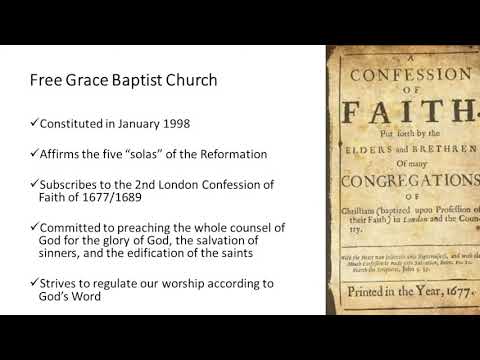
Why should a church bind itself to a confession of faith? This introductory lesson on the Second London Baptist Confession of 1677/1689 grounds the answer exegetically in Ephesians 4 — where Christ gives gifted men to the church so that the body attains doctrinal unity and is no longer tossed about by every wind of teaching — and then traces the historical origins of the 1689 among the Particular Baptists, distinguishing them from Anabaptists, Presbyterians, and Congregationalists. Four functions of a confession are developed: defining, defending, discriminating, and disciplining with reference to the doctrine of the church. The lesson closes by distinguishing Reformed theology (Calvinism plus covenant theology plus the regulative principle) from mere five-point Calvinism, and by defending the confession's silence on matters of Christian liberty as a feature, not a defect.

Introduction to the book of Exodus
The book of Exodus, whose Hebrew title derives from its opening words ('these are the names'), sets forth the foundational redemptive act of the Old Testament — God's deliverance of Israel from Egyptian bondage in fulfillment of the Abrahamic covenant promise of Genesis 15. This session surveys the book's structure, authorship, and theological themes, including the threefold division of the law (moral, judicial, and ceremonial), the typological relationship between Moses and Christ, and the Baptist confessional distinction that identifies the Mosaic covenant as a covenant of works rather than an administration of the covenant of grace. The study closes by tracing how Exodus functions as a foundational template for redemptive history across both Testaments, climaxing in the antitypical work of the Lord Jesus Christ as the true Passover lamb and covenant mediator.

The Lord's Assessment of John the Baptist - Matthew 11:2-15
Matthew 11:2-15 presents Christ's own assessment of John the Baptist, and this exposition works through two movements: the question John sends from prison concerning the Messiah's identity, and the Lord's threefold commendation of John as no mere reed, no court prophet, but the greatest born of women and the anti-typical Elijah. The sermon argues that John's struggle was not with who Jesus was but with the implications of the messianic reign — why the herald of judgment should languish in prison while the Messiah's full justice remained deferred — a tension the church in every age must learn to hold without abandoning confidence in God's sovereign timetable. Listeners are called to pray for and expect ministers who combine the light of sound exegesis with the heat of genuine conviction, men who, like John, neither fear nor flatter any flesh.

The Royal Wedding
Psalm 45 presents a royal wedding between the divine-human Messiah and his church, and the sons of Korah compose it as a song of love that the New Testament apostles and the entirety of the Old Testament prophetic witness sustain. The sermon works through the psalm's four sections — the psalmist's intention, the perfections and person of King Messiah, the instruction to the bride, and the closing declaration — demonstrating that a divine Messiah was not a novelty invented by John or Paul but was anticipated in the Hebrew Scriptures. Christ is celebrated as fairer than the sons of men, committed to truth and righteousness, triumphant over his enemies, fully God and fully man in the hypostatic union, and the one who clothes his bride in imputed righteousness received through faith alone. The appropriate response of the church is repentance, exclusive allegiance, worship, and gladness before her great King.

The Divinity of the Word, Part 2
John 1:3–5 teaches that the eternal Word is the creator of all things, establishing Christ unmistakably on the divine side of the creator-creature distinction. The sermon works through the Trinitarian doctrines of inseparable operations and appropriations, showing from Genesis 1, Psalm 33, Job 26, Colossians 1, and Hebrews 1 that creation is the undivided act of the one God, yet scripture distinctively attributes it to the Son. Because Jesus is creator, sustainer, and enthroned Lord, his people need not be paralyzed by circumstance — and the darkness, however violently it resists the light, cannot overcome it.

The Divinity of the Word
John 1:1–5 opens not in a Bethlehem stable but in eternity, establishing the Word's co-eternality, personal distinction from the Father, and full consubstantiality with the Father before a single creature existed. This sermon works through the first clause of John's prologue under five sub-points drawn from verse 1: the eternity, distinctiveness, and consubstantiality of the Word with the Father, the repetition of that glory in verse 2, and (deferred to the following week) the Word as creator of all things. The doctrine of the Trinity — one in essence, three in subsistence — is shown to be not an academic luxury but the very foundation of all communion with God and the indispensable framework for understanding why the incarnation is the supreme act of grace.

The Practice of the Church
Acts 2:41–47 describes the first-century church's response to apostolic preaching and, when read in light of the whole New Testament, is prescriptive for churches today. The sermon traces two main movements: the power of the gospel that produces faith, repentance, and baptism, and the fourfold practice of the church — steadfast continuation in the apostles' doctrine, fellowship, the breaking of bread, and prayer. Cessationism is applied to the signs and wonders of the apostolic era, while the ongoing marks of the church are drawn from the Belgic Confession's articles on the true church and the obligations of her members. The practical burden is that believers must resist both the reduction of church life to entertainment and the temptation to substitute online participation for embodied, corporate worship.

The Christian Sabbath, Part 3
Three passages in the New Testament — Romans 14, Galatians 4, and Colossians 2 — are commonly marshalled against the abiding validity of the Fourth Commandment, but careful exegesis reveals that none of them address the weekly Lord's Day Sabbath. Romans 14 concerns Christian liberty over matters indifferent, principally Jewish dietary laws and Israel's feast calendar; Galatians 4 rebukes the Judaizers' demand that calendar observance supplement faith in Christ for justification; and Colossians 2 warns against a syncretistic heresy that mingled Christ, Judaism, and angel worship. In each case Paul is dealing with Israel's ceremonial calendar, not the moral Sabbath commandment rooted in creation and redemption, which remains binding on the new covenant people of God and is observed on the first day of the week in light of Christ's resurrection.

The Christian Sabbath, Part 2
The Christian Sabbath, grounded in both creation and redemption, does not cease in the New Covenant but is transformed by the resurrection of Christ from the seventh day to the first day of the week. Working through the ministry of Christ in Matthew 5 and 12, the resurrection accounts across all four Gospels, and the apostolic teaching in Hebrews 4, Acts 20, 1 Corinthians 16, and Revelation 1, this exposition argues that the moral obligation of one day in seven for the worship of God remains perpetually binding on the church. The shift from Saturday to Sunday Sabbath is grounded in Christ's completed redemptive work, which mirrors the Father's rest at the close of creation, establishing the Lord's Day as the Christian Sabbath. Believers are called to receive this day not as a legal burden but as a gracious gift from God, a weekly foretaste of the consummate rest that awaits the people of God.

The Christian Sabbath, Part 1
The Fourth Commandment's call to Sabbath observance is grounded not in Mosaic legislation alone but in the created order itself, the pattern of divine rest in Genesis 2, and the logic of redemption running through both Testaments. This sermon, the first in a series on the Christian Sabbath, expounds Deuteronomy 5:12–15 alongside key Old Covenant passages — Genesis 2, Exodus 16, Isaiah 56 and 58, and Jeremiah 31 — to argue that Sabbatarianism is a moral, perpetual, and trans-covenantal obligation rooted in creation and confirmed by covenant. The confession of the Second London Baptist Confession chapter 22 frames the doctrinal parameters, and the sermon closes with a call to receive the Sabbath not as a burden but as a blessed provision of God for his creatures.

The New and Living Way
Hebrews 10:19–25 presents two grounds of confidence for the people of God — boldness of access to the Holy of Holies through Christ's blood and flesh, and the possession of a great high priest over the house of God — and then presses three exhortations upon that foundation: draw near, hold fast the confession of hope, and consider one another to stir up love and good works. The sermon traces the problem of sinful man's exclusion from God's presence from Exodus 40 through the Levitical sacrificial system to its resolution in the incarnation and definite atonement of Christ, who consecrated a new and living way. Particular attention is given to the prohibition against forsaking the assembly, argued to be grammatically tied to the third exhortation and theologically governing all three, so that corporate Lord's Day worship is the ordained context in which God's people draw near, are educated in hope, and mutually provoke one another to love and good works. The sermon closes by calling the unconverted to look to Christ and the converted to embrace their shared responsibility for one another's souls through faithful churchmanship.

The Second Commandment
The Second Commandment (Deuteronomy 5:8–10) does not merely forbid the worship of false gods — it forbids the worship of the true God in a false manner, a distinction that carries enormous weight for how the church orders its worship today. The sermon works through the commandment's prohibition against idols and images (including pictorial representations of Christ), the theological rationale grounded in God's jealousy and immutability, the transgenerational consequences of false worship understood not as a hereditary curse but as the imitation of godlessness, and the promise of mercy to those who love and obey God. The positive application is the Regulative Principle of Worship: only what God has commanded is acceptable, and anything beyond or contrary to that command — however sincere the motive — constitutes the offering of strange fire to Yahweh.

The Hearing before the Sanhedrin, Part 1
The trial of Jesus before the Sanhedrin (Matthew 26:57–64) was no honest hearing but a predetermined execution by the highest religious court in Israel, assembled in violation of their own law and Scripture. This sermon examines the setting of the hearing, the fraudulent witness testimony regarding the temple, and the high priest's sworn examination of Jesus — in which Christ openly affirms that He is the Messiah, the Son of God, and Daniel's Son of Man. The temple charge against Jesus is shown to be a deliberate misquotation and misinterpretation of John 2:19, where Christ spoke not of the physical structure but of His own death and resurrection. The Sanhedrin's wickedness is set in sharp contrast to the resolve of Christ, who endures this sham trial in silence and then under oath, fulfilling Isaiah 53 and Daniel 7, in order to accomplish the salvation of His people.

The Believer's Gratitude Toward God
Psalm 103 grounds thanksgiving not in vague sentiment but in the specific mercies of a covenant-keeping God toward those He has redeemed. Working through David's threefold structure — the reminder to bless God, the reasons for blessing God, and the reflection on God's kingdom — the sermon traces the chief benefit of divine grace as the forgiveness of sins accomplished in Christ, before moving outward to temporal providences, divine mercy measured against human frailty, and the universal summons of all creation to praise. The sermon draws on Deuteronomy's warnings against forgetting God's benefits and Paul's account of the worthy walk in Colossians 1 to show that detailed, specific thanksgiving is a mark of those who have received grace. The congregation is called to speak to their own souls, directing them away from self-absorption and toward the God whose mercy extends from everlasting to everlasting.

Bible Study - Exodus 4
Exodus 4 continues the call narrative begun in chapter 3, tracing Moses' repeated reluctance to accept the commission to deliver Israel from Egypt and God's patient, sovereign response to each objection. God confirms Moses' authority through three authenticating signs — the rod becoming a serpent, the leprous hand, and water turned to blood — not as ends in themselves but as instruments to authenticate Moses as God's spokesman, consistent with the function of signs throughout Scripture. The chapter's second half traces Moses' return to Egypt, including the judicial hardening of Pharaoh's heart as an act of divine justice rather than injustice, Israel's identification as God's firstborn, and the concluding scene of Israel's elders bowing in worship upon receiving Moses and Aaron's testimony. The sermon calls hearers to find comfort in the absolute sovereignty of God over nature, disease, human speech, and pagan rulers, and to let that knowledge shape reverent, joyful corporate and private worship.

Bible Study - Exodus 3
Exodus 3 presents the burning bush theophany as a revelation of the character of God before it is a commission to Moses. The passage is expounded under three headings: the commission given to Moses (vv. 1–12), the revelation of the divine name Yahweh (vv. 13–15), and the instructions given to Moses concerning Israel and Pharaoh (vv. 16–22). The divine name 'I AM WHO I AM' discloses God's self-existence, eternality, immutability, and covenantal faithfulness — attributes that must frame corporate worship and undergird the believer's confidence in affliction.

The Lord's Betrayal in the Garden
Matthew 26:47–50, read alongside John 18:1–11, presents the betrayal of the Son of God in Gethsemane as the arrival of the cup of divine wrath — the hour for which he came. The sermon traces three aspects of the betrayal: its significance as the fulfillment of prophecy and the onset of Messianic suffering, the diabolical plan coordinated by Judas and the religious leaders, and the execution of that plan through a hypocritical kiss. The exposition then turns to John 18 to show that even as Christ surrendered, he revealed his divine identity by the words 'I Am,' causing the armed mob to draw back and fall to the ground — a display of the glory that will be fully manifested at his return. The central application is twofold: believers are called to stand in awe of the active obedience and voluntary self-surrender of Christ whose righteousness is imputed to them, and unbelievers are warned that the only preparation for facing that glory is faith in the Lord Jesus Christ.

The Third Missionary Journey, Part 4
Acts 20:1–16 narrates Paul's closing movements on his third missionary journey — through Macedonia and Greece, into Troas where Eutychus falls to his death and is raised, and then south toward Jerusalem. The passage is used to argue that the early church's pattern of worship is not merely descriptive but carries prescriptive force: the Lord's Day (the first day of the week), corporate assembly, the Lord's Supper, and the preaching of God's Word are the God-ordained elements of Christian worship, regulated by Scripture alone. Cessationist and confessional commitments frame the reading throughout, and the sermon closes with a direct call to sinners to trust in Christ's imputed righteousness and atoning blood as the only ground of salvation.

The Problem Worse than Paralysis
The healing of the paralytic in Matthew 9:1–8 exposes a problem far deeper than physical disability: the guilt of sin before a holy God. Jesus pronounces forgiveness before He commands the man to rise, revealing that the greater miracle is not restored limbs but a cleansed soul — and that the Son of Man possesses divine authority on earth to forgive sins. The physical healing serves as demonstrable evidence of the greater, invisible reality: that Christ accomplished what His name declared He would do, saving His people from their sins. The right response to such power is not mere wonder but the fear-and-joy that drives genuine worship and sustains the believer's cheer through every temporal affliction.
Nations Rage, God Mocks

Psalm 2 confronts the rage of earthly rulers against God and His anointed with a sober theological question: why do the nations engage in so futile an endeavor? The sermon expounds the psalm under three headings — the rebellion of earthly kings, the reign of the heavenly king, and the recognition of the true king — tracing the Davidic covenant through its fulfillment in the resurrection and exaltation of Christ. The Covenant of Redemption grounds the certainty of Christ's present reign at the right hand of the Father, and that certainty is the sole comfort available to God's people as nations continue to rage and the history of the church runs red with the blood of martyrs. Hearers are called either to kiss the Son in filial fear and find blessing, or to perish in the way of the ungodly.
Stewards of the Mystery
1 Corinthians 4:1–5 presents ministers of Christ not as celebrities or gurus but as servants and stewards entrusted with the mystery of the gospel — a role demanding faithfulness, not worldly success. Against the backdrop of the factionalism at Corinth, where worldly wisdom had infiltrated the church's evaluation of apostles, Paul asserts that the only judge competent to assess a steward's motives is the Lord himself. The sermon traces three movements: the nature of the steward's calling, the irrelevance of human verdict, and the eschatological praise that awaits the faithful at Christ's return.

The Third Missionary Journey, Part 3
Acts 19:21–41 records Paul's final days in Ephesus, culminating in a riot instigated by the silversmith Demetrius, whose financial interests were threatened by the gospel's advance against idolatry. The passage is examined under four headings: Paul's strategic plans for further ministry, the anger of the silversmiths rooted in profit dressed as piety and patriotism, the confused uproar in the theater, and the intervention of the city clerk whose cool legal reasoning protected the church. The exposition draws out the apologetic purpose of Luke's account — demonstrating that Roman civil authority found no legal fault with Christianity — and closes with an urgent call to forsake every idol and trust the righteousness of Christ alone.

Waging the Good War
First Timothy 1:18–20 charges Timothy to wage the good warfare of the Christian faith, grounded in faith and a good conscience. This exposition identifies two weapons of the faithful minister—trust in the living God and a conscience calibrated by sound doctrine—set against the backdrop of false teachers who have shipwrecked the faith by rejecting the gospel of free and sovereign grace. The sermon then turns to the solemn consequence of neglecting that warfare, tracing the excommunication of Hymenaeus and Alexander as a case study in church discipline executed for the purity of the church and the potential restoration of the offender. Hearers are pressed to examine whether they possess genuine discernment regarding the gospel and genuine sensitivity toward sin, waging the warfare not to earn salvation but in response to the grace already secured in Christ.