
Topic
Theology Proper
372 sermons · All topics

Hyper-Calvinism's Root Error
Hyper-Calvinism and Arminianism are identified as mirror-image errors: Arminianism over-weights human agency, while Hyper-Calvinism rests on a false conception of God and his ways in the world. The root error of Hyper-Calvinism is traced to speculation about what God has not revealed, producing conclusions that contradict Scripture.

The Psalmist's Contemplation on the Revelation of God, Part 1

Psalm 19:1–6 presents the doctrine of general revelation — God's self-disclosure through the created order — and David's prophetic anticipation of the gospel's universal proclamation. The sermon traces the content, constancy, and comprehensive scope of general revelation, grounding each observation in Paul's parallel argument in Romans 1:18–32. The expositor then argues, against Calvin's merely comparative reading, that Paul's citation of Psalm 19:4 in Romans 10:18 legitimizes a Christological interpretation of verses 4b–6, in which the sun typifies Christ the Son of Righteousness, the great Bridegroom of his church, whose gospel goes forth conquering to the ends of the earth. Hearers are called to receive the Son whose rays of saving grace cannot be stopped any more than the circuit of the sun.

The Holy Confidence

Jeremiah 9:23–24 confronts the hollow complacency of boasting in wisdom, might, and riches — the carnal securities that cannot avert the certain judgment of God — and calls God's people instead to a holy confidence whose sole ground is the knowledge of the Lord who exercises lovingkindness, judgment, and righteousness. The sermon traces a threefold structure: the folly of earthly boasting illustrated from Scripture and the case of Nebuchadnezzar, the necessity of glorying in God alone as the antidote to every false confidence, and the hallowed contemplations — lovingkindness, judgment, and righteousness — that are to fill the believing mind. The Christward trajectory of the passage is pressed home: Christ secures the lovingkindness, bears the judgment, and provides the righteousness that alone avails before God, so that the promise 'believe on the Lord Jesus Christ and you will be saved' is as certain as every judgment God has already executed.

The Gospel Foundation for Corporate Prayer
The apostle Paul grounds the church's corporate prayer in a three-part theological rationale drawn from 1 Timothy 2:3–7: the nature of God, the office of Christ, and the ministry of Paul. The phrase 'all men' in verses 1–4 refers not to every individual without exception but to all kinds of men without distinction — Jew and Gentile, slave and king — a reading demanded by Paul's own doctrine of reprobation in Romans 9 and confirmed by the scope of his apostolic commission to the Gentiles. Christ's mediatorship is shown to require both a divine and a human nature, and his ransom is definite in its design — paid for all kinds of men, not all men without exception — precluding both universalism and any notion of unmet desires in God. The sermon closes by pressing the congregation to show up for corporate prayer, to pray specifically for the salvation of those in civil authority, and to exhort all around them to flee to Christ.

The Central Demand of the Covenant
Deuteronomy 10 presents the central demand of the Mosaic covenant — that Israel fear, love, and serve the Lord with all their heart and soul — set against the backdrop of the golden calf incident and the covenant's renewal. The sermon traces this demand from its roots in Deuteronomy 10:12–13 through its echoes in Genesis 18, Proverbs 21, Hosea 12, Zechariah 7, Micah 6, and Matthew 23, demonstrating that obedience rooted in heart religion has always been God's requirement of His people. The threefold division of the law is expounded, with the moral law established as perpetually binding while the ceremonial law finds its fulfillment in Christ and the judicial law expires with the Israelite theocracy. The sermon closes by pressing believers to hold fast to God, keeping His law not as a means of justification but as the pattern for sanctification purchased by Christ, the true Israel who alone fulfilled the covenant.

CTF 2026: Q&A Panel Discussion
A panel of Reformed Baptist and Reformed theologians fields audience questions on some of the most demanding loci in Reformed theology: federal headship and the fall, God's effective and permissive will in the hardening of Pharaoh's heart, the mystery of the first sin, free will as acting according to nature, hyper-Calvinism, the infralapsarian and supralapsarian debate, and the legitimacy of the free offer of the gospel under God's exhaustive decree. The discussion is frank about the limits of creaturely knowledge on questions the secret will of God has not resolved, while insisting that doctrinal humility and ordinary means of grace—not cage-stage polemics or churchless social media—are the proper context for growth in these truths.

CTF 2026 - Session 4: Pastoral Sermon

Hebrews 2:10 declares that it was fitting for God — the source and goal of all things — to bring many sons to glory through the sufferings of Christ. This sermon traces the eternal decree of election to glory, showing that the predestined are appointed not only to grace but to the full unveiled sight of God in Christ. Drawing on Hebrews 1–2, 2 Corinthians 4, and Psalm 36, the preacher argues that regenerate eyes now see the glory of God refracted through creation, Scripture, and the means of grace, as a foretaste of the unmediated vision that awaits the saints. The exhortation is to resist stopping at the creature, tracing every creaturely beauty upward to God himself, and to hunger for the glory that outweighs all present suffering.

CTF 2026 - Session 2: Introducing “Of God’s Decree”

What does it mean that God has decreed whatsoever comes to pass, and how should that staggering claim be approached without either flattening its force or drawing false conclusions from it? This lecture introduces 1689 London Baptist Confession chapter three ('Of God's Decree'), establishing three guiding principles for the study: the decree is not our duty to obey, it remains largely veiled in mystery despite its scriptural attestation, and it demands a robust creator-creature distinction throughout. Working through 2LCF chapters two through five as a unified doctrinal unit, the lecture distinguishes God's imminent work of decreeing from his transitive works of creation and providence, and sets up the question — to be addressed in the following session — of whether God's comprehensive decree makes him the author of sin.

CTF 2026 - Session 1: God's Decree in the Puritan Confessions
The doctrine of God's eternal decree, as confessed in the Westminster Confession of Faith, the Savoy Declaration, and the Second London Baptist Confession of 1677/1689, is not a single isolated chapter but a thread woven through the entire fabric of Reformed confessional theology. Drawing on Isaiah 46:8–11, this study traces the decree from its grounding in the doctrine of divine simplicity through creation, providence, the fall, covenant, redemption, the ordo salutis, perseverance, the spread of the gospel, and final judgment. The three Puritan-era confessions are shown to form a deliberate family — Westminster as parent, Savoy as child, and the Second London as grandchild — sharing common language and structure while registering careful Baptist and Congregationalist revisions. The study calls hearers not to speculative curiosity but to humble worship before the sovereign God whose decree is simply God decreeing.

CTF 2026 - Session 3: Is God the Author of Sin?
Two difficult theological questions frame this conference session: Is God the author of sin, and do a believer's sins work together for good? Drawing on 1689 LBCF 3.1, Acts 2:23, Acts 17:28, and Romans 8:28, the session argues that God's comprehensive, eternal decree encompasses all things — including sin — without making God personally culpable for evil, because sin is a privation of good rooted in the creature's deformed nature rather than in God's infinitely good being. The session closes by showing from Romans 8:28, with support from Robert Haldane and Genesis 50:20, that God's overruling providence turns even the believer's own sins toward their ultimate good and his glory — not as license to sin, but as ground for humility, dependence, and hope.

The Theater of His Glory
Psalm 19 sets creation and Scripture side by side as God's two books of revelation: the heavens declare His glory in every language to every people, while the Word of God converts the soul and opens eyes to see what unbelief cannot perceive. The sermon works through the psalm to show that general revelation leaves all people without excuse before God, yet only the regenerate, illumined by the Spirit through Scripture, properly receive the theater of God's glory. The three closing applications call Christians to train their children in a Christ-centered view of both books of revelation, to cultivate daily awareness of God's hand in creation, and above all to prize the Word of God as the supreme gift that leads to life and holiness.

A Trinitarian Blessing
What does it mean for a church letter full of conflict, rebuke, and difficult confrontation to close with a sweeping word of blessing? Paul's benediction in 2 Corinthians 13:14 — the most elevated Trinitarian affirmation in the New Testament — does exactly that, pronouncing grace, love, and communion upon a fractious and sinning congregation without exception. The sermon distinguishes the benediction (a word of blessing descending from heaven to God's people) from the doxology (praise ascending from earth to God), tracing how each element of the Trinitarian blessing — the grace of the Lord Jesus Christ, the love of God the Father, and the communion of the Holy Spirit — flows downward from the triune God as spiritual reality, not mere concept. The application is pointed: whatever the believer's besetting sin, weakness of assurance, or relational difficulty, the remedy begins not with human effort but with receiving the grace, love, and fellowship that the triune God lavishes upon his people.

The Central Confession of Israel's Faith
The Shema of Deuteronomy 6:4 — 'Hear, O Israel, the Lord our God, the Lord is one' — is examined as the central confession of Old Covenant Israel's faith, carrying both theological and polemical force for a people about to enter a land saturated with polytheism and syncretism. The sermon traces the purpose of God's commandments (obedience secured tenure in the land), the theological content of the Shema (divine unity of singularity and simplicity, and its compatibility with Trinitarian confession), and the fitting response of wholehearted love toward the one living and true God. The application presses New Covenant believers to the same totality of devotion — presenting themselves as living sacrifices — grounded in the redemption God has accomplished in Christ, the true Israel who kept the covenant His people perpetually broke.

Fearfully and Wonderfully Made
Psalm 139:13–16 declares that the formation of every human being in the womb is an act of God's immediate, intimate providence — the divine Weaver knitting together image-bearers for His own glory. The sermon argues that human dignity is grounded not in sentiment or politics but in divine authorship: God knows each person's substance before conception, fashions every inward part, and has decreed their days in His eternal book. The Incarnation deepens rather than evacuates this ethical claim, for the Son of God assumed embryonic and fetal life, passing through every stage of human existence to redeem a multitude of sinners. The congregation is called to tremble before the God who sees in secret, to defend the sanctity of life from conception to death, and to rest in the omnipotent providence of the One who has numbered both our members and our days.
Intro/Teaser - CTF 2026 - Understanding God's Decree
This introductory segment promotes the 2026 Confessing the Faith conference hosted by Free Grace Baptist Church in Chilliwack, BC, which will address 1689 London Baptist Confession Chapter 3 on the decree of God. The conference follows a sequential exposition of the confession, having previously covered the doctrine of Scripture (Chapter 1) and the doctrine of God and the Holy Trinity (Chapter 2). Featured speakers include Dr. Jim Renahan and Dr. Richard Barcelos of the International Reformed Baptist Seminary, alongside Pastor David Charles, who will offer a pastoral reflection on how the doctrine of divine decree is to be taught, embraced, and preached. The segment frames the doctrine of God's decree as foundational to Christian stability, peace, and worship, contending that what believers face in this world is governed by the sovereign God who has ordained whatsoever comes to pass for His glory and the good of His people.

What Is Confessing the Faith 2026? | Understanding God's Decree | Reformed Baptist
This episode of Ask Free Grace Baptist Church introduces the 2026 Confessing the Faith conference (April 10–11, Chilliwack, BC), which will focus on 1689 London Baptist Confession chapter 3, the doctrine of God's decree. Three speakers — Dr. Jim Renihan and Dr. Richard Barcelos of the International Reformed Baptist Seminary, and Pastor David Charles — will address the biblical, historical, and pastoral dimensions of the decree. The conversation explains why the doctrine matters: God's sovereign ordination of all things is not fate or impersonal force but the purposeful governance of the God revealed in Scripture, producing stability, peace, and worship in his people.

The Cry of Dereliction
What does Christ mean when he cries 'My God, my God, why have you forsaken me?' from the cross? This sermon on Matthew 27:45–46 carefully distinguishes what the cry of dereliction does not mean — no ontological division within the Trinity, no dissolution of the hypostatic union, no suffering of all three persons — before arguing that it expresses Christ's true humanity as our surety bearing the punishment of loss: the withdrawal of the Father's smiling favor and consolatory presence as the Son satisfies divine justice for the sins of his people. The sermon draws extensively on Psalm 22 to show that the forsakenness is covenantal and substitutionary, not metaphysical, and closes with a call to believe on the crucified and risen Christ who cried this cry so that his people never will.

2LCF Chapter 8, Of Christ the Mediator, Part 1
The 2nd London Confession of Faith Chapter 8, 'Of Christ the Mediator,' stands at the structural and theological center of the confession — all that precedes it tends toward it, and all that follows flows from it. This session examines paragraphs 1, 2, 3, 7, and 9, focusing on the identity, deity, and divine relations of the Son of God as the appointed mediator. Drawing on the Nicene and Chalcedonian creeds and the biblical witness, the study argues that the Son is very and eternal God, eternally begotten of the Father, of one substance and equal with him, the creator and sovereign governor of all things — and that this high Christology is the necessary foundation for understanding the incarnation and saving work that follows.
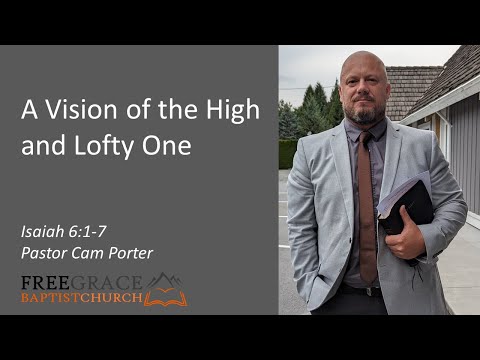
A Vision of the High and Lofty One
Isaiah 6:1–7 presents the prophet's visionary encounter with the enthroned Lord — holy, holy, holy — and his subsequent cleansing by a coal from the altar. This sermon works through five movements in the passage: the introductory contrast between dying earthly kings and the eternal High King of Heaven; the exemplary posture of the seraphim before the divine majesty; the superlative holiness, glorious titles, and unbounded presence of the Lord of hosts; Isaiah's fitting confession of his own uncleanness; and the gracious divine initiative in purification, which anticipates the definite atoning work of Christ. The congregation is called to approach the living God with the humility of Isaiah and the seraphim, confident that the same sovereign who commissioned his prophet will fill the whole earth with his glory through the proclamation of the gospel.

2LCF Chapter 7, Of God's Covenant
God's covenant with humanity is not an afterthought to the fall but the divinely ordained means by which the Creator bridges the infinite distance between himself and the creature. This study of 2LCF Chapter 7 traces three movements: the necessity of covenant rooted in the creator-creature distinction, the necessity of a covenant of grace arising from man's fall and God's sovereign pleasure to save, and the progressive revelation of that covenant from the protevangelium in Genesis 3 through its ratification in the blood of Christ at Calvary. The sermon insists that the covenant of grace is not merely administered across multiple Old Testament epochs but revealed through them and finally ratified — not administered — in the new covenant, a distinctively Reformed Baptist reading of covenant theology. The hearer is called to rest entirely on the covenant obedience of Christ, the only mediator, rather than on any obedience of their own.
2LCF Chapter 5, Of Divine Providence
Divine providence — God's upholding, directing, disposing, and governing of all creatures and all their actions — is the subject of 2LCF Chapter 5. The chapter moves from a general statement of providence in paragraph 1 through the relationship of first and second causes, the use of means, and the hardest pastoral question: how God's sovereign decree relates to sin in general, in believers, and in unbelievers. The session closes by grounding the doctrine in the particular care God exercises over his church, whose history is the key to all human history.
The Third Commandment
The Third Commandment — 'You shall not take the name of the Lord your God in vain' (Deuteronomy 5:11) — carries far greater weight than mere avoidance of profanity, because the divine name is not an arbitrary label but a revelation of God's very being, perfections, works, and decree. The sermon examines three aspects: the theological significance of God's name, the breadth of the prohibition (spanning blasphemy, frivolous speech, euphemisms, unlawful oaths, magic and sorcery, misapplication of providence, and maintenance of false doctrine), and the positive duty to use God's name reverently in prayer, praise, theological discourse, and the keeping of solemn oaths. The closing application presses hearers toward an 'answerable conversation' — a profession of faith matched by a life that gives no occasion to the enemies of the Lord to blaspheme.

2LCF Chapter 4, Of Creation
2LCF Chapter 4 expounds the doctrine of creation across three paragraphs, addressing what creation is, the triune God who creates, the nature and dignity of man as image-bearer, and the covenantal framework that gives creation its redemptive telos. The sermon argues that creation ex nihilo (qualified as God bringing forth all that is not God) and creation ex materia are distinct but complementary categories, and that divine immutability is preserved because no change or new perfection accrues to God through the act of creating. Ultimately, creation serves as the theatre within which God executes His eternal decree of redemption, bringing a multitude of elect sinners to glory through the perfect work of Jesus Christ.

The Second Commandment - Deuteronomy 5:8-11
The Second Commandment (Deuteronomy 5:8-11) prohibits both the making of images to represent God and the worship of those images — two distinct but related offenses against the infinitely simple, spiritual, and incomprehensible God. Because God cannot be captured in creaturely form, any visible representation of Him, including pictures or films of the Lord Jesus Christ, violates the commandment: the hypostatic union cannot be depicted by an artist's rendering, and Christ is to be set forth through preaching, not imagery. The positive demand of the commandment is worship regulated strictly by divine command — the regulative principle — which restricts the church to the elements God has prescribed in Scripture, excluding both the inventions of men and the traditions of Rome.

The First Commandment
Deuteronomy 5:7 — 'You shall have no other gods before me' — is the foundation of covenant loyalty, defining not only who the one true God is but what response He demands from His people. This study works through the prohibition against other gods (atheism, polytheism, syncretism, sorcery, heresy, and creature-worship) before turning to the positive duties the commandment requires: knowing God, loving Him, fearing Him, obeying Him, trusting Him, and worshipping Him on His own terms. The first commandment is not merely theological orthodoxy but a call to total, exclusive, and practical devotion to Yahweh — a devotion made possible only by the grace that plants His fear in the heart.

2LCF Chapter 3, Of God's Decree
God's decree — His eternal, immutable purpose to foreordain whatsoever comes to pass — is the subject of 2 London Baptist Confession of Faith Chapter 3. This study works through paragraphs 1–7, establishing that the decree is absolute and unconditional, covers all events including the free and sinful actions of creatures without making God the author of sin, and that election unto life is grounded solely in God's free grace rather than any foreseen condition in the creature. The session addresses the distinction between preterition and double predestination, the infralapsarian and supralapsarian debate, and closes with the confession's insistence that this high doctrine is to be handled with prudence, producing praise, humility, diligence, and abundant consolation in those who sincerely obey the gospel.

Ask FGBC #42: What Words Aren't In The Bible But Help Protect Its Teachings?
Scripture and theology regularly employ concepts that require precise extra-biblical vocabulary to guard against error and heresy. This Q&A session works through a range of theological terms — Trinity, consubstantiality, partitive exegesis, inseparable operations, and more — explaining why the church has historically coined and defended such language rather than restricting itself to bare biblical words. The discussion traces how heretics from the Arians to the Anomeans exploited the refusal to use extra-biblical terms, and why the apostolic mandate to 'earnestly contend for the faith' requires the full use of theological grammar inherited from the church's confessional tradition.

2LBC - Chapter 2 - Of God and the Holy Trinity
What does it mean that God is one, simple, immutable, immense, and triune — and why does any of it matter for Christian worship? This confession study works through the Second London Baptist Confession of Faith Chapter 2 ("Of God and the Holy Trinity"), tracing the three movements of the chapter: God's essential glory in paragraph 1, God's transcendent relations in paragraph 2, and God's triune majesty in paragraph 3. Along the way, foundational interpretive principles for speaking rightly about God are established — the legitimate use of logical consequences from Scripture, the necessity of extra-biblical vocabulary to guard biblical truth, and the reading of anthropomorphic language according to the meaning rather than the letter. The session closes with a direct application: the doctrine of God is not speculative labor but the very foundation of communion with Father, Son, and Holy Spirit, and of the creature's comfortable dependence upon him.

Live Stream - May 4, 2025
Isaiah 55:10–11 sets forth the certain efficacy of God's word, both written and incarnate. The sermon exposition moves in two parts: first, the power of the written word of God, which—like rain and snow—never returns to the Lord void but accomplishes precisely what he purposes; second, the glory of the incarnate Word, the eternal Son who is himself sent forth from the Father and whose redemptive work—incarnation, active obedience, passive obedience, resurrection, and session—is no less certain in its accomplishment. The doctrine of eternal generation is traced through the Old Testament (Genesis 1, Psalm 2, Psalm 45, Psalm 110, Psalm 130, Proverbs 8, Micah 5, Isaiah 9) before the sermon applies both truths to unbelievers (urgency of gospel response) and believers (covenant renewal at the Lord's Supper).

CLIP: The Trinity in 2 Minutes
The doctrine of the Trinity is not a division of the divine essence into three parts, but one infinite and undivided substance eternally subsisting as Father, Son, and Holy Spirit. The confession's language moves deliberately between the oneness and the threeness of God — the Father unbegotten, the Son eternally begotten, the Holy Spirit proceeding from both — holding the unity and the distinction together without confusion. This doctrine is not speculative theology but the very foundation of the Christian's communion with God and the ground of confident, joyful worship.