
Topic
Soteriology
2,239 sermons · All topics

Live Stream - April 6, 2025

Philippians 2:8 sets forth the humility of Christ as both the ground of the believer's salvation and the supreme example for the church's conduct. The sermon traces Christ's obedience from his mother's womb to the cross, distinguishing the active and passive obedience that together constitute the basis of justification by faith alone. Against the errors of eternal functional subordination, the speaker anchors Christ's submission firmly in his human nature as covenant mediator, not in any hierarchy within the immanent Trinity. The Lord's Supper is then administered as a seal of precisely these twin benefits — the active obedience that clothes the sinner in righteousness and the passive obedience that cleanses from sin.

2LCF Chapter 1: Of the Holy Scriptures, Paragraphs 1-3
Philippians 2:8 presents Christ's humiliation as a twofold act: the declaration that he humbled himself voluntarily, and the demonstration that this humility extended from the womb to the cross through entire, exact, and perpetual obedience. The sermon carefully distinguishes the obedience rendered according to Christ's humanity as covenant mediator from any eternal subordination within the Godhead, rejecting eternal functional subordination as a departure from classical theism. The active obedience of Christ — his positive fulfilment of God's law throughout his life — and his passive obedience in his atoning death together constitute the sole ground of justification, which believers receive by faith alone and commemorate in the Lord's Supper.

The High Priestly Prayer, Part 8
John 17:21–23 records Christ's high priestly petition for the unity of all believers across every age — a unity patterned on the mutual indwelling of the Father and the Son. The sermon works through the petition ('that they all may be one'), the divine paradigm (the perichoretic union of the Father and Son as the exemplar for creaturely unity), and the missional purpose (a unified church publishes to the world the reality of the Incarnation and the love of the Father). Believers are called to pursue a common faith, a common orientation, and a common goal — the glory of God — knowing that their corporate life is itself a testimony to the mission of the sent Son.

The Example of the Savior, Part 3
Philippians 2:8 presents the humility of Christ not as incidental biography but as the doctrinal and ethical foundation for the church's conduct. This sermon examines first the declaration of Christ's humility — that he humbled himself voluntarily, according to his human nature as covenant mediator, in active obedience to every demand of God's law from his mother's womb — and then its demonstration in the extent of that humiliation: even the death of the cross, a death cursed by the law and laden with shame. The active and passive obedience of Christ, taken together, are the sole ground of justification by faith alone, which is why the Lord's Supper is received not as a reward for good conduct but as a proclamation of what the Savior accomplished on behalf of his people.

March 30 PM

Galatians 2:17–21 closes Paul's autobiographical defense of justification by faith alone, and these five verses press three weighty questions: Is Christ a minister of sin when believers forsake the Mosaic ceremonies? Who is the true transgressor? And what does Judaizing heresy actually do to the cross of Christ? The sermon argues that to impose any measure of works upon the economy of salvation — whether old-covenant ceremony or its modern legalistic counterpart — is to render the incarnation, the perfect obedience, and the atoning death of the Son of God as vanity. The single ground of the believer's justification, assurance, and perseverance is the Son of God who loved us and gave himself for us, in whom alone everlasting righteousness is found.

2LCF Chapter 1: Of the Holy Scripture, Paragraphs 1-3
The 1689 London Baptist Confession of Faith opens with the doctrine of Holy Scripture because all subsequent confessional theology stands or falls on this foundation. This session works through paragraphs 1–3 of Chapter 1, establishing first the necessity of Scripture — grounded in the insufficiency of general revelation for saving knowledge and the cessation of direct prophetic revelation — and then the identity of Scripture, treating the question of canon (which books belong) and the exclusion of the Apocrypha. Three criteria for canonicity are examined: the providential exposure of books, the divine attributes Scripture bears, and apostolic origin broadly understood.

The High Priestly Prayer, Part 7
John 17:20 records Christ's intercession extending beyond the apostles to all who would believe through their word — a prayer that excludes the world and encompasses the elect of every age. The verse yields five doctrinal implications: justification is by faith alone; the apostolic word is the ordained instrument of that faith; Christ assumes gospel advance and missions; sovereign election and predestination undergird the certainty that there will be believers; and the world possesses a solidarity in enmity against God that mirrors, and indicts, the disunity too common among God's people. Practically, the sermon calls the church to gospel-centred ministry, qualified and instructional preaching, the earnest pursuit of unity, and calls the unconverted to believe on the Lord Jesus Christ without delay.

Unpacking Covenant Theology: Tensions in Reformed Tradition
The relationship between the Mosaic Covenant and the Covenant of Works has generated significant tension within Westminster confessional theology, particularly around Meredith Kline's view of republication. While the broader Reformed tradition has historically accommodated a range of positions — including treating the Mosaic Covenant as a subservient covenant of works — the Westminster Confession narrows that range by specifying the Mosaic Covenant as an administration of the Covenant of Grace, creating a confessional problem for those who hold Kline's position. This exchange examines how confessional Presbyterians (including paedobaptists) navigate the resulting tension, with reference to OPC reports on republication.

Introduction to Deuteronomy
Deuteronomy is introduced as the second giving of the law — not a new law, but a restatement of the Sinai covenant addressed to the second generation of Israel standing on the plains of Moab, poised to enter the land of promise. The session surveys Mosaic authorship, the book's place in the Pentateuch, its historical context, its broad outline (God's activity, law, covenant, and servants), and its major theological emphases: reminder, transition, exhortation, and instruction in theology proper, the promise of land, and the worship of God. The study concludes with the typological significance of Deuteronomy for the New Testament, tracing how the book prefigures Christ as prophet, priest, king, and true Israel, and how its promise of new covenant in chapter 30 points forward to what Jeremiah 31 and the gospel make explicit.
Our Robe of Beauty
Galatians 2:16 presents a five-fold declaration that justification is by faith alone and not by the works of the law — a doctrine that stands at the very heart of the Christian gospel. This sermon works through four categories: a definition of justification as a forensic declaration set in opposition to condemnation, its foundation in the obedience and satisfaction of Christ alone (not infused righteousness, works, the act of faith, or evangelical obedience), the transaction of imputation by which sin is credited to Christ and his righteousness credited to the believer, and faith as the empty instrument that receives rather than earns that righteousness. The pastoral application presses the believer's assurance away from inward evidences toward the finished work of Christ, and calls the unconverted to look to Christ in faith as their only standing before a holy God.

The High Priestly Prayer, Part 6
John 17:17–19 records Christ's priestly petition that the Father sanctify the apostles by the truth — consecrating them, as the Old Testament priests were consecrated, for the specific mission of preaching and writing to which He was sending them. The instrument of that sanctification is the truth: the incarnate Word who is truth, the Spirit of truth, and the written Word breathed out by that Spirit. Christ's own sanctification in verse 19 is not a prayer for personal holiness but His self-consecration as the high priest who offers Himself as sacrifice, and that priestly self-offering is the very foundation on which the apostles — and all believers — are set apart. The practical summons is plain: growth in grace and conformity to Christ come through the ordinary means of God's truth, not through experience, emotion, or entertainment, and the church's fidelity to that pattern depends on elders who are devoted to teaching it.

The Priority in the Believer's Life - Matthew 6:25-34
Jesus commands his disciples not to worry about life, body, or tomorrow in Matthew 6:25–34, grounding the prohibition in three realities: God's providential care demonstrated in birds and lilies, the contrast between Gentile obsession and the believer's knowledge of a knowing Father, and the governing priority of verse 33 — seek first the kingdom of God and his righteousness. The sermon argues that carnal anxiety is theologically inconsistent for the Reformed believer: one who confesses God's comprehensive sovereignty in salvation yet surrenders to worry about temporal provision has applied Calvinism selectively. The antidote is not mere positive thinking but the cultivation of contentment rooted in the imputed righteousness of Christ, which grants entrance into the very kingdom we are commanded to seek first.

Live Stream - March 16, 2025
Philippians 2:7 presents four statements concerning the Incarnation of the Son of God: he made himself of no reputation, took the form of a bond servant, came in the likeness of men, and was found in appearance as a man. The sermon works carefully through each phrase to establish true Humanity against kenotic Christology on one side and Docetism on the other, arguing that Christ never ceased to be God but assumed a full human nature into personal union — the hypostatic union confessed at Chalcedon and codified in the 1689 LBCF chapter 8. Paul's purpose is ultimately ethical: the condescension of the eternal Son from the heights of Divinity to the form of a bond servant is the supreme argument against selfish ambition and conceit among believers.
The Use of the 2nd London Confession
A confession of faith is not a human addition to Scripture but a tool the church uses to define, defend, discriminate, discipline, and delimit its doctrine. Drawing on passages from the Pastoral Epistles, Jude, and Ephesians 4, this Sunday School address argues that the Second London Baptist Confession of 1689 serves the local church in six concrete ways: it establishes doctrinal boundaries, equips members for apologetics, vets candidates for ministry, grounds church discipline, protects Christian liberty by identifying what lies outside its purview, and anchors the church in the catholicity of the Reformed tradition. The session closes with a call to reject autonomous biblicism in favour of confessional theology understood as the fruit of the Spirit's ongoing work in the teaching ministry of Christ's church.

The High Priestly Prayer, Part 5
Christ's high priestly prayer in John 17:11–16 reveals two central petitions: that the Father would preserve the disciples by His name, and that He would protect them from the evil one — not by removing them from the world, but by keeping them within it. The sermon traces three arguments for preservation: Christ's own keeping of the disciples during His earthly ministry, His impending physical departure, and the world's settled hatred of those who belong to Him. Against this backdrop, the interceding Christ prays not merely for survival but for joy — that His people would suffer without losing sight of the strength that joy in God provides. The application is direct: Christians are left in the world for a reason, and the mission of gospel proclamation gives meaning to every trial they endure.

The Example of the Savior, Part 2
Philippians 2:7 sets forth Christ's incarnation as the supreme argument against selfish ambition and conceit. This expository sermon works through four statements in the verse — Christ made himself of no reputation, took the form of a bondservant, came in the likeness of men, and was found in appearance as a man — with careful attention to the kenotic controversy, the hypostatic union, and the patristic formulations at Nicaea and Chalcedon. The heresy of kenotic Christology (that Christ emptied himself of his divine attributes) is refuted from 2 Corinthians 8:9, John 1:14, and Hebrews 2, while docetism is equally rejected in favor of Christ's true and complete humanity. The doctrinal weight is carried in service of Paul's pastoral concern: the one who was in the form of God and equal with God voluntarily humbled himself, and that reality demolishes every claim to selfish priority among his people.

The High Priestly Prayer, Part 4
What grounds the prayers Jesus offers for his people, and why does he explicitly exclude the world from his intercession? Working through John 17:9–11a, this sermon examines the focus and rationale of Christ's high priestly intercession: he prays specifically for the elect whom the Father gave him, not for the reprobate world, and he does so as the mediating priest who both sacrifices and intercedes on behalf of his own. The mutual possession declared in verse 10 — 'all mine are yours and yours are mine' — establishes the full equality of the Son with the Father, while 'I am glorified in them' frames the church as a trophy case of divine grace displayed before angels and nations. The sermon closes with an exhortation to treasure the blessedness of election: a Savior who intercedes, a triune God who is known, and a security that nothing can sever.

The Example of the Savior, Part 1
Philippians 2:5–6 presents both a profound Christological confession and a direct ethical demand: the church is to pursue unity and love by imitating the mind of Christ. This sermon expounds the divinity of the Son — his eternal existence in the form of God and his equality with the Father — as the theological foundation for Paul's call to selflessness and others-mindedness in the local church. Christ's equality with God was not seized by usurpation, as Adam and Lucifer attempted, but was his by eternal generation and consubstantiality with the Father. Because the superior condescended to serve the inferior, those who are inferior to one another have every reason to renounce selfish ambition and conceit.
Ask FGBC #39: What Does The Bible Mean By The Unforgiveable Sin?
What is the unforgivable sin, and should a troubled conscience fear having committed it? Drawing on Matthew 12:31-32 and the apostasy warnings of Hebrews 6 and 10, this Q&A response argues that blasphemy against the Holy Spirit is not a momentary verbal offense but a wholesale, persistent rejection of the redemptive work of God in Christ — impugning the Spirit's testimony to Christ's works and glory. The defining mark of a genuine apostate is not anguish or doubt but a hardened, unrepentant contempt, like those who cried 'crucify him.' Anyone asking whether they have committed this sin gives evidence by that very asking that they have not.
The Woman Who Was a Sinner
Luke 7:36–50 presents three persons — the woman who was a sinner, the judgmental Pharisee Simon, and the Savior — to demonstrate that Christ freely receives and forgives notorious sinners, and that the devotion the woman shows is not the cause of her forgiveness but the consequence of it. The sermon argues she had already been saved before entering Simon's house, and that her tears, hair, and ointment are the fruit of a faith already given, not works by which she procured salvation. Against the self-righteous contempt of Simon, who mistakes moral superiority for spiritual standing, Christ's declaration 'your faith has saved you' makes plain that free forgiveness is received instrumentally through faith alone and expressed afterward in love. Believers are called to examine whether their own lives reflect the same gratitude this woman showed — not by manufactured effort, but by pondering the greatness of what they have been freely forgiven.
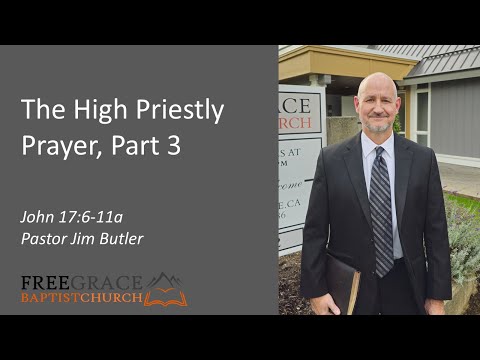
The High Priestly Prayer, Part 3
Jesus intercedes for his apostles in John 17:6–11a, and this sermon examines who those men are, what qualifies them as objects of his high priestly prayer, and why he prays for them rather than for the world. The exposition grounds the disciples' identity in the Father's sovereign, electing gift of them to the Son within the eternal covenant of redemption, their reception of the words the Father gave to the Son, and their growing recognition that the Son is one in being with the Father. The preacher draws out the implication that faithful gospel ministry, like the ministry of Christ himself, must declare only what has been received from God, without accommodation to cultural pressure or the demand for entertainment.

Ask FGBC #38: Faith vs Trust, Are They the Same?
Faith and trust are examined as near-synonymous terms in the Greek New Testament, with the threefold schema of assent, belief, and trust acknowledged but handled with care lest 'trust' become a works-oriented addition to saving faith. The sermon addresses whether doubt and fear disqualify a person from genuine saving faith, arguing from Matthew and Luke that believers in Scripture feared and doubted while possessing true faith. Perseverance is grounded not in the strength of a believer's grip on Christ but in the immutability of God's electing decree, the intercession of Christ, and the abiding of the Spirit, as articulated in 1689 LBCF 17.2. The practical counsel given is to strengthen weak faith through Scripture memory, doctrine, and the means of grace.

The Believer's Response to Trials
James 1:2–8 addresses the Christian's response to trials — not with grief or complaint, but with counted joy grounded in a clear theological understanding of God's purpose in suffering. The sermon works through two movements: the believer's response to trials in verses 2–4 (identifying, expecting, and rightly receiving them) and the believer's request during trials in verses 5–8 (seeking wisdom from a generous God and coming in faith without double-mindedness). The central application is that Christians must lay up this theology before trials arrive, so that when affliction comes, they are equipped to respond with settledness, faith, and prayer rather than anger or despair.

Trinitarian Assurance

Ephesians 1:3–14 presents a Trinitarian doxology in which the Father's election and predestination, the Son's redemption through His blood, and the Spirit's sealing together constitute the full ground of the believer's assurance. The passage resists any reduction of the three persons to isolated roles, insisting on inseparable operations even as Paul shines distinct light on each person's work. The sermon argues that the Christian's assurance must be anchored not in self-examination of fruit-bearing but in the objective, Trinitarian work of God accomplished entirely outside of us in Christ.

The Joy of the Gospel
Ephesians 2:1–10 presents the whole arc of redemption in miniature: total depravity, sovereign grace, and the new life of sanctification. This sermon works through that arc by contrasting the bad news of verses 1–3 — that every human being is spiritually dead, enslaved to fleshly desires, complicit with satanic powers, and deserving of divine wrath — with the good news of verses 4–10, where God's rich mercy, unearned grace, and sovereign bestowal of faith rescue sinners who had nothing to offer Him. The central application is that the regenerate life is marked not by boasting but by the Spirit's fruit, and that the gathered church is itself a foretaste of the eternal communion for which God has prepared His people in Christ.

Livestream - February 16
Galatians 2:11–16 records the Apostle Paul's public confrontation of the Apostle Peter at Antioch, where Peter's hypocritical withdrawal from table fellowship with Gentile believers was silently but powerfully undermining the doctrine of justification by faith alone. Paul's rebuke exposes that any action compromising the gospel — even short of openly denying it — is a serious offense, because justification rests solely upon the imputed righteousness of Christ and the pardon of sins secured by his active and passive obedience, received through faith apart from works of the law. The sermon traces the five-fold reiterative emphasis of verse 16 and grounds the necessity of this doctrine in the immutable character of God himself, who cannot justify the wicked apart from the perfect satisfaction rendered by the Lord Jesus Christ. Saints are exhorted to rest their peace not in any degree of personal obedience but entirely in the finished work of Christ, and sinners outside of Christ are called to believe on him as the only ground of justification.

2LCF Chapter 32 - Of the Last Judgement
2 London Baptist Confession of Faith Chapter 32 examines the doctrine of the Last Judgment under three heads: the concept of the Day of Judgment (its divine appointment, its agent in Christ, and its comprehensive scope over angels and all humanity), the goal of that day (the manifestation of God's mercy in the eternal salvation of the elect and his justice in the eternal damnation of the reprobate), and its practical relevance (deterring sin, consoling the afflicted people of God, and keeping believers watchful). The session concludes with a survey of the three millennial positions and four interpretive approaches to the book of Revelation, explaining why the Confession deliberately avoids resolving those disputes in order to function as a broad consensus document. The consistent ethical burden throughout is that contemplation of the coming judgment should shape present conduct: purifying the elect, driving evangelism, and giving the suffering saints confidence that divine justice will prevail.

The Apostolic Magnitude of Justification
Paul's confrontation of Peter at Antioch in Galatians 2:11–16 is not merely a biographical episode but a defence of the doctrine of justification by faith alone. Peter's hypocritical withdrawal from table fellowship with Gentile believers, driven by fear of the circumcision party, was not an open denial of the gospel but a compromise of it — and Paul's rebuke exposes how even the appearance of impropriety can bring the truth of the gospel into disrepute. The sermon then turns to the apostolic doctrine set forth in verses 15–16, tracing the five-fold reiterative negation and affirmation of justification by faith and not by the works of the law, grounding Christian peace in the imputation of Christ's active and passive obedience. Hearers are exhorted to carry the doctrine of justification beyond the service itself, resting their peace not on any measure of personal performance but on the sole and complete work of the Lord Jesus Christ.

The Conversion of Matthew
Matthew 9:9-13 presents the sovereign call of Christ to Matthew, a tax collector despised in first-century Jewish society as a collaborator with Gentile oppressors and a companion of sinners. The sermon traces three movements in the passage: the authoritative call that produced immediate discipleship, the feast Matthew threw to honor Christ and evangelize his former associates, and Christ's threefold response to the Pharisees' complaint — identifying himself as a physician to the sick, appealing to Hosea 6:6 against mere external religion, and declaring his mission to call sinners to repentance. The central application is that no sinner is too notorious to be received by Christ, and Matthew's immediate rising and following is held up as the pattern for genuine repentance and faith.

Baptism and testimony: Janelle Neels
A brief baptismal testimony in which the speaker recounts her conversion in September 2018, tracing God's providential drawing of her through faithful Christian friends, the preaching of the gospel, and a decisive moment of repentance and faith. She describes the assurance that followed — sin forgiven, fear of death removed, adoption into God's family — and anchors her ongoing Christian life in Galatians 2:20.