
Topic
Bibliology
415 sermons · All topics
Intro/Teaser - CTF 2026 - Understanding God's Decree

This introductory segment promotes the 2026 Confessing the Faith conference hosted by Free Grace Baptist Church in Chilliwack, BC, which will address 1689 London Baptist Confession Chapter 3 on the decree of God. The conference follows a sequential exposition of the confession, having previously covered the doctrine of Scripture (Chapter 1) and the doctrine of God and the Holy Trinity (Chapter 2). Featured speakers include Dr. Jim Renahan and Dr. Richard Barcelos of the International Reformed Baptist Seminary, alongside Pastor David Charles, who will offer a pastoral reflection on how the doctrine of divine decree is to be taught, embraced, and preached. The segment frames the doctrine of God's decree as foundational to Christian stability, peace, and worship, contending that what believers face in this world is governed by the sovereign God who has ordained whatsoever comes to pass for His glory and the good of His people.

What Is Faith? When Should I Be Baptized? & more| Ask FGBC Batch 6
This Q&A episode from a confessional Reformed Baptist church addresses twelve questions spanning baptism, faith, church membership, Scripture interpretation, seminary training, and the heresies of Federal Vision and Baxterianism. Particular attention is given to the definition of saving faith — distinguishing the objective content of the faith from the act of believing, warning against loading faith with feelings, faithfulness, or love as its ground, and insisting that faith is the empty instrument through which God-given grace lays hold of Christ alone. The episode closes with treatments of conviction of sin, catechetical instruction of children, and the importance of an educated ministry.

2LBCF Chapter 14 - Of Saving Faith

What is saving faith, where does it come from, and what does it rest upon? Working through Chapter 14 of the 1689 London Baptist Confession of Faith, this study examines saving faith under three headings: its nature (divine source, instrumental means, and fortifying ordinances), its object (the consequent acts of believing the Word and the principal acts of accepting, receiving, and resting upon Christ alone), and the variety and degree of faith across believers. The confession's teaching is grounded throughout in Scripture and the broader confessional architecture, demonstrating that saving faith is a purchased grace of the covenant of grace, given and sustained by the Spirit of Christ through the Word and the appointed means of the church.

The Reign of the Son of the Most High
Psalm 2 sets the fallen world's rebellion against God and His Anointed within a framework of divine sovereignty, showing that the rage of nations and rulers against Yahweh and His Christ is both futile and answerable. The psalm unfolds in four movements: the insurrection of mankind against God, the installation of the Son as King on Zion, the revelation of the eternal decree establishing the Son's universal inheritance, and the exhortation to kiss the Son in saving faith. Christ is identified as the eternal, only-begotten Son of the Father whose resurrection vindicates His divine Sonship, and whose worldwide reign is not yet complete but is advancing through the gospel mission entrusted to the church. The psalm closes with both a warning to the impenitent and a promise of blessedness to all who trust in Him.

The Third Appearance of Christ to the Disciples, Part 3
John 21:20–25 closes the fourth gospel with two interlocking concerns: the sovereign headship of Christ over His church and the divine authority of Holy Scripture. Peter's question about John's fate draws a sharp rebuke — 'What is that to you? You follow me' — which exposes the temptation to play the victim of providence rather than the contented subject of Christ's will. The passage then grounds the church's authority in the eyewitness testimony of the beloved disciple, written by the Spirit for one declared purpose: that you may believe that Jesus is the Christ and have life in His name. The sermon closes with John's doxological acknowledgment that the infinite Word made flesh exceeds all possible description, and calls every hearer to follow Christ in their appointed station rather than fixate on the lot of others.

2LCF Chap.12 of Adoption
The twelfth chapter of the 1689 London Baptist Confession treats adoption as a distinct benefit of the gospel, flowing necessarily from justification and grounded solely in God's sovereign grace through the Lord Jesus Christ. This study traces the basis of adoption — its recipients (the justified), its source (God's free vouchsafing), and its ground (the merit of Christ alone) — before working through the four categories of benefit the confession enumerates: inclusion in the family of God, reception of privileges (the divine name, the Spirit of adoption, bold access to the throne of grace), fatherly treatment (pity, protection, provision, and chastening), and the inheritance of everlasting salvation. A sustained contrast between Paul's juridical language of adoption and John's language of new birth demonstrates that both apostles teach the same doctrine from different vantage points, while an extended excursus on Hebrews 9–10 applies the Old Covenant / New Covenant contrast to rebut the paedobaptist argument for an internal-external continuity between the covenants. The children of God are called to live out their adoption by walking in love, light, and wisdom as Ephesians 5 commands.
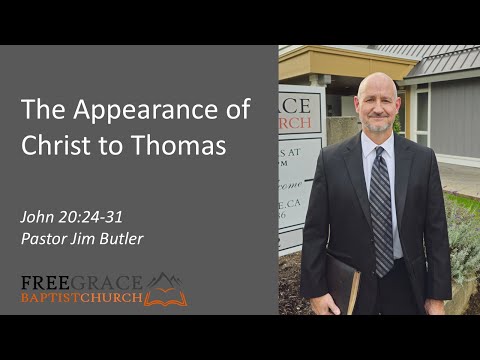
The Appearance of Christ to Thomas
John 20:24–31 presents Thomas not merely as a doubter but as an obstinate man who refuses to believe the resurrection unless his own conditions are met — rejecting the Old Testament prophets, the repeated predictions of Christ, and the apostolic testimony of ten eyewitnesses. Christ responds not with rebuke but with sovereign grace, appearing again on the Lord's Day and inviting Thomas to examine the wounds that sealed a finished atonement. The confession that follows — 'My Lord and my God' — is the theological and experiential crown of the fourth gospel, answering John's own stated purpose in verses 30–31: that through the written word, those who have not seen may nevertheless believe and have life in Christ's name.

2LCF Chap. 11
Chapter 11 of the Second London Confession of Faith sets forth the biblical doctrine of justification with precision: sinners are accepted before God not by infused or inherent righteousness, nor by the imputation of faith as an act of obedience, but by the imputation of Christ's active obedience to the whole law and His passive obedience in death, received through faith alone as the instrument of justification. The confession navigates the doctrine through careful negative and positive statements, guarding both the sole ground of acceptance in Christ and the inseparable connection between justification and sanctification. Believers are called to rest their assurance entirely on Christ's active and passive obedience — cleansed in His blood and clothed in His righteousness — rather than on any covenantal faithfulness of their own.

The Seventh Commandment, Part 1
The seventh commandment — 'You shall not commit adultery' (Deuteronomy 5:18) — presupposes and protects the divinely ordained institution of marriage, which Scripture grounds in three purposes: the mutual help of husband and wife, the increase of mankind through procreation, and the prevention of uncleanness. This study examines the basis of the commandment in the creation ordinance of Genesis 2, the law of God in the Decalogue and apostolic teaching, and the sanctions attached to its violation in Leviticus and Proverbs. The prohibition extends beyond adultery to fornication, incest, rape, and related sexual sins, with particular attention given to the difficult case legislation of Deuteronomy 22 and the critical difference between seduction and rape in that text.

The Promise of the Covenant of Grace
Galatians 3:15–18 presents Paul's covenantal argument that the Mosaic law, given 430 years after the Abrahamic promise, cannot annul the covenant of grace nor supplement faith with legal works as the ground of justification. The sermon traces four interlocking points: the immutability of God's redemptive promise, the nature of Abraham's faith in Christ as the singular promised seed, the pedagogical and temporary character of the Mosaic covenant as a distinct covenant of works, and the inheritance as freely given by promise rather than earned by law. The pastoral application is a call to rest entirely on Christ, the champion of the covenant of grace, and to resist every system that adds law-keeping or circumcision to faith as the basis of standing before God.
The Sixth Commandment, Part 3
The sixth commandment, 'You shall not murder' (Deuteronomy 5:17), prohibits unlawful killing with premeditation and malice, but the Bible distinguishes murder from lawful taking of life in capital punishment, self-defense, and just war. This study works through the Old Testament legal framework for self-defense, particularly Exodus 22:2–3, alongside several narrative examples, to establish that defensive homicide is not forbidden by Scripture. The teaching of Jesus in Matthew 5:38–42 is examined carefully to show that the Sermon on the Mount addresses personal, interpersonal ethics — not a universal prohibition on self-defense — and that Jesus himself assumes people will protect themselves and others. The study concludes with a call to think with biblical clarity on these matters in an age of muddled Christian ethics.

2LCF Chapter 8, Of Christ the Mediator, Part 3
The sinlessness of Christ, the efficient and instrumental causes of the incarnation, and the hypostatic union are examined through a clause-by-clause exposition of 2LCF Chapter 8, paragraph 2, with supporting analysis of paragraphs 3 and 7. The confession's language — 'yet without sin,' 'conceived by the Holy Spirit,' 'of the seed of Abraham and David,' 'without conversion, composition, or confusion' — is unpacked against the background of patristic Christology, Chalcedonian definition, and Reformed theological precision. The ministry of the Holy Spirit throughout the entire mediatorial life of Christ is recovered as an often-neglected dimension of Christology. Incarnational and interpretive rules drawn from paragraph 7 equip hearers to handle Scripture passages that appear to diminish Christ's deity, by distinguishing what is predicated of a nature from what is predicated of the one person according to a nature.

2LCF Chapter 8, Of Christ the Mediator, Part 2
The incarnation of the Son of God — his taking to himself a true and complete human nature — is the greatest of all gospel mysteries and the life and soul of the church. Working through paragraphs one, two, three, seven, and nine of the Second London Confession chapter eight, this study examines the timing, manner, and extent of the Son's assumption of humanity, arguing that the incarnation was neither a subtraction from deity nor an addition to it, but a terminative assumption by which the eternal Son united human nature to his own divine person in the hypostatic union. The full extent of that assumption — body, reasonable soul, human will, human affections, and the common sinless infirmities of our nature — is not a speculative nicety but a soteriological necessity: what is not assumed is not healed.

2LCF Chapter 8, Of Christ the Mediator, Part 1
The 2nd London Confession of Faith Chapter 8, 'Of Christ the Mediator,' stands at the structural and theological center of the confession — all that precedes it tends toward it, and all that follows flows from it. This session examines paragraphs 1, 2, 3, 7, and 9, focusing on the identity, deity, and divine relations of the Son of God as the appointed mediator. Drawing on the Nicene and Chalcedonian creeds and the biblical witness, the study argues that the Son is very and eternal God, eternally begotten of the Father, of one substance and equal with him, the creator and sovereign governor of all things — and that this high Christology is the necessary foundation for understanding the incarnation and saving work that follows.

2LCF Chapter 7, Of God's Covenant
God's covenant with humanity is not an afterthought to the fall but the divinely ordained means by which the Creator bridges the infinite distance between himself and the creature. This study of 2LCF Chapter 7 traces three movements: the necessity of covenant rooted in the creator-creature distinction, the necessity of a covenant of grace arising from man's fall and God's sovereign pleasure to save, and the progressive revelation of that covenant from the protevangelium in Genesis 3 through its ratification in the blood of Christ at Calvary. The sermon insists that the covenant of grace is not merely administered across multiple Old Testament epochs but revealed through them and finally ratified — not administered — in the new covenant, a distinctively Reformed Baptist reading of covenant theology. The hearer is called to rest entirely on the covenant obedience of Christ, the only mediator, rather than on any obedience of their own.

The Fourth Commandment, Part 3
Hebrews 4:9's use of the word 'Sabbatismos' — Sabbath-keeping as a practice to be observed — anchors the argument that a weekly Sabbath rest remains binding on the New Covenant people of God. The sermon traces the theological rationale for the day-change from Saturday to Sunday through the resurrection of Christ, arguing that the Son's rest from the work of new creation mirrors the Father's rest from the work of creation. Three alleged anti-Sabbatarian texts — Romans 14, Galatians 4, and Colossians 2 — are examined in turn and shown to address Jewish ceremonial calendar observances, not the moral fourth commandment. The burden of proof, the speaker argues, lies with those who would remove one commandment from the Decalogue, not with those who keep all ten intact.

The Fourth Commandment, Part 2
What does Jesus's ministry teach about the continuing obligation of the Sabbath commandment, and how does the resurrection determine which day Christians must observe? This study works through the Fourth Commandment (Deuteronomy 5:12–15) in its New Covenant application, examining Christ's relation to the law in Matthew 5:17–20, his correction of Pharisaic Sabbath-keeping in Matthew 12, and the testimony of all four Gospel accounts that the resurrection occurred on the first day of the week. The moral principle of one day in seven devoted to God is shown to be trans-covenantal and perpetual, while the positive-law element — which day — shifts from Saturday to Sunday with the resurrection of Christ, establishing what the 1689 London Baptist Confession calls the Christian Sabbath.

2LCF Chapter 4, Of Creation
2LCF Chapter 4 expounds the doctrine of creation across three paragraphs, addressing what creation is, the triune God who creates, the nature and dignity of man as image-bearer, and the covenantal framework that gives creation its redemptive telos. The sermon argues that creation ex nihilo (qualified as God bringing forth all that is not God) and creation ex materia are distinct but complementary categories, and that divine immutability is preserved because no change or new perfection accrues to God through the act of creating. Ultimately, creation serves as the theatre within which God executes His eternal decree of redemption, bringing a multitude of elect sinners to glory through the perfect work of Jesus Christ.

The Second Commandment - Deuteronomy 5:8-11
The Second Commandment (Deuteronomy 5:8-11) prohibits both the making of images to represent God and the worship of those images — two distinct but related offenses against the infinitely simple, spiritual, and incomprehensible God. Because God cannot be captured in creaturely form, any visible representation of Him, including pictures or films of the Lord Jesus Christ, violates the commandment: the hypostatic union cannot be depicted by an artist's rendering, and Christ is to be set forth through preaching, not imagery. The positive demand of the commandment is worship regulated strictly by divine command — the regulative principle — which restricts the church to the elements God has prescribed in Scripture, excluding both the inventions of men and the traditions of Rome.

The Introduction to the Ten Commandments
The Ten Commandments stand apart from all other Mosaic legislation as the moral law of God — written by God himself on two tablets of stone, binding on all humanity in every age, and distinct from the ceremonial and judicial laws that have either been fulfilled in Christ or expired with the Old Covenant commonwealth. This study works through the introduction to the Decalogue in Deuteronomy 5, establishes the threefold division of the law, and then traces the threefold use of the moral law: its civil function as a restraint on sin in society, its pedagogical function in driving sinners to Christ, and its normative function as the pattern for the believer's sanctification. Four classical principles for interpreting the commandments are introduced to guide the series ahead, drawn from the Westminster Larger Catechism and Reformed exegetical tradition.

Ask FGBC #42: What Words Aren't In The Bible But Help Protect Its Teachings?
Scripture and theology regularly employ concepts that require precise extra-biblical vocabulary to guard against error and heresy. This Q&A session works through a range of theological terms — Trinity, consubstantiality, partitive exegesis, inseparable operations, and more — explaining why the church has historically coined and defended such language rather than restricting itself to bare biblical words. The discussion traces how heretics from the Arians to the Anomeans exploited the refusal to use extra-biblical terms, and why the apostolic mandate to 'earnestly contend for the faith' requires the full use of theological grammar inherited from the church's confessional tradition.

Live Stream - May 4, 2025
Isaiah 55:10–11 sets forth the certain efficacy of God's word, both written and incarnate. The sermon exposition moves in two parts: first, the power of the written word of God, which—like rain and snow—never returns to the Lord void but accomplishes precisely what he purposes; second, the glory of the incarnate Word, the eternal Son who is himself sent forth from the Father and whose redemptive work—incarnation, active obedience, passive obedience, resurrection, and session—is no less certain in its accomplishment. The doctrine of eternal generation is traced through the Old Testament (Genesis 1, Psalm 2, Psalm 45, Psalm 110, Psalm 130, Proverbs 8, Micah 5, Isaiah 9) before the sermon applies both truths to unbelievers (urgency of gospel response) and believers (covenant renewal at the Lord's Supper).

The Power of the Word of God
Isaiah 55:10–11 declares that God's word, like rain and snow sent from heaven, does not return to him void but accomplishes precisely what he purposes. This sermon expounds that promise under two heads: the power of the written word and the glory of the incarnate word. The written word is shown to be efficacious in gospel proclamation — bringing either the aroma of life or of death — while the incarnate word, the eternal Son proceeding from the Father, accomplishes a definite redemption that cannot be frustrated. Both heads converge in a call to sinners to seek the Lord while he may be found and to believers to renew covenant at the Lord's Supper with confidence in the abundance of divine pardon.

Light Prevails Over Darkness
Ephesians 5:13–14 sets before the hearer a decisive confrontation: the light of Christ exposes the darkness of sin, spiritual blindness, and death, and effectually calls sinners to life. The sermon traces the contextual contrast between spiritual darkness and light, the two components by which Christ's light operates (the external word and the internal work of the Spirit), and the gospel call to awake and arise. Justification by faith alone — faith as the sole instrument by which the sinner receives and rests on Christ's imputed righteousness — is the doctrinal center from which applications to the unbeliever, the backslidden, and the walking believer are drawn.

The Necessity of Faithful Obedience - Deuteronomy 4:1-49
What is the gospel of Jesus Christ? Expounding 1 Corinthians 15:1–4, this sermon argues that the death, burial, and resurrection of Christ constitute the indispensable content and ground of Christian faith. The necessity of the gospel is traced through five considerations — from the Christian's proneness to forget, to the apostolic authority behind its proclamation, to its primacy of place in Christian witness. The essential content is then unfolded in Christ's atoning death for sins, the theologically rich significance of his burial as reversal of Adam's curse, and the resurrection as vindication of his completed work and guarantee of the believer's own resurrection.

The Necessity of Faithful Obedience
Deuteronomy 4 closes Moses' historical prologue with an urgent exhortation to the second generation of Israel on the necessity of faithful covenant obedience before crossing the Jordan. The chapter's three movements — the necessity of obedience (vv. 1–8), the dangers of idolatry (vv. 9–31), and the incomparability of Israel's God (vv. 32–40) — are treated as an impassioned speech by a man who lived the history he recounts. Scripture's sufficiency is defended against every form of addition or subtraction, and the regulative principle of worship is grounded in God's self-revelation at Sinai as a consuming fire who receives no image.

2LCF Chapter 1: Of the Holy Scripture, Paragraphs 1-3
The 1689 London Baptist Confession of Faith opens with the doctrine of Holy Scripture because all subsequent confessional theology stands or falls on this foundation. This session works through paragraphs 1–3 of Chapter 1, establishing first the necessity of Scripture — grounded in the insufficiency of general revelation for saving knowledge and the cessation of direct prophetic revelation — and then the identity of Scripture, treating the question of canon (which books belong) and the exclusion of the Apocrypha. Three criteria for canonicity are examined: the providential exposure of books, the divine attributes Scripture bears, and apostolic origin broadly understood.

Unpacking Covenant Theology: Tensions in Reformed Tradition
The relationship between the Mosaic Covenant and the Covenant of Works has generated significant tension within Westminster confessional theology, particularly around Meredith Kline's view of republication. While the broader Reformed tradition has historically accommodated a range of positions — including treating the Mosaic Covenant as a subservient covenant of works — the Westminster Confession narrows that range by specifying the Mosaic Covenant as an administration of the Covenant of Grace, creating a confessional problem for those who hold Kline's position. This exchange examines how confessional Presbyterians (including paedobaptists) navigate the resulting tension, with reference to OPC reports on republication.

Ask FGBC #40: Is It Okay to Have Children’s Bibles With Pictures of Jesus?
The second commandment forbids images of God and Christ, including pictures of Jesus in children's Bibles. While children's Bibles without images may serve a limited purpose, parents are called to instruct children directly from Scripture, since it is by the Word — not by pictures — that God saves sinners and edifies his people. Any children's Bible used should accurately represent the sense of Scripture rather than obscure it through paraphrase.
The Use of the 2nd London Confession
A confession of faith is not a human addition to Scripture but a tool the church uses to define, defend, discriminate, discipline, and delimit its doctrine. Drawing on passages from the Pastoral Epistles, Jude, and Ephesians 4, this Sunday School address argues that the Second London Baptist Confession of 1689 serves the local church in six concrete ways: it establishes doctrinal boundaries, equips members for apologetics, vets candidates for ministry, grounds church discipline, protects Christian liberty by identifying what lies outside its purview, and anchors the church in the catholicity of the Reformed tradition. The session closes with a call to reject autonomous biblicism in favour of confessional theology understood as the fruit of the Spirit's ongoing work in the teaching ministry of Christ's church.