
Theological term
Covenant of Works
267 sermons · All terms
2LCF Chapter 11 - Of Justification, Part 1

What does it mean to be justified before a holy God, and on what basis does that standing rest? This confession study works through paragraphs one and two of Chapter 11 of the 1689 London Baptist Confession of Faith, examining the forensic nature of justification against both Roman Catholic infused righteousness and Baxterian neonomianism. The twin foundations of justification are established: the pardon of sins through Christ's passive obedience and the imputation of righteousness through his active obedience, both received by faith alone as a gift of God. The lecture closes by showing that justifying faith, though the sole instrument of justification, is never alone in the person justified but is always accompanied by sanctification.

2LCF Chapter 10 - Of Effectual Calling

Effectual calling is the first step in the application of redemption — the sovereign act by which God, through His Word and Spirit, brings the elect from a state of total spiritual death into union with Christ. This session works through 1689 London Baptist Confession chapter 10, situating effectual calling within the broader ordo salutis and showing how it alone accounts for the biblical data on God's absolute sovereignty, the total spiritual inability of fallen man, and the uncoerced freedom of the believer's response. The result guards against both the Arminian error of grounding salvation in the foreseen decisions of the creature and the hyper-Calvinist error of denying man's responsibility to repent and believe, while grounding evangelism in confidence that God can revive the deadest of hearts.

The Consubstantiality of the Son, Part 3
John 5:27–30 presents the Son of God claiming the divine prerogatives of life-giving and universal judgment as proof of His consubstantiality with the Father — the same divine nature, not a derivative or lesser deity. The sermon works through the distinction between the present spiritual resurrection of verse 25 and the future general resurrection of all mankind in verses 28–29, establishing that the 'good' who rise to life are those justified by faith alone, whose works are the fruit and evidence of that faith rather than its ground. Christ's declaration in verse 30 — 'I can of myself do nothing' — is shown to be not a confession of subordination but an assertion of the unity of the divine will across the three persons. Hearers are called either to take refuge in Christ's blood and righteousness before the day of judgment, or, if already believing, to long with biblical legitimacy for the coming of the just Judge who will vindicate His church and right every wrong.

2LCF Chapter 8 - Of Christ the Mediator, Part 2
Christ the Mediator, as confessed in chapter 8 of the 1689 London Baptist Confession of Faith, is examined through Hebrews 10 and supporting Scripture, tracing the pre-temporal appointment of the Son in the covenant of redemption, his hypostatic union, his anointing for the mediatorial office, and the execution of his saving work. The confession's account of Christ's perfect obedience, sacrificial death, and resurrection is shown to satisfy divine justice, procure reconciliation, and secure an everlasting inheritance for all the Father has given him. Particular attention is given to the retrospective communication of Christ's redemptive benefit to elect saints under the old covenant, demonstrating that salvation has always been by grace through faith in Christ alone. The study exhorts believers to find stability, comfort, and assurance in a precise knowledge of who Christ is and what he has accomplished.

The 4th Commandment (Part 3)
The Christian Sabbath is grounded in both creation and redemption, and the New Testament establishes Sunday — the Lord's Day — as the day of corporate worship by precedent and pattern rather than by bare precept. This third installment in a study of the Fourth Commandment examines three apostolic texts (Acts 20:7, 1 Corinthians 16:1–2, Revelation 1:10) that demonstrate the early church's practice of gathering on the first day of the week, then turns to two alleged anti-Sabbatarian passages (Romans 14 and Galatians 5) to show that neither addresses the weekly Sabbath but rather deals with Jewish calendar observances and the question of justification by works. The moral principle of one day in seven set apart for God remains binding on New Covenant believers, while the positive law has lawfully shifted the day from Saturday to Sunday in light of Christ's resurrection.

The Judgment Throne of Christ
Matthew 25:31–46 presents not a parable but a prophecy: the Son of Man, identified as Daniel's divine king, will sit on the throne of glory and separate all nations into the righteous and the wicked. The passage is examined to show that it does not overturn justification by faith alone, but rather demonstrates that those justified by grace will inevitably produce the good works that serve as fruits and evidences of saving faith. The sermon sets the evidentiary nature of works — care for Christ's brethren — against any works-righteousness reading, drawing on Galatians 5:6, Ephesians 2:8–10, James 2, and the 1689 London Baptist Confession to ground the argument. Hearers are called to confess Christ now, since the same Lord who bids 'come' in his earthly ministry will bid 'come' or 'depart' on the day of judgment.

2LCF Chapter 8 - Of Christ the Mediator, Part 1
Chapter 8 of the 1689 London Baptist Confession opens with the pre-temporal appointment of Christ as mediator in the covenant of redemption, then moves to the historical stages of that mediatorial work, beginning with the incarnation. The confession affirms that the Son of God, consubstantial and co-eternal with the Father, took on true human nature — with all its essential properties and common infirmities, yet without sin — so that two whole and distinct natures are inseparably united in one person: the hypostatic union. Drawing on John 1, Hebrews 2, 4, and 7, Galatians 4, and the Chalcedonian Definition of 451, the study traces the biblical and creedal foundations of Reformed Christology, and shows how the confession's language connects the Reformed Baptist tradition to the settled Christological consensus of the ancient church.

Redeemed by the Precious Blood of Christ
God is an impartial judge who will call every person to account for every transgression of his law, and no corruptible thing — no silver, gold, religious ritual, or moral effort — can satisfy the demands of that justice. Redemption comes exclusively through the precious blood of Christ, the spotless Lamb foreordained before the foundation of the world, whose death made propitiation for sin and whose perfect obedience is imputed to the believer's account. Drawing from 1 Peter 1:17–21, this sermon expounds the condition, command, reason, and result of the Christian's call to conduct life in reverent fear: not a slavish terror born of misunderstanding God's character, but a reverent awe that flows from knowing the God who is both perfectly just and perfectly merciful. The believer's ongoing faith and hope are to rest continually in God — grounded in Christ's resurrection, confirmed by his ascension to glory, and oriented toward the certain hope of the new heaven and new earth.

2LCF Chapter 7 - Of God's Covenant, Part 2
1689 London Baptist Confession of Faith, Chapter 7, paragraph 3 sets out three theological covenants — the covenant of grace, the covenant of redemption (pactum salutis), and the covenant of works — as the structural architecture of all Scripture. This sermon expounds each in turn, demonstrating from texts in Genesis, Isaiah, Hosea, Galatians, and Romans that the covenant of grace is founded on an eternal transaction between the Father and the Son, and that it is God's provision for sinners rendered incapable of acceptance with God since Adam's fall. The covenant of works is shown to be indispensable to a right understanding of justification: without it, the imputed righteousness of Christ collapses into either moralism or antinomianism, and the distinction between forgiveness and imputation is lost. Covenant theology is pressed not as academic machinery but as the very ground of the believer's comfort, assurance, and stability before God.
Clip: Flyover of Covenant Theology (2LCF Chapter 7 - Of God's Covenant)
Covenant theology serves as the central hermeneutical architecture of Scripture, and this introductory flyover situates it against competing systems — dispensationalism and New Covenant theology — before tracing its practical consequences for continuity between the Testaments, the role of ethnic Israel, the subjects of baptism, and the law of God in the new covenant. Two key distinctions between the 1689 London Baptist Confession and the Westminster Confession are noted: the particular Baptists' omission of an explicit covenant of works statement in Chapter 7, and their refusal to identify the Old Covenant as an administration of the covenant of grace. The sermon locates covenant theology not merely in academic method but in pastoral comfort, grounding the blood-bought people of God in the assurance that God is in Christ reconciling the world to himself.
Chapter 7 - Of God's Covenant
1689 London Baptist Confession chapter 7 traces the biblical and theological architecture of God's covenant: from the necessity of divine condescension (paragraph 1), through the gracious character of the covenant of grace (paragraph 2), to the three theological covenants — grace, redemption, and works — and their progressive historical unfolding (paragraph 3). The session contrasts covenant theology with dispensationalism and New Covenant theology as competing hermeneutical frameworks, argues that the Old (Mosaic) Covenant functioned as a republication of the covenant of works rather than an administration of the covenant of grace, and demonstrates from Genesis 3:15 through Jeremiah 31 and Matthew 26 that all historical covenants advance a single promise of redemption finally and fully disclosed in the new covenant inaugurated by Christ. The practical payoff is a robustly confessional case for believers-only baptism: the new covenant community is defined by inward regeneration, universal knowledge of the Lord, and definitive forgiveness — marks that exclude the external-and-internal covenant structure required to justify paedobaptism.

2LCF Chapter 6 - Of the Fall of Man, of Sin, and of the Punishment Thereof
The fall of man, as confessed in chapter 6 of the 1689 London Baptist Confession of Faith, is not merely a historical curiosity but the doctrinal foundation upon which the entire superstructure of redemption rests. This study works through all five paragraphs of the chapter, tracing the integrity of man at creation, the covenantal mechanics of the fall through Adam as federal head, and the resulting conditions of total depravity, total inability, imputed guilt, and remaining corruption in the regenerate. The covenants of redemption, works, and grace are shown to be structurally inseparable, so that any distortion of one inevitably corrupts the doctrine of justification by faith alone. Listeners are called to abandon any confidence in human free will for salvation, to extend charity toward fellow believers who struggle with remaining sin, and to marvel at a sovereign grace that alone can raise the spiritually dead.

Introduction to the Decalogue
Exodus 20:1–2, the preface to the Decalogue, reveals God as the sovereign Lawgiver who redeems before He commands — a pattern in which grace precedes obligation that runs from Sinai through the new covenant. The sermon examines three classical uses of the Ten Commandments (civil, pedagogical, and normative) and the threefold division of the law (moral, ceremonial, judicial), demonstrating that the moral law alone abides in its full binding force for all people and all ages. Believers are not justified by the law but are directed by it as the objective standard of sanctification, so that love for God and neighbor is never left undefined or sentimental.

2LCF Chapter 4 - Of Creation
The 2nd London Confession of Faith Chapter 4 sets forth the biblical doctrine of creation: that the triune God — Father, Son, and Holy Spirit — freely called all things into being ex nihilo in the space of six literal days for the manifestation of His glory. The study examines the Trinitarian authorship of creation, the doctrine of appropriations, the nature of man as a dichotomous image-bearer possessing knowledge, righteousness, and holiness, and the probationary command given to Adam as positive law. A sustained application presses the church to hold the doctrine of six-day creation and the historical integrity of Genesis 1–3, recognizing that capitulation on creation undermines Christian ethics across every domain — marriage, sexuality, human dignity, and ecclesial order.

The Meeting with the Samaritan Woman, Part 1
John 4:1–15 presents Jesus passing through Samaria not merely as a geographical necessity but as a divine appointment rooted in his mission to save sinners without distinction of race, sex, or moral standing. The sermon examines the two natures of Christ as the theological ground for understanding why Jesus is both weary at the well according to his humanity and omnisciently aware of the woman's sin according to his divinity. The offer of living water is traced through its Old Testament antecedents — Isaiah, Jeremiah, Ezekiel, and Zechariah — and shown to signify the whole grace of salvation freely given, not earned, and never revoked. Hearers are pressed to see in the Samaritan woman's partial interest an indictment of those who have heard the gospel repeatedly yet remain indifferent, and are called to cry out to Christ for the living water he is willing to give.

Exodus 19
Exodus 19 records Israel's arrival at Sinai and God's formal entry into covenant with the nation — a covenant that functions as a republication of the covenant of works, in which Israel, like Adam before them, is called to obedience and fails, thereby pointing forward to the last Adam, Jesus Christ. The chapter unfolds in three movements: the exhortation to faithfulness through the covenant terms (vv. 1–8), the consecration of the people for readiness (vv. 9–15), and the theophanic demonstration of divine glory (vv. 16–25). The Sinai theophany, with its thunder, fire, and death-boundary around the mountain, teaches that God's people require a mediator — a lesson that finds its fulfillment in Christ, the Mediator of the New Covenant. The church, as the true Israel of God, inherits the vocation of Exodus 19:6 — a royal priesthood, a holy nation — and is therefore called to proclaim the praises of God with reverence befitting the consuming fire she approaches in worship.

Live Stream - July 11, 2021
John 1:18 presents two inseparable doctrines: the invisibility and incomprehensibility of God, and the revelation of that invisible God through the incarnate Word. The sermon works through the prologue of John's Gospel to show that while no creature has ever perceived the essential glory of God — not Abraham, not Moses, not Isaiah — the only begotten Son, who exists eternally in the bosom of the Father as a distinct yet consubstantial person of the Trinity, has exegeted the Father to us. The practical burden is that saving knowledge of God is not merely knowledge about the economy of redemption but knowledge of the Redeemer himself — Father, Son, and Holy Spirit — and that the chief end of man is to glorify and enjoy this triune God forever.

The Incarnation of the Word, Part 2
John 1:15–17 presents the preeminence of the incarnate Word and the fullness of grace and truth that flows from Him to needy sinners. The testimony of John the Baptist — that Christ ranks before him because He was before him — is an affirmation of Christ's co-eternity, distinctness, and consubstantiality with the Father, in accord with the Nicene Creed. Verse 17 is not a sharp antithesis between Moses and Jesus but a contrast in the mode of divine revelation: the law was mediated through Moses, while grace and truth came through the mediator Himself, who is the very embodiment of God's glory. The sermon calls hearers to stand in awe of the preeminent Redeemer, to find every spiritual need met in His inexhaustible fullness, and to close with Christ without delay.

Introduction to the Book of Exodus
The book of Exodus, whose Hebrew title derives from its opening words ('these are the names'), sets forth the foundational redemptive act of the Old Testament — God's deliverance of Israel from Egyptian bondage in fulfillment of the Abrahamic covenant promise of Genesis 15. This session surveys the book's structure, authorship, and theological themes, including the threefold division of the law (moral, judicial, and ceremonial), the typological relationship between Moses and Christ, and the Baptist confessional distinction that identifies the Mosaic covenant as a covenant of works rather than an administration of the covenant of grace. The study closes by tracing how Exodus functions as a foundational template for redemptive history across both Testaments, climaxing in the antitypical work of the Lord Jesus Christ as the true Passover lamb and covenant mediator.

The Christian Sabbath, Part 3
Three passages in the New Testament — Romans 14, Galatians 4, and Colossians 2 — are commonly marshalled against the abiding validity of the Fourth Commandment, but careful exegesis reveals that none of them address the weekly Lord's Day Sabbath. Romans 14 concerns Christian liberty over matters indifferent, principally Jewish dietary laws and Israel's feast calendar; Galatians 4 rebukes the Judaizers' demand that calendar observance supplement faith in Christ for justification; and Colossians 2 warns against a syncretistic heresy that mingled Christ, Judaism, and angel worship. In each case Paul is dealing with Israel's ceremonial calendar, not the moral Sabbath commandment rooted in creation and redemption, which remains binding on the new covenant people of God and is observed on the first day of the week in light of Christ's resurrection.

All Of Christ For Justification
Philippians 3:1–9 presents the apostle Paul's radical revaluation of every religious credential he possessed, moving them all from the gain column to the loss column so that Christ alone might occupy the place of righteousness before God. This sermon expounds what it means to have no confidence in the flesh: that justification rests on Christ's perfect active obedience imputed to the believer, not on any combination of works, faith, and sincere effort. The loss column of sin is dealt with equally fully — Christ bearing the certificate of debt and nailing it to the cross, cancelling the debt in its entirety. Hearers are called to count all self-generated merit as rubbish and to rest, passively and completely, in Christ's righteousness received through faith alone.

The Lord's Prayer in Gethsemane
What does the agony of Christ in Gethsemane reveal about who He is and what He accomplishes? Expounding Matthew 26:36–46, this sermon traces the Savior's three prayers against the disciples' repeated failure to watch, showing that Christ's soul-sorrow is perfectly consistent with His true humanity, while His unwavering resolve to drink the cup of divine wrath flows from His eternal commitment as covenant mediator. The cup is not metaphor for mere suffering but the concentrated fury of God upon a sinless substitute — which explains both why martyrs die differently than Christ and why the imputation of His active obedience is as necessary as the forgiveness of sins. Believers are called to marvel at His sufficiency, to watch and pray with sobriety about their own weakness, and to rest entirely on the righteousness of Another.
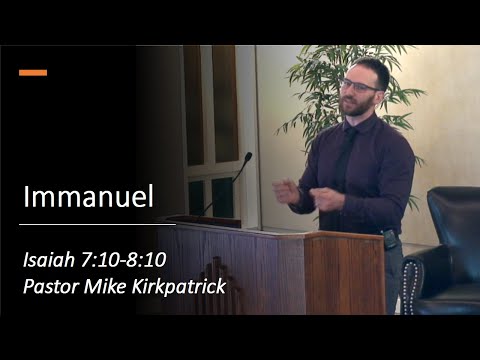
Immanuel

Isaiah 7:10–8:10 presents the Immanuel prophecy not as a comfortable seasonal text but as a word of judgment against Ahaz's faithless trust in Assyria and a word of hope for the covenant remnant. The sermon traces two contrasting realities: 'Assyria with us,' the consequence of royal unbelief, and 'God with us,' the promise that anchors the remnant through exile and desolation. The Immanuel sign finds its definitive fulfillment in Matthew 1, where the virgin-born Son saves his people from sin rather than merely political oppression — a truth that remains the ground of steadfastness for the church in every era of suffering and exile.

Introduction to the Book of Exodus
The book of Exodus is not a standalone document but the second movement of the Pentateuch, continuing the story of the covenant people from Genesis through to their deliverance from Egypt, the giving of the law at Sinai, and the construction of the tabernacle. This introductory study surveys the book's structure through three themes — deliverance, demand, and dwelling — and traces how each anticipates Christ: Moses as covenant mediator prefiguring the greater Mediator, the Passover lamb pointing to the sacrifice of Christ, and the tabernacle foreshadowing the incarnation. The threefold division of God's law (moral, judicial, ceremonial) is explained with reference to the 1689 London Baptist Confession of Faith, with particular attention to why the moral law remains perpetually binding while the judicial and ceremonial laws have expired. The study closes by applying the Immanuel principle — that God redeems his people in order to commune with them — to the corporate worship of the New Covenant church.

The Council at Jerusalem, Part 2
The Jerusalem Council of Acts 15 confronts the Judaizing error that Gentile salvation requires circumcision and law-keeping in addition to faith in Christ. Drawing on Peter's testimony in Acts 15:6–12 and its grounding in the Cornelius episode of Acts 10, the sermon argues that God himself made no distinction between Jew and Gentile, purifying hearts by faith alone — making any human addition to the gospel a direct testing of God. Faith is shown to be the empty hand that receives Christ's righteousness, not a virtue that earns it, and the church is called to guard the law-free gospel against every cultural or ecclesiastical supplement that would corrupt it.

The Incarnation of the Word
John 1:14 declares that the eternal Word — the second person of the Trinity, who was in the beginning with God and was God — became flesh and dwelt among men. This sermon expounds the incarnation under two heads: first, the identity and reality of the Word taking on true humanity (the hypostatic union of two complete natures in one person), and second, the glory of that Word as the only begotten of the Father, full of grace and truth. The incarnation is shown to be the indispensable ground of redemption — whatever is not assumed is not redeemed — and sinners are urged to flee to a mediator who is full, not miserly, in grace and truth.

The First Missionary Journey, Part 6
Paul's sermon in the synagogue at Pisidian Antioch reaches its practical climax in Acts 13:38–43, where he preaches forgiveness of sins and justification by faith alone — two distinct yet inseparable blessings secured by Christ's active and passive obedience. The law of Moses cannot justify; it can only expose the sinner's inability and drive him to Christ, in whom every believer is declared righteous by the imputation of Christ's righteousness received through faith alone. Paul's warning from Habakkuk 1:5 presses the point home: to despise this gospel is to invite a judgment more severe than the Babylonian captivity. The sermon closes by tracing the same doctrine of justification through the vision of Joshua the high priest in Zechariah 3, and exhorts believers to continue in the grace of God as the only ground of perseverance.
The Only Redeemer of God's Elect
Galatians 3:10–14 sets law and gospel in sharp contrast, demonstrating that justification before God is entirely excluded from the domain of law-keeping. Paul's threefold appeal to Deuteronomy 27, Habakkuk 2:4, and Leviticus 18:5 establishes that the law demands perfect, perpetual, and entire obedience — an impossibility for sinners in Adam. The only hope lies in Christ's substitutionary, curse-bearing work: he bore the imputed sin of his people, exhausted the wrath of God in their place, and secured for them both the blessing of Abraham and the gift of the Holy Spirit. The sermon calls hearers to abandon every form of faith-plus-works supplementation and to rest wholly in the particular redemption accomplished by Christ alone.

The Fourth Commandment
The Fourth Commandment's call to observe the Sabbath is not a Mosaic innovation for Israel alone but a creation ordinance rooted in God's own rest and ratified across redemptive history. This sermon surveys Old Testament Sabbath theology — from Genesis 2 through the prophets Isaiah and Jeremiah — arguing that the Ten Commandments carry trans-covenantal moral force and that the Sabbath commandment retains binding validity for New Covenant Christians. Christ's defense of Sabbath in Mark 2 is shown to confirm rather than abolish the commandment, clearing away Pharisaic distortion while pointing back to the creational gift given for man as man, not Jew as Jew. Hearers are called to call the Sabbath a delight, to work diligently the six days, and to gather with the covenant community on the Lord's Day in holy worship.

The Suffering Servant
1 Peter 2:21–25 sets forth Christ's suffering as redemptive before it is exemplary: Peter's primary purpose is not to give believers a moral template but to ground their conduct in the substitutionary, sin-bearing work of the Servant prophesied in Isaiah 53. The sermon traces the description of Christ's redemptive suffering — his sinlessness, his silence under reviling, and his substitutionary death on the tree — before turning to its results: the freedom of God's people from sin's penalty and power, and the recovery of straying sheep by the Shepherd and Overseer of their souls. Believers are therefore called not to whine or revile under unjust treatment, but to commit themselves to him who judges righteously, following the pattern of the one whose stripes have healed them.