

2,065 sermons · All speakers

The Believer in a Sinful Generation
Philippians 2:14–18 grounds the believer's daily conduct in a theology of sanctification and election: the command to do all things without complaining or disputing flows from the purpose of God to make his people blameless and harmless, validating their identity as children of God in a crooked and perverse generation. Drawing on the wilderness generation of Numbers and the Deuteronomy 32 backdrop Paul himself invokes, the sermon traces the catastrophic pattern of grumbling as a failure to submit to divine providence, and contrasts it with the church's calling to shine as lights and hold forth the word of life. The commendation of joy in verses 17–18 is grounded in Paul's readiness for martyrdom and his deep pastoral investment in the Philippians' growth, showing that the minister's eschatological joy is bound up with his people's faithful walk. The concrete application is simple: be blameless in yourself, peaceable toward the church, and a shining light in the world by faithful presence and gospel proclamation rather than withdrawal.

The Trial Before Pilate, Part 2
Standing before Pontius Pilate, Jesus affirms His kingship while making clear that His kingdom does not originate from this world and poses no military threat to Rome — it advances solely through the proclamation of truth. The sermon works through John 18:33–40 under two heads: Pilate's examination of Jesus (vv. 33–38) and Pilate's cowardly compromise (vv. 39–40), drawing in the parallel account in Luke 23 to trace Jesus' transfer to Herod and back. Pilate's threefold declaration of innocence, Herod's contemptuous mockery, and the crowd's demand for Barabbas together underscore the great exchange: the just for the unjust, the holy Lamb standing in the place of guilty, vile, helpless sinners.
The Third Commandment
The Third Commandment — 'You shall not take the name of the Lord your God in vain' (Deuteronomy 5:11) — carries far greater weight than mere avoidance of profanity, because the divine name is not an arbitrary label but a revelation of God's very being, perfections, works, and decree. The sermon examines three aspects: the theological significance of God's name, the breadth of the prohibition (spanning blasphemy, frivolous speech, euphemisms, unlawful oaths, magic and sorcery, misapplication of providence, and maintenance of false doctrine), and the positive duty to use God's name reverently in prayer, praise, theological discourse, and the keeping of solemn oaths. The closing application presses hearers toward an 'answerable conversation' — a profession of faith matched by a life that gives no occasion to the enemies of the Lord to blaspheme.

The Trial Before Pilate, Part 1
John 18:28–32 records the delivery of Jesus to Pontius Pilate, an event framed by both human wickedness and divine sovereignty. The sermon surveys the prior trial before the Sanhedrin in Matthew 26, exposing the false charges, the deliberate misquotation of Jesus's words about the temple, and the formal charge of blasphemy — then turns to John's account of the hypocrisy, lawlessness, and impotence of the Jewish authorities before Pilate. Against that backdrop of gross injustice, verse 32 grounds the entire episode in divine decree: the very words Jesus had spoken concerning his death were being fulfilled, and the wrath of men was being overruled by the providence of God for the salvation of the elect. The chief application is adoration — the redeemed sinner is called to see how far the Savior went to secure redemption, and the unbeliever is called to come to the one who will not cast out any who come to him in faith.

The Victory of David Over Goliath
David's defeat of Goliath in 1 Samuel 17 is not a moralistic lesson in overcoming personal giants, but a theological declaration that the living and true God vindicates His covenant people against those who defy Him. The narrative turns on two explicit lessons David announces in verses 46–47: that all the earth will know there is a God in Israel, and that Israel will learn the Lord does not save by sword and spear. David functions typologically as the singular seed of the woman, his headshot of Goliath advancing the Genesis 3:15 promise toward its fulfillment at Golgotha, where Christ crushed the serpent's head through His death and resurrection. The sermon calls believers to the same confidence David displayed — trusting the living God rather than human strength, because the same God who delivered David has promised to build His church and defend His people.

The Second Commandment - Deuteronomy 5:8-11
The Second Commandment (Deuteronomy 5:8-11) prohibits both the making of images to represent God and the worship of those images — two distinct but related offenses against the infinitely simple, spiritual, and incomprehensible God. Because God cannot be captured in creaturely form, any visible representation of Him, including pictures or films of the Lord Jesus Christ, violates the commandment: the hypostatic union cannot be depicted by an artist's rendering, and Christ is to be set forth through preaching, not imagery. The positive demand of the commandment is worship regulated strictly by divine command — the regulative principle — which restricts the church to the elements God has prescribed in Scripture, excluding both the inventions of men and the traditions of Rome.

The Importance of Spiritual Exercise
Philippians 2:12–13 is not a self-salvation passage but a call to Spirit-enabled perseverance rooted in the sovereign grace of God. The sermon expounds the believer's responsibility to 'work out' a salvation already given — not to attain it, but to live in conscious, fear-driven obedience to the God who both justifies and sanctifies. Against hyper-Calvinist passivity on one side and Arminian self-effort on the other, the text holds together human duty and divine empowerment: God works in believers both to will and to do according to his good pleasure. The practical summons is to pursue sanctification — the whole of it, fear, trembling, cross-contemplation, and dependence on the Spirit — as those destined for glorification.

The First Commandment
Deuteronomy 5:7 — 'You shall have no other gods before me' — is the foundation of covenant loyalty, defining not only who the one true God is but what response He demands from His people. This study works through the prohibition against other gods (atheism, polytheism, syncretism, sorcery, heresy, and creature-worship) before turning to the positive duties the commandment requires: knowing God, loving Him, fearing Him, obeying Him, trusting Him, and worshipping Him on His own terms. The first commandment is not merely theological orthodoxy but a call to total, exclusive, and practical devotion to Yahweh — a devotion made possible only by the grace that plants His fear in the heart.

2LCF Chapter 3, Of God's Decree
God's decree — His eternal, immutable purpose to foreordain whatsoever comes to pass — is the subject of 2 London Baptist Confession of Faith Chapter 3. This study works through paragraphs 1–7, establishing that the decree is absolute and unconditional, covers all events including the free and sinful actions of creatures without making God the author of sin, and that election unto life is grounded solely in God's free grace rather than any foreseen condition in the creature. The session addresses the distinction between preterition and double predestination, the infralapsarian and supralapsarian debate, and closes with the confession's insistence that this high doctrine is to be handled with prudence, producing praise, humility, diligence, and abundant consolation in those who sincerely obey the gospel.

The Trial Before the Jews
John 18:13–27 presents the trial of Jesus before the Jewish authorities alongside Simon Peter's three denials, and John's deliberate interweaving of the two scenes forces the reader to measure Peter's cowardice against his Master's composed, unflinching faithfulness. Jesus, the true high priest, stands before the illegitimate proceedings of Annas and Caiaphas — proceedings marked by false witnesses, unprovoked violence, and a verdict predetermined by envy — and yet he defends his disciples, demands lawful evidence, and maintains his identity without wavering. Peter, by contrast, cannot acknowledge his Lord to a servant girl, illustrating the fickleness that characterises even redeemed sinners. The sermon closes by calling believers to remember both the rooster's rebuke of unfaithfulness and the grace of a Saviour who restores the very disciples who forsook him.
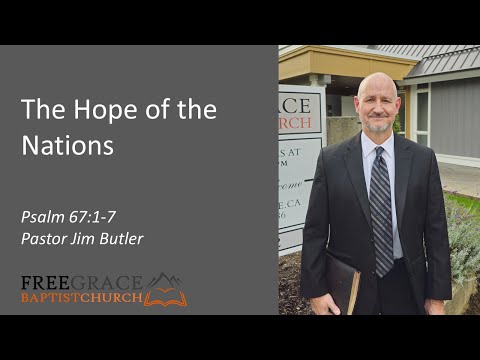
The Hope of the Nations
Psalm 67 is a missionary psalm in which the psalmist first petitions God on behalf of the church — for mercy, blessing, and the communion of God's presence — and then turns those blessings outward, praying that the nations would be saved, become worshipers of the true God, and come under His righteous rule. The Aaronic blessing of Numbers 6 stands behind verse 1, and the 'that' of verse 2 reveals the logic of all divine blessing: the church is enriched by God in order to become a conduit of His saving way to the ends of the earth. The sermon closes by calling the congregation to pray with the confident expectation of verses 6 and 7 — that God shall bless His people and all the ends of the earth shall fear Him — tying the psalm's vision directly to Christ's Great Commission.

The Introduction to the Ten Commandments
The Ten Commandments stand apart from all other Mosaic legislation as the moral law of God — written by God himself on two tablets of stone, binding on all humanity in every age, and distinct from the ceremonial and judicial laws that have either been fulfilled in Christ or expired with the Old Covenant commonwealth. This study works through the introduction to the Decalogue in Deuteronomy 5, establishes the threefold division of the law, and then traces the threefold use of the moral law: its civil function as a restraint on sin in society, its pedagogical function in driving sinners to Christ, and its normative function as the pattern for the believer's sanctification. Four classical principles for interpreting the commandments are introduced to guide the series ahead, drawn from the Westminster Larger Catechism and Reformed exegetical tradition.

The Arrest of Jesus
John 18:1–12 presents the arrest of Jesus not as a defeat but as a sovereign, voluntary act of the divine-human Mediator. The passage is expounded under three headings: the betrayal of Jesus by Judas and his coalition of enemies, the glory of Jesus manifested in his command of the situation and his 'I am' declaration that felled the arresting party to the ground, and the arrest proper in which Jesus rebukes Peter's sword and embraces the cup of the Father's wrath. The sermon closes by tracing three layers of antitypical significance — the greater-David typology of 2 Samuel 15, the binding of Isaac in Genesis 22, and the garden of Eden in Genesis 1–3 — to show that the arrest of Christ is the hinge on which God's eternal purpose to save his people from their sins turns.

The Faithful Christian Mother
Proverbs 31:28–30 grounds this sermon on the faithful Christian mother in four doctrinal categories: her condition before God, her influence over her children, her authority over her children, and her responsibility toward her children. The fear of the Lord that marks the virtuous woman is not a natural disposition but a new-covenant gift of sovereign grace, as Jeremiah 32:40 and Romans 3:18 together demonstrate. Because salvation is by grace alone through faith alone, the mother's instruction, example, discipline, and love flow from a regenerate heart rather than from moralism. Mothers are exhorted to maintain dependence on God, to ground child-rearing in Scripture rather than cultural trends, and to persevere in a calling that is high, demanding, and ultimately accountable to God.

Ask FGBC #42: What Words Aren't In The Bible But Help Protect Its Teachings?
Scripture and theology regularly employ concepts that require precise extra-biblical vocabulary to guard against error and heresy. This Q&A session works through a range of theological terms — Trinity, consubstantiality, partitive exegesis, inseparable operations, and more — explaining why the church has historically coined and defended such language rather than restricting itself to bare biblical words. The discussion traces how heretics from the Arians to the Anomeans exploited the refusal to use extra-biblical terms, and why the apostolic mandate to 'earnestly contend for the faith' requires the full use of theological grammar inherited from the church's confessional tradition.

The Preface to the Ten Commandments
Deuteronomy 5:1–6 opens the Ten Commandments not with a command but with a declaration of divine redemption — 'I am the Lord your God, who brought you out of the land of Egypt, out of the house of bondage.' This study works through the summons to covenant obedience, the grace-grounded preface to the Decalogue, and the uniqueness of the moral law as trans-covenantal and abiding. The threefold division of the law — moral, ceremonial, and judicial — is examined through the confession, the prophets, the Gospels, and the epistles, equipping believers to distinguish what abides in the new covenant from what was fulfilled and abrogated in Christ.

The Power of the Word of God
Isaiah 55:10–11 declares that God's word, like rain and snow sent from heaven, does not return to him void but accomplishes precisely what he purposes. This sermon expounds that promise under two heads: the power of the written word and the glory of the incarnate word. The written word is shown to be efficacious in gospel proclamation — bringing either the aroma of life or of death — while the incarnate word, the eternal Son proceeding from the Father, accomplishes a definite redemption that cannot be frustrated. Both heads converge in a call to sinners to seek the Lord while he may be found and to believers to renew covenant at the Lord's Supper with confidence in the abundance of divine pardon.

CLIP: An URGENT Plea With Unbelievers (Isaiah 55)
Isaiah 55 issues an urgent, time-sensitive call to unbelievers: the window of grace will close, and those who die outside of Christ will face the wrath of a thrice-holy God. The sermon confronts common self-excuses for delaying repentance — including the notion that one's sins are too great — and answers them with the inexhaustible pardoning grace of God. Every sinner is summoned to seek the Lord while he may be found, flee to Christ immediately, and rest in the abundance of his mercy.

The Necessity of Faithful Obedience, Part 2
Moses concludes the historical prologue of Deuteronomy with a programmatic warning to the second generation of Israel: idolatry will bring exile, but repentance will meet a merciful God. The sermon expounds Deuteronomy 4:25–49, tracing the consequences of covenant-breaking, the grounds of covenant mercy, and the incomparability of Israel's God as the only legitimate basis for obedience. The practical application presses the necessity of self-government, the danger of forgetfulness, and the trans-covenantal obligation of parents to pass covenant instruction to their children.
ARBCWC - Pastors' Updates April 2025
Pastors and church leaders from Reformed Baptist congregations across Western Canada and beyond gather to report on the state of their churches and give thanks to God for his faithfulness. The reports span church plants in Regina, Medicine Hat, Armstrong, Weyburn, Lethbridge, Moose Mountain, Dryden (Ontario), and Tama (Iowa), with recurring themes of slow but steady growth, the challenges of introducing confessional Reformed Baptist practice in broadly evangelical contexts, the encouragement of associational fellowship, and shared prayer for gospel advance, church planting, and the conversion of souls.
CTF 2025 - Session 7 - Pastoral Reflections on Classical Theism
The prologue of John's Gospel (1:1–18) discloses both the divine perfections and the eternal relations of the divine persons — the very realities that classical theism and the Second London Confession articulate in Chapter 2. This address draws that exegetical foundation into pastoral practice, arguing that a robust theology proper is not abstract speculation but the necessary ground for faithful ministerial function and focus. The preacher identifies six areas — the salvation of sinners, the catechesis of children, the perseverance of the saints, assurance of salvation, communion with God, worship, and the knowledge of God — each of which depends inextricably on a well-formed doctrine of God.

Live Stream - April 20, 2025
Romans 4:25 presents the death and resurrection of Christ not merely as historical events but as the twin pillars of justification by faith alone: Christ was delivered up because of our offenses and raised because of our justification. The sermon traces the specific character of those offenses — the lawlessness Paul catalogues in Romans 1–3 — before arguing that the resurrection serves four distinct functions in establishing justification: it declares Christ to be the Son of God with power, testifies that his sacrifice was accepted by the Father, confirms that divine justice was fully satisfied, and announces that redemption was accomplished. The congregation is urged never to separate the passion from the resurrection, never to reduce Christianity to the moral effect of a story, and to rest the whole of their justification on the finished work of Christ alone.

The Resurrection and Justification
Romans 4:25 binds the death and resurrection of Christ together as twin pillars of the doctrine of justification by faith alone. Christ was delivered up because of the offenses of his people — bearing the substitutionary curse that divine justice demanded — and was raised because of their justification, the resurrection serving as the Father's public testimony that satisfaction had been rendered and righteousness secured. The sermon works through four reasons why Paul links the resurrection to justification: the resurrection declared Christ to be the Son of God with power, testified that his sacrifice was accepted, confirmed that satisfaction was rendered, and marked the completion of redemption and the inauguration of Christ's present session. Believers are called to rest their entire confidence for standing before God on this finished work, and the unconverted are urged to confess and believe in the risen Lord Jesus.

The Necessity of Faithful Obedience
Deuteronomy 4 closes Moses' historical prologue with an urgent exhortation to the second generation of Israel on the necessity of faithful covenant obedience before crossing the Jordan. The chapter's three movements — the necessity of obedience (vv. 1–8), the dangers of idolatry (vv. 9–31), and the incomparability of Israel's God (vv. 32–40) — are treated as an impassioned speech by a man who lived the history he recounts. Scripture's sufficiency is defended against every form of addition or subtraction, and the regulative principle of worship is grounded in God's self-revelation at Sinai as a consuming fire who receives no image.

Live Stream - April 13, 2025
Philippians 2:9–11 sets forth the exaltation of Christ as the direct consequence and divine vindication of his humiliation. The sermon works through three considerations in the nature of that exaltation — the consequences of Christ's humiliation for the sinner (freedom from sin's penalty and power, from Satan's bondage, from the law's curse, and free access to God), the Father's approbation of the Son's finished work, and the manifestation of Christ's divine identity in the name given above every name. The significance of the exaltation presses toward a universal, unavoidable submission: every knee will bow and every tongue confess, whether in saving faith now or in compelled acknowledgment on the last day. The sermon closes by pressing sinners to confess Christ willingly in the present day and by reminding believers that the pattern of Christ's humiliation leading to exaltation both grounds their salvation in his active and passive obedience and shapes their life of humble, others-centered love in the church.

The High Priestly Prayer, Part 9
John 17:24–26 records the final petition of Christ's high priestly prayer: that those given to him by the Father would be with him in glory and behold his mediatorial splendor. The sermon traces the theological logic from election and effectual calling through justification to glorification, grounding the certainty of the believer's future glory in the Father's eternal love for the Son and the irreversible decree of God. Along the way, the sermon addresses the relationship between sovereign election and the free offer of the gospel, arguing that the doctrines of sovereign grace are the very foundation of evangelism, not a barrier to it. The practical exhortation is twofold: let the hope of future glory fuel present sanctification, and let the love and presence of God sustain patient endurance through affliction.

Wilderness wanderings
Deuteronomy 2–3 records Moses rehearsing the wilderness wanderings for the second generation of Israel, poised on the plains of Moab before the conquest of Canaan. God's multinational sovereignty is on display as He assigns territorial boundaries to Edom, Moab, and Ammon, then delivers Sihon and Og into Israel's hands — demonstrating that the God of Israel governs all nations, not merely His covenant people. The historical review functions both as a warning against repeating the unbelief of the first generation and as an encouragement to trust the same God who preserved Israel through forty years of wilderness trudging. New Covenant believers are called to the same posture: to dwell on the record of God's faithfulness in redemptive history so as to remain steadfast through present trials.

Live Stream - April 6, 2025
Philippians 2:8 sets forth the humility of Christ as both the ground of the believer's salvation and the supreme example for the church's conduct. The sermon traces Christ's obedience from his mother's womb to the cross, distinguishing the active and passive obedience that together constitute the basis of justification by faith alone. Against the errors of eternal functional subordination, the speaker anchors Christ's submission firmly in his human nature as covenant mediator, not in any hierarchy within the immanent Trinity. The Lord's Supper is then administered as a seal of precisely these twin benefits — the active obedience that clothes the sinner in righteousness and the passive obedience that cleanses from sin.

The High Priestly Prayer, Part 8
John 17:21–23 records Christ's high priestly petition for the unity of all believers across every age — a unity patterned on the mutual indwelling of the Father and the Son. The sermon works through the petition ('that they all may be one'), the divine paradigm (the perichoretic union of the Father and Son as the exemplar for creaturely unity), and the missional purpose (a unified church publishes to the world the reality of the Incarnation and the love of the Father). Believers are called to pursue a common faith, a common orientation, and a common goal — the glory of God — knowing that their corporate life is itself a testimony to the mission of the sent Son.

The Example of the Savior, Part 3
Philippians 2:8 presents the humility of Christ not as incidental biography but as the doctrinal and ethical foundation for the church's conduct. This sermon examines first the declaration of Christ's humility — that he humbled himself voluntarily, according to his human nature as covenant mediator, in active obedience to every demand of God's law from his mother's womb — and then its demonstration in the extent of that humiliation: even the death of the cross, a death cursed by the law and laden with shame. The active and passive obedience of Christ, taken together, are the sole ground of justification by faith alone, which is why the Lord's Supper is received not as a reward for good conduct but as a proclamation of what the Savior accomplished on behalf of his people.