
Scripture
Ephesians
70 sermons
The Stewardship of the Mystery of Christ

Ephesians 3:1–7 presents Paul simultaneously as prisoner and steward — his imprisonment for preaching Gentile inclusion in the covenant of grace is inseparable from the divine commission that caused it. The sermon traces the apostolic stewardship of the mystery of Christ: a truth partially disclosed in the Old Testament through types and promises, but fully unveiled in the New Testament through the Spirit's revelation to the apostles and prophets. The content of the mystery is that Gentiles are fellow heirs of the same body, not a parenthetical people of God, but full partakers of the covenant promise in Christ through the gospel — a reality that demolishes any two-peoples-of-God framework. The power enabling that ministry is God's alone, not the orator's persuasion, so that faith rests in divine power rather than human wisdom.

The Gentiles and the Covenant of Grace, Part 3
Ephesians 2:19–22 closes Paul's argument about the equal standing of Gentile believers within the covenant people of God. This sermon works through three aspects of the temple Paul constructs in these verses — its foundation (apostles and prophets), its cornerstone (Christ himself), and its materials (believers united to him) — showing that Gentile inclusion is not second-tier membership but full citizenship in the kingdom and full membership in the household of God. The sermon presses hard on the corporate nature of these privileges, arguing from David's anguish in 1 Samuel 26 that to be cut off from public worship is to be cut off from the inheritance of the Lord, and that Christians who treat gathered worship as optional have surpassed David in privileges while falling far short of him in appetite.

The Gentiles and the Covenant of Grace, Part 1
Ephesians 2:11–13 presents the former covenantal destitution of Gentile believers and the transforming power of Christ's blood that brought them near to God. The passage shows that Gentiles suffered two compounding liabilities: individual deadness in sin and corporate exclusion from the commonwealth of Israel and the covenants of promise. Against this bleak background, the apostle's 'but now' in verse 13 declares that union with Christ — secured through his atoning blood — has abolished the alienation and incorporated believing Gentiles into the one new humanity. The sermon argues that this covenantal reversal should evoke perpetual humility and gratitude in every believer, and calls the unbeliever to come to the Father through the Son in the Spirit.

The Saving Grace of God, Part 3
Ephesians 2:8–10 demolishes every notion that the sinner contributes to his own salvation, whether by supplying the faith or by bringing meritorious works. This sermon works through the passage in two movements: the application of redemptive grace in verses 8–9, where salvation is shown to be by grace alone through a faith that is itself God's gift and not the sinner's offering, and the consequence of redemptive grace in verse 10, where the good works of the justified are presented not as the cause or condition of salvation but as its God-prepared effect. The controlling purpose is doxological — that in every age where sinners are saved, the exceeding riches of God's grace in Christ Jesus are displayed, and God alone receives the glory.

The Saving Grace of God, Part 1
Ephesians 2:1–3 confronts the reader with a precise diagnosis of humanity's condition apart from saving grace: spiritual death in Adam, slavery to the world-system, subjection to Satan, and liability to the wrath of God. The sermon grounds this diagnosis in the covenant of works, the doctrine of original sin, and the federal headship of Adam, drawing on Romans 5 and 1 Corinthians 15 to show that all humanity stands condemned either in Adam or justified in Christ. Total depravity is shown to be comprehensive — corrupting not only outward conduct but the mind and heart — making sovereign grace the only remedy for sinners who are, apart from Christ, lifeless, helpless, and hopeless.

Chap. 15 - Of Repentance unto Life and Salvation
1689 London Baptist Confession chapter 15 treats repentance not as a meritorious work but as an evangelical grace — a gift sovereignly granted by God through the Holy Spirit, inseparable from saving faith. This study walks through all five paragraphs of the chapter, distinguishing the Greek definition of repentance as a change of mind from its fruits, exposing the danger of collapsing that distinction into a salvation-by-works scheme. The covenant of grace is shown to be the practical ground by which God provides and sustains both faith and repentance for the elect throughout their lives, including ongoing repentance for remaining sin.

Chap. 14 - Of Saving Faith

Saving faith is the gracious gift of the Holy Spirit, worked in the hearts of the elect through the ministry of the Word, enabling them to trust in Christ alone for justification, sanctification, and eternal life. This study of 1689 London Baptist Confession chapter 14 distinguishes true saving faith from temporary or false faith, establishes that faith is built on knowledge rather than religious emotion or experience, and traces the three classical elements of faith — notitia, assensus, and fiducia — while guarding against both the mysticism that smuggles emotion into the essence of faith and the rationalism that mistakes bare intellectual assent for it. The practical burden throughout is that the proper object of saving faith is Christ and his work alone, and that assurance, while distinct from faith itself, grows through the appointed means of grace.

The Apostle's Prayer for the Ephesians, Part 2
Ephesians 1:19–23 presents the climax of Paul's apostolic prayer: that believers would know the exceeding greatness of God's power. This sermon expounds three demonstrations of that power in Christ — his resurrection from the dead, his current session at the right hand of the Father, and his dominion over all things for the sake of the church. The doctrines of inseparable operations and appropriations ground the Trinitarian account of these events, while the universal and eternal sovereignty of the enthroned Christ is set forth as the foundation for perseverance, praise, and fearlessness in the face of hostile spiritual and civil powers.

The Apostle's Prayer for the Ephesians, Part 1
Paul's prayer in Ephesians 1:15–18 opens a window into apostolic intercession and its theological priorities. The sermon expounds the occasion of Paul's prayer — rooted in the Ephesians' justifying faith and the love that necessarily flows from it — and the content of his first two petitions: that God would give the Holy Spirit as the Spirit of wisdom and revelation, and that the saints would know the hope of God's effectual calling and the riches of the glory of their coming inheritance. Sovereign grace underlies both: the eyes of the Ephesians' understanding had already been enlightened by God at conversion, and Paul's prayer builds on that accomplished work toward ongoing sanctification. The sermon calls believers to reshape their prayer lives after the apostolic pattern, prioritizing growth in the knowledge of God above all other petitions.
The Ministry of the Holy Spirit, Part 2
Ephesians 1:13–14 presents the Holy Spirit as both the seal and the guarantee of the believer's inheritance, grounding the security of salvation not in human performance but in the inseparable operations of the triune God. The sermon traces the instrumentality of the word of truth — showing that sinners must hear the gospel before they can believe — and then expounds the sealing of the Spirit as authentication, ownership, and security. The guarantee of the Spirit is the first installment of a heavenly inheritance that awaits the full redemption of the purchased possession at the consummation of the age. Believers are therefore urged to rest their assurance in the Father who chose, the Son who redeemed, and the Spirit who seals and guarantees.

The Ministry of the Holy Spirit
What is the Holy Spirit's relationship to the Father and the Son, and why does it matter that Christians understand this precisely? Working through Ephesians 1:13–14 as the destination, this sermon first establishes the full personal divinity of the Holy Spirit by tracing his presence and activity across both Testaments — from creation in Genesis 1 through the baptism of Christ, Pentecost, and the apostolic letters — demonstrating that the Spirit is not a force or a lesser deity but the third person of the one undivided triune God. The sermon draws on the 1689 London Baptist Confession chapter 2 paragraph 3, the Nicene Creed, and a wide range of triadic New Testament texts to guard against the heresies of Sabellianism and Arianism. The congregation is called to pursue the knowledge of this triune God as the irreplaceable foundation of assurance, evangelism, and Christian perseverance.
Clip: Theology is crucial for every church and believer
Theology proper — the knowledge of who God is as Father, Son, and Holy Spirit — is not an academic luxury but the essential foundation of Christian life, worship, and witness. This sermon clip from an exposition of Ephesians 1:3–14 argues that the church's tendency to rush past doxological passages to practical ethics has left believers spiritually thin, prone to a mercenary relationship with God rather than one grounded in the infinite riches of his grace. The preacher calls the congregation to disciplined study of the Trinity, warning that without it believers become vulnerable to ancient heresies and lose the impetus to proclaim Christ to a lost world.

The Redemptive Work of the Son, Part 2
Ephesians 1:8–12 grounds the individual believer's redemption within a cosmic divine purpose: God's wisdom in the plan of salvation maintains all his holy perfections without compromise, the mystery of his will now openly revealed in the gospel calls sinners from every tribe and nation, and all things will be recapitulated — gathered up and set in order — under the lordship of Christ at his return. The inheritance of the elect is secured by predestination, not by human performance, so that the redeemed exist 'to the praise of his glory' — as a trophy case of grace before angels and the entire created order.

The Redemptive Work of the Son, Part 1
Ephesians 1:6–7 sets forth the redemptive work of the Son within the triune economy of salvation, moving from the Father's electing purpose in eternity past to Christ's historic accomplishment of redemption in time. The sermon expounds two interlocking realities: the Father's sovereign initiative in bestowing grace upon the elect in the Beloved, and the Son's purchase of redemption through the shedding of his blood. Redemption is shown to be not a mere exercise of divine power but the payment of a ransom price, with the forgiveness of sins as its primary blessing — all flowing from the inexhaustible riches of God's grace. Hearers are called to respond with worship, gratitude, and increasing love for Christ, the Beloved of both the Father and the redeemed.

The Gracious Purpose of the Father, Part 2
Ephesians 1:5–6 presents predestination not as cold metaphysical fate but as an act of divine love, wherein God in love predetermined his elect unto adoption as sons by Jesus Christ, according to the good pleasure of his own will and not any foreseen merit in the creature. The sermon works through the motive of predestination (the love of God), the means (adoption as sons by Christ, grounded in the covenant of redemption), and the goal (the praise of the glory of God's grace), drawing extensively on parallel Pauline and Johannine texts. Against both Arminian and Pelagian objections, the preacher demonstrates that predestination to adoption is precisely what makes Christian praise coherent — the creature contributes nothing, and God receives all glory. Believers are called to live out their adopted status by walking in love, light, and wisdom as members of the household of God.

The Gracious Purpose of the Father
Ephesians 1:3–6 opens with what the Apostle Paul calls a 'barakah' — a formal blessing of God followed by specific reasons for that praise. This sermon expounds the Father's role in the covenant of redemption: His sovereign, unconditional election of sinners in Christ before the foundation of the world, and His predestinating purpose that those chosen would be made holy and blameless. Election is the cause, not the consequence, of faith and repentance — sinners dead in trespasses and sins are chosen not because of foreseen merit but according to the good pleasure of God's will alone. The sermon calls believers to respond to the doctrine of election not with defensive polemic but with the doxological posture Paul himself models: praise, blessing, and adoration to God Most High.

The Introduction to Ephesians
Ephesians 1:1–2 introduces one of the richest doctrinal letters in the New Testament canon, and this sermon surveys the authorship, historical context, and theological purpose of the epistle before examining Paul's greeting to the saints. The apostle's self-identification as one sent by Christ 'by the will of God' grounds his authority not in self-appointment but in sovereign divine commission, while his description of the recipients as 'saints' and 'faithful in Christ Jesus' defines sainthood in purely biblical terms — all who are justified by grace alone through faith alone in Christ alone. The sermon traces Paul's founding ministry in Ephesus through Acts 18–19, showing how the gospel's triumph over witchcraft, idolatry, and the cult of Diana provides the backdrop for the letter's emphasis on Christ's supremacy over all powers. The epistle is previewed as a two-part structure — doctrinal foundation (chapters 1–3) followed by practical application (chapters 4–6) — aimed at grounding believers in both the indicatives and imperatives of redemption.
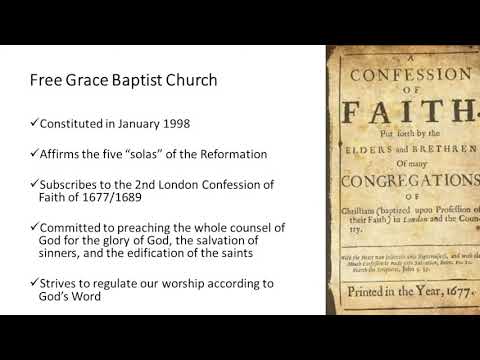
Introduction to the 2nd London Baptist Confession 1677/1689
Why should a church bind itself to a confession of faith? This introductory lesson on the Second London Baptist Confession of 1677/1689 grounds the answer exegetically in Ephesians 4 — where Christ gives gifted men to the church so that the body attains doctrinal unity and is no longer tossed about by every wind of teaching — and then traces the historical origins of the 1689 among the Particular Baptists, distinguishing them from Anabaptists, Presbyterians, and Congregationalists. Four functions of a confession are developed: defining, defending, discriminating, and disciplining with reference to the doctrine of the church. The lesson closes by distinguishing Reformed theology (Calvinism plus covenant theology plus the regulative principle) from mere five-point Calvinism, and by defending the confession's silence on matters of Christian liberty as a feature, not a defect.

The Whole Armor of God
Ephesians 6:10–20 calls the people of God to don the whole armor of God — not as an invitation to physical combat, but as a summons to faithful spiritual warfare against the devil and his hosts. The sermon works through three movements: the commands to be strong in the Lord and to put on the armor, the reasons rooted in the nature of the spiritual enemy, and a pastoral survey of each piece of armor from the belt of truth to the sword of the Spirit and prayer. The controlling emphasis falls on standing — not heroics, but covenantal steadfastness in union with Christ, who is already exalted far above all principalities and powers.
The Inclusion of Wretches in God's Covenant
Ephesians 2:1–10 presents the full arc of redemption — from the total deadness of sinners to their gracious vivification in Christ — and this exposition traces that arc through the origin, objects, and execution of salvation. The sermon grounds the covenant of grace in the prior covenant of redemption (Ephesians 1:3–14), showing that the Father's election, the Son's redemption, and the Spirit's sealing together exclude every contribution of the sinner. Salvation is by grace alone through faith alone, with faith itself a gift conveyed by God to the spiritually dead — not a human instrument brought to the table that God then rewards. The exposition closes by distinguishing justification from sanctification and warning against both Roman Catholic and Federal Vision distortions of grace, anchoring the believer's final acceptance before God solely in the active and passive obedience of Christ.

Gentile Inclusion in God's Covenant
Ephesians 2:11–22 presents Gentile inclusion in the covenant promises of God as a third demonstration of divine power, alongside the resurrection of Christ and the salvation of individual sinners. Gentile believers were once Christless, churchless, hopeless, godless, and homeless — aliens from the commonwealth of Israel and strangers to the covenants of promise — but now, through the blood of Christ, they have been brought near and made one new man together with believing Jews. The sermon refutes dispensationalism's two-peoples framework, explains the threefold division of the law (moral, judicial, ceremonial) to clarify what Christ abolished at the cross, and calls the church to a high corporate esteem of the household of God as the dwelling place of the Spirit.
The Whole Armor of God
Ephesians 6:10–18 calls believers to put on the whole armor of God — not for ceremonial display but for genuine hand-to-hand combat against principalities, powers, and the spiritual hosts of wickedness. The armor is not native to the believer but is provided entirely through union with Christ: truth, imputed righteousness, the gospel of peace, faith, and salvation constitute the defensive elements, while the Word of God is the offensive sword. The sermon argues that the Christian life is a lifelong fight requiring daily, persevering diligence — not passive rest — and closes by urging both believers and unbelievers to recognize that lasting victory over sin is possible only through the blood of atonement and the grace of the triune God.

The Inclusion of the Gentiles in God's Covenant
Ephesians 2:11–22 addresses the radical transformation of Gentile believers, who were once 'aliens from the commonwealth of Israel and strangers from the covenants of promise,' into full participants in the covenant of grace. The sermon traces three movements in the text: the former plight of Gentile unbelievers (vv. 11–12), their present reception through the blood of Christ (vv. 13–17), and the purchased benefits now belonging to them as fellow citizens, members of God's household, and living stones in his temple (vv. 18–22). Christ is shown to be the one who is peace, who makes peace through the cross by abolishing the ceremonial law's enmity, and who preaches peace through the apostolic gospel. The exposition concludes with a call to prize corporate worship as the special dwelling place of God Most High, in which Jewish and Gentile believers together form one temple indwelt by the Spirit.
Be Imitators of God

Ephesians 5:1–21 confronts believers with a single pressing question: what is truly honorable and acceptable in the sight of God rather than in the sight of men? Working through three consecutive imperatives — walk in love, walk in light, and walk in wisdom — the sermon grounds each in the indicative of redemption: because the Father has predestined, adopted, and redeemed a people through Christ's perfect and acceptable sacrifice, they must imitate God as dear children. The practical implications range from the mortification of sexual sin and covetousness to the filling of the Spirit expressed in mutual speech, psalmody, thanksgiving, and submission, all of which flow from what Christ alone accomplished as the only sweet-smelling offering acceptable to the Father.

The Spirit's Application of Redemption
The Holy Spirit's work in applying redemption to sinners is the focus of this exposition of Ephesians 1:13–14, the concluding verses of Paul's great doxology on the blessings of God the Father and God the Son. The Spirit functions both as a seal — impressing upon the heart of the believer the assurance that he is a child of God — and as a guarantee or down payment of the full inheritance yet to be received in glory. Drawing from the 1689 London Baptist Confession's chapter on assurance and the writings of J.C. Ryle, the sermon calls believers struggling with weak faith to rest in the objective work of the triune God, and exhorts them to pursue holiness through the means of grace as the proper fruit of that assurance.

The Son's Accomplishment of Redemption
Ephesians 1:7–12 sets forth the Son's accomplishment of redemption within the eternal Covenant of Redemption, in which the Father plans, the Son accomplishes, and the Spirit applies salvation. Working through four movements in the text — redemption by the Son's blood, the revelation of the mystery of God's will, the cosmic reconciliation of all things in Christ, and the reward of an eternal inheritance — the sermon shows that sinners enslaved to sin have been purchased at a cosmic price paid only by the eternal God-Man. The sermon closes by calling believers to meditate on and proclaim this redemption, and by urging unbelievers to believe on Christ before they die in their bondage.

The Father's Plan of Redemption
Ephesians 1:3–6 opens a doxology that gives the believer a glimpse into the eternal counsel of the triune God — what Reformed theology calls the covenant of redemption, or pactum salutis. The Father's role in that counsel is threefold: he blesses his people with every spiritual blessing in Christ, he sovereignly elects and predestines a multitude to adoption as sons, and he does all of this to the praise of his glorious grace. The sermon calls believers to respond to this free and sovereign electing love not with presumption but with worship, obedience, and a deepened sense of the gravity of sinning against so gracious a Father.

The Pursuit of Christian Unity
Ephesians 4:1–3 commands believers to walk worthy of their calling by cultivating four virtues — lowliness, gentleness, long-suffering, and forbearing love — as the means by which the church maintains the Spirit-wrought unity already given to it. The sermon distinguishes this genuine, truth-grounded unity from any ecumenicism that achieves togetherness by dissolving doctrinal conviction. Because the Holy Spirit is the author of church unity and the triune God is its ultimate foundation, to abandon the pursuit of it is to dishonor God himself. Hearers are pressed to give diligent, active effort to preserve what the Spirit has produced, and those outside of Christ are reminded that Christian ethics, including the pursuit of unity, can only flow from salvation by grace alone through faith alone in Christ alone.

The Exceeding Riches of God's Grace
Ephesians 2:8–9 presents the doctrine of salvation as originating entirely in the triune God — elected by the Father before the foundation of the world, redeemed through the blood of the Son, and sealed by the Holy Spirit. Preached on Reformation Day, this exposition traces the grace-alone, faith-alone framework of the Five Solas back to their Pauline foundation, demonstrating that the Protestant Reformation was a recovery of plain biblical reading rather than a theological novelty. The sermon confronts the human tendency toward self-credit in salvation by exposing total depravity in Ephesians 2:1–3, so that the 'but God' of verse 4 lands with full force. Hearers are urged to abandon every ground of boasting and to look to Christ alone for salvation.

The Place of Good Works
Ephesians 2:10 establishes that good works occupy a precise and necessary place in the Christian life — not as a condition of salvation, but as its inevitable consequence. This sermon traces the Reformed doctrine of justification by faith alone through Paul's letters to the Romans and the Galatians, exposing the Roman Catholic error of collapsing justification and sanctification into a faith-plus-works scheme and demonstrating why any such admixture invalidates grace entirely. Drawing on the Westminster Shorter Catechism, the 1689 Confession, and writers from Machen to Gill, the sermon argues that the predestinating grace of God not only secures the salvation of the elect but also sets them on a course of holy living. Believers are exhorted to neither hide behind sola fide as a license for indolence nor to mistake moral performance for the ground of their acceptance before God.