
Cited in sermons
Dale Ralph Davis
317 sermons · All people cited

The Commission Given to Joshua

Joshua 1:1–9 records the divine commission given to Joshua upon the death of Moses — a commission built on four pillars: the reminder of God's covenant promise, the blessing of God's presence, the charge to courageous obedience, and the centrality of God's Word. God's appointment of Joshua as Moses' successor demonstrates that sovereign providence works through human instruments, yet is never bound to them; the faithfulness of God outlasts every leader. The sermon draws a direct line from the conquest commission to the Great Commission of Matthew 28, arguing that Christ's promised presence with His church is the only sufficient ground for courage and faithfulness in gospel ministry.

A Psalm of Thanksgiving
Psalm 103 calls God's people to bless the Lord with the whole soul and to forget none of His benefits — a command that presupposes the constant human tendency toward spiritual amnesia and ingratitude. The sermon works through David's threefold structure: a reminder to bless God (vv. 1–2), the reasons to bless God (vv. 3–18), and a reflection on God's universal kingdom (vv. 19–22). The reasons are organized around the gifts God gives (spiritual and physical), the recipients of those gifts (the oppressed and covenant people), and the character of the giver Himself — merciful, gracious, slow to anger, and abounding in steadfast love. Thanksgiving is not a seasonal sentiment but the daily reflex of those who know their guilt before a holy God and have received forgiveness through the blood of Christ.

Wednesday Night Bible Study - Leviticus 1-16
Leviticus 16, the Day of Atonement, stands at the theological center of both the book and the Pentateuch, answering the question Exodus leaves unresolved: how may sinful man enter the presence of a holy God. This session reviews the whole of Leviticus 1–16, tracing the book's structure from the sacrificial system and the institution of the priesthood through the laws of cleanness, showing that every element of the ceremonial apparatus — offering, priest, atonement — was divinely instituted, not humanly devised. The Nadab and Abihu incident demonstrates that unauthorized worship is mortal transgression, while the two-goat ritual of chapter 16 pictures both propitiation and expiation, all pointing forward to the once-for-all sacrifice of the Lord Jesus Christ.

The Contest at Carmel
Elijah's confrontation with the prophets of Baal on Mount Carmel exposes the absolute futility of idolatry and the exclusive sovereignty of Yahweh. Set against the backdrop of Ahab's state-sponsored Baalism and a three-year drought, the passage drives a direct challenge: total allegiance belongs to the living God alone, with no syncretistic middle ground. The sermon traces the contest from Elijah's gauntlet through the false prophets' frenzied failure to God's decisive, fire-bearing answer, arguing that the same God who consumed the sacrifice at Carmel receives sinners today through the atoning blood of Christ. The application is direct: those who still halt between two opinions are called to repent and look to Christ in faith, while believers are charged to hold fast to God Most High without divided allegiance.

The Triumph of Samson at Gaza
Judges 16 records the final chapter of the Samson cycle, moving from the removal of Gaza's city gates through Samson's betrayal by Delilah to his death in the destruction of the temple of Dagon. Against readings that reduce Samson to a figure of ungoverned sexual appetite, this exposition argues that Samson is a faithful judge of Israel, Spirit-empowered and strategically purposeful, whose every encounter with the Philistines is ordered by divine providence toward the deliverance of God's people. The departure of Yahweh from Samson is traced not to moral degeneracy but to Samson's disclosure of the sign of his Nazirite vow, which jeopardized the mission for which he was set apart. Throughout, Samson is presented as a type of the Lord Jesus Christ, whose greater deliverance through death saves more than his life alone could accomplish.

The One Thing Needful
Luke 10:38–42 presents two sisters whose contrasting postures before Christ expose a perennial danger for the people of God: the distraction of much serving to the neglect of the one thing needful. The sermon works through Martha's fourfold complaint — impugning Christ's care, demanding he redirect Mary, mingling grumbling with service, and collapsing into self-pity — before turning to Christ's gentle double-named rebuke and his commendation of Mary's humble discipleship. The passage does not condemn service, family, work, or daily necessity, but it does condemn the disordering of priorities that allows lawful things to crowd out devotion to the word of Christ. The lasting and untakeable benefit Christ promises to those who sit at his feet is the governing application: seek first the kingdom, receive the word with a noble heart, and trust that all other things will be added.

The Anointing at Bethany
John 12:1–11 presents the anointing at Bethany as a window into the worthiness of Christ on the eve of His passion. Mary's extravagant gift of costly spikenard — lavished on the feet of Jesus six days before the Passover — is set in deliberate contrast with the sanctimonious theft of Judas Iscariot and the misguided indignation of the disciples. Christ receives the anointing, defends Mary from her critics, and interprets the act as preparation for His burial, underscoring that the one going to the cross is altogether lovely and chief among ten thousand. The sermon calls believers to a devotion that spares no expense in worship while also commending practical service to the poor — not as competing priorities, but as the inseparable fruit of a life oriented toward Christ.

The Triumph of Samson at Jawbone Height
Judges 15 presents Samson not as a man governed by lust but as a Spirit-empowered deliverer who typifies the Lord Jesus Christ. This exposition traces three movements: the betrayal by Samson's father-in-law, the treachery of the men of Judah who preferred Philistine subjection to covenantal freedom, and the triumph at Jawbone Height where the Spirit of the Lord shattered Samson's bonds and enabled him to slay a thousand men. The central application calls God's people away from the assimilation of godless culture toward uncompromising allegiance to the Word of God, grounded in dependence upon the God who furnishes His servants with every means of victory.

The Installation of the Priesthood
Leviticus 8–10 records the ordination, ministry, and judgment of Israel's priesthood, tracing the way sinful man may approach a thrice-holy God through divinely prescribed sacrifice. The death of Nadab and Abihu for offering that which the Lord had not commanded warns that worship is regulated by God alone, not by the worshiper's innovation. Christ fulfills every type embedded in this system — as the holy, harmless, and undefiled High Priest who satisfies divine justice once for all. The sermon calls new-covenant worshipers to approach the Lord's Supper with the same reverence and eager joy that the priestly fire of Leviticus 9 ought to have kindled.

The Royal Wedding
Psalm 45 presents a royal wedding between the divine King and his bride, the church, composed centuries before the incarnation as a song of love pointing directly to the Lord Jesus Christ. The sermon moves through four sections: the psalmist's overflowing intention, the perfections and divine-human person of the King, the instruction to the bride concerning faith and repentance, and the declaration of the King's eternal glory. Christ is shown to be fairer than all the sons of men, advancing his kingdom through truth, humility, and righteousness rather than deception, while his priestly office — not only his kingly conquest — is pressed upon the hearer as the only ground of hope for sinners. The bride is clothed not in her own righteousness but in the imputed righteousness of Christ, received by faith alone, to be brought with gladness into the King's palace.

The Resurrection and Justification
Romans 4:25 encapsulates the whole gospel in a single verse: Christ was delivered up because of our offenses and raised because of our justification. This sermon expounds the redemptive purpose behind both the death and the resurrection of Christ, showing that the cross satisfies divine justice through substitutionary atonement while the empty tomb confirms that satisfaction was accepted and justification accomplished. The doctrine of justification by faith alone — the forgiveness of sins and the imputation of Christ's righteousness — rests inseparably on the historical and theological reality of the resurrection. Believers are called to live daily in light of the finished work of the Son, and those without Christ are urged to look to Him in faith for everlasting life.

The Sanctuary and Ark of the Testimony
Exodus 25:1–22 opens the third major division of Exodus — the dwelling of God among his redeemed people — which the sermon argues is the climax of the entire book. Working through the offerings for the tabernacle, the purpose of the sanctuary, and the construction and function of the ark, the exposition traces how God's intent to dwell with Israel typologically anticipates the new covenant reality secured by Christ, the great high priest and true mercy seat. The regulative principle of worship is grounded exegetically in God's precise prescriptions for the tabernacle and applied to New Covenant church practice. Hearers are called to count corporate worship a privilege and to approach God only in the manner he has commanded in Holy Scripture.

2LCF Chapter 24 - Of the Civil Magistrate, Part 2
The institution of monarchy in Israel, recorded in 1 Samuel 8, exposes the perennial danger of substituting a new form of government for trust in God—a sin Israel had already committed in 1 Samuel 4 and against which God had vindicated himself in chapter 7. The passage illustrates that total depravity applies not only to individuals but to corporate institutions, and that governments possessing legitimate divine sanction can nonetheless exploit those they govern. The sermon concludes with a survey of four historic approaches to the church-state relationship—Erastianism, Roman Catholic theocracy, theonomy, and the two-kingdoms framework—arguing that the two-kingdoms distinction, wherein Christ rules the church by his Word and the civil order by natural law, provides the most scripturally defensible framework for Christian citizenship.

The Triumph of the Lamb
Revelation 12 presents a cosmic drama in three acts — the incarnation of the Son, the defeat of the dragon in heaven, and the persecution of the woman — that together constitute a behind-the-scenes theological account of what Christ accomplished at His first advent. The serpent of old, identified as the devil and Satan of Genesis 3:15, suffers four successive and total failures: he cannot stop the birth of the male child, he is cast from heaven, he cannot destroy the woman in the wilderness, and his rage against the rest of her offspring only confirms that the decisive battle has already been lost. Christ's ascension to God's throne, not His second coming, marks the moment Satan is ejected from heaven and universal kingship is secured. The church, still militant on earth, overcomes not by health, wealth, or worldly ease but by the blood of the Lamb and the word of its testimony, persevering under persecution as the sign of Satan's defeat rather than his victory.

The Ratification of the Covenant, Part II
Exodus 24:9–18 concludes the ratification of the Mosaic covenant and introduces Moses' solitary ascent to receive the Decalogue inscribed by God. The passage raises the theological question of how sinful, finite creatures can see the invisible God — answered through the category of theophany, a creaturely manifestation of divine glory that does not expose God's essential being. The covenant meal of verse 11 seals the bond between God and Israel, while Moses' charge to Aaron and Hur underscores the necessity of law and legal structure given the persistent sinfulness of man. The passage closes the 'demand' section of Exodus and opens toward the 'dwelling' section, whose pinnacle is God's desire to tabernacle in the midst of his people.

The Promise of the Conquest
Exodus 23:20–33 records God's promises and warnings to Israel on the eve of the conquest of Canaan. The passage presents God as the divine initiator of the conquest — sending the Angel of the Lord (identified as the pre-incarnate Christ) to guide and fight for Israel — and then enumerates blessings contingent on covenant obedience: provision, health, fruitfulness, and the gradual dispossession of the Canaanites. The sermon exposes the Mosaic covenant as a covenant of works in which blessings follow obedience and curses follow infidelity, and closes by contrasting Israel's inevitable failure under that arrangement with the covenant of grace secured by Christ on behalf of his people.

Laws Concerning Marriage and Capital Offences
Exodus 22:16–20 presents two distinct legal categories: the seduction of an unbetrothed virgin and three capital offenses — sorcery, bestiality, and idolatry. The sermon works through each law in its ancient Israelite context, drawing on Deuteronomy 18, 22, 27, and 13 to amplify and clarify the Exodus text, and defends the coherence of the bride-price legislation against the charge that it sanctions rape. All three capital offenses are shown to be covenant-destroying acts that strike at both the religious and civil foundations of Israel's polity, carrying the theological weight of treason against the Lord of the Covenant. The general equity of these laws presses the church today toward a high view of marriage, a total rejection of the occult, and recognition that first-table faithfulness to God is the indispensable ground of second-table obligations to one's neighbor.

A Psalm of Thanksgiving
Psalm 103 calls the redeemed to bless God with the totality of their being — not passively, but by deliberately rehearsing his mercies against the ever-present tendency to forgetfulness. The psalm moves from the forgiveness of sins as the chief and foundational benefit, through temporal preservation and physical provision, to the perfections of God himself — his mercy, his patience, his covenant faithfulness — as the inexhaustible ground of praise. The sermon presses the congregation to fight spiritual amnesia privately in prayer and publicly in corporate worship, and to understand that gratitude is not an optional ornament but a defining mark of those who walk worthily before God.

The Gentiles and the Covenant of Grace, Part 3
Ephesians 2:19–22 closes Paul's argument about the equal standing of Gentile believers within the covenant people of God. This sermon works through three aspects of the temple Paul constructs in these verses — its foundation (apostles and prophets), its cornerstone (Christ himself), and its materials (believers united to him) — showing that Gentile inclusion is not second-tier membership but full citizenship in the kingdom and full membership in the household of God. The sermon presses hard on the corporate nature of these privileges, arguing from David's anguish in 1 Samuel 26 that to be cut off from public worship is to be cut off from the inheritance of the Lord, and that Christians who treat gathered worship as optional have surpassed David in privileges while falling far short of him in appetite.

The Saving Grace of God, Part 1
Ephesians 2:1–3 confronts the reader with a precise diagnosis of humanity's condition apart from saving grace: spiritual death in Adam, slavery to the world-system, subjection to Satan, and liability to the wrath of God. The sermon grounds this diagnosis in the covenant of works, the doctrine of original sin, and the federal headship of Adam, drawing on Romans 5 and 1 Corinthians 15 to show that all humanity stands condemned either in Adam or justified in Christ. Total depravity is shown to be comprehensive — corrupting not only outward conduct but the mind and heart — making sovereign grace the only remedy for sinners who are, apart from Christ, lifeless, helpless, and hopeless.

The Problem of Israel's Apostasy
Israel's apostasy in Judges 2:7–3:6 follows a pattern rooted not in ignorance but in a failure to know the Lord experientially — a failure that produced syncretism, Baal worship, and divine chastisement. The sermon traces the root, description, and divine response to Israel's apostasy, showing that God's repeated raising up of judges was not provoked by Israel's repentance but by his own covenant faithfulness and mercy. Samson is presented as a type of Christ, each of the twelve judges pointing typologically to the Savior who would definitively deliver his people from their sins. The church is exhorted to keep herself unspotted from the world, resisting the toleration that leads by degrees to full apostasy.
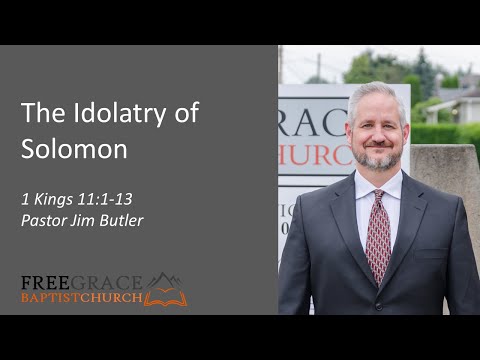
The Idolatry of Solomon
Solomon's idolatry in 1 Kings 11:1–13 exposes how a man richly blessed by God — with the law, direct divine appearances, a faithful father, and transcendent wisdom — can fall into the grossest sin when he fails to guard his heart. The sermon traces the problem, precedent, and practice of Solomon's idolatry before examining God's just and covenant-shaped response: judgment tempered by the unconditional Davidic covenant that finds its telos in the Lord Jesus Christ. The passage issues sober warnings against the assumption that age, experience, knowledge, or good pedigree secure ongoing faithfulness apart from vigilant dependence on the Holy Spirit.

The 8th Commandment, Part 2 & Economic Theory
The Eighth Commandment's prohibition against theft carries positive moral obligations — diligent labor, charitable giving, and biblical contentment — and provides the scriptural framework for evaluating economic and political systems. Drawing on the Mosaic law, the apostolic letters, and historical narrative, the sermon argues that socialism and communism are founded upon institutionalised theft and therefore stand under divine condemnation, while capitalism, for all its imperfections, respects the God-given right to private property. Israel's demand for a king in 1 Samuel 8 and Ahab's seizure of Naboth's vineyard in 1 Kings 21 are presented as biblical case studies in governmental confiscation. Hearers are exhorted to cultivate contentment, labor faithfully, give charitably, and judge all economic theory by the standard of Exodus 20:15.

The Confidence of the Believer
Micah 7 opens with a prophet's anguished cry — 'Woe is me' — over the collapse of covenant faithfulness in Israel: corrupt leadership, broken families, and the absence of godly community. The sermon works through three movements in the chapter: Micah's lamentation over the state of the covenant people (vv. 1–6), his counsel to the faithful remnant to look to God and trust his promises (vv. 7–13), and his petitions and doxology to the God who pardons iniquity, subdues sin, and casts all transgressions into the depths of the sea (vv. 14–20). The central corrective the prophet offers is the same one the just have always lived by: not optimism, not realism, but faith in the sovereign God of the covenant, whose compassions are new each morning and whose purposes for his remnant cannot be frustrated.

The Healing of Naaman
The healing of Naaman in 2 Kings 5 exposes a pagan military commander who possesses everything except the one thing he needs: cleansing from leprosy and reconciliation to the living God. The passage traces the providence of God in orchestrating Naaman's encounter with Elisha, Naaman's fury at the simplicity of the cure, his genuine conversion and humble confession of faith in Yahweh alone, and finally the greed of Gehazi, whose attempt to put a price on God's free grace earns him the very disease Naaman was healed of. The sermon presses toward these gospel applications: sovereign grace humbles its recipients rather than inflating them, salvation is by grace alone through faith alone with nothing added, and God's grace is not a commodity to be bought, manipulated, or supplemented with human achievement.

The Promise of the Coming King
Isaiah 9:6–7 presents the promised Messianic King in language that exceeds any earthly monarch — a child born yet mighty God, a son given yet everlasting Father, the Prince of Peace who secures shalom through conquest. This exposition sets the passage in its historical context of Assyrian devastation and prophetic hope, then works through the fourfold identification of the King and the fourfold character of His kingdom. The central application is that this King presently reigns at the right hand of the Father, and entrance into His eternal, covenantal, just, and secure kingdom is by grace through faith alone in the Lord Jesus Christ.

The Preservation of the Kingdom
2 Kings 11 records the near-extinction and miraculous preservation of the Davidic royal line under the murderous usurpation of Athaliah — and its theological significance reaches from Genesis 3:15 to the throne of the ascended Christ. The chapter is read as a node in the unbroken typological-covenantal chain running from the proto-evangelium through the Davidic covenant, the incarnation, and the present reign of the Lord Jesus at the Father's right hand. The sermon argues that every assault on the messianic line, whether Athaliah's massacre, Herod's slaughter of the innocents, or the devil's wilderness temptation, is overruled by the sovereign providence of God, who protects his kingdom through unexpected instruments and will advance it until every enemy is made a footstool. The congregation is exhorted to draw courage from this narrative in the face of present opposition to Christ's church, resting in the certainty that the zeal of the Lord of hosts will perform his promise.

Introduction to the Decalogue
Exodus 20:1–2, the preface to the Decalogue, reveals God as the sovereign Lawgiver who redeems before He commands — a pattern in which grace precedes obligation that runs from Sinai through the new covenant. The sermon examines three classical uses of the Ten Commandments (civil, pedagogical, and normative) and the threefold division of the law (moral, ceremonial, judicial), demonstrating that the moral law alone abides in its full binding force for all people and all ages. Believers are not justified by the law but are directed by it as the objective standard of sanctification, so that love for God and neighbor is never left undefined or sentimental.

2LCF Chapter 3 - Of God's Decree
God's decree — his eternal, comprehensive, and unchangeable purpose over all things — is the subject of 1689 London Baptist Confession Chapter 3. The confession affirms that God has foreordained whatsoever comes to pass, including the free and sinful actions of men, without becoming the author of sin or violating the will of the creature. Paragraph 2 refutes the Molinist and Arminian claim that God's decree is grounded in his foreknowledge of human choices, insisting instead that election puts sinners in Christ rather than finding them there. The doctrine is shown to be practically consoling, doxologically oriented, and inseparable from the character of God as defined in Chapter 2.

The Cleansing of the Temple
Jesus' cleansing of the temple in John 2:13–17 is not an aberration from his character but a direct expression of his identity as the Son of God and the antitype of the temple itself. The passage reveals two inseparable realities: the apostasy of first-century Israel's worship and the messianic zeal prophesied in Psalm 69, Malachi 3, and the post-exilic prophets. Christ's authority to purge the temple rests on his sonship by nature, not adoption, and his action announces that the entire Old Covenant sacrificial system finds its fulfillment in him. The sermon calls the church to recover zeal for the purity of God's worship, to identify and resist the defections of contemporary Christendom, and to look in faith to the Lamb who has displaced every animal sacrifice.