
Cited in sermons
Dale Ralph Davis
317 sermons · All people cited

The Cross and the Crown of Christ, Part 1

Psalm 22 is the suffering Messiah speaking in his own voice — a depth of self-disclosure that the prophet Isaiah 53 approaches but does not match. This sermon works through the first two of three laments in verses 1–11: Christ's desolation under judicial desertion by the Father, and the reproach heaped upon him by his enemies. The cry of dereliction is neither a rupture in the Trinity nor a dissolution of the hypostatic union, but a penal desertion in which the Father withdraws his favorable countenance from the one who has been made sin as mediator. Throughout each lament Christ models the pattern of honest complaint before God followed by confident recourse to the Father's holiness, covenant faithfulness, and sovereign purpose — a pattern the church is called to imitate in its own far lesser sufferings.

The Regulation of Priests and Prophets
Deuteronomy 18 governs the two offices through which God communicated with Old Covenant Israel: the Levitical priesthood and the prophetic ministry. The chapter moves from the material provision owed to priests and Levites, through a comprehensive prohibition of pagan divination, to the promise of a succession of prophets culminating in one greater than Moses — the Lord Jesus Christ, identified explicitly in Matthew 17 and Acts 3. The sermon draws out the typological and redemptive-historical unity of the chapter, showing that what Israel sought illegitimately through witchcraft and necromancy, God supplied legitimately through his Word-bearing offices, and that the old covenant's pattern of 'do this and live' finds its fulfillment in Christ who kept the covenant perfectly on behalf of his people.

The Maintenance of Justice (Higher Court and Monarchy)
Deuteronomy 17:8–20 establishes two institutions for the maintenance of justice in Old Covenant Israel: a higher court to adjudicate cases too complex for local tribunals, and a monarchy governed by the law of God. The higher court — composed of priests, Levites, and judges at the central sanctuary — held binding authority over difficult cases involving degrees of guilt, civil disputes, and punishments, with criminal contempt of that court carrying a capital sanction. The king was not an absolute sovereign but a servant under God's law, prohibited from multiplying horses, wives, and wealth as a guard against misplaced trust, and required to read the law of God daily so that fear of the Lord, not pride or military power, would govern his reign.

Deuteronomy 16:1-17 - The Annual Feasts of Israel
Deuteronomy 16:1–17 presents three annual feasts — Passover and Unleavened Bread, Weeks, and Tabernacles — as divinely ordained memorials calibrated to keep Old Covenant Israel's allegiance fixed on Yahweh. Each feast commemorates a distinct aspect of God's redemptive work: deliverance from Egypt, provision at harvest, and sustenance through wilderness wandering. The Passover's substitutionary logic — where efficacy rested in God's provision rather than the offerer's moral worthiness — typologically prefigures Christ as the Lamb whose blood alone secures the sinner's safety. The sermon draws out the connection between the central sanctuary requirement of Deuteronomy 12 and the New Covenant church as the God-ordained means by which worship is preserved from corruption and believers are hedged against apostasy.

The Deliverance of the Psalmist, Part 4
Psalm 18:46–50 closes with a threefold ascription of praise to the God who delivers His anointed King — a King who is not merely David but David's greater Son, the Lord Jesus Christ. The passage is expounded under four movements: the praise of God as the living Rock (v. 46), God as the God of vengeance and victory (v. 47), God as the God of deliverance and destruction (v. 48), and God as the God of grace and glory (v. 49), all grounded in the Davidic covenant of 2 Samuel 7. The sermon presses the church to find in the invincibility of God's covenant kingdom the steel needed to persevere through present affliction, and to ground all worship in the theological confession that the Lord lives, that Christ's righteousness is imputed to His people, and that God's promises are yea and amen in His Son.

The Deliverance of the Psalmist, Part 1
Psalm 18:1–19 presents David's praise to God for deliverance from all his enemies, and the psalm functions typologically: David points forward to his greater Son, the Lord Jesus Christ, whose sufferings, death, and resurrection are the ultimate fulfillment of what the psalmist describes. Working through three divisions — the occasion of praise (the superscription), the declaration of praise (vv. 1–3), and the motivation for praise (vv. 4–19) — the sermon demonstrates that David's deliverance rests not on David's own prowess but on the sovereign power and delight of Yahweh. The sermon calls believers to love God with the love that is the chief fruit of faith, to cry out to God in distress rather than to despair, and to find consolation in the reality that God moves heaven and earth to vindicate his people and vanquish their enemies.

The Conversion of Rahab the Harlot
Joshua 2 presents the conversion of Rahab the harlot as a deliberate theological interruption in Israel's conquest narrative — not incidental color, but a magnification of the sovereign, free grace of Yahweh toward a Gentile prostitute. The sermon works through her fear, confession, and covenant with the spies to demonstrate that salvation is by grace alone through faith alone, a faith that inevitably produces works, as James 2 and Hebrews 11 confirm. Rahab's inclusion in the genealogy of Christ in Matthew 1 seals the point: the God of heaven and earth is also the God of sinful Gentile harlots, and His grace toward her is a standing summons for sinners to come immediately to the Lord Jesus Christ.

Deuteronomy 14:1-29 - Laws of Death, Diet, and Tithing
Deuteronomy 14 regulates mourning rites, dietary practices, and tithing for Old Covenant Israel — not as arbitrary impositions but as expressions of a holy people set apart by God from the nations around them. The chapter's controlling logic is covenantal identity: because Israel bore the status of God's firstborn son, every dimension of daily life, from the menu to the method of mourning, was to reflect that consecration. The dietary laws, now abrogated under the New Covenant as ceremonial law fulfilled in Christ, nevertheless carry a permanent New Covenant counterpart: the people of God are still to be distinguished from the world in holiness, presenting their bodies as living sacrifices. The tithing section closes the chapter with a call to generous, joyful giving that cares for the Levite, the stranger, the fatherless, and the widow — a call that carries into the New Covenant era as well.

The Solicitation to Apostasy
Deuteronomy 13 confronts Israel with three escalating scenarios of solicitation to apostasy: the false prophet, the intimate family member or friend, and the corrupt city given over to idolatry. In each case the text demands not tolerance but purging, because defection from the living and true God constitutes treason against the theocratic covenant order. The chapter's severity is inseparable from its mercy: faithful execution of justice removes the cause of divine wrath and secures the covenant blessings sworn to the fathers. The passage presses the hearer to examine whether fidelity to God holds firm against both miraculous signs that lead astray and the subtler pull of intimate relationships.

The Central Sanctuary
Deuteronomy 12 establishes the principle that Israel's worship must be conducted where and how God commands — not where or how the surrounding nations worship their gods. Working through four sections of the chapter, this exposition traces the logic from the destruction of Canaanite shrines and the centralization of sacrificial worship, through the legislation governing ordinary and sacrificial eating, to the climactic prohibition of verse 32: 'You shall not add to it nor take away from it.' The regulative principle of worship is not an Old Covenant curiosity but a transcovenantal demand, grounded in the first and second commandments and confirmed in the New Covenant by 1 Timothy 3:15 and Hebrews 12:28-29. The sermon calls hearers to resist the perennial temptation to import pagan practices and autonomous creativity into the worship of the living and true God, and to find in prescribed worship the very joy and blessing God promises his obedient people.

Review Of Israel's Rebellion
Deuteronomy 9 confronts Israel's temptation to attribute their inheritance of the promised land to their own righteousness, and Moses systematically dismantles that presumption. The chapter divides into the anticipation of the conquest (vv. 1–6) and a recapitulation of Israel's wilderness rebellions (vv. 7–29), each episode confirming that Israel stood not by merit but by the sovereign mercy of God and the faithfulness of his covenantal promises to Abraham, Isaac, and Jacob. Moses's intercessory prayer at the chapter's close models covenant pleading that appeals not to Israel's worthiness but to God's glory, his sworn word, and the redemption he himself accomplished. The passage calls God's people in every era to forsake self-righteousness and rest entirely on divine grace.

The Reign of the Son of the Most High
Psalm 2 sets the fallen world's rebellion against God and His Anointed within a framework of divine sovereignty, showing that the rage of nations and rulers against Yahweh and His Christ is both futile and answerable. The psalm unfolds in four movements: the insurrection of mankind against God, the installation of the Son as King on Zion, the revelation of the eternal decree establishing the Son's universal inheritance, and the exhortation to kiss the Son in saving faith. Christ is identified as the eternal, only-begotten Son of the Father whose resurrection vindicates His divine Sonship, and whose worldwide reign is not yet complete but is advancing through the gospel mission entrusted to the church. The psalm closes with both a warning to the impenitent and a promise of blessedness to all who trust in Him.

A Psalm of Thanksgiving
Psalm 103 is a psalm of David that models the discipline of deliberate thanksgiving — speaking to one's own soul rather than merely listening to its despondency. This exposition works through three movements: the reminder to bless God (vv. 1–2), the reasons to bless God catalogued as gifts, their recipients, and their giver (vv. 3–18), and a reflection on the sovereign kingdom of God (vv. 19–22). The chief benefit heading David's list is the forgiveness of sins — the one blessing that remains constant through every external adversity — and the sermon calls hearers to fight melancholy with the specific, rehearsed goodness of God rather than merely silencing the soul's complaints.
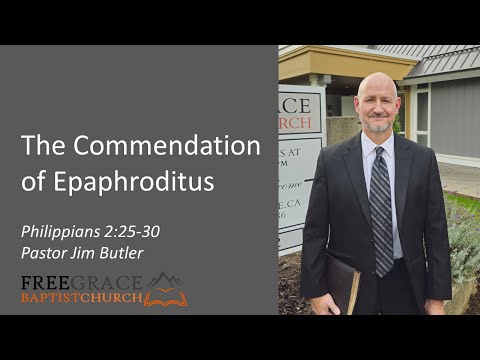
The Commendation of Epaphroditus
Philippians 2:25–30 presents Epaphroditus as a model of Christian ministry and other-mindedness, embodying the very exhortation Paul gave in Philippians 2:3–4 to esteem others above oneself. The sermon examines the three titles Paul assigns Epaphroditus in relation to himself — brother, fellow worker, fellow soldier — and his two roles in relation to the Philippian church — messenger and minister. The Christian life, and pastoral ministry in particular, is shown to be genuine warfare requiring devotion, discipline, and diligence. The church is called to receive and esteem men who hazard their lives for the work of Christ, recognising that to neglect such men is to demean the ascended Christ who gives them as gifts to his church.

The Bronze Serpent
Numbers 21:1–9 records Israel's sin of grumbling in the wilderness, God's judgment through fiery serpents, and the divinely prescribed remedy: look at the bronze serpent lifted on a pole and live. The sermon traces this narrative in two movements — the defeat of the Canaanites in verses 1–3, where Israel prays and trusts God, contrasted with the failure of verses 4–9, where they grumble despite God's provision. The bronze serpent functions as a type of Christ, as Jesus himself declares in John 3:14, and the sermon presses the application that justification is by faith alone — not by prior works, not by self-examination of the wound, but by looking to the one lifted up. Weak faith does not disqualify the sinner; even a feeble look at the appointed remedy brings the sinner into peace with God.

The Victory of David Over Goliath
David's defeat of Goliath in 1 Samuel 17 is not a moralistic lesson in overcoming personal giants, but a theological declaration that the living and true God vindicates His covenant people against those who defy Him. The narrative turns on two explicit lessons David announces in verses 46–47: that all the earth will know there is a God in Israel, and that Israel will learn the Lord does not save by sword and spear. David functions typologically as the singular seed of the woman, his headshot of Goliath advancing the Genesis 3:15 promise toward its fulfillment at Golgotha, where Christ crushed the serpent's head through His death and resurrection. The sermon calls believers to the same confidence David displayed — trusting the living God rather than human strength, because the same God who delivered David has promised to build His church and defend His people.

2LCF Chapter 3 - Of God's Decree
God's decree — His eternal, immutable purpose to foreordain whatsoever comes to pass — is the subject of 2 London Baptist Confession of Faith Chapter 3. This study works through paragraphs 1–7, establishing that the decree is absolute and unconditional, covers all events including the free and sinful actions of creatures without making God the author of sin, and that election unto life is grounded solely in God's free grace rather than any foreseen condition in the creature. The session addresses the distinction between preterition and double predestination, the infralapsarian and supralapsarian debate, and closes with the confession's insistence that this high doctrine is to be handled with prudence, producing praise, humility, diligence, and abundant consolation in those who sincerely obey the gospel.

The Necessity of Faithful Obedience, Part 2
Moses concludes the historical prologue of Deuteronomy with a programmatic warning to the second generation of Israel: idolatry will bring exile, but repentance will meet a merciful God. The sermon expounds Deuteronomy 4:25–49, tracing the consequences of covenant-breaking, the grounds of covenant mercy, and the incomparability of Israel's God as the only legitimate basis for obedience. The practical application presses the necessity of self-government, the danger of forgetfulness, and the trans-covenantal obligation of parents to pass covenant instruction to their children.

Wilderness Wanderings
Deuteronomy 2–3 records Moses rehearsing the wilderness wanderings for the second generation of Israel, poised on the plains of Moab before the conquest of Canaan. God's multinational sovereignty is on display as He assigns territorial boundaries to Edom, Moab, and Ammon, then delivers Sihon and Og into Israel's hands — demonstrating that the God of Israel governs all nations, not merely His covenant people. The historical review functions both as a warning against repeating the unbelief of the first generation and as an encouragement to trust the same God who preserved Israel through forty years of wilderness trudging. New Covenant believers are called to the same posture: to dwell on the record of God's faithfulness in redemptive history so as to remain steadfast through present trials.
Deuteronomy 1
Deuteronomy 1 opens Moses' first address to the second generation of Israel on the plains of Moab, a historical review designed to prepare the people for the conquest of the promised land. Moses rehearses four episodes: God's command to advance from Horeb, the appointment of judges, the rebellion at Kadesh Barnea rooted in unbelief, and the punishment that fell on the first generation. The central diagnostic is verse 32 — 'you did not believe the Lord your God' — which exposes unbelief as the taproot of Israel's grumbling, refusal, and covenant faithlessness. The sermon calls the New Covenant congregation to dwell on this history so as to be steadfast in the future, trusting the same God whose promises are yes and amen in Christ.

Introduction to Deuteronomy
Deuteronomy is introduced as the second giving of the law — not a new law, but a restatement of the Sinai covenant addressed to the second generation of Israel standing on the plains of Moab, poised to enter the land of promise. The session surveys Mosaic authorship, the book's place in the Pentateuch, its historical context, its broad outline (God's activity, law, covenant, and servants), and its major theological emphases: reminder, transition, exhortation, and instruction in theology proper, the promise of land, and the worship of God. The study concludes with the typological significance of Deuteronomy for the New Testament, tracing how the book prefigures Christ as prophet, priest, king, and true Israel, and how its promise of new covenant in chapter 30 points forward to what Jeremiah 31 and the gospel make explicit.

The Idolatry of Solomon
Solomon's reign, celebrated across 1 Kings 3–10 as a golden age of wisdom and divine blessing, collapses in chapter 11 under the weight of multiplied foreign wives and the idolatry they drew him into — a direct violation of the Mosaic prohibitions in Deuteronomy 7 and 17. The sermon traces the idolatry itself (vv. 1–8) and the divine response (vv. 9–13), showing that Solomon's sin was aggravated by his knowledge of the law, the good example of his father David, and two personal appearances of God. From this sobering case the sermon draws eight practical warnings: that experience, godly example, knowledge, and wisdom are not in themselves sufficient to secure present faithfulness, and that the believer's only safeguard is constant dependence on the Holy Spirit and a mind rooted in Scripture.

The Dedication of the Temple
Solomon's prayer at the dedication of the temple in 1 Kings 8:22–53 is grounded not in Israel's merit but in the character of God — his incomparability, faithfulness, and transcendence held together with his immanence. The petitions that follow address every covenant curse Moses had warned of: civil injustice, military defeat, drought, famine, and exile, each met with Solomon's recurring plea that God hear from heaven and forgive. The prayer reaches beyond Israel to encompass the nations, anticipating the Gentile inclusion Paul expounds in Ephesians 3 and finding its ultimate fulfilment in the Lord Jesus Christ, the true Son of God who builds the eternal house of God. Believers are exhorted to imitate Solomon's theology-saturated prayer, to receive affliction as God's appointed means of conformity to Christ, and to rest in the faithfulness of a God who has always kept his covenant promises.

The Harlotry of Israel in Moab
Numbers 25 records the final plague upon the first generation of Israel: sexual harlotry with the women of Moab leading directly to idolatrous worship of Baal of Peor, the very site where God had been blessing Israel through Balaam's compelled oracles. The chapter unfolds in three movements — the sin of the people, the zealous intercession of Phinehas, and the commanded judgment on Midian — each illuminated by the Apostle Paul's use of this passage in 1 Corinthians 10 as a warning to the new covenant church. Phinehas, acting as a priestly guardian of the sanctuary with divinely commended zeal, typifies Christ's priestly office and intercession, pointing forward to the one whose unchangeable priesthood averts the wrath of God from new covenant Israel through his life, death, and resurrection. The passage calls the church to flee idolatry, to marry only in the Lord, and to perfect holiness in the fear of God, lest spiritual harlotry — defection from the living God through unholy alliances — repeat in the new covenant community what it wrought in the old.

The Oracles of Balaam, Part 2
Numbers 24 records the third and fourth oracles of Balaam, an unconverted soothsayer compelled by the Spirit of God to bless Israel rather than curse her at Balak's command. The sermon traces the messianic trajectory of these oracles — the star out of Jacob, the scepter rising from Israel, the dominion of one from Judah — arguing that Balaam is ultimately preaching Christ and the triumph of his kingdom, which finds its New Covenant terminus in the church as the Israel of God. The text becomes a call to faithful gospel ministry: if a reprobate soothsayer could handle the Word of God accurately, the church has every right to demand that her ordained ministers do likewise.

The Suffering and Glory of Christ
Psalm 22 presents the suffering and glory of Christ with a precision and detail that exceeds even the Passion narratives of the four Gospels. The psalm's first half expounds the dereliction Christ endured on the cross — not as a breach of the Trinity or a dissolution of the hypostatic union, but as the penal withdrawal of the Father's sensible favor while the Son bore the curse due to his people's lawbreaking. The second half moves from that suffering to the exaltation of the Redeemer, the adoption of his brethren, the extension of his kingdom to all nations, and the generational advance of his church — all grounded in the finished work of the cross. The sermon calls believers to make much of the Psalms in both private devotion and corporate worship, hearing in them the very voice of Christ.

The Enthronement of the King-Priest
Psalm 110 is the most frequently quoted Old Testament text in the New Testament, and for good reason: it presents the Lord Jesus Christ in his twofold office as enthroned King and eternal Priest. This exposition works through all seven verses under three headings — the enthronement of Christ at the Father's right hand (vv. 1–3), the Melchizedekan priesthood sworn by God's oath (v. 4), and the triumph of Christ over all his enemies (vv. 5–7). The sermon calls believers entering a new year to fix their minds on the reigning King-Priest rather than on the hostility of the present evil age, and urges the unconverted to come to Christ in faith on the grounds that God's saving purpose is irreversible.

Bible Study - Saul and the witch at Endor
King Saul's consultation with the witch at Endor (1 Samuel 28) illustrates the catastrophic spiritual consequences of persistent disobedience to God's revealed word. Having been cut off from God through compounding acts of rebellion — beginning in 1 Samuel 13 and 15 — Saul finds himself without prophetic word, priestly access, or divine dream, and turns in desperation to a source God had expressly condemned. The narrative is set in deliberate contrast with David, who, though not sinless, maintained communion with God through repentance and reliance on the means of grace. The lesson closes with a call to seek God earnestly through Scripture and prayer rather than turning to any substitute, however desperate the circumstances.

The Atonement at Gibeah
The atonement made at Gibeah — where seven descendants of Saul were executed to satisfy the blood-guilt incurred by Saul's slaughter of the Gibeonites — is expounded as a typological anticipation of penal substitutionary atonement. David's inquiry of God, the Gibeonites' insistence that no silver or gold could ransom a murderer (Numbers 35:33), and the hanging of the seven men before the Lord all illustrate that atonement is the satisfaction of divine justice through blood. The sermon argues that Rizpah's grief beside the bodies of her sons is a solemn, sin-cursed scene designed to strip away abstraction and force the reader to feel the horror of what atonement costs. Only when the gore of Gibeah is taken seriously does Golgotha regain its proper weight: Christ, the greater Son of David, stood in the place of his people to quench the wrath of God and secure the covenant safety of all whom the Father gave him.

The Righteousness of David
David's declaration in 2 Samuel 22:21 — 'The Lord rewarded me according to my righteousness' — presents an apparent contradiction for anyone who knows his history of adultery, murder, and failure of justice in his own household. This sermon works through that tension by examining the theology underlying David's claim: his righteousness is not a personal moral achievement but the imputed righteousness of Christ received by faith alone, the same doctrine Paul draws from David's own Psalm 32 when arguing for justification in Romans 4. The sermon concludes with a call to imitate David not merely in doctrine but in appetite — in his fierce love for public worship, the means of grace, and the presence of God.