
Cited in sermons
Dale Ralph Davis
317 sermons · All people cited

The Enthronement of the Priest-King

Psalm 110, the most frequently cited Old Testament passage in the New Testament, presents the Messiah as the divinely enthroned Priest-King whose universal dominion is secured by the oath of God. This exposition traces three movements in the psalm: the enthronement and government of Christ the King (vv. 1–3), his eternal priesthood after the order of Melchizedek (v. 4), and the triumphant conquest of his enemies (vv. 5–7). The sermon draws on Peter's argument in Acts 2, Paul's application in 1 Corinthians 15 and Ephesians 1, and the author of Hebrews to show that Christ's present session at the right hand of the Father is not passive but active — he reigns, subdues, and intercedes. Christians living in tumultuous times are urged to resist despair by fixing their confidence in the sovereign rule of the enthroned Priest-King rather than in the shifting circumstances of earthly politics.

The Redemption of Boaz and the Hope of Christ the King

Ruth 4 culminates the book's central theme of redemption, showing how Boaz's costly love for Ruth and Naomi foreshadows the costlier love of Christ for his unlovely people. The kinsman-redeemer who willingly takes on an obligation he was not bound to fulfill — redeeming land, line, and a Moabite widow — points forward through the Davidic genealogy to the King who identifies with sinners and purchases his bride at the price of his own blood. God's sovereign providence moves through unsavory sinners and hopeless circumstances to build the royal line, a pattern that should silence despair among God's people in every age. The sermon calls believers to find their only settled hope in Christ the King, and invites the unbeliever to look to that same King and live.

The Testimony of John the Baptist, Part 3
John 1:30–34 records the Baptist's testimony concerning the dignity of Christ's person — his preeminence as the eternal Word who was before John, his anointing with the Spirit without measure for the work of mediation, and his identity as the natural, essential, and eternal Son of God. The sermon traces the Old Testament prophetic background of the Spirit's descent (Isaiah 11, 42, and 61), the active and passive obedience of Christ as the ground of the believer's acceptance before God, and the Baptist's final declaration that this Jesus is the Son of God. From this foundation the preacher draws an urgent gospel application: the same Lamb who takes away sin will visit unbelief with wrath, and the only fitting response is faith in him now.

The Royal Wedding
Psalm 45 presents a royal wedding between the divine-human Messiah and his church, and the sons of Korah compose it as a song of love that the New Testament apostles and the entirety of the Old Testament prophetic witness sustain. The sermon works through the psalm's four sections — the psalmist's intention, the perfections and person of King Messiah, the instruction to the bride, and the closing declaration — demonstrating that a divine Messiah was not a novelty invented by John or Paul but was anticipated in the Hebrew Scriptures. Christ is celebrated as fairer than the sons of men, committed to truth and righteousness, triumphant over his enemies, fully God and fully man in the hypostatic union, and the one who clothes his bride in imputed righteousness received through faith alone. The appropriate response of the church is repentance, exclusive allegiance, worship, and gladness before her great King.

The Trial before Pilate, Part 2
Matthew 27:15–23 records Pilate's attempt to grant amnesty to Jesus through the Passover prisoner-release custom, a device that exposes the cowardice of the Roman governor, the envious malice of the Jewish religious leaders, and the terrifying moral bankruptcy of mob rule. The passage is expounded under five heads — the custom of amnesty, the leaders' motivation of envy, the warning of Pilate's wife, the demand of the multitudes, and Pilate's cross-examination — each of which illuminates the comprehensive reach of human depravity. The substitution of Barabbas for Jesus is treated as emblematic of definite atonement: the just going to the cross in the place of the unjust, securing both the forgiveness of sins and the imputed righteousness of Christ received by faith alone. Hearers are urged not to be carried along by ungodly leaders, to flee to Christ without delay, and to eat the Lord's Supper as a memorial of the blood atonement and active obedience of the Second Person of the Trinity wrought entirely on behalf of his people.

David's Rise and Saul's Resentment
1 Samuel 18 traces the beginning of David's rise to prominence and Saul's corresponding descent into envious rage. The chapter presents a sustained contrast between Jonathan's covenant faithfulness — his willing deferral to David as the Lord's anointed — and Saul's increasingly vicious antagonism, from murderous spear-throwing to cynical manipulation of marriage negotiations. The sermon draws out the theological spine of the narrative: the presence of Yahweh with David is both the cause of his success and the source of Saul's terror, a pattern that points forward to the New Covenant reality that those united to Christ by faith enjoy the peace, protection, and communion of God. Listeners are called to watch against both external and internal threats to the kingdom, and to pursue the God-fearing faithfulness modelled in David rather than the self-securing apostasy of Saul.

The Victory of David Over Goliath, Part 2
David's victory over Goliath in 1 Samuel 17 is fundamentally a theological event, not a heroic self-help narrative. The sermon works through David's preparation, his declaration of faith in the name of the Lord of hosts, the decisive defeat of Goliath, and the rout of the Philistines, arguing that the emphasis falls squarely on who Yahweh is rather than on what David achieves. The fatal headshot dealt to Goliath is then traced through the biblical-theological thread of Genesis 3:15, illustrated in Judges 4 and 9, and shown to culminate in Christ's crushing of the serpent's head through His own suffering, death, and resurrection — the definitive victory to which David's victory is typological.

The Victory of David Over Goliath, Part 1
1 Samuel 17:1–37 is not a psychological self-help story about facing personal obstacles; it is a narrative of the glory of God. Goliath defies the armies of the living God, and David — a type of Christ — meets that defiance not with natural courage but with faith grounded in the proven faithfulness of Yahweh. The sermon traces the contrast between Israel's faithless paralysis and David's God-centred confidence, showing that apostasy produces cowardice while faith in the living God produces boldness. The practical summons is to walk by faith rather than by sight, to serve faithfully in ordinary providential callings, and to draw confidence for present trials from remembered past mercies.

The Third Missionary Journey, Part 7
Acts 20:32–38 concludes Paul's farewell address to the Ephesian elders at Miletus, functioning as a pastoral charge that moves from doctrinal grounding to ethical example to affectionate departure. The sermon treats three movements: Paul's commendation of the elders to God and the Word of His grace as the only sufficient resource for long-term ministry, Paul's example of non-covetousness and manual labor as a rebuke against ministerial greed, and the tearful parting as a model of godly gratitude for the instruments of grace. A sustained excursus defends the biblical warrant for paying pastors from 1 Corinthians 9, 1 Timothy 5, and 2 Timothy 2, establishing that Paul's voluntary self-support was the exercise of a right, not the abolition of one. The sermon closes with a call to pray for faithful ministers and to value the means God ordains for the salvation of sinners.

The Anointing of David
God's rejection of Saul and anointing of David in 1 Samuel 16 sets the stage for one of the richest typological passages in the Old Testament. The sermon traces two movements — God's sovereign selection of David at Bethlehem and David's providential entry into Saul's court — to establish that God judges by the heart rather than outward appearance, that the reception of the Spirit precedes conflict rather than eliminating it, and that David's entire narrative points forward to his greater Son, the Lord Jesus Christ. Listeners are called to resist the health-and-wealth error that trials signal divine disfavor, to tend the inner man before God in private, and to rest in the one through whom the righteousness David celebrated by faith is actually accomplished and imputed.
Nations Rage, God Mocks
Psalm 2 confronts the rage of earthly rulers against God and His anointed with a sober theological question: why do the nations engage in so futile an endeavor? The sermon expounds the psalm under three headings — the rebellion of earthly kings, the reign of the heavenly king, and the recognition of the true king — tracing the Davidic covenant through its fulfillment in the resurrection and exaltation of Christ. The Covenant of Redemption grounds the certainty of Christ's present reign at the right hand of the Father, and that certainty is the sole comfort available to God's people as nations continue to rage and the history of the church runs red with the blood of martyrs. Hearers are called either to kiss the Son in filial fear and find blessing, or to perish in the way of the ungodly.

The Victory of Samson at Jawbone Height
Judges 15 recounts Samson's victory over the Philistines at Jawbone Height, but the chapter's deepest scandal is not the enemy outside — it is the cowardice of the covenant tribe of Judah, who bind their own deliverer and surrender him to those he was sent to destroy. This sermon traces three movements in the text: the betrayal by Samson's father-in-law, the treachery of Judah's three thousand men, and the Spirit-empowered defeat of a thousand Philistines with a fresh jawbone. Throughout, Samson emerges as a type of Christ — delivered by his own people into enemy hands, yet vindicated by God — and the lesson pressed upon the hearer is that God's grace delivers a people who neither cry out for deliverance nor deserve it.

The Messiah, The Baptist, And The Kingdom
Matthew 11:2–15 presents three interlocking questions: who is Jesus the Messiah, who is John the Baptist, and what is the nature of the kingdom of heaven? The sermon works through John's imprisoned inquiry — not as rank unbelief but as a struggle with the shape of the messianic agenda — and Christ's answer, which grounds assurance in fulfilled Old Testament prophecy rather than in political deliverance. John is then assessed by Christ himself as more than a prophet, the very subject of Malachi's covenant-messenger prophecy, a man of unflinching courage who stands as a model for preachers and all believers. The enigmatic kingdom-violence saying of verse 12 is read as a positive-negative pairing: the kingdom forcefully advances through proclamation and regeneration, but violent men persist in opposing and plundering it until Christ's enemies are made his footstool.
Immanuel
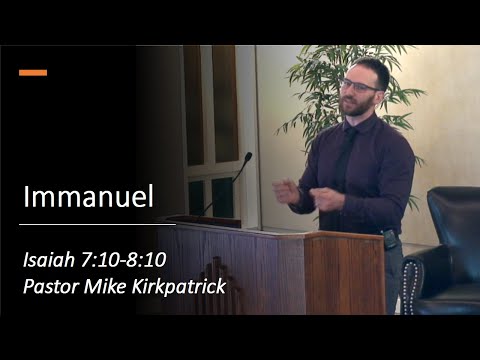
Isaiah 7:10–8:10 presents the Immanuel prophecy not as a comfortable seasonal text but as a word of judgment against Ahaz's faithless trust in Assyria and a word of hope for the covenant remnant. The sermon traces two contrasting realities: 'Assyria with us,' the consequence of royal unbelief, and 'God with us,' the promise that anchors the remnant through exile and desolation. The Immanuel sign finds its definitive fulfillment in Matthew 1, where the virgin-born Son saves his people from sin rather than merely political oppression — a truth that remains the ground of steadfastness for the church in every era of suffering and exile.

Exodus 1
Exodus 1 traces the rapid shift from Israel's prosperity under Joseph to their brutal subjugation under a new Pharaoh who knew nothing of the covenant arrangement his predecessors had honored. The chapter moves in two broad movements: the origin of the oppression in the multiplication of Israel, which paradoxically fulfilled God's Abrahamic promise of seed and land, and the gravity of that oppression as Pharaoh escalated from forced labor to state-sponsored infanticide. The defiance of the Hebrew midwives Shiphrah and Puah, grounded in the fear of God rather than the fear of man, illustrates the Reformed conviction that civil obedience finds its limit where God's law begins. The sermon closes by drawing three contemporary applications: vigilance against the gradual escalation of tyranny, confidence in the sovereign providence of God who keeps his covenant promises even through suffering, and the call to Spirit-wrought courage that refuses to silently deny Christ.

The Anointing at Bethany
Sandwiched between the conspiracy of the religious leaders and the betrayal of Judas, the anointing at Bethany (Matthew 26:6–13) presents an act of extravagant devotion that Christ himself defends, interprets, and immortalizes. The sermon works through three movements: the act itself, the disciples' indignant complaint, and Christ's authoritative response, showing that what pragmatic men call a waste Christ calls a good work. Against the tendency toward either-or Christianity, the passage enforces both fervent worship of Christ and genuine care for the poor as inseparable obligations. The abiding lesson is that no expenditure of time, wealth, or devotion directed to the Lord of glory can ever constitute a waste, because he is chief among ten thousand and altogether lovely.

The Covenant with David
The Davidic Covenant in 2 Samuel 7:1–17 is a sovereign promise by God to David that a seed from his line will establish an eternal kingdom — a promise that cannot be annulled by death, destroyed by sin, or exhausted by time. The sermon traces the historical background of the covenant (the ark's wandering, God's presence with his pilgrim people, David's own rise from the sheepfold), then unfolds the triple meaning of 'house' — physical dwelling, dynastic succession, and temple — showing that God's answer to David's desire to build for him is instead to build a dynasty for David. Covenant theology frames the whole: the Davidic covenant is not a new or separate covenant of grace but a further discovery of the one covenant purpose moving from Genesis 3:15 through Abraham and David to its full realization in the Lord Jesus Christ, the son of David who now reigns over a kingdom without end. The sermon closes with Jeremiah 23:5–6 — the Lord our righteousness — pressing hearers to rest in Christ's imputed righteousness as the ground of their entry into that everlasting kingdom.

The Enthronement of the Messiah
Psalm 110 presents the enthroned Messiah as divine King, eternal Priest, and triumphant Conqueror — a vision the early church clung to precisely because they suffered under Rome and unbelieving Israel. This exposition traces the three offices of the Mediator through seven verses, showing that Christ's present session at the right hand of the Father is not a passive waiting but an active subjugation of all enemies. The sermon rebukes a domesticated, sentimental Christology and calls believers to confident, volunteer service under the sovereign who must reign until every enemy is made his footstool.
The Past as a Present Reminder
Hebrews 10:32–39 calls suffering believers to recall God's proven faithfulness in former days as the present ground for ongoing endurance. The apostle first rehearses the Hebrew Christians' early trials — public reproach, solidarity with persecuted brothers, and joyful acceptance of plundered possessions — showing that heavenly-mindedness, not stoic willpower, sustained them then and must sustain them now. He then exhorts them not to cast away their confidence, grounding Christian perseverance not in moral grit but in faith in the Son of God who loved and gave himself for his people. The sermon applies this to every believer: remember what God has done, set your hope on the enduring possession in heaven, and press forward by faith rather than drawing back to perdition.

The LORD is my Shepherd
Psalm 23 is examined as a hymn of trust composed amid difficulty rather than prosperity, arguing that David's confident confession — 'The Lord is my shepherd, I shall not want' — is made precisely in the shadow of danger, not in spite of it. The sermon expounds the psalm under two headings: the covenant Lord as the shepherd who provides daily physical and spiritual provision, and as the gracious host who prepares a table in the presence of enemies. Christians are exhorted to make diligent use of the means of grace — private prayer and Scripture, corporate worship, the preached word, and the Lord's Supper — as the God-ordained way to walk with Christ through the valley of the shadow of death toward their eternal dwelling in the house of the Lord.

Psalm 5
Psalm 5 is David's prayer tutorial, teaching the believer how to approach God in dangerous and difficult circumstances. The sermon works through four movements in the psalm: preparing prayer with ordered intentionality, grounding prayer in a precise knowledge of God's character, making requests on the basis of divine grace rather than personal merit, and declaring a confident assurance in Yahweh's protection of the righteous. Because God abhors not merely evil deeds but evildoers themselves outside of Christ, the believer can pray against oppression with holy boldness, resting in the promise that Yahweh's favor surrounds the righteous as an encompassing shield.

Psalm 6
Psalm 6 is a psalm of desperate supplication — David bypasses every recommended pattern of ordered prayer and plunges directly into petition, driven by some combination of divine displeasure, physical affliction, and the threat of enemies. The sermon works through three movements: David's agony in verses 1–3, the arguments he marshals before God in verses 4–7 (resting on God's covenant love, the purpose of praise, and a frank recounting of his misery), and the assurance he reaches in verses 8–10 that Yahweh has heard and will answer. The governing application is that God's chesed — his covenant love that pledges never to let go — is both the ground of bold prayer and the foundation of confident assurance when answers are delayed.

Saul and the Medium at En Dor
When Saul consults a medium at En Dor on the eve of his final battle with the Philistines, the deepest terror of 1 Samuel 28 is not the Philistine army but the silence of God — the Lord refuses to answer Saul by dreams, Urim, or prophets. The passage exposes the bankruptcy of pragmatic religion: Saul does not want communion with God, only tactical advantage, and so he turns to what God has explicitly forbidden. The sermon examines the three main interpretive positions on the conjured spirit, argues that a demonic entity — not the real Samuel — appeared to the medium, and closes by distinguishing between the hardened reprobate who has been abandoned by God and the struggling believer who is called to renew repentance and press into the ordained means of grace.
Stephen's Defense, Part 8
Stephen's defense before the Sanhedrin turns on a single argument: the tabernacle and temple were never ends in themselves but types pointing forward to Jesus Christ, so the Sanhedrin's attachment to the temple above the one the temple signified exposes them as the true anti-temple party. Working through Acts 7:46–50 against the background of the Davidic Covenant in 2 Samuel 7, the sermon traces how David's desire to build a house for God is fulfilled typically in Solomon and ultimately in the Lord Jesus Christ, who as the Son of God builds the church as the true dwelling place of God Most High. The testimony of Isaiah 66:1–2 then seals the point: God who fills heaven and earth cannot be confined to any man-made structure, yet this same transcendent God condescends to dwell with the poor and contrite in spirit — a reality now fully realized in new covenant worship through Christ.

The Capture of the Ark
Israel's decision to fetch the Ark of the Covenant as a battlefield talisman in 1 Samuel 4 exposes a perennial human tendency: taking the good gifts of God and treating them as instruments of manipulation rather than means of worship. The chapter's three movements — Israel's defeat, Eli's death, and the naming of Ichabod — together declare that God will not be controlled by technique, and that He would sooner allow the symbol of His presence to fall into pagan hands than permit His people to profane it through superstition. The sermon presses believers to examine whether their own acts of piety — prayer, fasting, corporate worship — are genuine communion with God or covert attempts to secure desired outcomes from Him.

Free Grace Baptist Church - March 13, 2019 Bible Study
Genesis 15 presents the Abrahamic covenant in two movements: the reiteration of God's promise of seed and land to a childless and landless Abram (vv. 1–6), and the solemn ratification of that covenant through a self-maledictory oath ceremony (vv. 7–17). Verse 6 — 'he believed in the Lord, and He accounted it to him for righteousness' — is expounded as the locus classicus of justification by faith alone, with faith understood as the empty instrument that receives an alien righteousness imputed from Christ, not a meritorious work brought to God. The unilateral passing of the divine presence between the animal pieces is shown to anticipate Calvary, where Christ became the curse for covenant-breakers, sealing in blood what God swore to Abraham.

Gentile Inclusion in God's Covenant
Ephesians 2:11–22 presents Gentile inclusion in the covenant promises of God as a third demonstration of divine power, alongside the resurrection of Christ and the salvation of individual sinners. Gentile believers were once Christless, churchless, hopeless, godless, and homeless — aliens from the commonwealth of Israel and strangers to the covenants of promise — but now, through the blood of Christ, they have been brought near and made one new man together with believing Jews. The sermon refutes dispensationalism's two-peoples framework, explains the threefold division of the law (moral, judicial, ceremonial) to clarify what Christ abolished at the cross, and calls the church to a high corporate esteem of the household of God as the dwelling place of the Spirit.

The Death of Ahab
The death of Ahab in 1 Kings 22:29–53 is the culmination of multiple prophetic pronouncements — by Elijah, the unnamed prophet of chapter 20, and Micaiah — all of which converge on a single 'random' arrow on the field of Ramoth Gilead, demonstrating that no disguise, no strategy, and no human ingenuity can deflect the sovereign judgment of God. The narrative also exposes the folly of Jehoshaphat, a genuinely godly king whose piety was unaccompanied by good sense, yet who was graciously preserved by the God he served despite the consequences he deserved. The criterion by which every king in 1 Kings is finally measured is not his administrative accomplishments but his fidelity to the Word of God. The sermon calls believers to combine true piety with godly wisdom, to flee from the wrath of God to the cross of Christ as the only refuge, and to take sober warning as parents against training children in wickedness.
Genesis 29:1-30
Genesis 29:1–30 narrates Jacob's arrival in Haran, his meeting with Rachel, and his marriages to both Leah and Rachel through the fraud of Laban. The passage is examined in three movements — arrival, meeting, and marriage — with particular attention to the irony that Jacob the deceiver is himself deceived by his father-in-law. The overarching application is the doctrine of divine providence: God works sovereignly through morally disordered and even perverse circumstances — the switched brides, Leah's unexpected marriage, the messianic line through Judah — to accomplish his redemptive purpose in Christ.

The Rejection of the True Prophet of God
When Ahab of Israel gathered four hundred prophets to sanction his campaign at Ramoth-Gilead, he had already resolved what he wanted to hear — and hated the one man who would tell him the truth. This exposition of 1 Kings 22:1–28 traces the confrontation between King Ahab and the prophet Micaiah, examining how the rejection of the true prophet is ultimately the rejection of the Word of God itself. Drawing on the parallel Paul draws in 2 Timothy 4:1–4, the sermon calls hearers to guard their hearts against the perennial temptation to accumulate teachers who scratch itching ears, and to receive the whole counsel of God — rebuke and exhortation included — as the mercy of a wise and sovereign Father.