
Topic
Covenant Theology
1,714 sermons · All topics

The Savior of the World

John 4:27–42 traces three interlocking movements — the Samaritan woman's testimony, Christ's teaching on the harvest, and the Samaritans' confession that He is the Savior of the world — to argue that Christ's saving work crosses every ethnic and religious boundary without exception. The passage exposes the active and passive obedience of Christ as the twin grounds of justification: His perfect compliance with the law of God and His atoning death together constitute the righteousness sinners receive by faith alone. The Samaritans' declaration in verse 42 is not merely a first-century curiosity but a standing gospel call — Christ is the Savior of the world, and all who hear are summoned to come and see Him.

The Crucifixion of Jesus, Part 5
The death of Christ on the cross was not a bare historical event but a theologically charged act that immediately reshaped the covenant order between God and man. This sermon expounds Matthew 27:51–56, examining the three signs that followed the crucifixion — the torn temple veil, the earthquake and split rocks, and the resurrection of the saints — as divine testimony to the efficacy of Christ's atoning work and the inauguration of the New Covenant. The witnesses to that death, both the confessing Roman soldiers and the faithful women who had followed Jesus from Galilee, confirm that the one crucified is truly the Son of God. Believers are called to rest in Christ's completed atonement, which has opened access to the Holy of Holies for all who come through him, and to look forward to the bodily resurrection he has secured for his people.

2LBC Chapter 5 - Divine Providence
The 1689 London Baptist Confession of Faith, Chapter 5, on Divine Providence, teaches that God upholds, directs, disposes, and governs all creatures and all their actions from the greatest to the least — not by blind fate or fortune, but according to his infinite power and wisdom, his infallible foreknowledge, and the free and immutable counsel of his will. The chapter unfolds in seven paragraphs, moving from the general definition of providence (paragraph 1) through its relation to second causes, ordinary means, miracles, the fall, remaining sin in believers, the hardening of unbelievers, and finally the special care God exercises over his church. God's sovereignty does not make him the author of sin nor does it remove human responsibility; first causality establishes rather than annuls second causality. The doctrine is a source of deep comfort: whatever befalls the elect is by God's appointment for his glory and their good.

December 1, 2021 - Wednesday Night Bible Study - Exodus 20:1-3 (1st Commandment)
Exodus 20:3 — 'You shall have no other gods before me' — is expounded through both its prohibitions and its positive demands. The first commandment condemns atheism, polytheism, syncretism, idolatry, sorcery, and heresy, while positively requiring the knowledge, love, fear, obedience, trust, and worship of the one true and living God alone. The sermon draws on Romans 1:18-32 to show that ungodliness — disordered thinking about God — is the root from which all societal unrighteousness springs. The sermon closes with a call to repentance, to flee to Christ as the remedy for every violation of this commandment, and to cultivate the knowledge of God as the chief guard against idolatry in its ancient and modern forms.

The Meeting with the Samaritan Woman, Part 2
John 4:16–26 presents Jesus exposing a Samaritan woman's sin through the law in order to drive her to the living water of eternal life, then correcting the corrupted worship of Samaria and declaring the arrival of new covenant worship. The sermon argues that true worship of God is irreducibly Trinitarian: the Father is the object, the Son is the mediator and the truth through whom access is granted, and the Holy Spirit is the enabling power. Jesus' self-disclosure as the great I Am — the fulfillment of Exodus 3:14 and the prophetic expectation of Deuteronomy 18 — confirms that the Messiah the woman anticipated is the very one speaking to her. Hearers are called to receive the living water freely offered and to engage in the distinctly Trinitarian worship that Christ here commands.

Introduction to the Decalogue
Exodus 20:1–2, the preface to the Decalogue, reveals God as the sovereign Lawgiver who redeems before He commands — a pattern in which grace precedes obligation that runs from Sinai through the new covenant. The sermon examines three classical uses of the Ten Commandments (civil, pedagogical, and normative) and the threefold division of the law (moral, ceremonial, judicial), demonstrating that the moral law alone abides in its full binding force for all people and all ages. Believers are not justified by the law but are directed by it as the objective standard of sanctification, so that love for God and neighbor is never left undefined or sentimental.

Nov 21, 2021 - 2LCF 4 - On Creation
The 2nd London Confession of Faith Chapter 4 sets forth the biblical doctrine of creation: that the triune God — Father, Son, and Holy Spirit — freely called all things into being ex nihilo in the space of six literal days for the manifestation of His glory. The study examines the Trinitarian authorship of creation, the doctrine of appropriations, the nature of man as a dichotomous image-bearer possessing knowledge, righteousness, and holiness, and the probationary command given to Adam as positive law. A sustained application presses the church to hold the doctrine of six-day creation and the historical integrity of Genesis 1–3, recognizing that capitulation on creation undermines Christian ethics across every domain — marriage, sexuality, human dignity, and ecclesial order.

The Meeting with the Samaritan Woman, Part 1
John 4:1–15 presents Jesus passing through Samaria not merely as a geographical necessity but as a divine appointment rooted in his mission to save sinners without distinction of race, sex, or moral standing. The sermon examines the two natures of Christ as the theological ground for understanding why Jesus is both weary at the well according to his humanity and omnisciently aware of the woman's sin according to his divinity. The offer of living water is traced through its Old Testament antecedents — Isaiah, Jeremiah, Ezekiel, and Zechariah — and shown to signify the whole grace of salvation freely given, not earned, and never revoked. Hearers are pressed to see in the Samaritan woman's partial interest an indictment of those who have heard the gospel repeatedly yet remain indifferent, and are called to cry out to Christ for the living water he is willing to give.

Exodus 19
Exodus 19 records Israel's arrival at Sinai and God's formal entry into covenant with the nation — a covenant that functions as a republication of the covenant of works, in which Israel, like Adam before them, is called to obedience and fails, thereby pointing forward to the last Adam, Jesus Christ. The chapter unfolds in three movements: the exhortation to faithfulness through the covenant terms (vv. 1–8), the consecration of the people for readiness (vv. 9–15), and the theophanic demonstration of divine glory (vv. 16–25). The Sinai theophany, with its thunder, fire, and death-boundary around the mountain, teaches that God's people require a mediator — a lesson that finds its fulfillment in Christ, the Mediator of the New Covenant. The church, as the true Israel of God, inherits the vocation of Exodus 19:6 — a royal priesthood, a holy nation — and is therefore called to proclaim the praises of God with reverence befitting the consuming fire she approaches in worship.

Live Stream - Nov 14, 2021
What did the Old Testament prophets understand about the salvation they foretold, and what does their searching mean for believers today? Expounding 1 Peter 1:10–12, this sermon argues that the prophets fully understood they were prophesying of a coming Messiah-King, but lacked the complete revelation of who he would be and when he would come — a fullness disclosed only in the New Testament through the apostolic proclamation of Jesus Christ. The pattern of Christ's sufferings followed by glory is the pattern appointed for all who are in him, so that present trials are not anomalies but the ordained path to the inheritance. Believers are called to diligent study of the completed revelation, to be astonished by so great a salvation, and to endure suffering with joy by fixing their gaze on what the prophets longed to see and the angels strain to behold.

The Magnitude of Salvation

1 Peter 1:10–12 raises a question that magnifies the gospel: if the Old Testament prophets searched so carefully for what believers now possess, how great must this salvation be? The sermon traces three witnesses to that greatness — the prophets who inquired but did not receive the full disclosure, the apostles who proclaimed what the Spirit now made plain, and the angels who bend over in perpetual wonder at a redemption they themselves never needed. The pattern of Christ's sufferings followed by glory is shown to be the shape of every believer's life, grounding present endurance in the certainty of future inheritance.

The Testimony Concerning Christ's Supremacy
John 3:31–36 contains John the Baptist's climactic testimony concerning the supremacy and authority of the Lord Jesus Christ. The passage presses two inseparable realities: Christ's origin from above establishes his absolute supremacy over every earthly voice, and the Father's gift of all things into the Son's hand grounds his authority to bestow everlasting life on believers and to execute wrath on those who remain in unbelief. The sermon traces how the Baptist's testimony in these verses is of one piece with the prologue of John's Gospel, the high-priestly prayer of John 17, and the whole drift of Scripture concerning the triune God. Hearers are called to look in faith to Christ, the Lamb of God, understanding that regeneration by the Spirit is the necessary precondition for that faith, and that to reject the Son is not neutrality but the tacit accusation that God is a liar.

2LCF 3 - Of God's Decree, Part II
God's decree, as confessed in 2LCF Chapter 3, encompasses both predestination unto life and the reprobation of the non-elect — a distinction the confession handles with care but which Scripture addresses with directness in passages such as Proverbs 16:4, Matthew 11:25-28, and Romans 9:17-23. The sermon distinguishes three theological frameworks integral to understanding the decree in salvation: the Pactum Salutis (the pre-temporal, intra-Trinitarian covenant of redemption), the Historia Salutis (the unfolding of redemption in space and time), and the Ordo Salutis (the application of redemptive benefit to the elect). God ordains not only the end — the salvation of a definite number — but also all the means, grounding the church's obligation to preach the gospel, make disciples, and pursue the lost. The doctrine, rightly received, produces praise, reverence, admiration, humility, diligence, and abundant consolation rather than either hyper-Calvinist passivity or Arminian nervousness.

The Crucifixion of Jesus, Part 4
What does it mean that Jesus cried out 'My God, my God, why have you forsaken me?' and then yielded up his spirit with a loud voice? This sermon on Matthew 27:47–50 reviews the cry of dereliction and then expounds the death of Jesus, arguing that Christ died not as a helpless victim but as the willing surety of the covenant of redemption, fulfilling the prophetic Scriptures to the last breath. The mockery of the bystanders — their misidentification of Elijah, their offer of sour wine — is set against the sovereign control of Christ, who lays down his life of himself. The sermon closes by drawing out three responses fitting the crucifixion: sober acknowledgment of human depravity, gratitude grounded in substitutionary atonement, and gospel proclamation that invites sinners to seek the altogether lovely Christ.

Exodus 18 - Jethro
Exodus 18 presents two interconnected events: the conversion of Jethro, priest of Midian, and his practical counsel to Moses on delegating judicial authority. The conversion of Jethro follows the pattern of one called out of polytheistic darkness into the knowledge of the true and living God — marked by joy, praise, confession of Yahweh's supremacy, and worship through sacrifice. The passage further grounds civil government in the fear of God and the rule of law, teaching that qualified civil rulers must be able, God-fearing, truthful, and free from covetousness — qualities that remain the standard for righteous governance in any age.

Exodus 17
Exodus 17 presents Israel's double failure at Rephidim: a murmuring complaint against Moses for lack of water, and then the subsequent victory over the Amalekites through Moses's upraised rod and Joshua's sword. The murmuring is exposed not merely as weakness but as theological insult — the question 'Is the Lord among us or not?' impugns the faithfulness of a God who has already split the sea, rained bread from heaven, and sworn to bring His people to the land of promise. The sermon draws out two counterbalancing lessons: the unrelenting faithfulness of God despite His people's unbelief, and the Reformed doctrine that divine sovereignty does not eliminate the use of means — Israel must both hold up the rod in dependence on God and swing the sword in disciplined obedience.

The Qualifications of Elders, Part 3
What qualifies a man for the office of elder extends far beyond his pulpit gifts — Paul's requirements in 1 Timothy 3:1–7 encompass his household, his maturity in the faith, and his standing before outsiders. This third installment in an expository series on elder qualifications examines three remaining criteria: the man's domestic faithfulness (ruling his wife and children well), his experience in the faith (not a novice), and his testimony among those outside the church. The sermon draws on Ephesians 5–6, Titus 1, Proverbs, and Spurgeon's 'Lectures to My Students' to show that these qualifications protect both the church and the man being considered for ministry.

Of God's Decree - Chap. 3
God's decree — his eternal, comprehensive, and unchangeable purpose over all things — is the subject of 1689 London Baptist Confession Chapter 3. The confession affirms that God has foreordained whatsoever comes to pass, including the free and sinful actions of men, without becoming the author of sin or violating the will of the creature. Paragraph 2 refutes the Molinist and Arminian claim that God's decree is grounded in his foreknowledge of human choices, insisting instead that election puts sinners in Christ rather than finding them there. The doctrine is shown to be practically consoling, doxologically oriented, and inseparable from the character of God as defined in Chapter 2.
Exodus 16 - Bread from heaven
Exodus 16 records Israel's complaint in the wilderness and God's provision of quail and manna, revealing that grumbling against His appointed servants is ultimately grumbling against God Himself. The chapter is expounded under three headings: the promise of bread (vv. 1–12), the presence of bread (vv. 13–31), and the preservation of bread (vv. 32–36). The manna narrative carries a Sabbatarian argument — the double portion on the sixth day presupposes Sabbath observance that predates Sinai, pointing back to Genesis 2 and forward to Exodus 20 and Hebrews 4. The episode also functions typologically, anticipating Christ as the true bread from heaven in John 6, and calls God's people in every covenant administration to daily dependence on their Provider rather than grumbling against His providence.
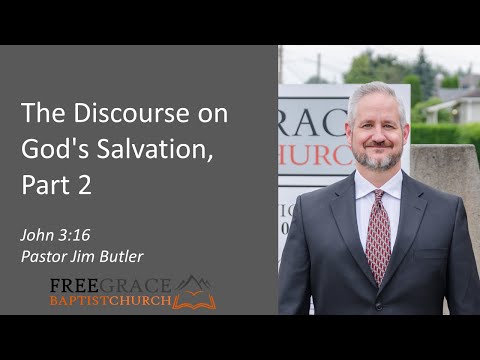
The Discourse on God's Salvation, Part 2
John 3:16 — Luther called it 'the Bible in miniature,' and this exposition treats it as precisely that: a compressed statement of the whole Christian gospel. The sermon moves through three divisions of the verse — the declaration of God's love, the demonstration of that love in the gift of the only begotten Son, and the description of those who receive God's redemptive love through faith. Central to the argument is the insistence that God's love is the source, not the consequence, of the atonement, and that 'the world' in John's vocabulary denotes persons from every tribe and tongue without ethnic distinction, not every individual without exception — a conclusion that grounds particular redemption in the wider theology of John's writings. The sermon closes with a direct appeal to unbelievers: the one way of salvation is to believe on Jesus Christ alone, whose active obedience supplies the righteousness that sinners need and whose substitutionary death removes the condemnation they deserve.

Exodus 15 - Song of Moses
Exodus 15 records the Song of Moses, a celebration of divine redemption and righteous judgment sung by Israel after the destruction of Pharaoh's army in the Red Sea. The sermon expounds the threefold structure of the song — the triumph of the Lord, the defeat of the Egyptians, and the majesty and incomparability of God — before tracing its prophetic reach into the nations' fear of Yahweh and the ultimate goal of covenant dwelling. The bitter waters of Marah complete the chapter, exposing Israel's reflexive grumbling as a failure to trust the God who had already done the greater work of redemption. Hearers are called to praise God for both his saving mercy and his just judgment, and to pass that doxological heritage to the next generation.

Chapter 2, Para. 3 - The Holy Spirit
The Holy Spirit as the third subsistence of the one divine essence is the subject of this study in Chapter 2, Paragraph 3 of the 1689 London Baptist Confession of Faith. The session traces the Spirit's presence and deity through both Testaments, works through the meaning of eternal procession from the Father and the Son (the filioque), and engages the historical debates at the councils of Nicaea, Constantinople, and Toledo that shaped confessional Trinitarian language. The practical conclusion drawn from the Confession is that the doctrine of the Trinity is not abstract speculation but the foundation of all communion with God and the believer's comfortable dependence upon Him.

The Discourse on God's Salvation, Part 1
Jesus answers Nicodemus's question — 'How can these things be?' — by pointing to three realities: his own incarnation as the one who descended from heaven, the Old Testament typology of the bronze serpent in Numbers 21, and the necessity of his crucifixion as the antitype to whom sinners must look in faith. The sermon works through John 3:11–15, examining Christ's authority to speak of heavenly things, the doctrine of the hypostatic union and the communication of idioms, and the parallel between Israel's look-and-live prescription in the wilderness and saving faith in the crucified Son of Man. The application is direct: the antidote to sin is not moral reformation but faith in the lifted-up Christ, who alone secures justification and eternal life for believing sinners.

A Practical Example for the Suffering Christian
Psalm 61 presents David at the edge of the wilderness — heart overwhelmed, throne usurped, kingdom collapsing — as a concrete example of what it looks like for a suffering believer to cry out to God, refocus on covenant faithfulness, and be brought from despair to joyful praise. The sermon traces three movements in the psalm: the cry for help from the brink of despair (vv. 1–2), the deliberate refocusing on God's past faithfulness, the Davidic covenant, and the eternal inheritance of the Messiah's kingdom (vv. 3–7), and the resulting resolve of praise (v. 8). David's process is not mystical — it is conscious, disciplined engagement with the means of grace: prayer, meditation on covenant promises, and fixing the mind on the eternal kingship of Christ. Suffering Christians are exhorted to follow that same pattern rather than abandoning the means of grace at the very moment they are most needed.

Exodus 14
Exodus 14 records the crossing of the Red Sea — a chapter whose driving theme is not merely Israel's deliverance but God's self-glorification over Pharaoh and his army. The exposition works through two main movements: the plan of God (vv. 1–14), in which God sovereignly directs Israel's route and hardens Pharaoh's heart so that He may gain honor, and the power of God (vv. 15–31), in which divine promise, protection, and action result in the salvation of Israel and the destruction of Egypt. Israel's fear and complaint throughout the chapter expose a chronic lack of faith, while Moses' brief but confident exhortation — 'Do not be afraid; stand still and see the salvation of the Lord' — models the response that faith in God's promises produces.

The Crucifixion of Jesus, Part 3
Matthew 27:45–46 records the fourth of Christ's seven words from the cross — the cry of dereliction, 'My God, my God, why have you forsaken me?' — and its interpretation demands both exegetical precision and doctrinal care. The darkness from the sixth to the ninth hour was not a solar eclipse but a supernatural sign of divine judgment, recapitulating the ninth plague pattern and marking the moment the Passover antitype was slain. The cry itself does not imply any ontological division within the Trinity, any dissolution of the hypostatic union, or the suffering of all three persons; rather, it expresses the withdrawal of divine consolation from the Son according to his true humanity as he bore, in our place as surety, the full weight of penal wrath. Believers are called to ground their assurance not in felt divine presence but in the covenant faithfulness of the God to whom Christ still cried 'my God' even in the depth of his substitutionary suffering.

The Meeting with Nicodemus, Part 2
John 3:4–10 confronts every hearer with the absolute necessity of regeneration before any entrance into the kingdom of God. Working through Nicodemus's proud misunderstanding and Christ's patient explanation, this exposition argues that the new birth is entirely God's sovereign work — initiated by the Holy Spirit, prefigured in Ezekiel 36 and Deuteronomy 30, and entirely prior to saving faith. The sermon also draws out the Trinitarian theology embedded in Christ's wind analogy, showing that the Spirit's sovereign, effectual work in regeneration reveals who God is, not merely what He does.
Exodus 13 - The consecration of the firstborn
Exodus 13 grounds the consecration of Israel's firstborn in the redemptive logic of the tenth plague: because God spared Israel's firstborn while striking Egypt's, Israel's firstborn belong to him — to be set apart, sacrificed if clean, or redeemed if human or unclean. The chapter's twin emphases on perpetual remembrance through the Feast of Unleavened Bread and the catechetical instruction of children press the same truth across generations: God's people are defined by what God has done for them, not by their own merit or strength. The typological weight of substitutionary redemption — one life in the place of another — finds its terminus in the Lamb of God who takes away the sin of the world, making these ordinances intelligible only in light of Christ. Practically, the sermon calls the congregation to remember the mighty works of God, to sacrifice freely in gratitude for redemption received, and to pass this theological inheritance faithfully to the next generation.

Sunday School - Chapter 2.3 - the Trinity
The doctrine of the Trinity is not a mathematical formula but a carefully defined confession of one divine being eternally subsisting as three distinct persons — Father, Son, and Holy Spirit. This session works through 1689 London Baptist Confession of Faith chapter 2, paragraph 3, examining the unity and equality of the persons, their distinction by eternal relations of origin, and the contemporary crisis caused by the abandonment of eternal generation. The denial of threeness is as heretical as the denial of oneness, and a recovery of Nicene Trinitarianism is essential not only for theological orthodoxy but for the health of the soul and the vitality of corporate worship.
The Meeting with Nicodemus
John 3:1–10 presents Jesus confronting Nicodemus — a ruler of the Sanhedrin sent by the Jerusalem religious leadership — with the doctrine of regeneration: that a man must be born again, born from above, before he can see or enter the kingdom of God. The sermon argues that the new birth is entirely a sovereign act of God Most High, not a command for the sinner to obey by his own power, and that regeneration logically precedes and produces saving faith rather than following it. Those born of God will evidence that new life through faith in Christ, a practice of righteousness, love for the brethren, and an overcoming of the world.