
Topic
Biblical Theology
1,075 sermons · All topics

The Crucifixion of Christ

How did it come to pass that the only holy, harmless, and undefiled man who ever lived was led out to be crucified between two criminals? John 19:16–24 answers on two levels: on the surface, the wickedness of men — Pilate's cowardice, the Sanhedrin's envy, the multitudes' manipulation — and beneath it, the sovereign, predetermined purpose of God who sent His Son to be the Lamb of God, the substitute for sinners. The sermon traces the location at Golgotha as the fulfillment of Genesis 3:15, the charge written by Pilate as an unwitting confession of Christ's kingship, and the conversion of the dying thief as the paradigm case of saving faith — seeing nothing but a bloodied, dying man on a cross and confessing Him as Lord of a kingdom.

The Christian Sabbath: Understanding Its Meaning Today
Hebrews 4:9 declares that a Sabbath rest remains for the people of God, and this sermon argues that the weekly Christian Sabbath retains its typological force in the new covenant because the consummmate eschatological rest it points toward has not yet arrived. Drawing on G.K. Beale and A.W. Pink, the exposition presses the logic that a sign pointing forward to a reality still future cannot have ceased to function. The hearer is called to receive Lord's Day worship as the market day of the soul and a forward-pointing sign of the eternal rest to come.
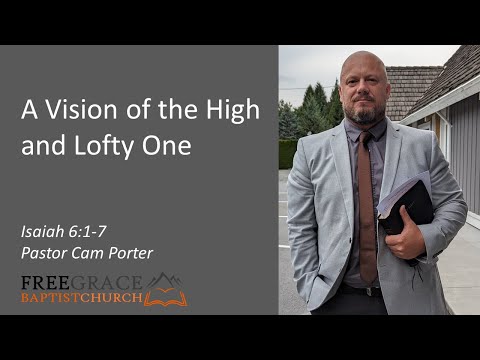
A Vision of the High and Lofty One

Isaiah 6:1–7 presents the prophet's visionary encounter with the enthroned Lord — holy, holy, holy — and his subsequent cleansing by a coal from the altar. This sermon works through five movements in the passage: the introductory contrast between dying earthly kings and the eternal High King of Heaven; the exemplary posture of the seraphim before the divine majesty; the superlative holiness, glorious titles, and unbounded presence of the Lord of hosts; Isaiah's fitting confession of his own uncleanness; and the gracious divine initiative in purification, which anticipates the definite atoning work of Christ. The congregation is called to approach the living God with the humility of Isaiah and the seraphim, confident that the same sovereign who commissioned his prophet will fill the whole earth with his glory through the proclamation of the gospel.

Positive Law vs. Moral Law: Understanding The Sabbath
The fourth commandment contains both a moral element and a positive-law element. The moral element — that one day in seven is owed to God in worship — is binding on all creatures by nature. The positive element — which specific day — is determined by the covenant one stands in: Saturday under the old covenant, Sunday under the new, the latter established by Christ's resurrection on the first day of the week. This distinction answers why the church's day of worship changed without abandoning the creational obligation to Sabbath rest.

The Bronze Serpent
Numbers 21:1–9 records Israel's sin of grumbling in the wilderness, God's judgment through fiery serpents, and the divinely prescribed remedy: look at the bronze serpent lifted on a pole and live. The sermon traces this narrative in two movements — the defeat of the Canaanites in verses 1–3, where Israel prays and trusts God, contrasted with the failure of verses 4–9, where they grumble despite God's provision. The bronze serpent functions as a type of Christ, as Jesus himself declares in John 3:14, and the sermon presses the application that justification is by faith alone — not by prior works, not by self-examination of the wound, but by looking to the one lifted up. Weak faith does not disqualify the sinner; even a feeble look at the appointed remedy brings the sinner into peace with God.
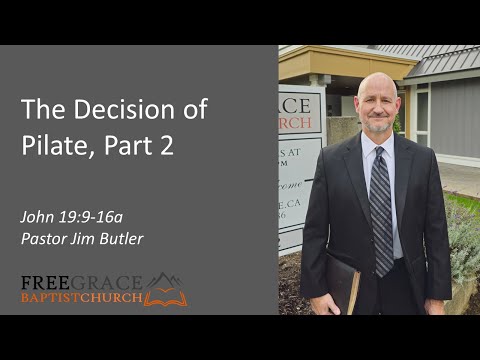
The Decision of Pilate, Part 2
John 19:9–16 records the exchange between Jesus and Pontius Pilate that culminates in the verdict of crucifixion. This sermon works through Pilate's confusion and arrogant assertion of authority, Christ's counter-declaration that all governing power derives from God Most High, and the theological weight of the greater sin belonging to those who delivered Christ up. The death of the Lamb of God at the hour of Passover preparation is no accident — it is the predetermined plan of the Father, the fulfillment of every Passover sacrifice, and the ground of forgiveness for wretched sinners who look to Christ in faith.

The Three Parables in Luke 15: Why God Repeats His Message of Love
Why does Scripture record three parables about lostness in a single chapter? Drawing on Luke 15, this exposition argues that divine repetition is not redundancy but pastoral mercy — God driving home the same nail of love and grace until it holds. The sermon calls both the familiar and the first-time hearer to lower their defences and receive afresh the truth that God knows every individual, whether near or far, and actively seeks the lost.
Redemption, Restoration, and Righteousness
Isaiah 61 presents the anointed Messiah declaring his own mission of redemption, restoration, and righteousness for his people. The sermon works through all eleven verses, arguing that Christ alone — anointed by the Spirit without measure as prophet, priest, and king — fulfils the role foreshadowed by every Old Covenant anointing and reverses the covenantal curses of Deuteronomy 28. His saving work springs up the church, the true Zion, from the ruins of Old Covenant desolation, and clothes her not in her own merit but in the imputed righteousness of the Mediator. The sermon closes with the church's response of rejoicing and a call to the unbeliever to believe on Christ and receive everlasting life.

The Scourging and Mockery of Jesus
What was Pilate attempting when he ordered Jesus scourged and permitted the soldiers' mock enthronement? This exposition of John 19:1–4 argues that Pilate's scourging of Jesus was a failed act of crowd appeasement by a governor who knew he was condemning an innocent man, while the soldiers' mockery staged a deliberate parody of royal investiture against one they took for a pretender to Jewish kingship. The sermon draws Isaiah 50 and 53 and Psalm 109 into the foreground to show that these sufferings were neither accidental nor outside the decree of God — the Father delivered up the Son, the Servant of Yahweh gave his back to those who struck him, and the imprecatory prayer of Psalm 109 illuminates the inner life of Christ before his accusers. The application presses the congregation to feel the weight of substitutionary suffering, to resist a superficial Christianity untouched by the cost of redemption, and to confess Christ's lordship now rather than in the judgment.

The Trial Before Pilate, Part 3
John 18:39–40 records Pilate's offer to release Jesus under the Passover custom, and the crowd's choice of Barabbas instead — a transaction that serves as an emblem of substitutionary atonement: the just taking the place of the unjust, the holy bearing what the unholy deserves. Drawing on Matthew 27:15–26 to amplify the scene, the sermon traces the envy of the religious leaders, the warning of Pilate's wife, the manipulation of the multitudes, Pilate's cowardly self-absolution, and the crowd's terrible cry of blood-guilt. The central application is that the believer stands before God not on the ground of personal righteousness but solely on account of Christ's vicarious obedience and death — the glorious exchange in which our sin is laid on him and his righteousness is credited to us.

The Fourth Commandment Part 1
The abiding validity of the Fourth Commandment is defended through a biblical theology of the Sabbath that traces the institution from creation through the old covenant. The sermon argues that Sabbath rest is grounded not in the Mosaic economy alone but in the creation ordinance of Genesis 2 and the redemption of Exodus, making it binding upon all humanity — not Jews only — as Christ himself teaches in Mark 2:27. The positive and moral character of the commandment is distinguished from its ceremonial and positive elements, with the day change to the Lord's Day deferred to the following session. Hearers are called to receive the Sabbath as the gift it is declared to be in Isaiah 58, not as a Judaizing imposition.

The Trial Before Pilate, Part 2
Standing before Pontius Pilate, Jesus affirms His kingship while making clear that His kingdom does not originate from this world and poses no military threat to Rome — it advances solely through the proclamation of truth. The sermon works through John 18:33–40 under two heads: Pilate's examination of Jesus (vv. 33–38) and Pilate's cowardly compromise (vv. 39–40), drawing in the parallel account in Luke 23 to trace Jesus' transfer to Herod and back. Pilate's threefold declaration of innocence, Herod's contemptuous mockery, and the crowd's demand for Barabbas together underscore the great exchange: the just for the unjust, the holy Lamb standing in the place of guilty, vile, helpless sinners.

The Victory of David Over Goliath
David's defeat of Goliath in 1 Samuel 17 is not a moralistic lesson in overcoming personal giants, but a theological declaration that the living and true God vindicates His covenant people against those who defy Him. The narrative turns on two explicit lessons David announces in verses 46–47: that all the earth will know there is a God in Israel, and that Israel will learn the Lord does not save by sword and spear. David functions typologically as the singular seed of the woman, his headshot of Goliath advancing the Genesis 3:15 promise toward its fulfillment at Golgotha, where Christ crushed the serpent's head through His death and resurrection. The sermon calls believers to the same confidence David displayed — trusting the living God rather than human strength, because the same God who delivered David has promised to build His church and defend His people.

2LCF Chapter 4, Of Creation
2LCF Chapter 4 expounds the doctrine of creation across three paragraphs, addressing what creation is, the triune God who creates, the nature and dignity of man as image-bearer, and the covenantal framework that gives creation its redemptive telos. The sermon argues that creation ex nihilo (qualified as God bringing forth all that is not God) and creation ex materia are distinct but complementary categories, and that divine immutability is preserved because no change or new perfection accrues to God through the act of creating. Ultimately, creation serves as the theatre within which God executes His eternal decree of redemption, bringing a multitude of elect sinners to glory through the perfect work of Jesus Christ.

The Trial Before Pilate, Part 1
John 18:28–32 records the delivery of Jesus to Pontius Pilate, an event framed by both human wickedness and divine sovereignty. The sermon surveys the prior trial before the Sanhedrin in Matthew 26, exposing the false charges, the deliberate misquotation of Jesus's words about the temple, and the formal charge of blasphemy — then turns to John's account of the hypocrisy, lawlessness, and impotence of the Jewish authorities before Pilate. Against that backdrop of gross injustice, verse 32 grounds the entire episode in divine decree: the very words Jesus had spoken concerning his death were being fulfilled, and the wrath of men was being overruled by the providence of God for the salvation of the elect. The chief application is adoration — the redeemed sinner is called to see how far the Savior went to secure redemption, and the unbeliever is called to come to the one who will not cast out any who come to him in faith.

The Trial Before the Jews
John 18:13–27 presents the trial of Jesus before the Jewish authorities alongside Simon Peter's three denials, and John's deliberate interweaving of the two scenes forces the reader to measure Peter's cowardice against his Master's composed, unflinching faithfulness. Jesus, the true high priest, stands before the illegitimate proceedings of Annas and Caiaphas — proceedings marked by false witnesses, unprovoked violence, and a verdict predetermined by envy — and yet he defends his disciples, demands lawful evidence, and maintains his identity without wavering. Peter, by contrast, cannot acknowledge his Lord to a servant girl, illustrating the fickleness that characterises even redeemed sinners. The sermon closes by calling believers to remember both the rooster's rebuke of unfaithfulness and the grace of a Saviour who restores the very disciples who forsook him.
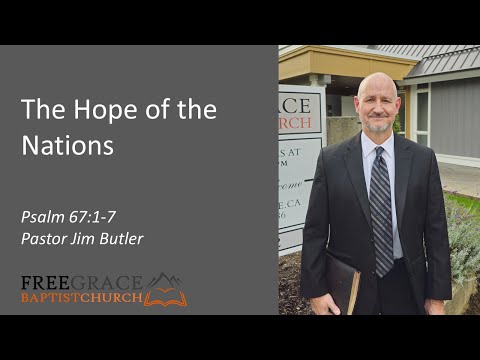
The Hope of the Nations
Psalm 67 is a missionary psalm in which the psalmist first petitions God on behalf of the church — for mercy, blessing, and the communion of God's presence — and then turns those blessings outward, praying that the nations would be saved, become worshipers of the true God, and come under His righteous rule. The Aaronic blessing of Numbers 6 stands behind verse 1, and the 'that' of verse 2 reveals the logic of all divine blessing: the church is enriched by God in order to become a conduit of His saving way to the ends of the earth. The sermon closes by calling the congregation to pray with the confident expectation of verses 6 and 7 — that God shall bless His people and all the ends of the earth shall fear Him — tying the psalm's vision directly to Christ's Great Commission.

The Arrest of Jesus
John 18:1–12 presents the arrest of Jesus not as a defeat but as a sovereign, voluntary act of the divine-human Mediator. The passage is expounded under three headings: the betrayal of Jesus by Judas and his coalition of enemies, the glory of Jesus manifested in his command of the situation and his 'I am' declaration that felled the arresting party to the ground, and the arrest proper in which Jesus rebukes Peter's sword and embraces the cup of the Father's wrath. The sermon closes by tracing three layers of antitypical significance — the greater-David typology of 2 Samuel 15, the binding of Isaac in Genesis 22, and the garden of Eden in Genesis 1–3 — to show that the arrest of Christ is the hinge on which God's eternal purpose to save his people from their sins turns.

The Preface to the Ten Commandments
Deuteronomy 5:1–6 opens the Ten Commandments not with a command but with a declaration of divine redemption — 'I am the Lord your God, who brought you out of the land of Egypt, out of the house of bondage.' This study works through the summons to covenant obedience, the grace-grounded preface to the Decalogue, and the uniqueness of the moral law as trans-covenantal and abiding. The threefold division of the law — moral, ceremonial, and judicial — is examined through the confession, the prophets, the Gospels, and the epistles, equipping believers to distinguish what abides in the new covenant from what was fulfilled and abrogated in Christ.

CTF 2025 - Session 4 – The Depth of God’s Eternal and Incomprehensible Nature

What does it mean for God to be eternal, and can finite creatures truly know an incomprehensible God? This conference session works through the classical doctrine of divine eternity — arguing from divine simplicity, immutability, and infinity that God's eternity is not endless temporal succession but the timeless, simultaneous, and perfect possession of boundless life — before turning to divine incomprehensibility, which is not a confession of ignorance but the recognition that the knowledge God has revealed of himself in nature and Scripture far surpasses the creature's capacity to measure or contain it. The session draws on Boethius, Augustine, Turretin, Charnock, Owen, and Bavinck to show that the two doctrines are inseparable, and closes with Solomon's prayer in 1 Kings 8 as a doxological meditation: if heaven itself cannot contain God, no created mind can comprehend him, and that inexhaustibility is the very ground of endless worship.

Live Stream - April 20, 2025
Romans 4:25 presents the death and resurrection of Christ not merely as historical events but as the twin pillars of justification by faith alone: Christ was delivered up because of our offenses and raised because of our justification. The sermon traces the specific character of those offenses — the lawlessness Paul catalogues in Romans 1–3 — before arguing that the resurrection serves four distinct functions in establishing justification: it declares Christ to be the Son of God with power, testifies that his sacrifice was accepted by the Father, confirms that divine justice was fully satisfied, and announces that redemption was accomplished. The congregation is urged never to separate the passion from the resurrection, never to reduce Christianity to the moral effect of a story, and to rest the whole of their justification on the finished work of Christ alone.

The Gospel's Indispensable Glory
What is the gospel? Paul's answer in 1 Corinthians 15:1–4 is not what we do or feel, but the objective, once-for-all work of the Lord Jesus Christ: his death for sins, his burial, and his bodily resurrection on the third day according to the Scriptures. This sermon works through two categories — the necessity of the gospel and its essential content — showing that the gospel is both the lifeblood of Christian existence and the only ground of justification and resurrection hope. The sermon closes with a direct summons: for the Christian, the risen Christ is blessed Savior and interceding High Priest; for the unbeliever, he is the coming Judge.

Wilderness wanderings
Deuteronomy 2–3 records Moses rehearsing the wilderness wanderings for the second generation of Israel, poised on the plains of Moab before the conquest of Canaan. God's multinational sovereignty is on display as He assigns territorial boundaries to Edom, Moab, and Ammon, then delivers Sihon and Og into Israel's hands — demonstrating that the God of Israel governs all nations, not merely His covenant people. The historical review functions both as a warning against repeating the unbelief of the first generation and as an encouragement to trust the same God who preserved Israel through forty years of wilderness trudging. New Covenant believers are called to the same posture: to dwell on the record of God's faithfulness in redemptive history so as to remain steadfast through present trials.

Ask FGBC #41: Why Does The Devil Hate Women So Much?
The question of why women have historically suffered disproportionate oppression and violence is examined through a biblical theological lens. Two theological threads are drawn out: Satan's covenantal enmity against the woman whose seed would crush him (Genesis 3:15), and the doctrine of total depravity, which explains how sinful men exploit the physically weaker vessel Peter describes in 1 Peter 3. The discussion concludes that the abuse of women is a symptom of human rebellion against God's creational order of male headship and protection.
Deuteronomy 1
Deuteronomy 1 opens Moses' first address to the second generation of Israel on the plains of Moab, a historical review designed to prepare the people for the conquest of the promised land. Moses rehearses four episodes: God's command to advance from Horeb, the appointment of judges, the rebellion at Kadesh Barnea rooted in unbelief, and the punishment that fell on the first generation. The central diagnostic is verse 32 — 'you did not believe the Lord your God' — which exposes unbelief as the taproot of Israel's grumbling, refusal, and covenant faithlessness. The sermon calls the New Covenant congregation to dwell on this history so as to be steadfast in the future, trusting the same God whose promises are yes and amen in Christ.

The High Priestly Prayer, Part 7
John 17:20 records Christ's intercession extending beyond the apostles to all who would believe through their word — a prayer that excludes the world and encompasses the elect of every age. The verse yields five doctrinal implications: justification is by faith alone; the apostolic word is the ordained instrument of that faith; Christ assumes gospel advance and missions; sovereign election and predestination undergird the certainty that there will be believers; and the world possesses a solidarity in enmity against God that mirrors, and indicts, the disunity too common among God's people. Practically, the sermon calls the church to gospel-centred ministry, qualified and instructional preaching, the earnest pursuit of unity, and calls the unconverted to believe on the Lord Jesus Christ without delay.

Introduction to Deuteronomy
Deuteronomy is introduced as the second giving of the law — not a new law, but a restatement of the Sinai covenant addressed to the second generation of Israel standing on the plains of Moab, poised to enter the land of promise. The session surveys Mosaic authorship, the book's place in the Pentateuch, its historical context, its broad outline (God's activity, law, covenant, and servants), and its major theological emphases: reminder, transition, exhortation, and instruction in theology proper, the promise of land, and the worship of God. The study concludes with the typological significance of Deuteronomy for the New Testament, tracing how the book prefigures Christ as prophet, priest, king, and true Israel, and how its promise of new covenant in chapter 30 points forward to what Jeremiah 31 and the gospel make explicit.

The High Priestly Prayer, Part 6
John 17:17–19 records Christ's priestly petition that the Father sanctify the apostles by the truth — consecrating them, as the Old Testament priests were consecrated, for the specific mission of preaching and writing to which He was sending them. The instrument of that sanctification is the truth: the incarnate Word who is truth, the Spirit of truth, and the written Word breathed out by that Spirit. Christ's own sanctification in verse 19 is not a prayer for personal holiness but His self-consecration as the high priest who offers Himself as sacrifice, and that priestly self-offering is the very foundation on which the apostles — and all believers — are set apart. The practical summons is plain: growth in grace and conformity to Christ come through the ordinary means of God's truth, not through experience, emotion, or entertainment, and the church's fidelity to that pattern depends on elders who are devoted to teaching it.

The Example of the Savior, Part 2
Philippians 2:7 sets forth Christ's incarnation as the supreme argument against selfish ambition and conceit. This expository sermon works through four statements in the verse — Christ made himself of no reputation, took the form of a bondservant, came in the likeness of men, and was found in appearance as a man — with careful attention to the kenotic controversy, the hypostatic union, and the patristic formulations at Nicaea and Chalcedon. The heresy of kenotic Christology (that Christ emptied himself of his divine attributes) is refuted from 2 Corinthians 8:9, John 1:14, and Hebrews 2, while docetism is equally rejected in favor of Christ's true and complete humanity. The doctrinal weight is carried in service of Paul's pastoral concern: the one who was in the form of God and equal with God voluntarily humbled himself, and that reality demolishes every claim to selfish priority among his people.

The Regulations for Life in Canaan
Numbers 32–36 closes the book with regulations governing Israel's entry into Canaan: the Transjordanian tribal allotments, the itinerary of the wilderness journey, the boundaries of the land, Levitical cities, cities of refuge, and the inheritance rights of female heirs. The legislation on cities of refuge anchors a sustained exposition of the distinction between murder and manslaughter, grounded in the Noahic covenant of Genesis 9:6, and carries forward the biblical case for capital punishment as a perpetual civil obligation. The study closes by tracing Christ through Numbers — as the guiding presence, the compassionate shepherd, the greater Joshua, the great high priest, and the brazen serpent lifted up for the life of the world — and applies the wilderness pattern to the new covenant people who must persevere through present affliction toward an eternal Canaan.