
Theological term
Typology
392 sermons · All terms

The Sanctuary and Ark of the Testimony

Exodus 25:1–22 opens the third major division of Exodus — the dwelling of God among his redeemed people — which the sermon argues is the climax of the entire book. Working through the offerings for the tabernacle, the purpose of the sanctuary, and the construction and function of the ark, the exposition traces how God's intent to dwell with Israel typologically anticipates the new covenant reality secured by Christ, the great high priest and true mercy seat. The regulative principle of worship is grounded exegetically in God's precise prescriptions for the tabernacle and applied to New Covenant church practice. Hearers are called to count corporate worship a privilege and to approach God only in the manner he has commanded in Holy Scripture.

The Champion of the Howling Wilderness

Matthew 4:1–11 presents the temptation of Christ not primarily as a model for personal resistance to sin, but as the decisive act of single combat in which the Lord Jesus Christ, as the second Adam and the true Israel, vicariously perfects obedience for his elect people. Where Adam fell in the garden amid every provision and where Israel failed in the wilderness under divine care, the Son of God enters a howling wilderness—hungry, alone, and unarmed—and vanquishes the devil point for point through resolute dependence on the word of God. The rich typological connections to Adam's expulsion, Israel's forty years of wandering, Moses' fast on Sinai, and David's unarmed single combat against Goliath converge on the one claim the passage presses: Christ alone is the covenantally faithful champion, and salvation belongs exclusively to those who trust in his doing, dying, and rising. Christians are therefore called to rejoice in their champion rather than to reduce this episode to a moral technique for fighting temptation.

The Promise of God's Provision
Genesis 22:1–19 presents the binding of Isaac as far more than a biographical account of Abraham's obedience — it is a typological promise of God's provision of the Messiah. The sermon works through the test presented to Abraham, his obedience in the three-day journey to Moriah, and God's approval through the substitutionary ram, showing how Abraham, Isaac, and the ram each function as types of the Father, the Son, and the Lamb of God respectively. Abraham's declaration in verse 8 — 'God will provide for himself the lamb for a burnt offering' — is read as genuine messianic anticipation, confirmed by Christ's own words in John 8:56. The passage calls believers to the kind of covenant-anchored faith that perseveres under affliction, catechizes their children in the great truths of God, and rests on the substitutionary atonement accomplished at Calvary.

The Promise of God's Son
The Davidic covenant of 2 Samuel 7 stands at the center of redemptive history, advancing the promise of the seed from Genesis 3:15 through Abraham to David and ultimately to the Lord Jesus Christ. The word 'house' in the passage carries triple meaning — David's palace, the dynasty God promises to establish, and the temple God will build through David's line — and each meaning finds its terminus in Christ, who reigns on David's throne forever and builds a spiritual temple from living stones. God's covenantal fidelity is the sole reason the Davidic dynasty survived the persistent sin of its kings, and that same fidelity secures the church today as citizens of Christ's everlasting kingdom. The sermon calls believers to come to the public worship of God on the Lord's Day with the joyful expectation of those who know they live in the age of fulfillment.

The Ratification of the Covenant, Part I
Exodus 24:1–8 records the formal ratification of the old covenant at Sinai, and this expository study examines three elements the text presents: God's instructions structuring nearness and distance on the mountain, Moses' compliance in writing the covenant words and erecting the altar and twelve pillars, and the blood-sprinkling ceremony that sealed the covenant between Yahweh and Israel. The sermon argues that the old covenant, far from being a mere administration of the covenant of grace, is a republication of the covenant of works — a position the 1689 LBCF reflects in distinction from the Westminster Confession. The blood of the ratification ceremony finds its antitype in the blood of Christ, whose once-for-all sacrifice inaugurates the new covenant in which believers stand accepted not by their own obedience but by that of their covenant head.

The Martyrdom of Stephen
The martyrdom of Stephen in Acts 7:54–60 displays the triune God sustaining, comforting, and ultimately receiving His servant in the moment of violent death. The sermon works through three movements: the blessedness of Stephen as he receives a vision of the glorified Christ standing at the right hand of the Father; the murderous rage of the Sanhedrin who stone him outside the city in lawless contempt of Roman authority; and Stephen's dying words — echoing the Savior's own cross-utterances — as he commends his spirit to Christ and intercedes for his killers. The conversion of Saul of Tarsus is set before the congregation as the answer to that dying prayer, a monument to sovereign grace, and the entire passage is pressed home with the comfort of Heidelberg Catechism Question 1: Christ alone is the believer's comfort in life and in death.

The Blessings of the Resurrected Christ
Luke 24:36–53 presents the resurrected Christ bestowing concrete blessings upon his disciples before his ascension: peace, bodily proof of his resurrection, exposition of the Old Testament Scriptures, enabling grace for comprehension, and the promise of the Spirit. The physical demonstration Christ offers refutes both ancient Docetism and its modern heirs — if Christ did not truly assume humanity, the unassumed is the unhealed, and salvation itself is a phantom. The sermon calls believers to rest their religious affections upon the crucified, risen, and ascended Christ as the sum and substance of all biblical revelation, finding in him both the ground of present comfort and the power for gospel proclamation.

The Perfection of Christ as the Prompting of His People
Hebrews 10:19–25 marks the great hinge of the epistle, where doctrinal exposition gives way to exhortation. The perfection of Christ's sacrifice and priesthood — the absolute sufficiency of His once-for-all offering and His unceasing high-priestly office — forms the irreplaceable ground upon which three congregational imperatives rest: draw near to God in full assurance of faith, hold fast the confession of hope without wavering, and consider one another in order to stir up love and good works. Christians are not called to seek experiential novelty or emotional stimulation, but to the settled, corporate, and simple obedience of gathered worship, resting entirely upon the finished work of the One who consecrated a new and living way through His own flesh.
The Feast of Tabernacles, Part 2
John 7:14–24 presents two confrontations: the Jews question Christ's authority, and Christ in turn questions the Jews' ethical integrity. The sermon works through three grounds of Christ's authority—his unity with the Father, the regenerate hearer's capacity to receive his word, and his mission to glorify the Father rather than himself—before turning to Christ's indictment of the Jews for plotting murder while professing fidelity to the Mosaic law. The exposition closes with Christ's appeal to righteous judgment over mere appearance, and the preacher applies the whole passage as a call to sinners to come and drink from the one who alone satisfies the soul's thirst.

The Problem of Israel's Apostasy
Israel's apostasy in Judges 2:7–3:6 follows a pattern rooted not in ignorance but in a failure to know the Lord experientially — a failure that produced syncretism, Baal worship, and divine chastisement. The sermon traces the root, description, and divine response to Israel's apostasy, showing that God's repeated raising up of judges was not provoked by Israel's repentance but by his own covenant faithfulness and mercy. Samson is presented as a type of Christ, each of the twelve judges pointing typologically to the Savior who would definitively deliver his people from their sins. The church is exhorted to keep herself unspotted from the world, resisting the toleration that leads by degrees to full apostasy.

The Feast of Tabernacles, Part 1
John 7:1–13 presents the Feast of Tabernacles as the backdrop for intensifying hostility toward Jesus, whose unbelieving half-brothers urge Him to seek public exposure — a suggestion rooted in a man-centered, politically distorted messianic expectation. Christ refuses to act on their counsel, insisting instead on the divine timetable that governs every movement of His redemptive mission. The passage confronts two errors simultaneously: the assumption that physical proximity to Jesus produces saving faith, and the temptation to shrink from confessing Christ under social pressure — both of which the text answers by pointing to sovereign grace and the covenant community as God's appointed means of steadying His people.
The Idolatry of Solomon
Solomon's idolatry in 1 Kings 11:1–13 exposes how a man richly blessed by God — with the law, direct divine appearances, a faithful father, and transcendent wisdom — can fall into the grossest sin when he fails to guard his heart. The sermon traces the problem, precedent, and practice of Solomon's idolatry before examining God's just and covenant-shaped response: judgment tempered by the unconditional Davidic covenant that finds its telos in the Lord Jesus Christ. The passage issues sober warnings against the assumption that age, experience, knowledge, or good pedigree secure ongoing faithfulness apart from vigilant dependence on the Holy Spirit.
2LCF Chapter 7 - Of God's Covenant

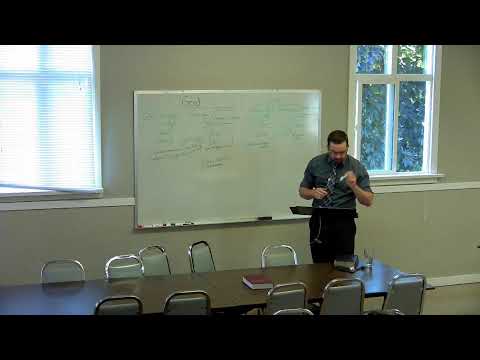
Covenant theology stands or falls on the careful distinction between the covenant of works, the covenant of grace, and the historical covenants that progressively reveal it. This lesson works through 2LCF Chapter 7, tracing the terms, parties, and rewards of each covenant from Adam through the Abrahamic and Mosaic administrations, and grounding the whole in the eternal covenant of redemption between the Father and the Son. The controlling argument is that the Abrahamic covenant — entered by natural generation, maintained by works, and breakable — cannot be identified with the covenant of grace, and that this distinction exposes the internal contradictions of paedobaptist covenant structures. The practical takeaway is that salvation has always been by grace through faith alone, because Christ as the second Adam is the only one who has met and can meet the terms of the covenant of works on behalf of the elect.

The New People of God, Part 1
What does it mean for the church to be built on Christ as a living cornerstone, and how does the Old Testament ground that identity? Expounding 1 Peter 2:6–8, this sermon traces the biblical-theological arc from Adam's failed dominion mandate in Genesis through Israel's typological history—law-giving, exile, and restoration—to the fulfilment of Isaiah's cornerstone prophecy in the Lord Jesus Christ. Israel's covenant history is shown to be a historical type of the cosmic reality: the broken covenant of works and its restoration by the Messiah, who is now building a global kingdom of redeemed image-bearers out of every tribe and tongue. Believers are called to marvel at God's sovereignty over history, over the kingdom of darkness, and over the unified message of Scripture that runs from Genesis 3:15 to the church as the true Israel of God.

Book introduction: The Mystery of Christ, His Covenant, and His Kingdom
Samuel Renihan introduces his book 'The Mystery of Christ, His Covenant, and His Kingdom,' explaining its origins in his seminary-era dissatisfaction with both pedobaptist and Baptist covenantal literature. He argues that historical particular Baptist covenant theology has been largely forgotten, and that modern Reformed Baptist literature has suffered from poor historical theology, excessive polemicism, and conclusions stated without premises. The book is structured by biblical theology rather than systematic theology, tracing three covenantal kingdoms — creation, Israel, and Christ — and contends that the concept of mystery in Paul is essential to a properly calibrated covenant theology that distinguishes the old covenants from the new covenant without collapsing the progressive development of divine revelation.
The Oppression of Israel by Pharaoh
Exodus 1 records the escalating oppression of Israel in Egypt — from the rise of an ignorant pharaoh, through forced labor, to an explicit policy of infanticide targeting Hebrew male infants. This exposition traces the passage in two movements: the connection between Exodus and the Abrahamic promises of Genesis, and the progressive stages of Pharaoh's tyranny, culminating in a national decree of genocide. The Hebrew midwives Shiphrah and Puah are held up as models of God-fearing civil disobedience, and the whole chapter is read typologically, anticipating the greater deliverance wrought through Moses and ultimately through the seed of Abraham, Jesus Christ. The congregation is called to imitate the courage of the faithful — to obey God rather than men in whatever sphere God has placed them.

The Feeding of the Five Thousand
John 6:1–15 presents the feeding of the five thousand as a sign — a theological event designed to reveal who Jesus is, not merely a remarkable act of provision. The miracle is set against the backdrop of the Passover and the Mosaic exodus, inviting comparison between the manna in the wilderness and Jesus as the living bread come down from heaven. The crowd's response — declaring him the prophet of Deuteronomy 18 and then attempting to seize him as a political king — exposes the persistent confusion between a physical, temporal messianic expectation and the spiritual, eternal salvation Christ actually came to accomplish. The sermon calls hearers to see in the bread and fish the One who supplies all things abundantly, who has both the compassion and the omnipotence to save every sinner who comes to him in faith.

The Rejection of the Son
John 5:41–47 records Christ's closing rebuke to the Jewish religious leaders who rejected Him despite the testimony of John the Baptist, His works, the Father, and the Scriptures. The sermon expounds two principal charges Jesus levels against His opponents: their refusal to receive the honor that comes from God alone, and their complete absence of love for God — demonstrated precisely by their rejection of the One the Father sent. Working through the accusation by Moses in verses 45–47, the exposition shows that to reject Christ is simultaneously to reject Moses, to reject the Father, and to worship an idol in place of the living God. The sermon closes with a call to receive Christ by faith, in whom alone eternal life is found.

The Refuge for God's People
Psalm 46 sets the people of God in the midst of cosmic and political chaos and calls them to find their sole refuge in the Lord of hosts. This exposition works through four movements in the psalm — the assurance of God's presence, the demonstration of his power over creation and the nations, the invitation to rehearse his past works in redemptive history, and the command to be still and know that he is God. The sermon argues that Reformed Christians who rightly confess God's sovereignty in salvation must equally rest in that sovereignty under tyranny, pandemic, and war. The chief application is that the church must know God — his perfections, his names, his covenant fidelity — because it is the knowledge of God, not practical principles, that steadies the soul and fuels missionary confidence in the darkest of times.

The Prophet's Faith in a Time of Distress
Habakkuk 3 presents the prophet's response to the announced Babylonian invasion of Judah: not despair, but a structured movement from fearful petition through deliberate theological remembrance to confident refuge in God. The sermon traces three movements in the psalm — petition, remembrance of God's acts in redemptive history, and refuge — arguing that a perplexed faith steadies itself not by self-reflection but by rehearsing who God is and what He has done. The doctrine of justification by faith (Habakkuk 2:4), appropriated in the New Testament, is shown here in its practical dimension: the just do not merely begin by faith but continue to live and persevere by it through every extremity. The congregation is called to imitate the prophet by building their own 'collage' of God's mighty works in Scripture, thereby finding rest, joy, and stability in God alone when earthly supports fail.

2LCF Chapter 8 - Of Christ the Mediator, Part 2
Christ the Mediator, as confessed in chapter 8 of the 1689 London Baptist Confession of Faith, is examined through Hebrews 10 and supporting Scripture, tracing the pre-temporal appointment of the Son in the covenant of redemption, his hypostatic union, his anointing for the mediatorial office, and the execution of his saving work. The confession's account of Christ's perfect obedience, sacrificial death, and resurrection is shown to satisfy divine justice, procure reconciliation, and secure an everlasting inheritance for all the Father has given him. Particular attention is given to the retrospective communication of Christ's redemptive benefit to elect saints under the old covenant, demonstrating that salvation has always been by grace through faith in Christ alone. The study exhorts believers to find stability, comfort, and assurance in a precise knowledge of who Christ is and what he has accomplished.
The 4th Commandment (Part 2)
The fourth commandment's demand for Sabbath observance does not dissolve at the close of the Old Covenant; it runs through redemptive history and finds its New Covenant expression in the Lord's Day. Working through Matthew 5, Matthew 12, and Hebrews 4, this sermon argues that Christ upheld the moral law in both doctrine and practice, that his resurrection on the first day of the week grounds the shift from Saturday to Sunday, and that Hebrews 4:9's use of 'sabbatismos' constitutes a positive, unequivocal New Testament Sabbath ordinance for the people of God. The moral principle — one day in seven set apart for worship — is trans-covenantal; only its ceremonial aspect, the specific day, is conditioned by the covenant one inhabits. Believers are called to approach the Lord's Day not as a burden but as a gift that functions as a weekly foretaste and down payment of the eternal rest secured by Christ's finished work.
Chapter 7 - Of God's Covenant
1689 London Baptist Confession chapter 7 traces the biblical and theological architecture of God's covenant: from the necessity of divine condescension (paragraph 1), through the gracious character of the covenant of grace (paragraph 2), to the three theological covenants — grace, redemption, and works — and their progressive historical unfolding (paragraph 3). The session contrasts covenant theology with dispensationalism and New Covenant theology as competing hermeneutical frameworks, argues that the Old (Mosaic) Covenant functioned as a republication of the covenant of works rather than an administration of the covenant of grace, and demonstrates from Genesis 3:15 through Jeremiah 31 and Matthew 26 that all historical covenants advance a single promise of redemption finally and fully disclosed in the new covenant inaugurated by Christ. The practical payoff is a robustly confessional case for believers-only baptism: the new covenant community is defined by inward regeneration, universal knowledge of the Lord, and definitive forgiveness — marks that exclude the external-and-internal covenant structure required to justify paedobaptism.
The Burial of Jesus
The burial of Jesus in Matthew 27:57–66 is examined across two movements: the burial proper (vv. 57–61) and the security measures taken at the tomb (vv. 62–66). Against both the swoon theory and ancient Jewish counter-testimony that the disciples stole the body, the sermon marshals the apologetic force of the sealed, guarded, newly-hewn tomb to demonstrate that the resurrection overcame every human precaution. The burial also carries weight in four theological categories: it confirms the reality of Christ's death, marks the final act of his humiliation as the last Adam, demonstrates his conquest of death, and strips the grave of its paralyzing power for all who belong to him.

The Preservation of the Kingdom
2 Kings 11 records the near-extinction and miraculous preservation of the Davidic royal line under the murderous usurpation of Athaliah — and its theological significance reaches from Genesis 3:15 to the throne of the ascended Christ. The chapter is read as a node in the unbroken typological-covenantal chain running from the proto-evangelium through the Davidic covenant, the incarnation, and the present reign of the Lord Jesus at the Father's right hand. The sermon argues that every assault on the messianic line, whether Athaliah's massacre, Herod's slaughter of the innocents, or the devil's wilderness temptation, is overruled by the sovereign providence of God, who protects his kingdom through unexpected instruments and will advance it until every enemy is made a footstool. The congregation is exhorted to draw courage from this narrative in the face of present opposition to Christ's church, resting in the certainty that the zeal of the Lord of hosts will perform his promise.

The Crucifixion of Jesus, Part 5
The death of Christ on the cross was not a bare historical event but a theologically charged act that immediately reshaped the covenant order between God and man. This sermon expounds Matthew 27:51–56, examining the three signs that followed the crucifixion — the torn temple veil, the earthquake and split rocks, and the resurrection of the saints — as divine testimony to the efficacy of Christ's atoning work and the inauguration of the New Covenant. The witnesses to that death, both the confessing Roman soldiers and the faithful women who had followed Jesus from Galilee, confirm that the one crucified is truly the Son of God. Believers are called to rest in Christ's completed atonement, which has opened access to the Holy of Holies for all who come through him, and to look forward to the bodily resurrection he has secured for his people.

The Meeting with the Samaritan Woman, Part 2
John 4:16–26 presents Jesus exposing a Samaritan woman's sin through the law in order to drive her to the living water of eternal life, then correcting the corrupted worship of Samaria and declaring the arrival of new covenant worship. The sermon argues that true worship of God is irreducibly Trinitarian: the Father is the object, the Son is the mediator and the truth through whom access is granted, and the Holy Spirit is the enabling power. Jesus' self-disclosure as the great I Am — the fulfillment of Exodus 3:14 and the prophetic expectation of Deuteronomy 18 — confirms that the Messiah the woman anticipated is the very one speaking to her. Hearers are called to receive the living water freely offered and to engage in the distinctly Trinitarian worship that Christ here commands.

The Crucifixion of Jesus, Part 4
What does it mean that Jesus cried out 'My God, my God, why have you forsaken me?' and then yielded up his spirit with a loud voice? This sermon on Matthew 27:47–50 reviews the cry of dereliction and then expounds the death of Jesus, arguing that Christ died not as a helpless victim but as the willing surety of the covenant of redemption, fulfilling the prophetic Scriptures to the last breath. The mockery of the bystanders — their misidentification of Elijah, their offer of sour wine — is set against the sovereign control of Christ, who lays down his life of himself. The sermon closes by drawing out three responses fitting the crucifixion: sober acknowledgment of human depravity, gratitude grounded in substitutionary atonement, and gospel proclamation that invites sinners to seek the altogether lovely Christ.

Exodus 17
Exodus 17 presents Israel's double failure at Rephidim: a murmuring complaint against Moses for lack of water, and then the subsequent victory over the Amalekites through Moses's upraised rod and Joshua's sword. The murmuring is exposed not merely as weakness but as theological insult — the question 'Is the Lord among us or not?' impugns the faithfulness of a God who has already split the sea, rained bread from heaven, and sworn to bring His people to the land of promise. The sermon draws out two counterbalancing lessons: the unrelenting faithfulness of God despite His people's unbelief, and the Reformed doctrine that divine sovereignty does not eliminate the use of means — Israel must both hold up the rod in dependence on God and swing the sword in disciplined obedience.

The Qualifications of Elders, Part 3
What qualifies a man for the office of elder extends far beyond his pulpit gifts — Paul's requirements in 1 Timothy 3:1–7 encompass his household, his maturity in the faith, and his standing before outsiders. This third installment in an expository series on elder qualifications examines three remaining criteria: the man's domestic faithfulness (ruling his wife and children well), his experience in the faith (not a novice), and his testimony among those outside the church. The sermon draws on Ephesians 5–6, Titus 1, Proverbs, and Spurgeon's 'Lectures to My Students' to show that these qualifications protect both the church and the man being considered for ministry.