
Theological term
Typology
392 sermons · All terms

CTF 2024 Session 2: Jesus Christ as the Scope of Scripture

What does the 1689 Second London Baptist Confession mean when it says 'the scope of the whole is to give all glory to God'? This lecture argues that Christ — specifically his incarnation, sufferings, and entrance into glory — is the scopus scripturae, the bullseye to which every part of Scripture aims. Drawing on the First Helvetic Confession, William Ames, John Owen, and Luke 24, the speaker demonstrates that Jesus himself read the entire Old Testament canon as pointing to his own sufferings and resurrection glory, and that the apostles after Pentecost interpreted Scripture in precisely the same way. The governing hermeneutical principle is that subsequent revelation often makes explicit what is implicit in antecedent revelation, so that Scripture is organically unified, self-interpreting, and consummated in the person and work of the Son of God.
The Covenantal Status of Israel in the Parable of the Vineyard

Matthew 21:33–46 presents the Parable of the Wicked Vinedressers as a compressed history of Old Covenant Israel — a nation privileged with God's presence, prophets, and promises, yet persistently covenant-breaking and finally guilty of rejecting the Messiah himself. The parable is read against Isaiah 5 and fulfilled in the AD 70 destruction of Jerusalem, which is the covenantal judgment pronounced in verse 43: the kingdom of God is taken from ethnic Israel and given to the church, the true Israel of God. The New Covenant people — constituted by faith in Christ, not ethnic descent — are that nation bearing fruit, identified as such in 1 Peter 2 and Galatians 6:16. The sermon argues that any future geopolitical restoration of Old Covenant Israel with a rebuilt temple and renewed sacrificial system would be a reversal of redemptive history, and that ethnic Jews today stand in need of the gospel like every other nation.

The Promise of Blessings and Cursing, Part 2
Leviticus 26:14–46 sets forth the covenant curses God threatened against Israel for breaking the Mosaic Covenant — a covenant of works — escalating through drought, wild animals, war, cannibalism, wholesale destruction, and exile. These curses came to historical fulfillment in the fall of the Northern Kingdom to Assyria in 722 BC, the fall of the Southern Kingdom to Babylon in 586 BC, and the destruction of Jerusalem by Rome in AD 70 — events prophesied in the Olivet Discourse and confirmed by Paul in 1 Thessalonians 2. The chapter closes with a promise of restoration conditioned on Israel's humble repentance and God's fidelity to the Abrahamic covenant. Believers under the New Covenant are freed from these covenant curses because Christ bore them fully, fulfilling the demands of the law and standing as the surety of a better covenant.

The Year of Jubilee
Leviticus 25 sets forth the sabbatical year and the Year of Jubilee as divine legislation governing the rhythms of rest, property redemption, and the release of indentured servants within Old Covenant Israel. The laws are grounded in the theological principle that the land belongs to God, who allotted it as gift to his people and therefore retains final authority over how it is held and transferred. The chapter points typologically beyond itself: the Jubilee's proclamation of liberty, initiated on the Day of Atonement, finds its antitype in Christ, who fulfills Isaiah 61 by proclaiming the acceptable year of the Lord through his atoning work. The practical summons of the passage is to express the fear of God in concrete generosity toward covenant members who fall into poverty, resisting every form of oppression.

Live Stream - January 14, 2024
Exodus 12 sets forth the institution of the Passover as a type pointing forward to the atoning work of Christ, the true Lamb of God. The sermon works through the preparation for the Passover (vv. 1–11) and its twofold significance in judgment and mercy (vv. 12–13), before drawing out the antitypical fulfillment: the identification, nature, appropriation, and particular benefits of Christ's sacrifice. A closing illustration from D. A. Carson presses the pastoral application that the ground of the believer's assurance before God is not the strength or quality of faith but the blood of the Lamb alone.

The Penalty for Blasphemy
Leviticus 24 addresses both the daily obligations of tabernacle worship and the capital penalty for blasphemy, grounding each in the direct speech of God to Moses. The chapter's narrative pivot — an incident in which a man of mixed Israelite and Egyptian descent blasphemes the name of Yahweh — becomes the occasion for case-law application of the third commandment, surrounded by reminders of the lex talionis and the equal accountability of stranger and native-born alike. The typological furniture of the holy place (lampstand and showbread) points forward to Christ as the true light and bread of life, while the blasphemy legislation, with its witness requirements and retributive principle, reveals a God who guards his own honour and structures justice with both severity and safeguard. The sermon exhorts hearers to put away every profane use of the divine name and to cultivate a reverent, wholehearted employment of it in thought, word, and worship.

The Husband and Wife Relationship
Ephesians 5:28–33 presents what Paul calls the 'one-flesh argument' — the creation-rooted logic that a husband who fails to love his wife acts against both Scripture and nature, since the wife is, in the deepest sense, his own flesh. The sermon works through four movements: the explanation, implication, affirmation, and application of that argument, grounding each in the harmony between general and special revelation. The affirmation from Genesis 2 is shown to be authoritative, accurate, and paradigmatic — the same text to which Christ and His apostles return whenever they address role distinction in marriage. Husbands are called to lead with love, nourish and cherish their wives as Christ does the church, and to repent of every form of negligence, coldness, or abuse that contradicts both the natural order and the gospel.

The Promise of the Messiah
Genesis 3:14–24 contains the first announcement of the gospel — the proto-evangel — in which God promises that the seed of the woman will crush the head of the serpent, though at the cost of his own suffering and death. The sermon traces four observations from verse 15: the Redeemer would be a man born of a woman, would accomplish victory through suffering, through death, and in total victory over the devil. The latter half of the passage is then examined for the hope that extends beyond the fall: Adam's naming of Eve as 'mother of all living' as an act of faith in God's promise, and God's provision of tunics of skin as a typological foreshadowing of blood atonement. The hearer is urged to cast faith upon the seed of the woman — the Lord Jesus Christ — who has done what Adam and Eve, and what every sinner, could not do for themselves.

The Feasts of the Lord
Leviticus 23 sets before Israel a calendar of holy convocations — the weekly Sabbath, the spring feasts of Passover, Unleavened Bread, and Weeks, and the fall feasts of Trumpets, Atonement, and Tabernacles — all commanded by God as the covenant head of his people. These feasts served to remind Israel of their redemptive history, promote joy and community, encourage charity, deter idolatry, and provide rest. As ceremonial law, they were typological ordinances pointing forward to Christ, and their perpetuity was covenantally conditioned: with the inauguration of the New Covenant, Christ abrogated them. The weekly Sabbath, however, rests on moral law grounded in creation and redemption and remains binding on the New Covenant people of God, who are called to observe the Lord's Day — not the Old Covenant feasts — as the appointed time for corporate worship.

Restrictions on Levitical Priesthood
Leviticus 21–22 sets out restrictions governing the Levitical priesthood: whom priests may mourn, whom they may marry, what physical conditions disqualify them from service, who may eat from their food, and what animals are acceptable for sacrifice. The underlying logic in every category is the same — the holy God who dwells among his people demands a priesthood, a sacrifice, and a manner of worship that reflect his holiness and are not corrupted by defilement or defect. These chapters point typologically beyond themselves to the Lord Jesus Christ, who alone fulfils what the Levitical order only approximated: the perfect high priest who is holy, harmless, and undefiled, and the perfect sacrifice offered once for all. The superiority of the new covenant is seen precisely here — the exclusions of the old order (eunuchs, the maimed, the lame) give way to the great invitation of Christ to the broken and outcast to come to the wedding feast.

The Psalmist's Prophetic Anticipation of the Apostolic Proclamation of Christ

Psalm 19 is read not merely as a declaration of general and special revelation but as a prophetic anticipation, interpreted by the Apostle Paul in Romans 10, of the apostolic proclamation of the gospel of Jesus Christ. Working through seven points across the psalm's three movements, the sermon traces the symbol, referent, and message of each image: heavens and firmament pointing to the apostles, the sun pointing to Christ the Bridegroom and Son of Righteousness, and the law, testimony, statutes, and judgments pointing to the gospel itself. The Word of God is shown to be perfect, sure, right, pure, clean, true, and righteous — qualities that belong to the gospel, not the Mosaic law — and its effects of conversion, wisdom, rejoicing, and enlightenment call both believer and unbeliever to rest in Christ, the Son of Righteousness, whose glory has gone out to the ends of the earth.

The Gospel According to Hosea: Part 2

Hosea 3 presents the redemption of Gomer by her husband Hosea as a typological mirror of Christ's redemption of His people from the bondage of sin. God's love for His adulterous people is unconditional not because covenantal conditions go unmet, but because He meets those conditions Himself — the wages of sin is death, and Christ pays that price in full. The sermon calls believers to faithful perseverance in the betrothal period between justification and glorification, and urges the unconverted to flee from the bondage of sin to the Savior who offers full and free salvation.

Wednesday PM - Sept 27, 2023
Leviticus 17 governs the sacrificial use of blood among the covenant people of Israel, and this exposition traces three interlocking regulations: the prohibition against slaughtering sacrificial animals outside the Tabernacle, the prohibition against ingesting blood, and the rules for handling game animals. The central rationale is penal substitution — the blood of the animal represents life given in the place of the worshiper's life, prefiguring the atoning work of Christ. The Holiness Code of Leviticus 17–26 functions as the ethical imperative that follows the indicative of sacrificial forgiveness, a pattern that anticipates the New Covenant movement from justification into sanctification.

The Context of John 3:16, Part 1

John 3:16 opens with the word 'for,' marking it as a continuation of a preceding argument — yet the verse is almost universally quoted without its Old Testament context. This sermon expounds Numbers 21:4–9, the account of the bronze serpent in the wilderness, which Jesus himself cites in John 3:14 as the direct backdrop for his declaration of the gospel to Nicodemus. The sin of Israel — grumbling against a gracious God despite his continual provision — brought deadly judgment in the form of fiery serpents, and the God-ordained remedy was not the removal of the snakes but a look of faith toward a bronze serpent lifted on a pole. Hearers are called to repent of complaining against God and the authorities he has appointed, and to return for the evening service where the typological fulfillment in the lifting up of the Son of Man will be applied to the gospel.

The Binding of Isaac
Genesis 22, the binding of Isaac, presents Abraham's supreme test of faith as both a window into faithful perseverance under affliction and a richly typological passage pointing forward to the atoning work of Christ. The sermon traces three movements: the presentation of the test, the obedience of Abraham, and God's approval and confirmed promises. Central to the exposition is the typological reading — Abraham as a figure of the Father, Isaac as the only beloved son who bears the wood, and the ram caught in the thicket as a type of the substitutionary Lamb of God who takes away the sin of the world. The application calls believers to cultivate persevering faith through the ordinary means of grace, trusting that God furnishes sufficient grace for whatever trial he appoints.
The Triumphal Entry
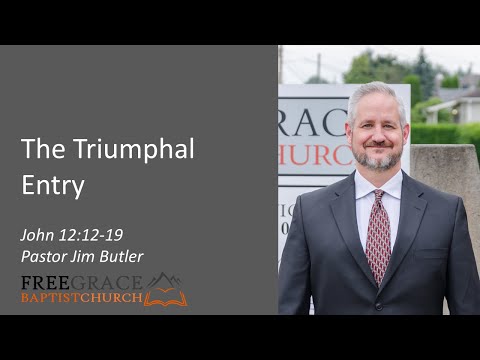
The triumphal entry of Christ into Jerusalem, recorded in John 12:12–19, is a dense convergence of Old Testament expectation and messianic fulfillment. The crowd's palm branches, their cry of Hosanna from Psalm 118, and Jesus' deliberate choice to ride a donkey in fulfillment of Zechariah 9:9 together constitute a public royal declaration — Christ confirming by his own action that he is the King of Israel, the opener of the gates of righteousness, who brings salvation not by overwhelming military force but by suffering and death. The disciples' initial incomprehension, resolved only after the glorification of Christ, illustrates how the resurrection supplies the hermeneutical key for reading the entire Old Testament. The Pharisees' admission of failure — 'the world has gone after him' — unwittingly echoes Zechariah 9:10 and testifies to the unstoppable advance of God's kingdom through Christ.

The Judicial Decision to Murder Jesus
The Sanhedrin's formal decree to execute Jesus, recorded in John 11:47–57, is the most extreme miscarriage of justice in human history — a body constituted to administer God's law plotting the murder of the only innocent man who ever lived. The sermon expounds the irony that Caiaphas, driven entirely by political self-preservation, nevertheless prophesied accurately: one man would die for the nation, and not for that nation only, but to gather the scattered children of God from every tribe, tongue, people, and nation. John's theological commentary on the high priest's words (vv. 51–52) unpacks the doctrinal heart of penal substitutionary atonement — the just for the unjust, the holy and harmless for the thoroughly defiled. The passage calls believers to stand in awe that Christ willingly walked into this kangaroo court, refused self-defense, and bore the wrath of godless men so that sinners might be freed from the wrath of God.

The Triumph of Samson at Jawbone Height
Judges 15 presents Samson not as a man governed by lust but as a Spirit-empowered deliverer who typifies the Lord Jesus Christ. This exposition traces three movements: the betrayal by Samson's father-in-law, the treachery of the men of Judah who preferred Philistine subjection to covenantal freedom, and the triumph at Jawbone Height where the Spirit of the Lord shattered Samson's bonds and enabled him to slay a thousand men. The central application calls God's people away from the assimilation of godless culture toward uncompromising allegiance to the Word of God, grounded in dependence upon the God who furnishes His servants with every means of victory.
The Day of Atonement
Leviticus 16 stands at the structural center of the Pentateuch, and its legislation governing the Day of Atonement reveals both the absolute holiness of God and the total sinfulness of man. The two goats — one slaughtered as a sin offering and one driven into the wilderness as the scapegoat — together signify substitutionary atonement and the definite removal of guilt from a specific covenant people. The high priest's own need for sacrifice before he could minister for Israel exposes the inadequacy of the Levitical priesthood and anticipates the once-for-all, self-sufficient sacrifice of Christ, whose blood retroactively atoned for Old Covenant believers and finally accomplished what the annual rite could only shadow. Believers in the New Covenant era need no further Day of Atonement ceremony; every observance of the Lord's Supper recalls the same removal of guilt that the scapegoat ceremony made visible to Israel.

The Installation of the Priesthood
Leviticus 8–10 records the ordination, ministry, and judgment of Israel's priesthood, tracing the way sinful man may approach a thrice-holy God through divinely prescribed sacrifice. The death of Nadab and Abihu for offering that which the Lord had not commanded warns that worship is regulated by God alone, not by the worshiper's innovation. Christ fulfills every type embedded in this system — as the holy, harmless, and undefiled High Priest who satisfies divine justice once for all. The sermon calls new-covenant worshipers to approach the Lord's Supper with the same reverence and eager joy that the priestly fire of Leviticus 9 ought to have kindled.

The Installation of the Priesthood
Leviticus 8–10 presents the ordination, ministry, and judgment of the Aaronic priesthood as a unified theological unit — the resolution of the tension left at the end of Exodus 40, where the glory of God filled the tabernacle but no one could enter. The divine approval signaled by fire consuming the sacrifice in Leviticus 9 stands in sharp contrast to the lethal fire that devours Nadab and Abihu in Leviticus 10, grounding the regulative principle of worship in the character of God himself: He must be regarded as holy, and He alone determines the manner of approach. The detailed legislation of chapters 1–7 is not merely ceremonial scaffolding but the appointed means by which a holy God draws near to an unclean people, typifying the better access secured by Christ in the New Covenant. The sermon calls the congregation to receive New Covenant worship as an advancement of — not a departure from — the principle that God's people must come to Him on His terms.

The Other Offerings
Leviticus 2–7 presents the grain, peace, sin, guilt, and trespass offerings alongside the burnt offering already treated in chapter 1, and the cumulative weight of this sacrificial legislation presses the reader toward two convictions: the absolute holiness of God and the radical sinfulness of man. Each offering — the substitutionary death of an unblemished animal, the sprinkling of blood, the atonement language repeated in nearly every pericope — functions as typology pointing forward to the one Lamb of God who would fulfill all that the system signified. The final summary verse of chapter 7 frames the entire system as divine law, not human suggestion, which carries direct implications for how the church must approach God in the new covenant era under the regulative principle of worship.

The Conduct of the New Man, Part 3
Ephesians 5:1–2 concludes Paul's extended exhortation on the conduct of the new man (Ephesians 4:17–5:2), calling believers to be imitators of God as dear children and to walk in love. The basis for this imitation is theological: God is definitionally love (1 John 4:8, 16), believers have been adopted into his family by sovereign election and effectual grace, and family membership carries both privilege and responsibility. The motivation for walking in love is the penal substitutionary atonement of Christ, whose self-offering was an acceptable sacrifice to the Father — the antitype of the Old Testament burnt offering — and whose love supplies both the standard and the ground for all Christian love toward God and neighbour.

The Burnt Offering
Leviticus 1 presents the burnt offering as the paradigmatic Old Covenant sacrifice, establishing the pattern of how sinful man may approach a holy God. The chapter addresses the costliness of sacrifice, the worshiper's heart disposition, the laying on of hands as substitutionary transference, and the meaning of atonement as the satisfaction of divine justice. The New Testament interprets this system typologically: the male without blemish, the substitutionary slaughter, and the sweet aroma of acceptance all prefigure the penal substitutionary atonement of the Lord Jesus Christ. Believers are called to read the Old Testament as a Christ-centered book and to worship God only in the manner He has prescribed.

The Royal Wedding
Psalm 45 presents a royal wedding between the divine King and his bride, the church, composed centuries before the incarnation as a song of love pointing directly to the Lord Jesus Christ. The sermon moves through four sections: the psalmist's overflowing intention, the perfections and divine-human person of the King, the instruction to the bride concerning faith and repentance, and the declaration of the King's eternal glory. Christ is shown to be fairer than all the sons of men, advancing his kingdom through truth, humility, and righteousness rather than deception, while his priestly office — not only his kingly conquest — is pressed upon the hearer as the only ground of hope for sinners. The bride is clothed not in her own righteousness but in the imputed righteousness of Christ, received by faith alone, to be brought with gladness into the King's palace.

Introduction to the Book of Leviticus
The book of Leviticus resolves a theological tension created at the close of Exodus: the tabernacle has become God's dwelling place, but no Israelite — not even Moses — can enter it. This introductory exposition surveys Leviticus 1:1 and the book as a whole, tracing three dominant theological themes: the holiness of God, the sacrificial system as God's own provision for sinful man's access to His presence, and the purity required of His covenant people. The Levitical types find their antitypes in the Lord Jesus Christ, who is simultaneously the high priest and the sacrificial victim, and whose atoning work is the substance toward which the entire ceremonial law pointed.
The Tabernacle Erected, and the Glory of God
Exodus 35–40 records the construction, assembly, and divine consecration of the Israelite tabernacle, culminating in the glory cloud filling the completed dwelling place. This session surveys those chapters as the climax of the book of Exodus, tracing the biblical-theological theme of God's dwelling with his people from Eden through the tabernacle, the Solomonic temple, and forward to the incarnate Word who tabernacled among us. A sustained exegetical focus falls on the tension in Exodus 40:35 — Moses unable to enter the glory-filled tabernacle — and its resolution in Leviticus 9, where blood atonement transforms God's dwelling place into a meeting place. The session closes by drawing out the regulative principle of worship, the typological significance of the tabernacle as a shadow of Christ, and the necessity of blood atonement for sinful creatures to approach a holy God.
The Promise of God's Presence
Exodus 33 confronts Israel with the consequences of the golden calf: God threatens to withhold His special presence, lest He consume a stiff-necked people in the wilderness. Moses responds not with passive acceptance but with escalating, bold intercession — arguing from grace received, from Israel's covenant identity, and finally from a desire to see God's glory itself. The sermon traces God's anthropomorphic self-disclosure, His accommodation of Moses' three petitions, and His self-proclamation as the God of sovereign grace and compassion. The controlling application is that it is the Giver, not the gift, that the people of God must desire above all things — and that access to His presence now comes through the mediation of Christ alone.
The Idolatry of Israel, Part III
Exodus 32:30–35 presents Moses interceding for Israel after the golden calf debacle, confessing their great sin and offering himself to be blotted out of God's book on their behalf. The sermon works through Moses's rebuke, his request, and God's response, giving particular attention to the theological question of whether God blots names from the Book of Life — resolving the tension by distinguishing the conditional Old Covenant (a covenant of works securing physical blessings) from the unconditional New Covenant, in which the elect are eternally secure in Christ. The Mosaic intercession is read typologically as pointing to Christ, who was, in effect, blotted out on behalf of his people. The sermon closes with application to the gravity of idolatry drawn from Romans 1 and a quote from John Stott.

The Gifts Given by the Ascended Christ, Part 1
Ephesians 4:7–11 presents Christ the ascended Lord as the giver of gifts to His church. This sermon expounds the provision of God's grace in verse 7, the Christological argument drawn from Psalm 68 in verses 8–10, and the specific gifted men named in verse 11 — apostles, prophets, evangelists, and pastor-teachers. The preacher argues that Paul's appeal to Psalm 68 is typological: as Yahweh conquered Israel's enemies, received tribute, and distributed it to his people, so Christ conquered sin and death, ascended to the right hand of the Father, and now distributes gifts to His church through the Spirit. The practical weight of the sermon falls on killing pride, praying for elders and deacons, and recognising that the teaching ministry — not celebrity — is the bond that produces the love and unity Paul commands in verses 2–3.