
Theological term
Covenant Theology
136 sermons · All terms

The Promise of Blessings and Curses (Part 1)

Leviticus 26:1–13 opens with a promise of blessing conditioned on Israel's obedience — a structure that raises the question of how the Old Covenant relates to the New. This study expounds the covenantal framework underlying Leviticus 26, arguing that the Old Covenant operated as a covenant of works at the national level, distinct from the covenant of grace realized in Christ. The blessings of rain, peace, and God's presence promised to Israel find their fulfillment in the New Covenant, where the obedience that secures blessing is Christ's own, imputed to his people by faith alone.
2LCF Chapter 6 - Of the Fall of Man, of Sin, and of the Punishment Thereof
The fall of man, sin, and the punishment thereof — explored through 2LCF Chapter 6 — answers the fundamental question of why the Lord Jesus Christ came in His first advent. This study traces the confession's argument from the fall as God's wise and holy counsel in paragraph 1, through the representative sin of Adam and its covenantal consequences in paragraphs 2–3, to the doctrine of original sin, total depravity, and total inability in paragraph 4, and finally to the remaining corruption that persists in the regenerate throughout this life in paragraph 5. The doctrine of imputation — both of Adam's guilt to his posterity and of Christ's righteousness to His people — is shown to be the theological nerve running through the whole chapter. The study closes with the pastoral application that an honest reckoning with one's own remaining corruption ought to produce charity and grace toward fellow believers rather than a Pharisaical demand for perfection in others.

Wednesday Night Bible Study - Leviticus 1-16
Leviticus 16, the Day of Atonement, stands at the theological center of both the book and the Pentateuch, answering the question Exodus leaves unresolved: how may sinful man enter the presence of a holy God. This session reviews the whole of Leviticus 1–16, tracing the book's structure from the sacrificial system and the institution of the priesthood through the laws of cleanness, showing that every element of the ceremonial apparatus — offering, priest, atonement — was divinely instituted, not humanly devised. The Nadab and Abihu incident demonstrates that unauthorized worship is mortal transgression, while the two-goat ritual of chapter 16 pictures both propitiation and expiation, all pointing forward to the once-for-all sacrifice of the Lord Jesus Christ.

The Refuge for God's People
Psalm 46 sets the doctrine of God's sovereign presence as the only sufficient ground for courage in affliction. The psalm's threefold refrain — 'The Lord of hosts is with us; the God of Jacob is our refuge' — anchors the people of God against both natural catastrophe and the rage of hostile nations. Drawing on Job, the upper room discourse, Acts 14, and the letters to the seven churches in Revelation, this exposition argues that suffering is the normative texture of the Christian life, not an anomaly to be explained away. The command of verse 10 — 'Be still and know that I am God' — is not passive fatalism but a call to steady, covenant confidence in the God whose justice, power, and faithfulness guarantee the final exaltation of Christ among the nations.

The Righteousness of David
David's declaration in 2 Samuel 22:21–25 that God rewarded him according to his righteousness stands in apparent tension with his gross sins of adultery, murder, and failure to act in the rape of Tamar. This sermon resolves that tension through the theology of justification by faith alone, demonstrating from Romans 4 that David, like Abraham, was accepted by God not on the basis of personal moral achievement but through the imputed righteousness of Christ received by faith — the same way any sinner in any covenant has ever entered the presence of God. David's own writings, particularly Psalm 32 and Psalm 51, confirm that he understood his standing before God to rest on atonement, forgiveness, and the crediting of another's righteousness, not sinless perfection. The sermon closes with a call to treasure public worship as David did, and to bring great sin to the great Savior who justifies the ungodly.
The Day of Atonement
Leviticus 16 stands at the structural center of the Pentateuch, and its legislation governing the Day of Atonement reveals both the absolute holiness of God and the total sinfulness of man. The two goats — one slaughtered as a sin offering and one driven into the wilderness as the scapegoat — together signify substitutionary atonement and the definite removal of guilt from a specific covenant people. The high priest's own need for sacrifice before he could minister for Israel exposes the inadequacy of the Levitical priesthood and anticipates the once-for-all, self-sufficient sacrifice of Christ, whose blood retroactively atoned for Old Covenant believers and finally accomplished what the annual rite could only shadow. Believers in the New Covenant era need no further Day of Atonement ceremony; every observance of the Lord's Supper recalls the same removal of guilt that the scapegoat ceremony made visible to Israel.

Introduction to the 1677/1789 2nd London Baptist Confession of Faith
The 1689 London Baptist Confession of Faith — formally composed in 1677 and adopted by particular Baptist churches in 1689 — stands in deliberate continuity with the Westminster Confession and the Savoy Declaration, adapting their language to reflect distinctively Baptist convictions while maintaining solidarity with the broader Reformed tradition. This introductory session traces the Confession's historical origins, its relationship to the First London Confession of 1644–46, and the legal and ecclesiastical context in which particular Baptists operated under the Act of Toleration. Six reasons are then advanced for why a 21st-century church should subscribe to a 17th-century confession: to define, defend, discriminate, discipline, distinguish matters of Christian liberty, and develop an appreciation for the history of the church. The session closes by urging that confessionalism, rightly understood, is not proud biblicism but the humble reception of gifts Christ has given to his church across the ages.
The Promise of God's Presence
Exodus 33 confronts Israel with the consequences of the golden calf: God threatens to withhold His special presence, lest He consume a stiff-necked people in the wilderness. Moses responds not with passive acceptance but with escalating, bold intercession — arguing from grace received, from Israel's covenant identity, and finally from a desire to see God's glory itself. The sermon traces God's anthropomorphic self-disclosure, His accommodation of Moses' three petitions, and His self-proclamation as the God of sovereign grace and compassion. The controlling application is that it is the Giver, not the gift, that the people of God must desire above all things — and that access to His presence now comes through the mediation of Christ alone.

2LCF Chapter 25 - Of Marriage

The confession's chapter on marriage (2LCF 25) rests on the foundation of Genesis 2 and Matthew 19, defining marriage as an exclusive covenant between one man and one woman, ordained by God before the fall and therefore neither a social construct nor a second-rate reality beneath celibacy. The chapter serves four structural functions: establishing the monogamous design of marriage, grounding its divine origin and pre-fall holiness, articulating its threefold providential purpose (companionship, procreation toward the inhabitation of creation, and a hedge against sexual immorality), and setting its regulative bounds with respect to both consanguinity and the Christian obligation to marry in the Lord. The placement of this chapter immediately before the chapter on the church (2LCF 26) is deliberate: God's use of marriage to populate the earth is the providential means by which He gathers the elect from every tribe, tongue, people, and nation unto Christ.

The Children of the Devil, Part 3
John 8:44–47 records Christ's unflinching indictment of the unbelieving Jewish religious leaders as children of the devil, a verdict he confirms by exposing three marks of their paternity: they reject the truth he speaks precisely because it is truth, they cannot convict him of a single sin, and they do not hear God's words because they are not of God. The sermon draws out the theological weight of each mark — the devil as murderer and father of lies in contrast to Christ as life and truth — and applies these diagnostic tests to the question of assurance: those who are of God love Christ and love the Word. The exposition closes with a call to both the congregation and the unconverted to rest in the imputed righteousness of Christ, received by faith alone, as the only ground of a right relationship with God the Father.

2LCF Chapter 21 - Of Christian Liberty and Liberty of Conscience
This exposition of 2nd London Baptist Confession chapter 21 (Of Christian Liberty and Liberty of Conscience) examines what freedom Christ secures for his people and what that freedom does not permit. The sermon works through three liberties from sin's bondage — from its guilt, its power, and its punishment — before turning to freedom in worship and obedience, distinguishing what Old and New Testament believers share and what New Testament believers enjoy in greater measure: freedom from the ceremonial law, greater boldness of access to the throne of grace, and fuller communication of the Spirit. A substantial section treats liberty of conscience — freedom from ecclesiastical tyranny, civil totalitarianism, and moral impositions of men — and the sermon closes by warning against the perversion of Christian liberty into licentiousness.

The New People of God: Part 2

The titles given to the church in 1 Peter 2:9–10 — chosen generation, royal priesthood, holy nation, and his own special people — are drawn directly from Old Testament Israel typology and applied to all who believe in Christ. Working through Deuteronomy 32, Exodus 19, 2 Samuel 7, and the Abrahamic covenant, the sermon traces how God's act of separating Israel from the nations at Babel prefigures his rescue of the spiritual Israel — the church — from the dominion of darkness into the marvelous light of Christ. The sermon argues that the new covenant fulfils what the old covenant typified: believers now constitute the household of God, the spiritual temple, and a royal priesthood whose commission is to proclaim the excellencies of the one who called them out of darkness. This demands that the church pursue its prophet-priest-king calling not through military or political dominion but through the proclamation of the gospel of King Jesus to every tribe, tongue, people, and nation.

2LCF Chapter 7 - Of God's Covenant, Part 2
1689 London Baptist Confession of Faith, Chapter 7, paragraph 3 sets out three theological covenants — the covenant of grace, the covenant of redemption (pactum salutis), and the covenant of works — as the structural architecture of all Scripture. This sermon expounds each in turn, demonstrating from texts in Genesis, Isaiah, Hosea, Galatians, and Romans that the covenant of grace is founded on an eternal transaction between the Father and the Son, and that it is God's provision for sinners rendered incapable of acceptance with God since Adam's fall. The covenant of works is shown to be indispensable to a right understanding of justification: without it, the imputed righteousness of Christ collapses into either moralism or antinomianism, and the distinction between forgiveness and imputation is lost. Covenant theology is pressed not as academic machinery but as the very ground of the believer's comfort, assurance, and stability before God.
Chapter 7 - Of God's Covenant
1689 London Baptist Confession chapter 7 traces the biblical and theological architecture of God's covenant: from the necessity of divine condescension (paragraph 1), through the gracious character of the covenant of grace (paragraph 2), to the three theological covenants — grace, redemption, and works — and their progressive historical unfolding (paragraph 3). The session contrasts covenant theology with dispensationalism and New Covenant theology as competing hermeneutical frameworks, argues that the Old (Mosaic) Covenant functioned as a republication of the covenant of works rather than an administration of the covenant of grace, and demonstrates from Genesis 3:15 through Jeremiah 31 and Matthew 26 that all historical covenants advance a single promise of redemption finally and fully disclosed in the new covenant inaugurated by Christ. The practical payoff is a robustly confessional case for believers-only baptism: the new covenant community is defined by inward regeneration, universal knowledge of the Lord, and definitive forgiveness — marks that exclude the external-and-internal covenant structure required to justify paedobaptism.
Clip: Flyover of Covenant Theology (2LCF Chapter 7 - Of God's Covenant)
Covenant theology serves as the central hermeneutical architecture of Scripture, and this introductory flyover situates it against competing systems — dispensationalism and New Covenant theology — before tracing its practical consequences for continuity between the Testaments, the role of ethnic Israel, the subjects of baptism, and the law of God in the new covenant. Two key distinctions between the 1689 London Baptist Confession and the Westminster Confession are noted: the particular Baptists' omission of an explicit covenant of works statement in Chapter 7, and their refusal to identify the Old Covenant as an administration of the covenant of grace. The sermon locates covenant theology not merely in academic method but in pastoral comfort, grounding the blood-bought people of God in the assurance that God is in Christ reconciling the world to himself.

Exodus 19
Exodus 19 records Israel's arrival at Sinai and God's formal entry into covenant with the nation — a covenant that functions as a republication of the covenant of works, in which Israel, like Adam before them, is called to obedience and fails, thereby pointing forward to the last Adam, Jesus Christ. The chapter unfolds in three movements: the exhortation to faithfulness through the covenant terms (vv. 1–8), the consecration of the people for readiness (vv. 9–15), and the theophanic demonstration of divine glory (vv. 16–25). The Sinai theophany, with its thunder, fire, and death-boundary around the mountain, teaches that God's people require a mediator — a lesson that finds its fulfillment in Christ, the Mediator of the New Covenant. The church, as the true Israel of God, inherits the vocation of Exodus 19:6 — a royal priesthood, a holy nation — and is therefore called to proclaim the praises of God with reverence befitting the consuming fire she approaches in worship.

The Antitype of the Temple
John 2:18–25 presents Jesus as the antitype of the Old Testament temple — the reality to which the type pointed and in which it finds its fulfillment and realization. The Jews' demand for a sign of his authority after the temple cleansing is answered by the one definitive sign: the death and resurrection of Christ, which the apostle John interprets for the reader in verses 21–22. The sermon also treats the omniscience of Christ as evidence of his divinity, demonstrated in his refusal to entrust himself to those whose belief was superficial and temporary. Hearers are called to flee to Christ in genuine faith and repentance, receiving both forgiveness of sin and the imputed righteousness of Christ that avails before the Father.

The Defense of the Faith
Jude 3 commands every believer — not merely pastors or theologians — to contend earnestly for the faith once for all delivered to the saints. This sermon examines the exhortation itself, the internal threat posed by sneaky, ungodly apostates who pervert grace and deny Christ, and the practical preparedness Jude prescribes: remembering apostolic warning, building up on the most holy faith through Scripture and prayer, and resting in the assurance that God himself preserves his people. The defense of the faith is not pessimistic trench-holding but confident advance grounded in Christ's promise to build his church against which the gates of Hades shall not prevail.

The Elements of Family Worship
Deuteronomy 6:6–7 commands parents to teach God's word diligently to their children in every season of daily life, and this sermon traces that mandate across both Testaments — from Abraham's household religion in Genesis 18, through the Psalms and Proverbs, to Paul's charge in Ephesians 6:4 and the example of Timothy's mother and grandmother. The preacher argues that family worship is a clear biblical obligation whose specific form is left to the conscience, and that failure to instruct children in the fear of God — illustrated negatively by Eli and Samuel's sons — leaves them unguarded against a culture actively hostile to Christ. Fathers and mothers are exhorted to commit first to public Lord's Day worship, to honour the sanctification of the Sabbath, and then to establish a family altar consisting of Scripture reading, prayer, and singing — scaled appropriately for their household — as the primary means of passing covenant knowledge to the next generation.
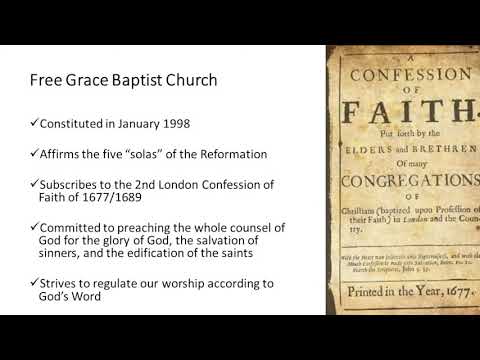
Introduction to the 1689 Second London Baptist Confession of Faith
Why should a church bind itself to a confession of faith? This introductory lesson on the Second London Baptist Confession of 1677/1689 grounds the answer exegetically in Ephesians 4 — where Christ gives gifted men to the church so that the body attains doctrinal unity and is no longer tossed about by every wind of teaching — and then traces the historical origins of the 1689 among the Particular Baptists, distinguishing them from Anabaptists, Presbyterians, and Congregationalists. Four functions of a confession are developed: defining, defending, discriminating, and disciplining with reference to the doctrine of the church. The lesson closes by distinguishing Reformed theology (Calvinism plus covenant theology plus the regulative principle) from mere five-point Calvinism, and by defending the confession's silence on matters of Christian liberty as a feature, not a defect.

The Christian Sabbath, Part 2
The Christian Sabbath, grounded in both creation and redemption, does not cease in the New Covenant but is transformed by the resurrection of Christ from the seventh day to the first day of the week. Working through the ministry of Christ in Matthew 5 and 12, the resurrection accounts across all four Gospels, and the apostolic teaching in Hebrews 4, Acts 20, 1 Corinthians 16, and Revelation 1, this exposition argues that the moral obligation of one day in seven for the worship of God remains perpetually binding on the church. The shift from Saturday to Sunday Sabbath is grounded in Christ's completed redemptive work, which mirrors the Father's rest at the close of creation, establishing the Lord's Day as the Christian Sabbath. Believers are called to receive this day not as a legal burden but as a gracious gift from God, a weekly foretaste of the consummate rest that awaits the people of God.

The Hearing before the Sanhedrin, Part 1
The trial of Jesus before the Sanhedrin (Matthew 26:57–64) was no honest hearing but a predetermined execution by the highest religious court in Israel, assembled in violation of their own law and Scripture. This sermon examines the setting of the hearing, the fraudulent witness testimony regarding the temple, and the high priest's sworn examination of Jesus — in which Christ openly affirms that He is the Messiah, the Son of God, and Daniel's Son of Man. The temple charge against Jesus is shown to be a deliberate misquotation and misinterpretation of John 2:19, where Christ spoke not of the physical structure but of His own death and resurrection. The Sanhedrin's wickedness is set in sharp contrast to the resolve of Christ, who endures this sham trial in silence and then under oath, fulfilling Isaiah 53 and Daniel 7, in order to accomplish the salvation of His people.

The Utility of Confessions and Introduction to the Second London Baptist Confession
Confessions of faith are not competitors to Scripture but are faithful summaries of biblical doctrine, and the church has historically depended on them for good reason. This address introduces the Second London Baptist Confession of 1689, tracing its historical origins among the Particular Baptists of the 17th century and its relationship to the Westminster Confession and the Savoy Declaration. Five interlocking uses of a confession are then examined: defining church doctrine, defending it against error, discriminating between members and officers on doctrinal grounds, disciplining departures from orthodoxy, and distinguishing confessed doctrine from matters of Christian liberty. The goal is not confessional enslavement but confessional clarity — guardrails that protect the church and free her members to worship and grow in the grace and knowledge of Christ.

The Third Missionary Journey, Part 1
Acts 19:1–10 opens Paul's extended ministry in Ephesus on the third missionary journey. The sermon works through three exegetical questions: the identity of the disciples Paul encounters (argued to be genuine Christian believers, not pre-Christian inquirers), the relationship between John's baptism and Christian baptism (argued to be one and the same ordinance), and the significance of the Spirit's coming with tongues and prophecy (argued to be a salvation-historical confirmation of Pentecost's fulfillment, not a normative pattern for all believers). The exposition concludes by drawing out Paul's ministry at the school of Tyrannus as a model of bold, reasoned, expositional gospel preaching that God uses to spread the word across an entire province.
Psalm 46
Psalm 46 presents God as the impenetrable refuge and omnipotent strength of His people in the midst of natural catastrophe, national upheaval, and personal affliction. The study works through four heads: the assurance of God's presence (vv. 1, 7, 11), the demonstration of God's power (vv. 2–6), the invitation to behold God's works (vv. 8–9), and the command to rest in God's sovereignty (v. 10). Covenant theology is not merely a theoretical construct but the very ground of the believer's comfort — the God of Jacob is a covenant-keeping God whose purposes cannot be frustrated by any earthly power. The congregation is called to the practical discipline of theology proper: to know God deeply so that the soul is stabilized, not paralyzed, in times of trouble.

The Covenant with David
The Davidic Covenant in 2 Samuel 7:1–17 is a sovereign promise by God to David that a seed from his line will establish an eternal kingdom — a promise that cannot be annulled by death, destroyed by sin, or exhausted by time. The sermon traces the historical background of the covenant (the ark's wandering, God's presence with his pilgrim people, David's own rise from the sheepfold), then unfolds the triple meaning of 'house' — physical dwelling, dynastic succession, and temple — showing that God's answer to David's desire to build for him is instead to build a dynasty for David. Covenant theology frames the whole: the Davidic covenant is not a new or separate covenant of grace but a further discovery of the one covenant purpose moving from Genesis 3:15 through Abraham and David to its full realization in the Lord Jesus Christ, the son of David who now reigns over a kingdom without end. The sermon closes with Jeremiah 23:5–6 — the Lord our righteousness — pressing hearers to rest in Christ's imputed righteousness as the ground of their entry into that everlasting kingdom.

The Fourth Commandment, Part 3
Romans 14, Galatians 4, and Colossians 2 are frequently cited as evidence that no special day of worship remains for the people of God, but a careful exegesis of each passage shows they address Jewish ceremonial observances and food laws — not the moral, Decalogical Sabbath. The argument of Romans 14 concerns Christian liberty in matters of diet and ethnic calendar practices, not the abrogation of the Lord's Day; Galatians 4 condemns the Judaizing of salvation by attaching religious merit to ceremonial observances; and Colossians 2:16-17 targets the 'sabbaths' that functioned as shadows alongside new moons and festivals — a grouping the Old Testament itself consistently distinguishes from the weekly Sabbath. The Christian Sabbath, grounded in creation, codified at Sinai, prophesied for the new covenant era, and transposed by Christ's resurrection to the first day of the week, remains binding on the people of God — kept not as a means of justification but as a fruit of it.

The Two Builders
Matthew 7:24–29 closes the Sermon on the Mount with a parable that presses every hearer to examine the foundation of their life before God. Both builders hear the words of Christ, but only the wise builder obeys them — and that obedience, rooted not in moral effort but in faith in Christ alone, is the mark that distinguishes genuine discipleship from hollow profession. The foolish builder is not a pagan but a hearer who pays lip service to the Word without submitting to it, a condition Ezekiel 33 and James 1 both diagnose with sobering precision. The sermon calls every listener to repent, believe the gospel, and rest on Christ as the only foundation that will withstand the final storm of God's holy wrath.

The Conversion of the Ethiopian Eunuch
Acts 8:26–40 records the Spirit-directed encounter between the evangelist Philip and an Ethiopian eunuch, a man doubly excluded from Israel's assembly by Deuteronomy 23:1 yet drawn by God's sovereign grace into the new-covenant community. The sermon traces three movements in the narrative — the providential meeting, the expository dialogue from Isaiah 53, and the eunuch's confession and baptism — arguing that the passage is not merely a quotation but a fulfillment of Isaiah 56, in which eunuchs and foreigners are brought near through the blood of Christ. Against any notion of baptism as a converting ordinance, the preacher grounds believers' baptism in the pattern of faith preceding baptism throughout Acts, Calvin's own concession that immersion was the ancient mode, and the 1689 LBCF's definition of baptism as an ordinance primarily for the party baptized. The sermon closes with an indiscriminate call to all sinners to relinquish their own righteousness and rest in the imputed righteousness of Jesus Christ.
Psalm 33
Psalm 33 calls the people of God to praise the Lord for His sovereignty in creation and in history, grounding that praise in the character of a covenant-keeping God whose word is unfailingly right and whose purposes stand forever. The sermon moves through the psalm's three movements: the call to skillful, joyful worship; the manifold reasons for praise drawn from God's power over creation, His overruling of human counsel, and His providential care over His elect; and the psalmist's concluding resolution to wait on God alone as help and shield. Listeners are pressed to ask whether their worship reflects genuine delight in the sovereign God of Psalm 33 and whether their trust rests in Him rather than in any human means or strength.