
Theological term
Covenant of Redemption
282 sermons · All terms
2LCF Chapter 7 - Of God's Covenant

Covenant theology stands or falls on the careful distinction between the covenant of works, the covenant of grace, and the historical covenants that progressively reveal it. This lesson works through 2LCF Chapter 7, tracing the terms, parties, and rewards of each covenant from Adam through the Abrahamic and Mosaic administrations, and grounding the whole in the eternal covenant of redemption between the Father and the Son. The controlling argument is that the Abrahamic covenant — entered by natural generation, maintained by works, and breakable — cannot be identified with the covenant of grace, and that this distinction exposes the internal contradictions of paedobaptist covenant structures. The practical takeaway is that salvation has always been by grace through faith alone, because Christ as the second Adam is the only one who has met and can meet the terms of the covenant of works on behalf of the elect.

The New People of God, Part 1
What does it mean for the church to be built on Christ as a living cornerstone, and how does the Old Testament ground that identity? Expounding 1 Peter 2:6–8, this sermon traces the biblical-theological arc from Adam's failed dominion mandate in Genesis through Israel's typological history—law-giving, exile, and restoration—to the fulfilment of Isaiah's cornerstone prophecy in the Lord Jesus Christ. Israel's covenant history is shown to be a historical type of the cosmic reality: the broken covenant of works and its restoration by the Messiah, who is now building a global kingdom of redeemed image-bearers out of every tribe and tongue. Believers are called to marvel at God's sovereignty over history, over the kingdom of darkness, and over the unified message of Scripture that runs from Genesis 3:15 to the church as the true Israel of God.

The Need for Gospel Ministers

Matthew 9:35–38 presents Christ surveying the multitudes of Galilee and responding not primarily to their political oppression but to their spiritual destitution — harassed and scattered like sheep without a shepherd because Israel's religious leaders had failed and become predators of the very flock they were charged to keep. The sermon traces the shepherd-and-harvest imagery through Numbers 27, 1 Kings 22, Jeremiah 23, and Micah 5 to demonstrate that God's remedy for faithless shepherds has always been the raising up of faithful men under the Messiah's authority. Christ's compassion, exercised according to his human nature, issues not in mere sympathy but in effective action: commanding his disciples to pray the Lord of the harvest to send out laborers, then immediately appointing and commissioning the Twelve. The congregation is called to share Christ's own compassion for the spiritually destitute, to believe that the harvest is genuinely plentiful across every tribe and nation, and to pray, give, identify, train, and send qualified men into gospel ministry.

The Apostle's Prayer for the Ephesians, Part 2
Ephesians 1:19–23 presents the climax of Paul's apostolic prayer: that believers would know the exceeding greatness of God's power. This sermon expounds three demonstrations of that power in Christ — his resurrection from the dead, his current session at the right hand of the Father, and his dominion over all things for the sake of the church. The doctrines of inseparable operations and appropriations ground the Trinitarian account of these events, while the universal and eternal sovereignty of the enthroned Christ is set forth as the foundation for perseverance, praise, and fearlessness in the face of hostile spiritual and civil powers.

Book introduction: The Mystery of Christ, His Covenant, and His Kingdom
Samuel Renihan introduces his book 'The Mystery of Christ, His Covenant, and His Kingdom,' explaining its origins in his seminary-era dissatisfaction with both pedobaptist and Baptist covenantal literature. He argues that historical particular Baptist covenant theology has been largely forgotten, and that modern Reformed Baptist literature has suffered from poor historical theology, excessive polemicism, and conclusions stated without premises. The book is structured by biblical theology rather than systematic theology, tracing three covenantal kingdoms — creation, Israel, and Christ — and contends that the concept of mystery in Paul is essential to a properly calibrated covenant theology that distinguishes the old covenants from the new covenant without collapsing the progressive development of divine revelation.

The Prophecy Concerning the Resurrection
Peter's Pentecost sermon in Acts 2:24–32 anchors the resurrection of Jesus Christ not in apostolic invention but in the prophetic word of Psalm 16, written by David nearly a millennium before the event. Working through Peter's appeal to and interpretation of that psalm, this exposition traces four aspects of the Messiah's disposition before His death — His focus, joy, confidence, and dependence upon the Father — and demonstrates that David, writing as a prophet under the Davidic covenant of 2 Samuel 7, could not have been describing his own resurrection since his tomb remained occupied. The resurrection is therefore the Father's public vindication that divine justice has been fully satisfied by Christ, the ground of the believer's justification, and the fulfillment of the Davidic covenant promise that one from David's line would build an eternal house for God. The sermon closes by calling sinners — however guilty — to call upon the risen Lord Jesus, the one on the middle cross who alone can grant everlasting life.

The Redemptive Work of the Son, Part 1
Ephesians 1:6–7 sets forth the redemptive work of the Son within the triune economy of salvation, moving from the Father's electing purpose in eternity past to Christ's historic accomplishment of redemption in time. The sermon expounds two interlocking realities: the Father's sovereign initiative in bestowing grace upon the elect in the Beloved, and the Son's purchase of redemption through the shedding of his blood. Redemption is shown to be not a mere exercise of divine power but the payment of a ransom price, with the forgiveness of sins as its primary blessing — all flowing from the inexhaustible riches of God's grace. Hearers are called to respond with worship, gratitude, and increasing love for Christ, the Beloved of both the Father and the redeemed.

The Bread of Life Discourse, Part 2
John 6:35–40 presents Christ as the Bread of Life whose identity, sovereignty, and redemptive mission are inseparable. The sermon expounds three movements in the text: Christ's self-identification as the Bread of Life with its attendant promise that those who come to Him will never hunger or thirst; the declaration of divine sovereignty in verse 37, grounding the certainty of salvation in the Father's eternal gift of a people to the Son; and the revelation of the Father's will in verses 38–40, encompassing the Son's mediatorial mission, the preservation of all given to Him, and the call to every sinner to see the Son in the preaching of the Word and believe. The doctrines of grace — total depravity, unconditional election, definite atonement, irresistible grace, and the perseverance and preservation of the saints — are shown to arise directly from the text, and the sermon closes by pressing the free offer of the gospel against both Arminian uncertainty and hyper-Calvinist paralysis.

The Gracious Purpose of the Father, Part 2
Ephesians 1:5–6 presents predestination not as cold metaphysical fate but as an act of divine love, wherein God in love predetermined his elect unto adoption as sons by Jesus Christ, according to the good pleasure of his own will and not any foreseen merit in the creature. The sermon works through the motive of predestination (the love of God), the means (adoption as sons by Christ, grounded in the covenant of redemption), and the goal (the praise of the glory of God's grace), drawing extensively on parallel Pauline and Johannine texts. Against both Arminian and Pelagian objections, the preacher demonstrates that predestination to adoption is precisely what makes Christian praise coherent — the creature contributes nothing, and God receives all glory. Believers are called to live out their adopted status by walking in love, light, and wisdom as members of the household of God.

The Gracious Purpose of the Father
Ephesians 1:3–6 opens with what the Apostle Paul calls a 'barakah' — a formal blessing of God followed by specific reasons for that praise. This sermon expounds the Father's role in the covenant of redemption: His sovereign, unconditional election of sinners in Christ before the foundation of the world, and His predestinating purpose that those chosen would be made holy and blameless. Election is the cause, not the consequence, of faith and repentance — sinners dead in trespasses and sins are chosen not because of foreseen merit but according to the good pleasure of God's will alone. The sermon calls believers to respond to the doctrine of election not with defensive polemic but with the doxological posture Paul himself models: praise, blessing, and adoration to God Most High.

2LCF Chapter 8 - Of Christ the Mediator, Part 2
Christ the Mediator, as confessed in chapter 8 of the 1689 London Baptist Confession of Faith, is examined through Hebrews 10 and supporting Scripture, tracing the pre-temporal appointment of the Son in the covenant of redemption, his hypostatic union, his anointing for the mediatorial office, and the execution of his saving work. The confession's account of Christ's perfect obedience, sacrificial death, and resurrection is shown to satisfy divine justice, procure reconciliation, and secure an everlasting inheritance for all the Father has given him. Particular attention is given to the retrospective communication of Christ's redemptive benefit to elect saints under the old covenant, demonstrating that salvation has always been by grace through faith in Christ alone. The study exhorts believers to find stability, comfort, and assurance in a precise knowledge of who Christ is and what he has accomplished.

2LCF Chapter 8 - Of Christ the Mediator, Part 1
Chapter 8 of the 1689 London Baptist Confession opens with the pre-temporal appointment of Christ as mediator in the covenant of redemption, then moves to the historical stages of that mediatorial work, beginning with the incarnation. The confession affirms that the Son of God, consubstantial and co-eternal with the Father, took on true human nature — with all its essential properties and common infirmities, yet without sin — so that two whole and distinct natures are inseparably united in one person: the hypostatic union. Drawing on John 1, Hebrews 2, 4, and 7, Galatians 4, and the Chalcedonian Definition of 451, the study traces the biblical and creedal foundations of Reformed Christology, and shows how the confession's language connects the Reformed Baptist tradition to the settled Christological consensus of the ancient church.

Redeemed by the Precious Blood of Christ
God is an impartial judge who will call every person to account for every transgression of his law, and no corruptible thing — no silver, gold, religious ritual, or moral effort — can satisfy the demands of that justice. Redemption comes exclusively through the precious blood of Christ, the spotless Lamb foreordained before the foundation of the world, whose death made propitiation for sin and whose perfect obedience is imputed to the believer's account. Drawing from 1 Peter 1:17–21, this sermon expounds the condition, command, reason, and result of the Christian's call to conduct life in reverent fear: not a slavish terror born of misunderstanding God's character, but a reverent awe that flows from knowing the God who is both perfectly just and perfectly merciful. The believer's ongoing faith and hope are to rest continually in God — grounded in Christ's resurrection, confirmed by his ascension to glory, and oriented toward the certain hope of the new heaven and new earth.

2LCF Chapter 7 - Of God's Covenant, Part 2
1689 London Baptist Confession of Faith, Chapter 7, paragraph 3 sets out three theological covenants — the covenant of grace, the covenant of redemption (pactum salutis), and the covenant of works — as the structural architecture of all Scripture. This sermon expounds each in turn, demonstrating from texts in Genesis, Isaiah, Hosea, Galatians, and Romans that the covenant of grace is founded on an eternal transaction between the Father and the Son, and that it is God's provision for sinners rendered incapable of acceptance with God since Adam's fall. The covenant of works is shown to be indispensable to a right understanding of justification: without it, the imputed righteousness of Christ collapses into either moralism or antinomianism, and the distinction between forgiveness and imputation is lost. Covenant theology is pressed not as academic machinery but as the very ground of the believer's comfort, assurance, and stability before God.
Chapter 7 - Of God's Covenant
1689 London Baptist Confession chapter 7 traces the biblical and theological architecture of God's covenant: from the necessity of divine condescension (paragraph 1), through the gracious character of the covenant of grace (paragraph 2), to the three theological covenants — grace, redemption, and works — and their progressive historical unfolding (paragraph 3). The session contrasts covenant theology with dispensationalism and New Covenant theology as competing hermeneutical frameworks, argues that the Old (Mosaic) Covenant functioned as a republication of the covenant of works rather than an administration of the covenant of grace, and demonstrates from Genesis 3:15 through Jeremiah 31 and Matthew 26 that all historical covenants advance a single promise of redemption finally and fully disclosed in the new covenant inaugurated by Christ. The practical payoff is a robustly confessional case for believers-only baptism: the new covenant community is defined by inward regeneration, universal knowledge of the Lord, and definitive forgiveness — marks that exclude the external-and-internal covenant structure required to justify paedobaptism.
The Prayer of the Persecuted Church
When the early church faced arrest and official prohibition of gospel preaching, its first instinct was corporate prayer — not political agitation or fearful compliance. This exposition of Acts 4:23–31 traces the structure of that prayer: an invocation of God as sovereign Creator, an exposition of Psalm 2 applied to the conspiracy against Christ and his people, and a pointed supplication not for safety or comfort but for boldness to declare the word. The sermon calls the contemporary church to the same God-centred prayer, understanding persecution as something always beneath the sovereign hand of God, and faithfulness in proclamation as the unchanging vocation of every Christian steward.

2LCF Chapter 6 - Of the Fall of Man, of Sin, and of the Punishment Thereof
The fall of man, as confessed in chapter 6 of the 1689 London Baptist Confession of Faith, is not merely a historical curiosity but the doctrinal foundation upon which the entire superstructure of redemption rests. This study works through all five paragraphs of the chapter, tracing the integrity of man at creation, the covenantal mechanics of the fall through Adam as federal head, and the resulting conditions of total depravity, total inability, imputed guilt, and remaining corruption in the regenerate. The covenants of redemption, works, and grace are shown to be structurally inseparable, so that any distortion of one inevitably corrupts the doctrine of justification by faith alone. Listeners are called to abandon any confidence in human free will for salvation, to extend charity toward fellow believers who struggle with remaining sin, and to marvel at a sovereign grace that alone can raise the spiritually dead.

The Savior of the World
John 4:27–42 traces three interlocking movements — the Samaritan woman's testimony, Christ's teaching on the harvest, and the Samaritans' confession that He is the Savior of the world — to argue that Christ's saving work crosses every ethnic and religious boundary without exception. The passage exposes the active and passive obedience of Christ as the twin grounds of justification: His perfect compliance with the law of God and His atoning death together constitute the righteousness sinners receive by faith alone. The Samaritans' declaration in verse 42 is not merely a first-century curiosity but a standing gospel call — Christ is the Savior of the world, and all who hear are summoned to come and see Him.

2LCF Chapter 3 - Of God's Decree, Part II
God's decree, as confessed in 2LCF Chapter 3, encompasses both predestination unto life and the reprobation of the non-elect — a distinction the confession handles with care but which Scripture addresses with directness in passages such as Proverbs 16:4, Matthew 11:25-28, and Romans 9:17-23. The sermon distinguishes three theological frameworks integral to understanding the decree in salvation: the Pactum Salutis (the pre-temporal, intra-Trinitarian covenant of redemption), the Historia Salutis (the unfolding of redemption in space and time), and the Ordo Salutis (the application of redemptive benefit to the elect). God ordains not only the end — the salvation of a definite number — but also all the means, grounding the church's obligation to preach the gospel, make disciples, and pursue the lost. The doctrine, rightly received, produces praise, reverence, admiration, humility, diligence, and abundant consolation rather than either hyper-Calvinist passivity or Arminian nervousness.

The Crucifixion of Jesus, Part 4
What does it mean that Jesus cried out 'My God, my God, why have you forsaken me?' and then yielded up his spirit with a loud voice? This sermon on Matthew 27:47–50 reviews the cry of dereliction and then expounds the death of Jesus, arguing that Christ died not as a helpless victim but as the willing surety of the covenant of redemption, fulfilling the prophetic Scriptures to the last breath. The mockery of the bystanders — their misidentification of Elijah, their offer of sour wine — is set against the sovereign control of Christ, who lays down his life of himself. The sermon closes by drawing out three responses fitting the crucifixion: sober acknowledgment of human depravity, gratitude grounded in substitutionary atonement, and gospel proclamation that invites sinners to seek the altogether lovely Christ.
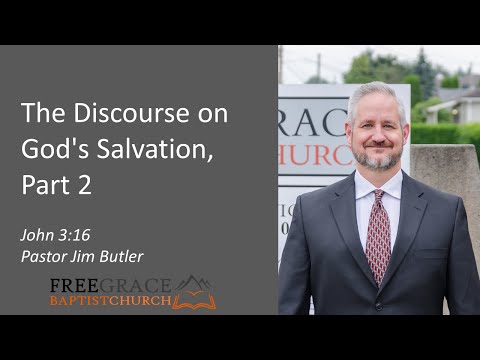
The Discourse on God's Salvation, Part 2
John 3:16 — Luther called it 'the Bible in miniature,' and this exposition treats it as precisely that: a compressed statement of the whole Christian gospel. The sermon moves through three divisions of the verse — the declaration of God's love, the demonstration of that love in the gift of the only begotten Son, and the description of those who receive God's redemptive love through faith. Central to the argument is the insistence that God's love is the source, not the consequence, of the atonement, and that 'the world' in John's vocabulary denotes persons from every tribe and tongue without ethnic distinction, not every individual without exception — a conclusion that grounds particular redemption in the wider theology of John's writings. The sermon closes with a direct appeal to unbelievers: the one way of salvation is to believe on Jesus Christ alone, whose active obedience supplies the righteousness that sinners need and whose substitutionary death removes the condemnation they deserve.

2LCF Chapter 2 - Of God and of the Holy Trinity, Part 3
The doctrine of the Trinity is not a mathematical formula but a carefully defined confession of one divine being eternally subsisting as three distinct persons — Father, Son, and Holy Spirit. This session works through 1689 London Baptist Confession of Faith chapter 2, paragraph 3, examining the unity and equality of the persons, their distinction by eternal relations of origin, and the contemporary crisis caused by the abandonment of eternal generation. The denial of threeness is as heretical as the denial of oneness, and a recovery of Nicene Trinitarianism is essential not only for theological orthodoxy but for the health of the soul and the vitality of corporate worship.

The Crucifixion of Jesus, Part 2
Matthew 27:39–44 records the threefold mockery of Christ on the cross — by passing bystanders, by the chief priests and scribes, and by the robbers crucified alongside him. Each taunt — that he could not save himself, that his kingship was fraudulent, that his claim to divine sonship was false — is shown to be an ironic confirmation of the very things the mockers deny: Christ's identity as temple builder, King of Israel, and Son of God. His refusal to descend from the cross is not weakness but the perfect obedience of the covenant of redemption, the very means by which he saves his people from their sins. The sermon closes with the conversion of the penitent thief as a trophy of sovereign grace and an argument for faith in a willing Savior.

The Enthronement of the Priest-King
Psalm 110, the most frequently cited Old Testament passage in the New Testament, presents the Messiah as the divinely enthroned Priest-King whose universal dominion is secured by the oath of God. This exposition traces three movements in the psalm: the enthronement and government of Christ the King (vv. 1–3), his eternal priesthood after the order of Melchizedek (v. 4), and the triumphant conquest of his enemies (vv. 5–7). The sermon draws on Peter's argument in Acts 2, Paul's application in 1 Corinthians 15 and Ephesians 1, and the author of Hebrews to show that Christ's present session at the right hand of the Father is not passive but active — he reigns, subdues, and intercedes. Christians living in tumultuous times are urged to resist despair by fixing their confidence in the sovereign rule of the enthroned Priest-King rather than in the shifting circumstances of earthly politics.

The Crucifixion of Jesus, Part 1
Matthew 27:32–38 records the crucifixion of the Lord Jesus Christ with studied brevity, and this expository sermon works through each verse to show that every detail — from the place called Golgotha to the division of garments and the charge above his head — is the deliberate fulfillment of Old Testament Scripture, not an accident or afterthought in the plan of God. The sermon traces the thread from the proto-gospel of Genesis 3:15 through the typological head-wounds of Israel's enemies to Christ's death blow against the devil at the place of the skull. Three concluding applications draw out the pastoral weight: the unwitting testimony of Pilate, the triumph of the skull-crushing seed of the woman, and the immeasurable love of the Savior who was stripped naked, numbered with transgressors, and crucified so that his people might be clothed with his righteousness, received in glory, and given everlasting life.

The Testimony of John the Baptist, Part 3
John 1:30–34 records the Baptist's testimony concerning the dignity of Christ's person — his preeminence as the eternal Word who was before John, his anointing with the Spirit without measure for the work of mediation, and his identity as the natural, essential, and eternal Son of God. The sermon traces the Old Testament prophetic background of the Spirit's descent (Isaiah 11, 42, and 61), the active and passive obedience of Christ as the ground of the believer's acceptance before God, and the Baptist's final declaration that this Jesus is the Son of God. From this foundation the preacher draws an urgent gospel application: the same Lamb who takes away sin will visit unbelief with wrath, and the only fitting response is faith in him now.

The Testimony of John the Baptist, Part 2
John 1:29 records the Baptist's singular declaration — 'Behold the Lamb of God who takes away the sin of the world' — a phrase saturated with the weight of Old Testament redemptive history. This sermon works through the theological freight of that title, tracing the Lamb through Genesis 22, Leviticus 16, and Isaiah 53 to show that Christ's mission is substitutionary blood atonement: he takes up the sin of his people in order to take it away entirely. The 'world' from which sin is removed is not every individual without exception but men and women without ethnic or national distinction, saved by grace alone through faith in Christ alone.

The Testimony of John the Baptist, Part 1
John 1:19–28 records the official interrogation of John the Baptist by a delegation sent from Jerusalem to establish his identity and authority. The Baptist's threefold denial — he is not the Christ, not Elijah bodily returned, not the prophet of Deuteronomy 18 — is matched by his positive confession as the voice of Isaiah 40, the forerunner who prepares the way of Yahweh and thereby implicitly confesses the deity of Jesus. The sermon traces the Baptist's testimony through Luke 1's prophecy of Zacharias, the Transfiguration account in Matthew 17, and the prologue of John 1, showing that the Baptist preached not only repentance but the remission of sins through the coming Messiah — that is, justification by faith alone. The governing application is that Christ's people exist to proclaim His preeminence, following the Baptist's model of humble, courageous, light-and-heat ministry that makes nothing of self and everything of Jesus.

The Soldiers Mock Jesus
The mockery of Jesus by the Roman soldiers in Matthew 27:27–31 is examined as a Lord's Supper meditation, tracing the psychological and physical brutality inflicted on the Son of God after Pilate's verdict. The scene is read through the lens of fulfilled prophecy — Isaiah 50:6 and Isaiah 53 — and the covenant of redemption, in which Christ willingly undertook every indignity as the surety and substitute for his people. The sermon closes by turning to the book of Revelation to show that what the soldiers performed in jest — robing, crowning, and hailing a king — Christ possesses in eternal reality, and calls believers to respond with the genuine homage these soldiers withheld.

The Incarnation of the Word, Part 1
John 1:14 — 'the Word became flesh and dwelt among us' — is the hinge on which all Christian theology turns. This exposition works through the identification, the incarnation proper, and the indwelling presence of the Word, establishing that the eternal Son assumed a true human nature (body and soul) without ceasing to be the second person of the Trinity — the doctrine the church confesses as the hypostatic union. The sermon draws on the active and passive obedience of Christ to show that the incarnation was not primarily exemplary but redemptive: the Word took flesh to render the perfect obedience sinners owe and to shed the blood that purchases their forgiveness. Hearers are pressed to see Christ not only as Redeemer but as reigning King, and the unbeliever is called to receive, by faith alone, that righteousness which comes from God.