
Theological term
Covenant of Grace
848 sermons · All terms

Stephen's Defense, Part 6

Acts 7:37–43 records Stephen's appeal to the wilderness generation as the climax of his defense before the Sanhedrin, demonstrating that Israel's persistent idolatry — not Stephen's teaching — represents the true rejection of Moses and of God. Stephen cites Deuteronomy 18:15 to show that Moses himself predicted the coming of Christ, the prophet like Moses, so that the council's rejection of Jesus is simultaneously a rejection of Moses and of the living God who sent him. The sermon traces Israel's descent from refusing Moses' word, to fashioning the golden calf, to God judicially giving them over to worship the host of heaven, drawing a direct line from Exodus 32 through Amos 5 to the very council Stephen addresses. The practical summons is double: flee idolatry in all its forms, whether tangible or inward, and flee to the God who, even in righteous judgment, remains ready to pardon.

Free Grace Baptist Church - March 13, 2019 Bible Study
Genesis 15 presents the Abrahamic covenant in two movements: the reiteration of God's promise of seed and land to a childless and landless Abram (vv. 1–6), and the solemn ratification of that covenant through a self-maledictory oath ceremony (vv. 7–17). Verse 6 — 'he believed in the Lord, and He accounted it to him for righteousness' — is expounded as the locus classicus of justification by faith alone, with faith understood as the empty instrument that receives an alien righteousness imputed from Christ, not a meritorious work brought to God. The unilateral passing of the divine presence between the animal pieces is shown to anticipate Calvary, where Christ became the curse for covenant-breakers, sealing in blood what God swore to Abraham.

The Christian Mother
Proverbs 31:28–30 sets forth the fear of the Lord as the defining virtue of a godly mother — the root from which her influence, authority, and responsibility toward her children flow. The sermon works through four observations: her condition before God (saved by grace and walking in the fear of Yahweh), her God-given influence over her children, her God-given authority over her children (grounded in the fifth commandment), and her responsibility to instruct, set an example, and discipline them. Fathers are called to honor and encourage their wives, children to express gratitude, and mothers to persevere in a calling that is difficult, often thankless, and of the utmost importance.

The Inclusion of Wretches in God's Covenant
Ephesians 2:1–10 presents the full arc of redemption — from the total deadness of sinners to their gracious vivification in Christ — and this exposition traces that arc through the origin, objects, and execution of salvation. The sermon grounds the covenant of grace in the prior covenant of redemption (Ephesians 1:3–14), showing that the Father's election, the Son's redemption, and the Spirit's sealing together exclude every contribution of the sinner. Salvation is by grace alone through faith alone, with faith itself a gift conveyed by God to the spiritually dead — not a human instrument brought to the table that God then rewards. The exposition closes by distinguishing justification from sanctification and warning against both Roman Catholic and Federal Vision distortions of grace, anchoring the believer's final acceptance before God solely in the active and passive obedience of Christ.

Stephen's Defense, Part 4
Stephen's defense before the Sanhedrin in Acts 7:17–29 centers on the birth, education, and first visits of Moses to his enslaved brethren — a narrative Stephen deploys not to instruct the Council in history they already knew, but to indict them for repeating the same rejection of God's appointed deliverer. The sermon traces two structural pillars: God's sovereign faithfulness to Abrahamic covenant promises across four centuries of bondage, and Israel's willful incomprehension of Moses as the pattern for the Sanhedrin's rejection of Jesus. The typological connection is explicit — Moses as redeemer-reconciler rejected by those he came to save is the Old Testament shadow of Christ rejected by the very people who claimed allegiance to Moses. Hearers are called to resist the impulse to drive away the deliverer and instead flee to the Lord Christ, in whom all the promises of God find their yes and amen.

Stephen's Defense, Part 2
Stephen's defense before the Sanhedrin in Acts 7:2–8 turns on a redemptive-historical reading of Abraham that dismantles the charges of blasphemy against the law and the temple. The sermon traces three movements: the call of Abraham (vv. 1–4), the promise of land and descendants made to a childless man (vv. 5–7), and the covenant of circumcision (v. 8). Central to the exposition is the argument that God appeared to Abraham outside the land and apart from any temple, that both circumcision and temple find their terminus in Christ, and that Abraham's justification was by faith alone — his obedience being the fruit, never the ground, of that faith. Listeners are urged to trust not in any outward religious token but in the God of Abraham who sent his Son to fulfill every covenantal obligation his people could not meet.

Genesis 13:1-18
Genesis 13 presents the separation of Abram and Lot as a sustained contrast between faith-driven generosity and sight-driven selfishness. Abram, though possessing the divine promise of the land, voluntarily surrenders his claim to preference and offers Lot first choice — a posture the New Testament repeatedly commends and commands. Lot's eastward movement toward Sodom illustrates the peril of choosing by the physical eye alone, while God's subsequent renewal of the covenant promise to Abram shows that the Word of God is the appointed remedy for the grief that faithfulness can cost. The sermon traces these Abrahamic land and seed promises through Joshua, the Psalms, Isaiah, and the New Testament epistles to demonstrate that their ultimate fulfillment is not territorial but cosmic — in Christ as heir of the world and in a redeemed multitude from every tribe and tongue and nation.

The Dedication of the Temple
Solomon's dedicatory prayer in 1 Kings 8:22–53 is examined as a model of theological depth and dependent petition. The prayer opens by rehearsing God's incomparability, faithfulness, transcendence, and imminence — attributes that ground every request that follows. Six petitions structured around covenant curse and restoration (Leviticus 26; Deuteronomy 28) demonstrate that forgiveness is the central burden of the prayer, and that affliction is a designed instrument for drawing God's people back to dependence on Him. Practical applications press the congregation toward reverent worship, heart-obedience rooted in justification by Christ's righteousness alone, daily confession of sin, and confidence in God's unfailing covenant fidelity.

Genesis 12:1-9
Genesis 12:1–9 presents the call of Abram as a programmatic text establishing God's covenantal plan of redemption, standing alongside Genesis 3:15 and Genesis 9:25–27 as a divinely initiated response to the human disaster of the fall and its aftermath. The sermon works through three movements: the grace of God in the call itself, the threefold promise of land, seed, and blessing in verses 2–3, and Abram's faith-driven obedience and worship in verses 4–9. Against dispensationalist readings, the land promise is shown to find its fulfillment not in a reconstituted geopolitical Israel but in Christ as heir of the world, with the seed promise identified in Galatians 3 as Christ himself and all who are united to him by faith. The listener is called to see in Abram's departure from country, family, and father's house a typological pattern for what occurs in every genuine conversion — the forsaking of former allegiances in the embrace of the living God.

The Condemnation of Heartless Worship
Malachi 1:6–14 exposes a pattern of heartless worship among the priests and people of Israel who offered blind, lame, and stolen animals on God's altar — defective sacrifices that expressed contempt for God's table without a word being spoken. The sermon traces the prophetic structure of divine accusation, petulant human question, and divine refutation, then draws four implications: heartless worship is evil, it is common even among the redeemed, it reduces religion to external formalism, and it provokes the judgment of God. The application turns on the regulative principle of worship — that God alone defines acceptable approach to himself — and calls believers to pursue good theology, responsible leadership, and biblical worship, while calling the unconverted to look by faith to the Lamb of God.
The Glory of the Father and the Son
John 17:1–5 opens Christ's high priestly prayer with a petition that the Father glorify the Son so that the Son may glorify the Father — a reciprocal glorification whose goal is the glory of God Most High. The sermon works through three grounds for this petition: the salvation of the elect given to the Son in the covenant of redemption, the accomplishment of Christ's active and passive obedience as the basis of justification, and the restoration of the Son's pre-incarnate glory. The full deity of Christ is defended against subordinationist readings by surveying New Testament texts where the title theos is applied directly to Jesus, and the sermon closes with the call to pursue the knowledge of God and Christ as the very essence of eternal life — through Scripture reading, prayer, and faithful attendance upon the means of grace.

The Male Child and the Dragon
Revelation 12 presents Christ as the decisive victor over Satan, tracing the dragon's fourfold defeat from the incarnation through the casting out of heaven to his continuing failed campaigns against the church. The chapter is read through the lens of Genesis 3:15 and its fulfillment in Christ's crosswork: the male child escapes the serpent's grasp, is caught up to God's throne, and the accuser is cast down by virtue of Calvary. Satan's ongoing rage against the church is not a sign of his power but of his desperation — a conquered enemy making war against those he cannot ultimately destroy. The people of God are called to understand that suffering under satanic opposition identifies them with Christ's own suffering and conforms them to his image, not to despair but to faith in the one who has already overcome.

The Royal Purpose in the Incarnation
John 18:37 records Jesus declaring before Pontius Pilate, 'For this cause I was born,' identifying the incarnation with a royal purpose — he entered the world as king. This sermon expounds John 18:33–40, tracing the nature of Christ's kingdom (not originating from this world, yet encompassing it), the method by which that kingdom advances (through truth, not military force), and the prophecy of Isaiah 9:6–7 that illuminates both the king and his everlasting dominion. The listener is called to receive the truth Christ embodies rather than dismiss it as Pilate did.

Remembered in the Land

Genesis 22:20–23:20 records the death of Sarah, Abraham's purchase of the cave of Machpelah, and the first parcel of land the patriarch ever owned in Canaan. The sermon unfolds under three headings — God's people pass, wander, and dwell — showing that even in the silence of ordinary providence, where God's name goes unmentioned, he is keeping covenant by securing a burial place in the promised land. Christians still mourn, still sojourn as exiles in this age, but the purchase of Machpelah points forward to the resurrection hope Abraham already believed, a hope now confirmed on the far side of Christ's coming.

Bond or Free
Galatians 4:21–31 presents the contrast between Hagar and Sarah as Paul's climactic illustration of the two mutually exclusive ways of standing before God: righteousness by law-keeping and righteousness by faith. Working through the passage under three headings — the illustration described, explained, and applied — the sermon argues that the Judaizers' demand for circumcision and law-observance is a return to the bondage of Mount Sinai, while all who believe in Christ belong to the Jerusalem above, the free woman, born of promise through the Spirit. Listeners are warned against the perpetual temptation to add anything to justification by faith alone, and are called to stand fast in the liberty Christ has secured for his people.

Everlasting Mercy
Psalm 118, the climax of the Egyptian Hallel (Psalms 113–118), is a song of thanksgiving for God's enduring covenant mercy (hesed), sung at Passover to celebrate divine deliverance. The sermon traces three movements in the psalm — God's enduring mercy, God's enduring faithfulness, and God's enduring praise — reading the whole through the lens of its New Testament fulfillment in Jesus Christ, who is the rejected stone become chief cornerstone. The exposition draws out how Christ accomplishes the true Exodus, delivering his people from bondage to sin, and calls hearers to trust in him as the only foundation of salvation, anticipating his second coming with praise rather than judgment.

The Dying Thief and the Prince of Life

The crucifixion scene of Luke 23:38–43 presents three voices: the cursed robber who reviles Christ to his last breath, the dying thief who exercises remarkable faith in a bloodied and apparently defeated king, and the Prince of Life who responds with sovereign assurance. This sermon exposition focuses on Christ's words to the thief — 'Assuredly, I say to you, today you will be with me in paradise' — unpacking the divine promise, immutable love, and perfection of Christ's blood and righteousness that undergird that assurance. The confession of faith's teaching on the perseverance and assurance of the saints illuminates why the thief's salvation is certain, and the same certainty belongs to all who believe on the Lord Jesus Christ.

The Divine Provision of Eternal Life
Isaiah 55 presents God's gracious and urgent invitation to sinners to receive the fullness of salvation — the refreshment, gladness, and nourishment of the gospel — entirely without cost, because the suffering servant of Isaiah 53 has already satisfied the purchase price. The sermon expounds the chapter in two movements: the invitation to come (vv. 1–5), grounded in the new covenant and secured by the Davidic king, and the call to faith and repentance (vv. 6–13), sustained by the sovereign power of God's Word. Believers are urged to treasure the abundance of every spiritual blessing already given in Christ, and unbelievers are warned not to squander their lives on what cannot satisfy while the Lord may yet be found.
The Imprisonment and Release of the Apostles
Acts 5:17–26 records the arrest, miraculous release, and re-arrest of the apostles at the hands of a Sanhedrin dominated by Sadducees — the very men who denied the existence of angels. The angel who opens the prison doors and the apostles who immediately return to temple preaching together demonstrate that no earthly authority can silence the gospel of Jesus Christ. This passage is treated as a paradigm for the church's experience throughout history: faithful proclamation will always draw persecution, yet Christ is building His church and the gates of hell shall not prevail against it. The sermon calls hearers to remember the globally persecuted church, to pursue the boldness of the apostles, and to believe the words of this life — the gospel of forgiveness and imputed righteousness in Christ.

Genesis 9:8-28
Genesis 9:8–28 divides into two sections: God's establishment of the Noahic Covenant with its sign of the rainbow, and the sin of Ham with the subsequent prophetic curse upon Canaan and blessing upon Shem and Japheth. The Noahic Covenant is identified as a common grace covenant securing the stability of the created order so that the covenant of grace may be proclaimed. Noah's prophetic pronouncement in verses 25–27 is treated as programmatic for redemptive history, tracing the two seeds of Genesis 3:15 through the flood into the post-diluvian world, culminating in the Gentile inclusion foreshadowed by 'Japheth dwelling in the tents of Shem' and confirmed at the Jerusalem Council in Acts 15.
Genesis 9:1-7
Genesis 9:1–7 establishes the Noahic Covenant, which mandates capital punishment as a universal and perpetual ordinance rooted in the image of God — not merely an Old Covenant provision for Israel. This study addresses common biblical objections (Exodus 20:13, Matthew 5:38–42, John 8) and pragmatic objections (deterrence, innocence, forgiveness), arguing that none successfully overthrow the divine mandate of Genesis 9:6, which is confirmed and not abrogated by the New Testament. The session urges listeners to think carefully from Scripture rather than from cultural sentiment, trusting that God's law concerning criminal justice reflects his character and serves the stability of the created order.
Genesis 9:1-17
Genesis 9:1–17 records the establishment of the Noahic covenant, a common grace covenant God makes with all flesh — universal in scope and perpetual in duration — to preserve the created order as the stage for the proclamation of the gospel. The passage divides into the covenant's stipulations (vv. 1–7) and its sign (vv. 8–17), with the stipulations covering the propagation of life, provision through diet, and the protection of life via capital punishment. The theological ground of the death penalty is the image of God: to murder a man is to assault the divine image, and the only commensurate response is execution by the civil magistrate. Romans 13:1–4 confirms that this mandate is not confined to the Mosaic economy but continues wherever civil government wields the sword as God's appointed avenger.

Reasons to Thank God
Psalm 103 summons the soul to deliberate, comprehensive praise — not as a once-yearly exercise but as the daily discipline of the redeemed. Working through David's three-part structure (the reminder to bless God, the reasons to bless God, and the exhortation to bless God), this exposition traces the spiritual and temporal gifts catalogued in the psalm, dwelling especially on the infinite, thorough, tender, sympathetic, and enduring character of divine mercy. The sermon warns that forgetfulness of God's benefits — as Deuteronomy repeatedly demonstrates — is the seedbed of apostasy, and it closes with a call to find in the cross of Christ the only sure foundation for a life of grateful blessing.

Genesis 8:1-22
Genesis 8 records the abatement of the flood, the exit of Noah's family from the ark, and God's covenantal promise never again to destroy every living creature by water. The chapter is structured as a mirror image of chapter 7: everything that came upon the earth in judgment now reverses in restoration. Noah's first act upon leaving the ark is not to secure food or shelter but to build an altar and offer burnt offerings — the response of a man who walks with God by grace through faith. God's promise in verses 21–22 establishes what will be developed in chapter 9 as the Noahic Covenant, a common-grace covenant that stabilises the created order so that God's redemptive purposes may unfold until Christ comes to deal definitively with sin.

Free Grace Baptist Church - September 30, 2018 PM
Psalm 143 confronts the fundamental problem of human unrighteousness: in God's sight no one living is righteous, and David's only refuge is not his own covenant faithfulness but God's righteousness, faithfulness, and hesed. The sermon traces David's two movements — his appeal to God's righteousness in the face of a crushed soul (vv. 1–6) and his petitions for God's guidance as a troubled servant (vv. 7–12) — showing that both sections keep the focus relentlessly on who God is rather than on the psalmist's circumstances. Luther's description of Psalm 143 as a Pauline psalm is vindicated by Paul's verbal allusion in Romans 3:20, where the same confession that no flesh is justified by works of the law becomes the pivot to the righteousness of God through faith in Jesus Christ. The sermon calls believers to let their prayers be preoccupied with God's character and Christ's imputed righteousness rather than their own merit, and invites the unbeliever to look to Christ for a righteousness entirely outside themselves.

Genesis 7:1-24
Genesis 7 records the command to enter the ark and the arrival of the floodwaters — a worldwide, catastrophic judgment of God upon all flesh outside the ark, and a sovereign act of divine preservation for Noah and his household. The flood is not myth or moral fable but datable history, rooted in the protoevangelium of Genesis 3:15: God preserves the seed of the woman so that Messiah may come. Noah's righteousness did not merit God's grace; rather, grace preceded and produced the faith that issued in obedience, with justification preceding sanctification — a pattern consistent throughout both Testaments. The ark stands as a type of Christ, the refuge for all of God's Noahs, and the passage calls believers to the same costly, faithful obedience Noah displayed in a faithless world.

The Blessedness of Belonging to Our Shepherd

Psalm 23 is among the most familiar passages in Scripture, yet its very familiarity can breed inattention to the depth of its claims. This exposition works through the psalm under four heads — God's provision, God's protection, God's consolation, and God's presence — showing that these blessings belong specifically and personally to all who belong to the Lord as his sheep, not to the world at large. The sermon presses the hearer to be consciously and consistently aware of this blessedness in the light of Christ, the Good Shepherd who laid down his life for the sheep, and closes with a direct call to the unconverted to hear his voice and believe.

Free Grace Baptist Church - September 19, 2018 Bible Study
Genesis 6:8–22 presents the flood narrative not primarily as natural history but as a theological tableau of human depravity, divine justice, and sovereign grace. The passage establishes a foundational biblical pattern: grace precedes and produces righteous conduct, so that Noah is not found righteous because he earned grace, but rather found blameless because God first granted him grace. The sermon traces the stark literary contrast between Noah, a man made just by divine mercy, and an earth filled with corruption and violence ripe for God's wrathful judgment, while drawing typological connections between Noah as a second Adam and the Ark as a figure of Christ, the shelter from divine wrath. Hearers are called to recognise that the same grace operative in Noah is the only distinction between the redeemed and the condemned, and to remain faithful in a faithless generation by looking beyond present trials to the God who sovereignly guides his people through judgment to life.
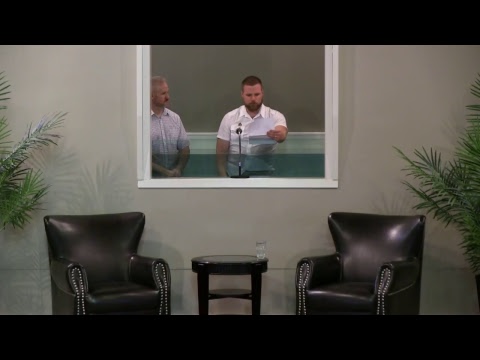
Livestream - Baptism: Wim Kerkhoff
Acts 8:26–40 records the conversion and baptism of the Ethiopian eunuch, and this exposition sets that account against its Old Testament backdrop in Isaiah 53 and Isaiah 56 to show that what is happening is not merely one man's conversion but the fulfillment of covenant promises: the inclusion of those doubly excluded from the assembly of Israel. The sermon works through three movements — the divine appointment of the contact, the gospel communication beginning from Isaiah 53, and the conversion issuing in immediate baptism upon confession of faith. The central application is that God is characteristically and eagerly a saving God, that believers' baptism follows faith as its ordained external sign, and that no sinner — whether powerful or poor, crisis-converted or quietly brought to faith — is beyond the reach of sovereign grace.

Genesis 5:1-32
Genesis 5 presents the genealogy of Adam through the godly line of Seth, tracing the covenant community from creation to Noah and ultimately to the Lord Jesus Christ. The relentless refrain 'and he died' across eight patriarchs confirms the execution of the curse pronounced in Genesis 3, while the singular exception of Enoch — who walked with God and was translated without death — serves as a visible foretaste of resurrection and eternal life. Walking with God, as Enoch's life demonstrates, is not reserved for extraordinary vocations but is the calling of every believer in every station of life, actuated by faith in Christ and ordered by the law of God as the rule of life.