
Theological term
Church Discipline
64 sermons · All terms

The Exhortation to Wage the Good Warfare

The closing verses of 1 Timothy 1 resume Paul's charge to Timothy to wage the good warfare against false teaching in Ephesus. This exposition works through two movements: the charge itself (vv. 18–19a), grounded in Timothy's apostolic authority and prophetic calling, and the conflict that necessitates it (vv. 19b–20), illustrated in the defection and discipline of Hymenaeus and Alexander. The sermon argues that gospel ministry in every age requires holding the objective content of the Christian faith, maintaining a good conscience, and exercising church discipline against those who blaspheme by contradicting the truth of Christ.

Ask FGBC #61: Conviction of Sin Before or After Regeneration?
The question of whether conviction of sin precedes or follows faith is examined through the lens of the ordo salutis. Conviction of sin necessarily precedes faith because without it the sinner would see no need for Christ, yet Scripture nowhere prescribes a fixed period of misery as a prerequisite for receiving the gift of faith. Conversion is the divine bestowal of the graces of faith and repentance together, not a staged sequence in which the sinner must accumulate sufficient guilt before God acts. The call of the gospel is not prolonged self-examination but immediate flight to Christ, and the doctrine of presumption that keeps sinners in unnecessary bondage is a Catholic, not Protestant, imposition on the gospel promise.

Ask FGBC #57: What Are the Requirements for Church Membership?
Church membership is not named by a single proof-text, yet the New Testament data — the numbered and joinable Jerusalem church, the bounded authority of pastors, the mutual accountability of members, and the discipline procedure of Matthew 18 — together demand a formal, local church membership. The prerequisites a confessional Reformed Baptist church may rightly require are a credible profession of faith, baptism by immersion, a general understanding of the confession of faith, a willingness to submit to the church's doctrine and government, and familiarity with its constitution and bylaws. A published confession of faith protects both the church and prospective members by ensuring honest communication of what the church believes before anyone commits to join. The question of young believers and membership is handled on a case-by-case basis, with no principled bar to admitting a child who has professed faith and been baptized.

Ask FGBC #56: When Should a Believer Be Baptized?
Baptism should follow faith without unnecessary delay — this is the consistent pattern of the book of Acts and a direct command of the exalted Christ. Drawing on texts from Acts 2, 8, 9, 10, and 16, the speaker argues that the New Testament knows no extended waiting period between conversion and baptism, and that believers' baptism by immersion is the only mode consistent with the Acts narratives. Practical obstacles — fear of family disapproval, prior infant baptism, or a desire to feel spiritually ready — are weighed against the clear divine imperative to believe and be baptized, and are found wanting. The closing exhortation is simple: read Acts, see what new believers did, and obey the same command.
The Exhortation to Perseverance and Unity
Philippians 4:1–3 sets before the church two inseparable obligations: standing fast in the Lord and pursuing unity among the saints. Working through the apostle's affection for the Philippians, his call to perseverance, and the concrete dispute between Euodia and Syntyche, this sermon shows that the absence of unity both destroys the church and renders perseverance a near-impossible task. The biblical remedy for conflict — private confrontation, appeal to witnesses, and involvement of the church — is traced from Proverbs 18 and Matthew 18:15–20, with a complementarian reading of 1 Timothy 2 clarifying the nature of Euodia and Syntyche's gospel labor. Hearers are called to fasten their grips on Christ, his doctrines, and one another for the long haul of the Christian life.

What Is Faith? When Should I Be Baptized? & more| Ask FGBC Batch 6
This Q&A episode from a confessional Reformed Baptist church addresses twelve questions spanning baptism, faith, church membership, Scripture interpretation, seminary training, and the heresies of Federal Vision and Baxterianism. Particular attention is given to the definition of saving faith — distinguishing the objective content of the faith from the act of believing, warning against loading faith with feelings, faithfulness, or love as its ground, and insisting that faith is the empty instrument through which God-given grace lays hold of Christ alone. The episode closes with treatments of conviction of sin, catechetical instruction of children, and the importance of an educated ministry.

The Ninth Commandment
The Ninth Commandment — 'You shall not bear false witness against your neighbor' (Deuteronomy 5:20) — addresses first and foremost the crime of perjury in a judicial context, then extends by implication to every form of falsehood: lying, slander, backbiting, gossip, and tailbearing. Working through Deuteronomy 19:15–21, the study examines the biblical lex talionis applied to false witnesses, where the perjurer receives the same penalty he sought to bring upon the accused, and draws out the retributive and deterrent logic of Old Covenant judicial law. The positive requirement of the commandment — the sanctity of truth in all areas of life — is traced through Leviticus 19, Proverbs, Romans 1, and the Westminster Larger Catechism's exhaustive treatment of sins against the ninth commandment. Hearers are called to active and passive faithfulness: neither speaking falsehood nor lending an ear to those who do.

The Appearance of Christ to the Disciples
John 20:19–23 presents two interlocking realities: the presence of the risen Christ among His fearful disciples on the first day of the week, and the commission He gives them to carry His gospel into the world. The peace Christ pronounces is not a generic greeting but the fruit of His atoning wounds — the satisfaction of divine justice that reconciles guilty sinners to God. From this the sermon argues that the church's entire mission is delimited by Christ's own sending: not entertainment, social uplift, or political activism, but the proclamation of the forgiveness of sins through the crucified and risen Lord, empowered by the promised Holy Spirit.
The Use of the 2nd London Confession
A confession of faith is not a human addition to Scripture but a tool the church uses to define, defend, discriminate, discipline, and delimit its doctrine. Drawing on passages from the Pastoral Epistles, Jude, and Ephesians 4, this Sunday School address argues that the Second London Baptist Confession of 1689 serves the local church in six concrete ways: it establishes doctrinal boundaries, equips members for apologetics, vets candidates for ministry, grounds church discipline, protects Christian liberty by identifying what lies outside its purview, and anchors the church in the catholicity of the Reformed tradition. The session closes with a call to reject autonomous biblicism in favour of confessional theology understood as the fruit of the Spirit's ongoing work in the teaching ministry of Christ's church.

Ask FGBC #37: Why join a church?
Church membership is not optional for the Christian: Scripture commands gathering together, pastoral ministry presupposes a definable flock, and the means of grace — preaching, baptism, the Lord's Supper, mutual accountability, and church discipline — are administered within the bounds of a local, covenanted congregation. The question of why one should formally join a church is answered first by the authority of God's command, and then by the necessarily local character of the duties owed between members and their pastors. Those who have been hurt by church abuse are exhorted not to abandon the institution but to find a congregation where they can commit themselves as members.

The Authority of the Church
Christ's promise in Matthew 16:19 to give 'the keys of the kingdom of heaven' to the church raises two perennial dangers: authoritarian abuse of ecclesiastical power and the outright abdication of it. This sermon expounds the identity of those entrusted with these keys (apostles, elders, and the gathered congregation together), the nature of the authority delegated (binding and loosing through preaching and discipline), and the proper ground of confidence when the church acts — not sacerdotal infallibility, but the assurance that heaven ratifies the church's faithful obedience to Scripture. The practical conclusion is that the keys are exercised through the proclamation of the Word, the admission and exclusion of members, and the administration of the sacraments — never through entertainment, self-help, or moral do-goodery.

The Penalty for Blasphemy
Leviticus 24 addresses both the daily obligations of tabernacle worship and the capital penalty for blasphemy, grounding each in the direct speech of God to Moses. The chapter's narrative pivot — an incident in which a man of mixed Israelite and Egyptian descent blasphemes the name of Yahweh — becomes the occasion for case-law application of the third commandment, surrounded by reminders of the lex talionis and the equal accountability of stranger and native-born alike. The typological furniture of the holy place (lampstand and showbread) points forward to Christ as the true light and bread of life, while the blasphemy legislation, with its witness requirements and retributive principle, reveals a God who guards his own honour and structures justice with both severity and safeguard. The sermon exhorts hearers to put away every profane use of the divine name and to cultivate a reverent, wholehearted employment of it in thought, word, and worship.

Death Penalty, Part 3
Romans 13:1–7 furnishes the New Testament's clearest warrant for civil government bearing the sword, including capital punishment — yet common objections, both biblical and pragmatic, continue to challenge this teaching. This third installment of a study arising from Leviticus 20 addresses the two most significant biblical objections: the pacifist misreading of Matthew 5:38–42 and the attempt to leverage John 8:1–11 against lawful execution. The sermon argues that Jesus in the Sermon on the Mount is correcting the misapplication of the lex talionis to personal relationships, not dismantling civil jurisprudence, and that his handling of the woman caught in adultery actually upholds Mosaic evidentiary law rather than nullifying capital punishment. Five pragmatic objections — that the death penalty is incompatible with Christian forgiveness, lacks mercy, risks executing the innocent, fails to deter, and forecloses salvation — are each answered from Scripture and reason.

The Triumph of the Church
Matthew 16:13–18 presents three interlocking realities about Christ and his church: the identity of Christ confessed by Simon Peter, the divine source of that confession, and the indestructible promise Christ appends to his church. The rock upon which the church is built is not Peter's person but the Christ Peter confessed — the second person of the triune God who assumed humanity, died, and rose for his people. Christ himself is the builder, foundation, and protector of the church, which means the gates of Hades assault the church not as a conquering force but as a defensive one being overrun by the church's gospel advance. The practical summons is for the church to fulfil her three marks — the preaching of the word, the administration of the sacraments, and the exercise of discipline — with the confidence that Christ's triumphant headship guarantees the church's survival into the eschaton.

Introduction to the 1677/1789 2nd London Baptist Confession of Faith
The 1689 London Baptist Confession of Faith — formally composed in 1677 and adopted by particular Baptist churches in 1689 — stands in deliberate continuity with the Westminster Confession and the Savoy Declaration, adapting their language to reflect distinctively Baptist convictions while maintaining solidarity with the broader Reformed tradition. This introductory session traces the Confession's historical origins, its relationship to the First London Confession of 1644–46, and the legal and ecclesiastical context in which particular Baptists operated under the Act of Toleration. Six reasons are then advanced for why a 21st-century church should subscribe to a 17th-century confession: to define, defend, discriminate, discipline, distinguish matters of Christian liberty, and develop an appreciation for the history of the church. The session closes by urging that confessionalism, rightly understood, is not proud biblicism but the humble reception of gifts Christ has given to his church across the ages.

The Conduct of the New Man, Part 2
Ephesians 4:29–32 calls believers to put off corrupt speech and bitter dispositions and to put on edifying words and a forgiving heart — not as conditions for salvation, but as conduct that flows necessarily from it. The sermon exposits the structure of Paul's exhortations: a prohibition, a positive exhortation, and a motivation in each subsection. Corrupt speech grieves the Holy Spirit, who has sealed believers for the day of redemption; and bitterness, wrath, clamor, and evil speaking are symptoms of the old man that must be mortified. The sermon closes with the ground of all Christian forgiveness: God in Christ has already forgiven us, and that forgiveness is the cause, not the goal, of our forgiveness toward others.

2LCF Chapter 26 - Of the Church, Part 2
The nature, governance, and life of the local church are expounded through 2LCF Chapter 26, paragraphs 5–15, a section that goes beyond the Westminster Confession of Faith and draws largely from the Congregationalist Savoy Declaration. The eleven paragraphs treat the Trinitarian foundation of the church, the regenerate membership required for entrance, congregational church polity, the two permanent offices of elder and deacon, the financial responsibility of churches toward their pastors, and the associational communion of independent churches. Christians are called to join themselves to particular churches, submit to both the privileges and discipline of those churches, and rest patiently in Christ's providential governance when offenses arise within the assembly.

2LCF Chapter 26 - Of the Church, Part 1
What is the church, and who governs it? This confession study works through 2LCF Chapter 26, paragraphs 1–4, examining the universal (catholic) church: its election-grounded identity, its visible and invisible dimensions, the perpetuity of Christ's kingdom despite the inevitable mixture and error found in even the purest churches, and the exclusive headship of the Lord Jesus Christ over his body. The session challenges both Landmark Baptist denials of a universal church and Roman Catholic claims to papal headship, grounding ecclesiology in the confession of Christ as Son of the living God as articulated in Matthew 16.

The Prohibition Against Judgmentalism
Matthew 7:1–5 is among the most frequently misapplied texts in Scripture, routinely weaponised to silence any and all Christian judgment. This sermon from the Sermon on the Mount demonstrates that Christ's prohibition targets not judgment as such but the censorious, fault-finding, hypercritical spirit endemic to the Pharisees and to fallen human nature generally. The preacher surveys five legitimate spheres of Christian judgment — identifying false teachers, exercising church discipline, addressing sins of elders, and rendering civil judgments — before expositing the speck-and-plank illustration as Christ's indictment of hypocrisy. The sermon closes with practical counsel for mortifying judgmentalism through dependence on the Holy Spirit, the pursuit of humility, and a right understanding of remaining corruption in oneself and in one's neighbour.

The 9th Commandment, Part 2
James 1:26 places the ninth commandment's prohibition of false witness directly inside the local church: a professing believer who does not bridle his tongue deceives himself, and his religion is exposed as useless — the same Greek word applied to idolatry. The sermon surveys the tongue's destructive power across James 3–4, Matthew 12 and 15, and a wide range of Proverbs texts, arguing that sins of speech are systematically undertriaged in the church compared to sins of action. Ten practical helps are offered, grounded in the conviction that taming the tongue is a fruit of genuine saving faith and requires the enabling power of the Holy Spirit working through the ordinary means of grace.

The Qualifications of Elders, Part 4
The elder's qualification 'able to teach' (1 Timothy 3:2) is not an arbitrary requirement but the inevitable expression of a word-centered religion. This sermon traces the centrality of the proclaimed Word from the Mosaic covenant through the prophetic institution, the earthly ministry of Christ, the apostolic mission, and the pastoral epistles, demonstrating that teaching and governing in the church have always been inseparable. The third main point applies this theology practically: men aspiring to eldership must demonstrate proven faithfulness as churchmen before the church recognizes, tests, and formally approves them by common suffrage according to 2nd London Confession chapter 26, paragraph 9.

The Call to Faithfulness in Perilous Times
Paul's warning in 2 Timothy 3:1–9 concerns not pagan opposition but a more dangerous internal threat: professing Christians within the local church who bear the outward form of godliness while denying its power. The sermon works through the passage in four movements — recognising the danger of 'the last days,' identifying the vice list under categories of pride, lovelessness, disobedience, slander, and treachery, heeding the exhortation to withdraw from such persons, and receiving encouragement that their folly will be publicly exposed. The congregation is called to maintain vigilant, doctrinally grounded churchmanship, to agonise over the church's internal corruptions as Ezekiel's faithful remnant did, and to resist both despair and naivety, trusting Christ's promise that the gates of Hades shall not prevail against his church.
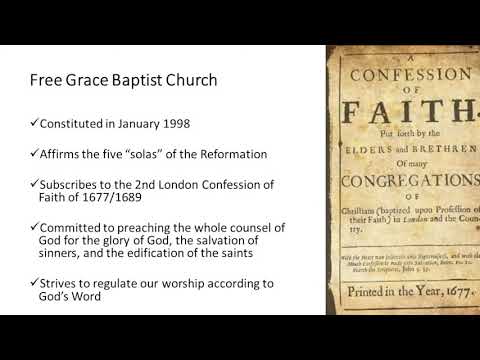
Introduction to the 1689 Second London Baptist Confession of Faith
Why should a church bind itself to a confession of faith? This introductory lesson on the Second London Baptist Confession of 1677/1689 grounds the answer exegetically in Ephesians 4 — where Christ gives gifted men to the church so that the body attains doctrinal unity and is no longer tossed about by every wind of teaching — and then traces the historical origins of the 1689 among the Particular Baptists, distinguishing them from Anabaptists, Presbyterians, and Congregationalists. Four functions of a confession are developed: defining, defending, discriminating, and disciplining with reference to the doctrine of the church. The lesson closes by distinguishing Reformed theology (Calvinism plus covenant theology plus the regulative principle) from mere five-point Calvinism, and by defending the confession's silence on matters of Christian liberty as a feature, not a defect.

How to Treat One Another in the Church

First Timothy 5:1–2 instructs Timothy — and by extension all Christians — on how to treat members of the congregation according to age and gender, framing those relationships by analogy to the family. The sermon grounds this instruction in the Fifth Commandment, drawing on Westminster Larger Catechism questions 124–131 to show that the commandment's scope extends beyond natural parents to all relationships of authority, age, and equality. Pastors must exhort older men as fathers, younger men as brothers, older women as mothers, and younger women as sisters with all purity — avoiding harshness on the one side and laxity or impropriety on the other. The closing application presses the doctrine of adoption: because believers are children of God and joint-heirs with Christ their elder brother, the church is a genuine household, and its members bear mutual responsibility to encourage and bear one another's burdens without waiting for pastoral direction.

The Utility of Confessions and Introduction to the Second London Baptist Confession
Confessions of faith are not competitors to Scripture but are faithful summaries of biblical doctrine, and the church has historically depended on them for good reason. This address introduces the Second London Baptist Confession of 1689, tracing its historical origins among the Particular Baptists of the 17th century and its relationship to the Westminster Confession and the Savoy Declaration. Five interlocking uses of a confession are then examined: defining church doctrine, defending it against error, discriminating between members and officers on doctrinal grounds, disciplining departures from orthodoxy, and distinguishing confessed doctrine from matters of Christian liberty. The goal is not confessional enslavement but confessional clarity — guardrails that protect the church and free her members to worship and grow in the grace and knowledge of Christ.

Waging the Good War
First Timothy 1:18–20 charges Timothy to wage the good warfare of the Christian faith, grounded in faith and a good conscience. This exposition identifies two weapons of the faithful minister—trust in the living God and a conscience calibrated by sound doctrine—set against the backdrop of false teachers who have shipwrecked the faith by rejecting the gospel of free and sovereign grace. The sermon then turns to the solemn consequence of neglecting that warfare, tracing the excommunication of Hymenaeus and Alexander as a case study in church discipline executed for the purity of the church and the potential restoration of the offender. Hearers are pressed to examine whether they possess genuine discernment regarding the gospel and genuine sensitivity toward sin, waging the warfare not to earn salvation but in response to the grace already secured in Christ.

The Rejection of Heretics
Titus 3:9–15 closes Paul's letter to Titus with a sharp command to avoid unprofitable disputes and to reject the divisive man — a command the broader pastoral epistles and the apostolic witness consistently reinforce. The sermon distinguishes heresy from damnable heresy, identifying denial of the Trinity, the hypostatic union, and justification by faith alone as the errors that condemn, while pressing the church not to confuse the struggling saint with the proud, self-serving false teacher. Church discipline for doctrinal error is treated with the same gravity as discipline for moral sin, and the concluding emphasis on good works is grounded in the confession that such works are the fruits and evidences of a true and lively faith, not the grounds of justification.

The Refutation of Heretics
Titus 1:10–16 identifies the threat posed by false teachers within the churches of Crete, describes their character and conduct, and prescribes the elder's task of refuting them. The passage exposes these men as insubordinate, deceptive, motivated by greed, and — paradoxically — more deeply defiled by their very attempts at self-imposed purity. Purity belongs not to those who abstain from foods under defunct old-covenant categories, but to those cleansed by the blood of Christ; any effort to supplement Christ's merit by legal observance strips away that merit entirely. The sermon closes with a call to robust ecclesiology: biblically qualified elders are the God-ordained safeguard against heresy, and the gospel that went to Crete proves that Christ is a real Savior for real sinners.

The Ninth Commandment
The Ninth Commandment—'You shall not bear false witness against your neighbor' (Deuteronomy 5:20)—extends far beyond courtroom perjury to govern every word spoken about another person. This sermon works through the prohibition in two directions: first, the specific offenses the commandment forbids (perjury, lying, slander, gossip, and tailbearing, including both their active propagation and their passive reception); second, the positive duties the commandment requires (truth-telling under oath, honest speech in all of life, charitable restraint, and the active discouragement of slanderers). Because no hearer perfectly fulfils Psalm 15's portrait of the righteous man, the sermon closes by directing the conscience to Christ, whose active obedience and atoning death cover the very sins of the tongue that the law condemns.

The Apostle Peter and Simon Magus
Acts 8:18–25 presents one of Scripture's most debated conversion accounts: Simon Magus, a former sorcerer who professed faith and was baptized, then attempted to purchase apostolic power with money. This exposition traces Peter's sharp rebuke — 'your money perish with you' — through its Old Testament resonances in Deuteronomy 29 and Proverbs 5, while weighing the evidence on both sides of the question of Simon's genuine conversion. The sermon concludes that the deeper question Acts 8 presses is not Simon's eternal state but the hearer's own: whether they have come to know the Christ who forgives wickedness, grants repentance, and receives every sinner who comes to him.