

58 sermons · All speakers

Psalm 13
Psalm 13 gives voice to the experience of God's apparent absence — the prolonged, disorienting silence when His face seems hidden and the enemy seems to be winning. This expository treatment of David's lament psalm traces two movements: the fourfold 'how long' of questions arising from the Lord's seeming absence (vv. 1–4), and the sudden turn to trust in His mercy and salvation (vv. 5–6). The sermon argues that faith is not a feeling but a tenacious clinging to the promises of a covenant-keeping God, and calls believers to keep praying, keep coming to the house of the Lord, and direct their attention away from their plight and toward God's unchanging goodness — even when, especially when, they must cry out 'how long.'

Jun 14, 2024
Jonah 4 exposes the problem of unrighteous anger with God's sovereignty, as the prophet sulks over the mercy God shows to Nineveh — the very enemies he wished to see destroyed. The passage sets God's character as the gracious covenant Lord, slow to anger and abounding in lovingkindness (Exodus 34), against Jonah's petty double standard: grieving more over a withered plant than over the souls of 120,000 people. God's gentle rebuke of Jonah magnifies rather than diminishes his sovereign mercy, which extends not merely to Israel but to the nations — a Gentile foretaste ultimately fulfilled in the proclamation of the gospel through Jesus Christ. The sermon calls hearers to repent of covetous anger at God's goodness toward others, and to trust that the same sovereign God who pitied Nineveh has pitied sinners in Christ Jesus.

How the Gospel Brings Change
The short letter of Philemon presents the gospel's power not merely to declare sinners righteous but to produce visible, concrete change in behavior and in human relationships. Paul's appeal to Philemon on behalf of the runaway slave Onesimus illustrates how regeneration transforms a person — one who was once unprofitable becomes profitable — and how that same gospel demands a corresponding transformation in how believers treat one another. The sermon traces Paul's careful, love-driven appeal (vv. 8–11) and the theological grounding of his request for Onesimus' reception (vv. 12–16), showing that God's sovereign providence over Onesimus' flight to Rome underscores the principle of Genesis 50:20: what men mean for evil, God means for good. Hearers are called to extend the same patient, gracious forgiveness to others that God in Christ has extended to them.

Our Good God Judges the Wicked
Nahum 1:7–14 sets the goodness of God against the backdrop of his unstoppable vengeance, and the two cannot be separated. The Lord is good precisely because he is a stronghold for his covenant people and because he will make an utter end of the wicked who oppress them — salvation and judgment belong together. Nineveh, the brutal capital of Assyria, stands under a certain death sentence, while Judah, even in a self-inflicted affliction, is promised the breaking of every chain. The passage calls the people of God to flee to Christ as the only refuge from end-time judgment, confident that his mercy endures forever toward those who trust in him.

A Time for Everything
Ecclesiastes 3:1–15 confronts the tyranny and perplexity of time by showing that God has ordered every season of life — from birth to death, weeping to laughter, war to peace — according to his sovereign decree. The preacher of Ecclesiastes does not resolve the tension between life's absurdities and God's purposes, but holds them in juxtaposition: God has put eternity in the heart of man, yet man cannot find out the work God does from beginning to end. The sermon draws two obligations from this: enjoy the good gifts God gives in time, and fear the God who governs all of time — including the appointed moment of Christ's incarnation, the moment of each sinner's effectual calling, and the appointed day of final judgment.

What is Good for Man?
Ecclesiastes 7:1–14 poses the question raised in 6:12 — who knows what is good for man in this vain, shadow-like life? Working through the 'better than' sayings of the chapter, the sermon argues that what is genuinely good for man is often the very thing he instinctively avoids: sorrow, rebuke, and adversity. These are not ends in themselves but instruments by which God cultivates wisdom, exposes the emptiness of riches, and teaches his people their creaturely dependence, so that their hope is ultimately anchored not in temporal blessing but in the incorruptible inheritance secured by Christ.

When The Rooster Crows
Peter's three denials of Christ in Mark 14:66–72 expose the depth of the fear of man lodged in every human heart — a fear so strong that one of the Lord's closest disciples crumbled before a servant girl's accusation. The sermon traces the two stages of Peter's denial against the backdrop of Christ's own bold confession before the Sanhedrin, pressing the contrast between the Lord's fidelity and the disciple's cowardice. Yet the controlling note is not condemnation but grace: the risen Christ's two-word restoration in Mark 16:7 — 'and Peter' — demonstrates that denial is not the unforgivable sin, and that God forgives the tears of his people as readily as their formal confessions. Believers are urged to pray now, while things are well, for the strength to stand under pressure, and to marvel at the sovereign mercy that forgives what no man would.

Live Stream - August 22, 2021
Joy and grief can coexist in the Christian life because they draw from different sources: grief responds to the realities of the temporal realm, while joy is rooted in the heavenly realities secured by Christ's resurrection and ascension. Expounding 1 Peter 1:6–9, this sermon works through three movements: the paradox of Christian experience (simultaneous rejoicing and grieving), the purpose of trials (proving and purifying genuine faith as gold is proved by fire), and the principle of maintaining joy (a growing, knowledge-grounded faith in Christ). The congregation is called to resist both stoic denial of suffering and carnal despair, and instead to cultivate an ever-deepening knowledge of Christ through the Word, prayer, and the local church, so that joy — rooted in the guaranteed inheritance awaiting believers — remains constant through manifold trials.

Live Stream - August 22, 2021
Facing persecution, trial, and the chaos of a fallen world, believers are not left without anchor. This exposition of 1 Peter 1:3–5 works through three movements: the author of salvation (God the Father, who acts out of abundant mercy), the nature of salvation (regeneration unto a living hope grounded in the resurrection of Christ, and an inheritance incorruptible, undefiled, and unfading), and the certainty of salvation (both the inheritance and the heirs are preserved by the power of God). The sermon calls believers to fix their hope on the coming glory rather than on the perishing things of this world, and it summons the unconverted to flee to Christ before facing the polar opposite of that glory.

Live Stream - August 15, 2021
Ruth 4 presents the redemption of Naomi and the perpetuation of the line of Elimelech through the costly love of Boaz, a kinsman-redeemer whose sacrifice foreshadows the redemptive work of Christ. The chapter closes with a genealogy pointing forward to David and, ultimately, to the King who defeats death and reigns at the right hand of the Father. Where Israel was without a king and God's people without hope, this text insists there is no hopeless future for the people of God, because their hope is grounded not in circumstances but in Christ the King who walks with his people in suffering and who gave himself as a bridegroom for an unlovely bride.

Live Stream - August 15, 2021
Drawing from 2 Timothy 1:8–12, this sermon confronts the church's tendency to romanticize suffering in the abstract while shrinking from it in practice. The gospel of Christ is inherently shameful by the world's measure — Christ died as a condemned man, bearing public disgrace — and those who hold to it will face ridicule, social pressure, and even imprisonment. The only ground for standing firm under such conditions is not personal resolve but the power of God, who purposed salvation in Christ before time began, abolished death through his appearing, and promises to preserve his gospel and his church until the last day.
2 Timothy 1
Paul's final letter charges Timothy — and every believer — not to be ashamed of Christ's gospel or of those who suffer for it. Expounding 2 Timothy 1:8–12, this sermon confronts the tendency to romanticize persecution in the abstract while failing to stand when actual pressure comes, drawing pointed application from recent governmental restrictions on church gatherings. The ground of unashamed endurance is the gospel itself: God's eternal purpose of grace, accomplished in Christ who has abolished death and brought immortality to light, and entrusted to a church that shall never finally fail. Christians are called to pray for courage in times of peace precisely so they do not waver when suffering arrives.

Aug 15
Ruth 4 culminates the book's central theme of redemption, showing how Boaz's costly love for Ruth and Naomi foreshadows the costlier love of Christ for his unlovely people. The kinsman-redeemer who willingly takes on an obligation he was not bound to fulfill — redeeming land, line, and a Moabite widow — points forward through the Davidic genealogy to the King who identifies with sinners and purchases his bride at the price of his own blood. God's sovereign providence moves through unsavory sinners and hopeless circumstances to build the royal line, a pattern that should silence despair among God's people in every age. The sermon calls believers to find their only settled hope in Christ the King, and invites the unbeliever to look to that same King and live.

Nov 08, 2020 Sunday PM Service
First Timothy 5:1–2 instructs Timothy — and by extension all Christians — on how to treat members of the congregation according to age and gender, framing those relationships by analogy to the family. The sermon grounds this instruction in the Fifth Commandment, drawing on Westminster Larger Catechism questions 124–131 to show that the commandment's scope extends beyond natural parents to all relationships of authority, age, and equality. Pastors must exhort older men as fathers, younger men as brothers, older women as mothers, and younger women as sisters with all purity — avoiding harshness on the one side and laxity or impropriety on the other. The closing application presses the doctrine of adoption: because believers are children of God and joint-heirs with Christ their elder brother, the church is a genuine household, and its members bear mutual responsibility to encourage and bear one another's burdens without waiting for pastoral direction.
Nov. 8, 2020 Sunday AM Service
Mark 8:31-33 records Jesus' first explicit prediction of His suffering, death, and resurrection — a proclamation that shattered every nationalist expectation of a triumphant Messiah. The sermon works through two movements: the cross predicted (vv. 31-32a), where Jesus identifies Himself as the suffering Son of Man whose death and resurrection were decreed by God from eternity, and the cross rejected (vv. 32b-33), where Peter's rebuke earns the reply 'Get behind me, Satan' because man's thoughts about the Messiah stand in direct opposition to God's. Rooted in Isaiah 53, Daniel 7, Hosea 6, and Psalm 118, the exposition argues that penal substitutionary atonement — the Son of Man bearing the wrath sinners deserve — is the only ground of eternal life, and that the same Christ who prepared His disciples for His own suffering now calls His people to take up their crosses in this present evil age.
Nations Rage, God Mocks
Psalm 2 confronts the rage of earthly rulers against God and His anointed with a sober theological question: why do the nations engage in so futile an endeavor? The sermon expounds the psalm under three headings — the rebellion of earthly kings, the reign of the heavenly king, and the recognition of the true king — tracing the Davidic covenant through its fulfillment in the resurrection and exaltation of Christ. The Covenant of Redemption grounds the certainty of Christ's present reign at the right hand of the Father, and that certainty is the sole comfort available to God's people as nations continue to rage and the history of the church runs red with the blood of martyrs. Hearers are called either to kiss the Son in filial fear and find blessing, or to perish in the way of the ungodly.
Stewards of the Mystery
1 Corinthians 4:1–5 presents ministers of Christ not as celebrities or gurus but as servants and stewards entrusted with the mystery of the gospel — a role demanding faithfulness, not worldly success. Against the backdrop of the factionalism at Corinth, where worldly wisdom had infiltrated the church's evaluation of apostles, Paul asserts that the only judge competent to assess a steward's motives is the Lord himself. The sermon traces three movements: the nature of the steward's calling, the irrelevance of human verdict, and the eschatological praise that awaits the faithful at Christ's return.

Waging the Good War
First Timothy 1:18–20 charges Timothy to wage the good warfare of the Christian faith, grounded in faith and a good conscience. This exposition identifies two weapons of the faithful minister—trust in the living God and a conscience calibrated by sound doctrine—set against the backdrop of false teachers who have shipwrecked the faith by rejecting the gospel of free and sovereign grace. The sermon then turns to the solemn consequence of neglecting that warfare, tracing the excommunication of Hymenaeus and Alexander as a case study in church discipline executed for the purity of the church and the potential restoration of the offender. Hearers are pressed to examine whether they possess genuine discernment regarding the gospel and genuine sensitivity toward sin, waging the warfare not to earn salvation but in response to the grace already secured in Christ.
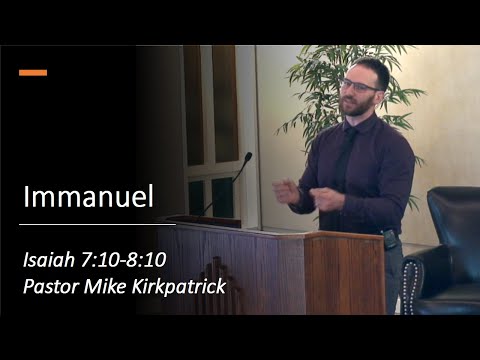
Immanuel
Isaiah 7:10–8:10 presents the Immanuel prophecy not as a comfortable seasonal text but as a word of judgment against Ahaz's faithless trust in Assyria and a word of hope for the covenant remnant. The sermon traces two contrasting realities: 'Assyria with us,' the consequence of royal unbelief, and 'God with us,' the promise that anchors the remnant through exile and desolation. The Immanuel sign finds its definitive fulfillment in Matthew 1, where the virgin-born Son saves his people from sin rather than merely political oppression — a truth that remains the ground of steadfastness for the church in every era of suffering and exile.

The Family of Christ
Mark 3:31–35 presents Christ distinguishing his earthly family from his spiritual family, using the arrival of his mother and brothers as a teaching moment about the nature of true belonging to God. The sermon works through two headings — Jesus's earthly family (vv. 31–32) and Jesus's spiritual family (vv. 33–35) — showing that physical descent and bloodlines carry no weight in determining who belongs to Christ. Membership in the family of God is defined by doing the will of God, which is unpacked as faith in Christ — repentance and belief in the gospel — not moral effort or ethnic identity. The hearer is pressed to consider whether they are an insider or an outsider, with the call to draw near to the elder brother through the means of grace.

Profaning God's Name
Malachi 1:6–14 indicts the post-exilic priests and people of Judah for profaning God's name through corrupt, indifferent, and weary worship — offering blind, lame, and stolen animals while vowing better. The sermon expounds three forms of disordered worship: worship that is questionable in its offerings, worship that ignores God's coming universal praise among the Gentiles, and worship that is openly profane through contempt and deceit. The underlying diagnosis is a low view of God: when the covenant Lord is diminished in the mind, acceptable worship becomes impossible. The application presses the regulative principle of worship — that God is to be approached on his own revealed terms, not by pragmatic innovation or felt-need programming — and calls the congregation to a high view of divine majesty as the indispensable foundation of right worship.

Isaiah 49:1-6
Isaiah 49:1–6 presents the second of Isaiah's four servant songs, in which the servant of the Lord addresses the nations directly, announcing that his mouth — made like a sharp sword and a polished shaft — is the weapon by which God will accomplish worldwide redemption. The servant is identified as the true Israel, fulfilling what national Israel failed to do, and his conquest extends not merely to the restoration of Jacob but to the Gentiles and the ends of the earth. Apparent failure and rejection, seen both in Isaiah's own ministry and in the Lord Jesus Christ's earthly preaching, do not negate the servant's mission, because his reward is with God. The sermon presses the church to faithfulness in preaching and hearing the Word of God as the appointed means by which the servant's conquest advances.

The LORD is my Shepherd
Psalm 23 is examined as a hymn of trust composed amid difficulty rather than prosperity, arguing that David's confident confession — 'The Lord is my shepherd, I shall not want' — is made precisely in the shadow of danger, not in spite of it. The sermon expounds the psalm under two headings: the covenant Lord as the shepherd who provides daily physical and spiritual provision, and as the gracious host who prepares a table in the presence of enemies. Christians are exhorted to make diligent use of the means of grace — private prayer and Scripture, corporate worship, the preached word, and the Lord's Supper — as the God-ordained way to walk with Christ through the valley of the shadow of death toward their eternal dwelling in the house of the Lord.

Judah and Tamar
Genesis 38 interrupts the Joseph narrative to focus on Judah, the man through whom the Messianic line would descend — and the portrait is not flattering. Judah marries a Canaanite, fathers wicked sons, withholds Shelah from Tamar in violation of levirate obligation, and solicits what he believes to be a roadside harlot. Yet God, faithful to His covenant promise to Abraham, Isaac, and Jacob, protects the seed through Tamar's act of faith and brings forth Perez, the ancestor of David and of the Lord Jesus Christ. The sermon calls hearers to marvel at a grace that saves wretched sinners — not because of their worthiness, but because God always does what He has promised to do.

Remembered in the Land
Genesis 22:20–23:20 records the death of Sarah, Abraham's purchase of the cave of Machpelah, and the first parcel of land the patriarch ever owned in Canaan. The sermon unfolds under three headings — God's people pass, wander, and dwell — showing that even in the silence of ordinary providence, where God's name goes unmentioned, he is keeping covenant by securing a burial place in the promised land. Christians still mourn, still sojourn as exiles in this age, but the purchase of Machpelah points forward to the resurrection hope Abraham already believed, a hope now confirmed on the far side of Christ's coming.

Liberty and Law
Galatians 5:1–15 presents the Pauline application of justification by faith alone: those whom Christ has liberated from the law's curse must stand fast in that freedom rather than entangle themselves again in the yoke of legal works-righteousness. The sermon works through two headings — the liberty of Christ (vv. 1–6) and the law of love (vv. 7–15) — showing that true Christian liberty is neither license for sin nor grounds for adding human merit to Christ's finished work. Justified believers are called to a gospel holiness expressed through love of God and neighbor, lived out by the Spirit in dependence on Christ's imputed righteousness alone.

Bond or Free
Galatians 4:21–31 presents the contrast between Hagar and Sarah as Paul's climactic illustration of the two mutually exclusive ways of standing before God: righteousness by law-keeping and righteousness by faith. Working through the passage under three headings — the illustration described, explained, and applied — the sermon argues that the Judaizers' demand for circumcision and law-observance is a return to the bondage of Mount Sinai, while all who believe in Christ belong to the Jerusalem above, the free woman, born of promise through the Spirit. Listeners are warned against the perpetual temptation to add anything to justification by faith alone, and are called to stand fast in the liberty Christ has secured for his people.

Everlasting Mercy
Psalm 118, the climax of the Egyptian Hallel (Psalms 113–118), is a song of thanksgiving for God's enduring covenant mercy (hesed), sung at Passover to celebrate divine deliverance. The sermon traces three movements in the psalm — God's enduring mercy, God's enduring faithfulness, and God's enduring praise — reading the whole through the lens of its New Testament fulfillment in Jesus Christ, who is the rejected stone become chief cornerstone. The exposition draws out how Christ accomplishes the true Exodus, delivering his people from bondage to sin, and calls hearers to trust in him as the only foundation of salvation, anticipating his second coming with praise rather than judgment.
The Majestic Name
Psalm 8 frames the majestic name of God as the beginning and end of all true praise, confronting the reader with the infinite distance between Creator and creature while simultaneously revealing the astonishing condescension of God in both creation and redemption. The sermon works through three movements: God's majestic name proclaimed in creation and defended through weakness (vv. 1–2), God's mindfulness of an infinitesimal humanity (vv. 3–5), and God's appointment of man to vice-regential dominion (vv. 6–9). Each movement is shown to find its ultimate fulfilment in the Lord Jesus Christ — the one who, as the last Adam, was made a little lower than the angels to purchase new creation for his people. The sermon closes with a call to study the attributes of God as the antidote to idolatry, and with a direct appeal to unbelievers to look to Christ, in whom Psalm 8 is fully realised.
Warning of Antichrist
What does the term 'antichrist' in 1 John 2:18–23 actually mean, and why is the popular question 'Who is the Antichrist?' the wrong question to ask? This exposition argues that John is not pointing to a single future eschatological figure but to a multitude of false teachers who deny that Jesus is the Christ and that He came in the flesh — teachers who have already appeared in every generation of the last hour, the entire era between Christ's two Advents. The remedy against antichrist is not prophetic speculation but deep, Spirit-illumined knowledge of the true Christ: His identity as the eternal Son, His unity with the Father, and the Trinitarian relations that ground saving faith. The sermon closes with a direct call to confess Christ, study His person rigorously, and stand ready for His return.