

2,065 sermons · All speakers
Ask FGBC #64: Who Should Catechize Your Children?
Deuteronomy 6 and Ephesians 6:4 establish the family — and the father in particular — as the primary locus of catechetical responsibility for children, not the church, the school, or civil government. The church's role is complementary: it equips parents, and through preaching, catechism classes, and Sunday school it instructs children alongside the home. Rote memorization of a catechism plants doctrinal truth that takes deep root at conversion, making faithful repetition a discipline as foundational as teaching a child to read or to do arithmetic.

The Central Demand of the Covenant
Deuteronomy 10 presents the central demand of the Mosaic covenant — that Israel fear, love, and serve the Lord with all their heart and soul — set against the backdrop of the golden calf incident and the covenant's renewal. The sermon traces this demand from its roots in Deuteronomy 10:12–13 through its echoes in Genesis 18, Proverbs 21, Hosea 12, Zechariah 7, Micah 6, and Matthew 23, demonstrating that obedience rooted in heart religion has always been God's requirement of His people. The threefold division of the law is expounded, with the moral law established as perpetually binding while the ceremonial law finds its fulfillment in Christ and the judicial law expires with the Israelite theocracy. The sermon closes by pressing believers to hold fast to God, keeping His law not as a means of justification but as the pattern for sanctification purchased by Christ, the true Israel who alone fulfilled the covenant.

The Introduction to First Timothy
What does it mean for a letter written to one man in one city to carry the authority of God himself? This introductory sermon on 1 Timothy 1:1–2 traces the post-prison ministry of the Apostle Paul, establishes the historical occasion of the letter, and unpacks the significance of Paul's self-description as 'an apostle of Jesus Christ by the commandment of God our Savior.' The greeting's three blessings — grace, mercy, and peace — are shown to be not mere formalities but the divinely appointed means by which Timothy could wage war against the false teaching overtaking Ephesus. The sermon closes with an appeal to sinners: the entire infrastructure of apostolic authority, qualified elders, and sound doctrine exists so that God might effectually call the lost through the foolishness of preaching.
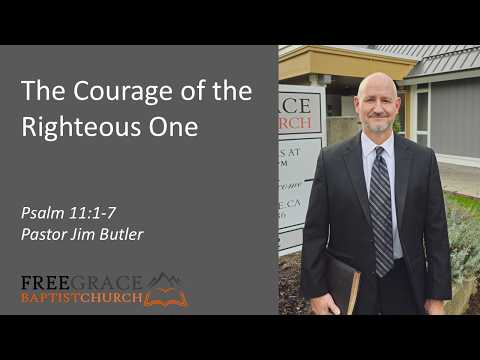
The Courage of the Righteous One
Psalm 11 presents the righteous man — supremely the Lord Jesus Christ — facing the temptation to abdicate his calling when wicked enemies ready their arrows and the foundations of moral order appear destroyed. The sermon expounds two movements: the temptation to flee (vv. 1–3) and the fortification found in contemplating God's sovereignty, omniscience, and justice (vv. 4–7). Because Christ steadfastly set his face toward Jerusalem and drank the cup of divine wrath to its dregs in the place of his people, believers have every reason to resist the same temptation to cowardice and unbelief, and to stand firm in the Lord.
Ask FGBC #63: What is Baxterianism?
Baxterianism, drawn from the teaching of 17th-century minister Richard Baxter, replaces the Reformed doctrine of justification by faith alone with a scheme in which God justifies the believer on the ground of evangelical obedience to a relaxed 'law of the gospel.' This Q&A exposition identifies Baxterianism as a conflation of justification and sanctification, a departure from the imputation of Christ's active and passive obedience, and an implicit relaxation of the moral law — errors addressed directly by 1689 LBCF chapters 11, 13, and 19. The discussion grounds its critique in Galatians 2:16 and the consistent witness of Paul that sinners are justified by faith alone, not by any human obedience, through the sole and finished work of Christ.

Review Of Israel's Rebellion
Deuteronomy 9 confronts Israel's temptation to attribute their inheritance of the promised land to their own righteousness, and Moses systematically dismantles that presumption. The chapter divides into the anticipation of the conquest (vv. 1–6) and a recapitulation of Israel's wilderness rebellions (vv. 7–29), each episode confirming that Israel stood not by merit but by the sovereign mercy of God and the faithfulness of his covenantal promises to Abraham, Isaac, and Jacob. Moses's intercessory prayer at the chapter's close models covenant pleading that appeals not to Israel's worthiness but to God's glory, his sworn word, and the redemption he himself accomplished. The passage calls God's people in every era to forsake self-righteousness and rest entirely on divine grace.

CTF 2026: Q&A Panel Discussion
A panel of Reformed Baptist and Reformed theologians fields audience questions on some of the most demanding loci in Reformed theology: federal headship and the fall, God's effective and permissive will in the hardening of Pharaoh's heart, the mystery of the first sin, free will as acting according to nature, hyper-Calvinism, the infralapsarian and supralapsarian debate, and the legitimacy of the free offer of the gospel under God's exhaustive decree. The discussion is frank about the limits of creaturely knowledge on questions the secret will of God has not resolved, while insisting that doctrinal humility and ordinary means of grace—not cage-stage polemics or churchless social media—are the proper context for growth in these truths.
Ask FGBC 69: Is the Threefold Division of the Law Biblical?
The threefold division of the law — moral, ceremonial, and judicial — is examined as a biblically grounded framework rooted not in Westminster Assembly invention but in the canonical structure of Scripture itself, traceable through the patristics and medieval scholastics. The discussion distinguishes natural or moral law (written on the heart by virtue of creation) from positive laws that are covenantally bounded and therefore terminable, using circumcision, dietary laws, and the Sabbath as test cases. The conversation addresses how the apostolic hermeneutic applies the moral principle behind positive laws (such as the ox-muzzling text) without collapsing into theonomy. Listeners are pressed to engage the exegetical evidence rather than dismissing the framework as "too tidy."
Ask FGBC #65: Are Reformed Baptists Really Just Anabaptists?
The claim that Reformed Baptists (specifically, Particular Baptists) descended from the Anabaptists is examined historically and found to be without evidential basis. Drawing on primary-source scholarship by historians such as Matthew Bingham and James Renihan, the discussion establishes that the Particular Baptists emerged from English Reformation Congregationalism — not from the continental Anabaptist movement — and that no documentary connection exists between the two bodies in the extant 17th-century literature. The conversation also notes that the Anabaptists themselves were not a monolithic group, making the category 'Anabaptist' less precise than popular usage suggests.
Ask FGBC 70: Is Progressive Covenantalism Compatible with the 1689?
Progressive Covenantalism and New Covenant theology are examined against the standard of the 1689 London Baptist Confession of Faith, with particular attention to whether either system can consistently affirm the covenant of works, the covenant of redemption, and the law/Sabbath chapters of the Confession. The discussion traces the hermeneutical root of these systems — a tendency toward biblicism that resists theological vocabulary not found verbatim in Scripture — and argues that their own best instincts, illustrated by Gary Long's late work on the Adamic covenant and the creation rest, point toward the fuller confessional expression of covenant theology. The conversation closes by considering the covenant of redemption and whether collapsing it into the eternal decree is adequate, finding devotional and doxological value in the anthropomorphic language of the pactum salutis even where precise metaphysics must be qualified.
Ask FGBC 67: Are Piper and MacArthur Reformed Baptists?
What separates a confessional Reformed Baptist church from a Calvinistic Baptist church associated with figures like John Piper or John MacArthur? This conversation argues that Calvinism, properly understood, is not reducible to the five points of Dort but entails a whole confessional heritage — covenant theology (including the covenant of works), cessationism, the regulative principle of worship, and adherence to one of the great Protestant confessions. The Second London Baptist Confession of 1689 is presented as the most mature expression of that heritage, providing a theological anchor that protects congregations from pastoral personality-driven ministry and binds them to the cumulative wisdom Christ has given his church through the ages.
Ask FGBC 68: Are Reformed Baptists More Baptist or More Reformed?
The question 'Are Reformed Baptists more Baptist or more Reformed?' draws out a careful answer: the two labels are not competing loyalties but successive correctives — Reformed Christianity corrects medieval Roman Catholic and Lutheran error, while the Baptist stream carries the Reformation's logic further in ecclesiology, the church-state relation, and liberty of conscience. Which emphasis comes to the foreground depends entirely on the conversation partner: against Christian nationalism the Baptist distinctives press harder; against Arminian dispensationalism the Reformed heritage dominates. The panel settles on a working formulation: Reformed in soteriology and theology proper, Baptistic in ecclesiology, and — with the addition of what the Reformation did not yet reform — small-c Catholic, Reformed, and Baptist.

Ask FGBC Batch 7: Anabaptists, Calvinism, Sincere Offer & More | Reformed Baptist Theology
This panel discussion brings together three Reformed Baptist pastors to address questions submitted to Free Grace Baptist Church on confessional identity, soteriology, covenant theology, and Lord's Day worship. The conversation distinguishes Particular Baptists from Anabaptists on historical-documentary grounds, examines the relationship between Calvinism and confessional Reformed Baptist identity, and evaluates the free and sincere offer of the gospel against what the panelists regard as the theological liabilities of well-meant-offer language. The discussion also treats the threefold division of the law, prosopological exegesis, and the scriptural rationale for two Lord's Day services, consistently grounding each answer in the 1689 Second London Baptist Confession and the exegetical tradition of the Particular Baptists.

Ask FGBC #62: What is Federal Vision?
Federal Vision theology, originating largely within Presbyterian and broader Reformed circles, conflates the covenant of works with the covenant of grace into a mono-covenantalism that mingles works and grace. The result is a doctrine of justification dependent on grace-assisted covenantal faithfulness rather than the imputed righteousness of Christ alone. This Q&A response argues that Federal Vision constitutes not a subtle revision but an outright rejection of the historic doctrine of justification by faith alone, grounded in both Christ's active obedience imputed to the believer and his passive obedience bearing the wrath of God in the sinner's stead.

The Challenge and Confidence of the Psalmist - Psalm 10:1-18
Psalm 10 presents a twofold movement: the challenge of the psalmist in verses 1–11, and the confidence of the psalmist in verses 12–18. The sermon argues that this psalm is not primarily about David's historical circumstances but about the earthly ministry of the Lord Jesus Christ — his humanity, his experience of apparent divine withdrawal, and his witness to the wickedness of those who conspired against him. The church, as joined to Christ, prays these words as her own, setting the promises of God against the troubled testimony of sense and experience, and resting in the certain reign of the Lord who will one day cause the man of the earth to oppress no more.

Ask FGBC #61: Conviction of Sin Before or After Regeneration?
The question of whether conviction of sin precedes or follows faith is examined through the lens of the ordo salutis. Conviction of sin necessarily precedes faith because without it the sinner would see no need for Christ, yet Scripture nowhere prescribes a fixed period of misery as a prerequisite for receiving the gift of faith. Conversion is the divine bestowal of the graces of faith and repentance together, not a staged sequence in which the sinner must accumulate sufficient guilt before God acts. The call of the gospel is not prolonged self-examination but immediate flight to Christ, and the doctrine of presumption that keeps sinners in unnecessary bondage is a Catholic, not Protestant, imposition on the gospel promise.

Life in the Wilderness and Canaan
Deuteronomy 8 sets the wilderness generation of Israel before the land of Canaan with a threefold movement: a reminder of God's providential humbling in the wilderness (vv. 1–5), a promise of abundant blessing in the land (vv. 6–10), and a solemn warning against the pride and forgetfulness that prosperity tends to generate (vv. 11–20). The wilderness was not divine cruelty but divine chastening — designed to produce dependence on God rather than self-sufficiency — a pattern the New Testament applies both to the believer's ongoing trials and to the person of Christ, who as the true Israel recapitulates the exodus, wilderness, and restoration that old covenant Israel failed to embody faithfully. The sermon closes by calling hearers to combat forgetfulness of God through regular remembrance of his word, his covenant, and his redemptive acts, recognising that the danger is never prosperity itself but the pride that severs gratitude from grace.

The Justice and Mercy of the Lord, Part 2
Psalm 9:13–20 presents two petitions that mirror the psalm's earlier doctrinal foundation: a cry for mercy grounded in God's proven faithfulness, and a cry for judgment grounded in the certainty of divine justice. The preacher traces both petitions through their Christological fulfillment — the man of sorrows who prays from the gates of death and the appointed judge of the world in righteousness — demonstrating that David's psalm finds its true subject in Christ. God's justice toward the wicked and His mercy toward the oppressed are not in tension but are two sides of the same covenantal reality: the overthrow of God's enemies is itself the preservation of God's people. Hearers are called to pray these psalms with theological weight, to assemble corporately as those delivered from the gates of death into the gates of Zion, and to seek the Lord while He may be found.

The Commendation of the Philippian Church
Philippians 4:14–23 closes Paul's letter with a commendation of the Philippian church for their constant and consistent financial partnership in his apostolic ministry. The sermon works through four observations: the apostle's commendation of the church's sacrificial generosity, his contentment that transcends material circumstances, his confidence that God will supply the church's needs according to his infinite riches, and the concluding greetings — including the remarkable note that believers within Caesar's own household send greetings to Philippi. The central application is that everything praiseworthy in the Philippians — their fellowship, their sacrifice, their fruitfulness — is itself the fruit of divine grace, so that God alone receives the glory.

Ask FGBC #60: How Necessary is Seminary for Pastors?
What level of theological education does Scripture require of a pastor, and does the answer change depending on whether the role is full-time or supported by another vocation? Drawing on 1 Timothy 3 and 5, John 21, and the example of Ezra, this Q&A response argues that while formal seminary training is not an absolute biblical requirement, the pastoral calling demands rigorous, ongoing preparation in the Word and doctrine — not merely a pleasant personality or a willingness to serve. The discussion distinguishes between men called to primary preaching ministry and those serving in a supportive elder capacity, and closes with a frank exhortation that mediocrity in the pulpit has eternal consequences.

The Justice and Mercy of the Lord
Psalm 9 presents the Lord as both righteous Judge of the wicked and secure refuge for the afflicted — realities that are inseparable and must be held together. Interpreted through a Christocentric lens consistent with Luke 24:44, the psalm is understood as the voice of the Lord Jesus Christ in his earthly ministry, with David functioning typologically to foreshadow the sufferings and vindication of the Son of Man. The first half of the sermon (vv. 1–12) expounds the psalmist's confidence in God: his declaration of whole-hearted praise, his affirmation that God judges the nations, and his assurance that God is an unfailing refuge for those who seek him — grounded ultimately in the doctrine of justification by faith alone. Hearers are called to seek their refuge in God rather than in circumstance, and to rejoice openly in the justice and mercy that belong inseparably to the character of the Most High.

The Believer's Contentment
Philippians 4:10–13 presents the contentment of the Apostle Paul not as an innate virtue but as a learned conviction forged through diverse and often severe circumstances. Working through Paul's expression of gratitude to the Philippians, his present situation, his learned conviction, his diverse circumstances, and his source of strength, this sermon argues that Christian contentment is utterly independent of circumstances because it is grounded in union with Christ — in justification, sanctification, and promised glorification. The practical exhortation confronts the common error of tying contentment to circumstances ('when I get married, then I will be content') and calls believers instead to submit sweetly to divine providence, rejoice in God's sovereign ownership of all things, and find their settled rest in Christ alone.

Ask FGBC #59: What is Faith?
Faith is defined in two senses in Scripture: as the objective content of the Christian religion (the propositions of the gospel to be believed) and as the subjective act of believing. In its saving sense, faith is the Spirit-given, empty-handed instrument by which a sinner rests upon and receives the Lord Jesus Christ and all the redemptive benefits secured by His obedient life, atoning death, and resurrection. Because regeneration precedes faith and faith itself is a divine gift, the strength of one's faith — or the feelings accompanying it — is never the ground of salvation; Christ alone is that ground. The discussion warns against distortions that load faith with feelings, smuggle faithfulness or love into its definition, or ground justification in evangelical obedience rather than in Christ received through faith alone.

The Blessings of Obedience
Deuteronomy 7:12–26 sets before the second generation of Israel the blessings that follow covenant obedience — material prosperity, physical health, and military victory over Canaan — and the antidote to the fear that would tempt them to doubt God's promises. The passage is read within a covenant-theological framework in which the Mosaic covenant functions as a covenant of works for the nation, distinct from the covenant of grace that runs through the promise of Genesis 3:15 to its fulfillment in Christ, the true Israel of God. The sermon draws the New Covenant application that the God who did not spare His own Son will certainly sustain His people in every present trial, and calls hearers to destroy idolatry publicly, conquer it in the heart, and keep it out of the home.

The Power of Jesus
The exorcism of the Gadarene demoniacs in Matthew 8:28–34 is not merely a historical episode but a public declaration of Christ's power to save. The casting out of a multitude of demons by Christ's voice alone demonstrates his sovereign authority over darkness, and this authority extends to the deliverance of every sinner from the dominion of sin and the devil. The sermon presses the listener to look to Christ and believe, for the same power that expelled the legion delivers souls from the kingdom of darkness into the kingdom of the Son.

The Authority of Christ Over the Demons
Matthew 8:28–34 records Christ's encounter with two demon-possessed men whose condition — violence, self-destruction, nakedness, and ceaseless torment among the tombs — exposes the wretchedness of Satan's kingdom and the glamorization of the occult as godless deception. The passage stands within Matthew's sustained demonstration in chapters 8–9 that the same authority with which Christ taught is confirmed in His works: one word, 'Go,' expels a legion. The city's request that Jesus depart reveals that the fear of God drives men either toward Him or away from Him, never to indifference. The sermon closes with the application of 1 Timothy 1:15 — that these two men are exhibit A that Christ Jesus came into the world to save even the chiefest of sinners — and an exhortation to parents to raise children who flee to the cross rather than to self-righteousness or the occult.

Ask FGBC #58: How to Start Reading the Bible?
How should a person begin reading the Bible — and how should they read it once they have opened it? This Q&A exchange addresses both the unbeliever encountering Scripture for the first time and the new believer seeking a starting point, recommending the law of God as a mirror of sin and the Gospels as the answer to that conviction. The discussion extends to the manner of reading: attending to the sense intended by the divine author rather than the nakedness of individual words, reading within the interpretive community of the church, and approaching the text through prayerful dependence that guards against the pride produced by knowledge acquired without humility. Practical counsel on guarding reading habits against the fragmenting effects of social media closes the exchange.

Ask FGBC #57: What Are the Requirements for Church Membership?
Church membership is not named by a single proof-text, yet the New Testament data — the numbered and joinable Jerusalem church, the bounded authority of pastors, the mutual accountability of members, and the discipline procedure of Matthew 18 — together demand a formal, local church membership. The prerequisites a confessional Reformed Baptist church may rightly require are a credible profession of faith, baptism by immersion, a general understanding of the confession of faith, a willingness to submit to the church's doctrine and government, and familiarity with its constitution and bylaws. A published confession of faith protects both the church and prospective members by ensuring honest communication of what the church believes before anyone commits to join. The question of young believers and membership is handled on a case-by-case basis, with no principled bar to admitting a child who has professed faith and been baptized.

The Dominion of the Incarnate Son
Psalm 8 is not merely a meditation on creation but a messianic prophecy concerning the dominion of the incarnate Son of God. The sermon traces the psalm's double register — the glory of God manifest in the created order and the glory of God manifest in the incarnation — grounding that interpretation in the two New Testament passages where Jesus and the Apostle Paul explicitly apply Psalm 8 to Christ: Matthew 21 and Hebrews 2. The exaltation of the God-man at the right hand of the Father, his conquest of the devil through death, and his propitiation for the sins of his people are shown to be the true fulfillment of the dominion language of verses 4–8. Believers are exhorted to silence the enemy's accusations against them by invoking the blood and righteousness of Christ, which is the ground of both justification and assurance.

The Command for the Conquest
Deuteronomy 7:1–11 sets out the divine policy for Israel's conquest of Canaan, commanding total destruction of the seven Canaanite nations and prohibiting political, social, and religious alliances with them. The passage answers the modern objection that God commanded genocide of innocent peoples by demonstrating from Leviticus 18 that the Canaanites were under divine judgment for extreme wickedness, and that God applied the same standard of judgment to Israel when Israel imitated their conduct. The distinction between Israel and Canaan rests entirely on sovereign, unconditional election — not Israel's numbers or righteousness — and finds its New Covenant fulfillment in the church as the true people of God united to Christ. The passage's prohibitions carry direct application to contemporary alliances: believers are to marry only in the Lord, avoid religious compromise on cardinal doctrines, and understand civil government's proper and limited role.