
Scripture
Matthew
299 sermons
2LCF Chapter 29 - Of Baptism

The 1689 London Baptist Confession chapter 29 sets forth a thoroughgoing Baptist doctrine of baptism: its nature as a New Covenant ordinance ordained by the incarnate mediator, its proper recipients as professing believers alone, its proper element and Trinitarian formula, and its proper mode as immersion. The study presses the case for believers-only baptism across five arguments — from covenant theology, federal headship, the doctrine of salvation, New Testament clarity, and the regulative principle of worship — demonstrating that paedo-baptism is not merely a secondary matter but a violation of Christ's express institution. The session closes with extended Q&A engaging questions about baptismal regeneration, the formula 'in the name of Jesus only,' and the standing of paedobaptist believers.

The Power of Jesus

The exorcism of the Gadarene demoniacs in Matthew 8:28–34 is not merely a historical episode but a public declaration of Christ's power to save. The casting out of a multitude of demons by Christ's voice alone demonstrates his sovereign authority over darkness, and this authority extends to the deliverance of every sinner from the dominion of sin and the devil. The sermon presses the listener to look to Christ and believe, for the same power that expelled the legion delivers souls from the kingdom of darkness into the kingdom of the Son.

The Authority of Christ Over the Demons
Matthew 8:28–34 records Christ's encounter with two demon-possessed men whose condition — violence, self-destruction, nakedness, and ceaseless torment among the tombs — exposes the wretchedness of Satan's kingdom and the glamorization of the occult as godless deception. The passage stands within Matthew's sustained demonstration in chapters 8–9 that the same authority with which Christ taught is confirmed in His works: one word, 'Go,' expels a legion. The city's request that Jesus depart reveals that the fear of God drives men either toward Him or away from Him, never to indifference. The sermon closes with the application of 1 Timothy 1:15 — that these two men are exhibit A that Christ Jesus came into the world to save even the chiefest of sinners — and an exhortation to parents to raise children who flee to the cross rather than to self-righteousness or the occult.

Christ in the River Jordan
The baptism of the Lord Jesus Christ in Matthew 3:13–17 is not merely a biographical episode but the inaugural step of the incarnate Son of God in His mediatorial mission to fulfill all righteousness for sinners. Tracing a rich theology of water through creation, the flood, the Exodus, and Joshua's crossing of the Jordan, the sermon demonstrates that Christ enters the river as the antitypical fulfillment of every prior act of divine cleansing, conquest, and covenant ratification. The descent of the Spirit like a dove and the Father's voice of approbation publicly inaugurate the new creation and identify Jesus as the obedient second Adam, the suffering servant, and the Davidic king. The sermon closes by drawing the believer's baptism directly from this pattern: only those who are the recipients of Christ's substitutionary righteousness, indwelt by the Spirit, and adopted into sonship are candidates for baptism by full immersion.

The Son of God and His Afflicted People
Matthew 14:22–33 presents Jesus walking on the sea as a revelation of His divine identity — the Son of God who, like Yahweh in Job 9:8 and Psalm 77:19, treads the waves. The disciples' terror, Peter's sinking faith, and the calming of the wind together drive toward the confession of verse 33: 'Truly, You are the Son of God.' The sermon draws out two complementary lessons: the people of God are not immune to prolonged trial and affliction, and the antidote to fear is not stoic resolve but the divinity of Christ — the Great I Am who sees His storm-tossed church and bids it be of good cheer.

The Signs and Wonders Following Jesus's Death
At the death of Jesus, Matthew records four signs: the tearing of the temple veil, an earthquake, split rocks, and the resurrection of Old Testament saints — phenomena unique or extended beyond what the other Synoptics report. This exposition works through Matthew 27:51–56, arguing that each sign carries distinct theological weight: the torn veil announces the abrogation of the old covenant by fulfillment and the opening of free access to God through Christ's flesh; the earthquake signals divine judgment and vindicates the Son; the resurrection of the saints demonstrates Christ's power over the grave, confirms the bodily resurrection hope, and shows the retrospective efficacy of his atoning work for old covenant believers. The sermon closes at the Lord's Supper table, where the confession of Gentile soldiers and faithful women together display that Christ's blood avails for every tribe, tongue, people, and nation.

The Description of Discipleship
Matthew 16:24–27 sets out the terms of Christian discipleship: self-denial, cross-bearing, and the daily following of Christ. The sermon distinguishes a superficial willingness to die for Jesus from the harder, quieter obedience of living for him — reading Scripture, praying, attending the assembly, and ordering family life under the Word. The whole argument is framed by the eschatological contrast between temporal gain and eternal loss, with the coming judgment of the Son of Man serving as the decisive motivation for prioritising Christ over wealth, comfort, and self. Justification by faith alone is never undermined; rather, the life of discipleship is presented as the necessary and inevitable fruit of genuine saving grace.

The Command from the Mount
Matthew 28:16–20 presents the risen Christ commissioning his disciples from a mountain in Galilee — a location Matthew treats as theologically laden with the entire biblical theology of mountains, from Eden to Sinai to Zion. The sermon traces that mountain typology across Genesis, Isaiah, Hebrews, and Zechariah to show that the Great Commission is nothing less than the eschatological commencement of the new covenant. Christ's declaration — 'All authority has been given to me in heaven and on earth' — is expounded as the mediatorial kingly inheritance he receives by virtue of the perfection of his redeeming work, not a restoration of suppressed divine glory. The commission therefore binds the church to gospel proclamation, believer's baptism, and the continual instruction of the baptized, all undergirded by the abiding presence of the exalted Christ through his threefold office of prophet, priest, and king.

The Cry of Dereliction
What does Christ mean when he cries 'My God, my God, why have you forsaken me?' from the cross? This sermon on Matthew 27:45–46 carefully distinguishes what the cry of dereliction does not mean — no ontological division within the Trinity, no dissolution of the hypostatic union, no suffering of all three persons — before arguing that it expresses Christ's true humanity as our surety bearing the punishment of loss: the withdrawal of the Father's smiling favor and consolatory presence as the Son satisfies divine justice for the sins of his people. The sermon draws extensively on Psalm 22 to show that the forsakenness is covenantal and substitutionary, not metaphysical, and closes with a call to believe on the crucified and risen Christ who cried this cry so that his people never will.

The Priority in the Believer's Life - Matthew 6:25-34
Jesus commands his disciples not to worry about life, body, or tomorrow in Matthew 6:25–34, grounding the prohibition in three realities: God's providential care demonstrated in birds and lilies, the contrast between Gentile obsession and the believer's knowledge of a knowing Father, and the governing priority of verse 33 — seek first the kingdom of God and his righteousness. The sermon argues that carnal anxiety is theologically inconsistent for the Reformed believer: one who confesses God's comprehensive sovereignty in salvation yet surrenders to worry about temporal provision has applied Calvinism selectively. The antidote is not mere positive thinking but the cultivation of contentment rooted in the imputed righteousness of Christ, which grants entrance into the very kingdom we are commanded to seek first.

2LCF Chapter 25 - Of Marriage
Marriage as a divine institution is examined through the four paragraphs of 2LCF Chapter 25, with Matthew 19:5–6 as the anchor text where Christ grounds marriage in the creation of male and female. The sermon argues that marriage is not a social construct or ecclesiastical sacrament but a creation ordinance ordained by God before the fall, designed for the union of one man and one woman in monogamous covenant. A threefold providential purpose is unfolded — companionship, the inhabitation of creation, and a hedge against sexual immorality — and the regulative bounds of marriage regarding consanguinity, affinity, and Christian marital duty are applied against both contemporary sexual confusion and Roman Catholic sacerdotalism.

The Parable of the Wedding Feast
The Parable of the Wedding Feast in Matthew 22:1–14 sets the rejection of Messiah by old covenant Israel within the full sweep of redemptive history, showing that their unwillingness, indifference, and violent opposition to Christ fulfilled the covenant-curse terms announced in Leviticus 26 and Deuteronomy 28, culminating in the destruction of Jerusalem in AD 70. The second invitation extends the gospel indiscriminately to Jew and Gentile alike, yet the man without a wedding garment — representing those who lack the imputed righteousness of Christ — is cast into outer darkness, demonstrating that entrance to the marriage supper of the Lamb requires being washed in Christ's blood and clothed in his alien righteousness. The closing verse, 'many are called but few are chosen,' is read as a specific condemnation of first-century Israel rather than a general statement about the smallness of the elect. The sermon closes with a call to receive the general and effectual calls of the gospel in gratitude, and transitions into the Lord's Supper as a foretaste of that feast.

CLIP: For many are called, but few are chosen
Matthew 22:14 — 'For many are called, but few are chosen' — is one of the most misread verses in the Gospels. This clip works through five reasons the statement cannot mean that only a small number will ultimately be saved: its immediate covenantal context (old covenant Israel's rejection of the Messiah), the great multitude of Revelation 7, the many who come from east and west in Matthew 8, the wedding hall filled with guests in Matthew 22:10, and Warfield's observation that the statement is an ethical confrontation rather than a prophetic census. The 'many called, few chosen' formula applies first to first-century Israel and then functions as a present warning: hearing the gospel is not the same as being effectually called, and the proper response is to receive and rest in Christ alone.

The Institution of the Lord's Supper
What does Christ accomplish at the Lord's Supper, and how does it connect to the Passover, the new covenant, and the future kingdom? Expounding Matthew 26:26–30, this sermon traces the institution of the supper through its Old Covenant setting in the Passover, the covenantal and sacrificial significance of the bread and cup, and the eschatological anticipation of the messianic feast. The sermon argues for a real but spiritual presence of Christ at the supper — against transubstantiation, consubstantiation, and bare memorialism alike — grounding this in the Spirit's mediating work. Throughout, the ordinance is presented as a means of grace that communicates the forgiveness of sins purchased through Christ's substitutionary, penal death for the many.

The Blessing of Gospel Rest
Matthew 11:25–30 grounds the gospel invitation — 'Come to me, all you who labor and are heavy laden' — in the sovereign will of the Father and the mediatorial office of the Son, so that the call to rest is inseparable from the doctrines of election and definite atonement. Jesus thanks the Father for hiding these things from the self-wise and revealing them to babes, declaring that all sovereign authority over salvation belongs to Him as the God-man and mediator. The 'rest' He offers is not relief from physical toil but deliverance from the crushing burden of sin and the impossible demands of pharisaical religion, received through faith alone. Those who come to Christ in faith are also exhorted to take His yoke — the life of sanctification — which is not oppressive bondage but the glad obedience of those justified freely by grace.

The Authority of the Church
Christ's promise in Matthew 16:19 to give 'the keys of the kingdom of heaven' to the church raises two perennial dangers: authoritarian abuse of ecclesiastical power and the outright abdication of it. This sermon expounds the identity of those entrusted with these keys (apostles, elders, and the gathered congregation together), the nature of the authority delegated (binding and loosing through preaching and discipline), and the proper ground of confidence when the church acts — not sacerdotal infallibility, but the assurance that heaven ratifies the church's faithful obedience to Scripture. The practical conclusion is that the keys are exercised through the proclamation of the Word, the admission and exclusion of members, and the administration of the sacraments — never through entertainment, self-help, or moral do-goodery.

The Triumph of the Church
What is the church, who builds it, and can anything destroy it? Expounding Matthew 16:13–18, this sermon works through Peter's confession of Christ as the Messiah and Son of the living God, traces the promise of the Davidic Covenant in 2 Samuel 7 to its fulfilment in Christ's declaration to build His church, and refutes the Roman Catholic claim that Peter is the rock upon which the church rests. The sermon closes with the triumph of the church: Christ owns it, Christ builds it, and the gates of Hades shall not prevail against it.

The Great Commission
Matthew 28:11–20 presents two responses to the resurrection of Christ: the fraudulent suppression of the evidence by the chief priests and elders, and the Great Commission given by the risen Lord to his disciples. The passage exposes the lie concocted by the Sanhedrin as historically incoherent and theologically revealing — a judgment of God upon covenant-breaking Israel. The Great Commission is then unfolded through its four-fold use of 'all': Christ's absolute authority as mediator grounds the command to go, make disciples, baptize believers as new covenant members, and teach them to observe all that he has commanded.

The Empty Tomb and the Risen Lord
The empty tomb of Matthew 28:1–10 is not a symbol or a felt experience but a historical event on which the entire Christian gospel stands or falls. Working through the arrival of the women, the descent of the angel, and the appearance of the risen Lord, this exposition shows that the resurrection was predicted by Christ, attested by angels, and confirmed by the physical presence of the one who holds his disciples as brethren even after their desertion. The sermon closes by grounding the believer's freedom from fear, confidence in advocacy, and obligation to proclamation in the fact that Jesus was raised for our justification.
The Covenantal Status of Israel in the Parable of the Vineyard
Matthew 21:33–46 presents the Parable of the Wicked Vinedressers as a compressed history of Old Covenant Israel — a nation privileged with God's presence, prophets, and promises, yet persistently covenant-breaking and finally guilty of rejecting the Messiah himself. The parable is read against Isaiah 5 and fulfilled in the AD 70 destruction of Jerusalem, which is the covenantal judgment pronounced in verse 43: the kingdom of God is taken from ethnic Israel and given to the church, the true Israel of God. The New Covenant people — constituted by faith in Christ, not ethnic descent — are that nation bearing fruit, identified as such in 1 Peter 2 and Galatians 6:16. The sermon argues that any future geopolitical restoration of Old Covenant Israel with a rebuilt temple and renewed sacrificial system would be a reversal of redemptive history, and that ethnic Jews today stand in need of the gospel like every other nation.

The Priority in the Believer's Life
Jesus prohibits anxiety over material provision in Matthew 6:25–34, grounding that prohibition in the sovereign care of a Father who already knows what His people need. The passage is expounded under two heads: the repeated prohibition against worry concerning life, body, and tomorrow (vv. 25–32), and the governing principle that believers are to seek first the kingdom of God and His righteousness (vv. 33–34). The sermon argues that chronic anxiety about temporal things is functionally Gentile thinking — a failure to translate sound doctrine of divine sovereignty and providence into the ordinary rhythms of daily life. The remedy is not mere willpower but a rightly ordered theology: what a man truly believes about God will determine whether he lives as a kingdom-seeking servant or as one paralyzed by the concerns of this world.

The Triumph of the Church
Matthew 16:13–18 presents three interlocking realities about Christ and his church: the identity of Christ confessed by Simon Peter, the divine source of that confession, and the indestructible promise Christ appends to his church. The rock upon which the church is built is not Peter's person but the Christ Peter confessed — the second person of the triune God who assumed humanity, died, and rose for his people. Christ himself is the builder, foundation, and protector of the church, which means the gates of Hades assault the church not as a conquering force but as a defensive one being overrun by the church's gospel advance. The practical summons is for the church to fulfil her three marks — the preaching of the word, the administration of the sacraments, and the exercise of discipline — with the confidence that Christ's triumphant headship guarantees the church's survival into the eschaton.
Judge Not

Matthew 7:1–6 is among the most misquoted passages in Scripture, weaponized by unbelievers to silence any moral reproof. This sermon works through four questions the text raises — why not judge, by what standard will we be judged, why do we judge, and how can we judge — and argues that Christ's caution is not a prohibition on all moral discernment but a warning against hypocritical, merciless condemnation that ignores one's own greater guilt before God. The solution lies in true repentance: only when the beam has been removed from one's own eye — by grace, through Christ — can a believer see clearly enough to restore a sinning brother with humility.

The Rich Young Ruler
What must a man do to inherit eternal life? The rich young ruler's question exposes the deepest error of fallen religion: the assumption that man possesses the moral ability to commend himself to a holy God. This sermon expounds Matthew 19:16–22, tracing Christ's deliberate use of the law — particularly the tenth commandment — not as a path of salvation but as a hammer to shatter the young man's self-righteousness and drive him to seek grace outside himself. The central application is urgent: stop asking what you shall do and ask instead in whom you shall believe, for justification is by faith alone in Christ alone, whose righteousness becomes yours and whose cross bears your sin.

The Active and Passive Obedience of Christ
The obedience of Christ — both active and passive — is the sole foundation of justification by faith alone. Working through two texts in Matthew's Gospel, this sermon expounds the theological distinction between Christ's active obedience, in which He fulfilled all righteousness on behalf of His people, and His passive obedience, in which He drank the cup of divine wrath and was overwhelmed by death as a ransom for many. Sinners cannot contribute a righteousness of their own; they need both the imputed righteousness of Christ's perfect life and the cleansing of His atoning blood. The occasion of three baptisms serves as the concrete illustration: the water publicly declares what God has accomplished inwardly through the finished work of the Savior.

The Necessity of Christ's Passion
Matthew 16:21–23 presents the first formal announcement of what Christ himself calls a divine necessity: he must go to Jerusalem, suffer at the hands of the elders and chief priests, be killed, and be raised on the third day. The sermon traces this necessity through the covenant of redemption, the Old Testament prophetic witness — Psalms 22, 69, and 110, Isaiah 52–53, Daniel 9, Zechariah 9–14 — and a series of informal anticipations across Matthew's Gospel. Peter's sharp rebuke is examined as a representative failure to grasp the messianic agenda of a suffering Servant, and Christ's equally sharp response — 'Get behind me, Satan' — is shown to be the definitive affirmation that substitutionary curse-bearing is non-negotiable: error here is not a skin disease but a disease at the heart. The congregation is urged to hold fast to the doctrine of Christ crucified and risen as the only stable ground of perseverance in the Christian life.
The Two Builders
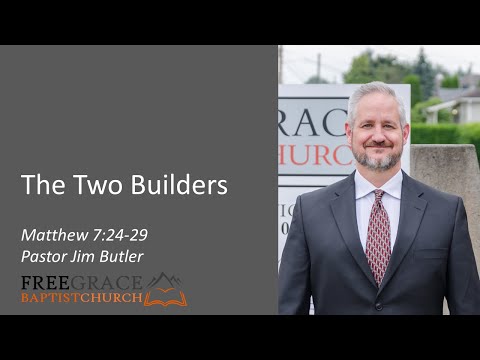
Matthew 7:24–29 concludes the Sermon on the Mount with a parable of two builders whose contrasting foundations — rock and sand — expose the decisive difference between saving faith and mere hearing. The sermon argues that true faith, sovereignly granted and resting on Christ alone, produces a life of obedience to his word, while the mere hearer — however impressed by the teaching — builds on shifting ground and faces a great and final ruin. The devil, the world, and remaining indwelling corruption all beat against both houses, but only the house founded on Christ stands. Hearers are urged to close with Christ now, trusting not in works or false religion but in his righteousness alone.

2LCF 26 - Of the Church, Part I
What is the church, and who governs it? This confession study works through 2LCF Chapter 26, paragraphs 1–4, examining the universal (catholic) church: its election-grounded identity, its visible and invisible dimensions, the perpetuity of Christ's kingdom despite the inevitable mixture and error found in even the purest churches, and the exclusive headship of the Lord Jesus Christ over his body. The session challenges both Landmark Baptist denials of a universal church and Roman Catholic claims to papal headship, grounding ecclesiology in the confession of Christ as Son of the living God as articulated in Matthew 16.

The Champion of the Howling Wilderness
Matthew 4:1–11 presents the temptation of Christ not primarily as a model for personal resistance to sin, but as the decisive act of single combat in which the Lord Jesus Christ, as the second Adam and the true Israel, vicariously perfects obedience for his elect people. Where Adam fell in the garden amid every provision and where Israel failed in the wilderness under divine care, the Son of God enters a howling wilderness—hungry, alone, and unarmed—and vanquishes the devil point for point through resolute dependence on the word of God. The rich typological connections to Adam's expulsion, Israel's forty years of wandering, Moses' fast on Sinai, and David's unarmed single combat against Goliath converge on the one claim the passage presses: Christ alone is the covenantally faithful champion, and salvation belongs exclusively to those who trust in his doing, dying, and rising. Christians are therefore called to rejoice in their champion rather than to reduce this episode to a moral technique for fighting temptation.

The Lord's Prayer
True prayer is distinguished from hypocrisy and paganism not merely by form but by motivation, manner, and theological grounding. Matthew 6:5–13 exposes the Pharisee who prays to be seen by men and the heathen who employs vain repetition to coerce a god, and sets against both the secret, faith-driven communion of the genuine child of God with his Father. The Lord's Prayer is not a liturgical formula to be recited but a structured outline — ordering petition rightly, with God's name, kingdom, and will before any human need — rooted in the sovereignty of a Father who knows what his children require before they ask. The sermon calls believers to examine their own prayer lives: whether prayer functions as worship and dependence upon the triune God, or as a merely transactional exercise.