

The Infallible Rule of All Saving Knowledge

Second Timothy 3:16–17 grounds the authority and sufficiency of Scripture in its divine origin: God breathed out these words, making them infallible, inerrant, and profitable for every purpose of the Christian life and ministry. The sermon works through the identity of Scripture (the whole Old and New Testament canon), its authority as the God-breathed word that admits no human arbitration, and its fourfold utility — doctrine, reproof, correction, and instruction in righteousness. The specific profitability of verse 17 is shown to fit the man of God for every good work, with the primary work being the preaching of the word commanded in 2 Timothy 4:2. The practical summons is to receive Scripture's reproof and correction without shrinking, and to value sound doctrine as the very means by which God shepherds, sanctifies, and equips his people.
Sunday School - Oct 1, 2023 - Pastor Ogallo's Presentation
Pastor Napthally Ogallo of Grace Baptist Church in Eldoret, Kenya presents a photographic and narrative report of the church's history, ministry, and ongoing needs to a supporting congregation. He traces the church's origins in the aftermath of Kenya's 2007–2008 post-election violence, its years of one-to-one evangelism, the gradual acquisition and development of church property, the loss of funds to a dishonest contractor, and the current state of an unfinished but usable building. The presentation closes with a candid account of challenges — extreme charismatic neighbours, widespread false gospels, theft, urban poverty, and drug use — set against the encouragement of baptisms, elder development, two church plants, a regional theological school, and a growing student ministry.

Live Stream - October 01, 2023
Acts 20:17–32 records Paul's farewell address to the Ephesian elders, and this exposition draws four lessons from that address for all who labour in Christian ministry and all who sit under it: the transparent example Paul modelled, the singular motivation of pleasing a sovereign God even through suffering, the urgent warning against wolves from without and false teachers from within, and the sustaining encouragement that God will keep his people to their inheritance through the gospel of his grace. The sermon calls those already in ministry to openness and fidelity, urges young believers to consider the call, and presses the unconverted to receive the gospel of the grace of God while it is offered.

The Apostolic Sermon
Peter's sermon on the day of Pentecost, recorded in Acts 2:14–41, is the first apostolic proclamation of the risen Christ, and it follows a carefully constructed argument: correcting a false accusation, demonstrating from Old Testament Scripture who the Messiah is, and confronting the hearers with their guilt before the exalted Lord. The sermon examines how Peter builds his case through the life, death, resurrection, and ascension of Christ, drawing on Joel 2, Psalm 16, and Psalm 110 to show that every stage of Christ's humiliation and exaltation was foreordained. The hearers' anguished question — 'What shall we do?' — is answered with a call to repentance, faith, and baptism, which Peter grounds not in human decision alone but in the sovereign, effectual call of God. The application presses hearers to submit to Christ as Lord, to feel the weight of sin's horror, and to follow repentance and faith with public baptism and membership in the local church.

Wednesday PM - Sept 27, 2023
Leviticus 17 governs the sacrificial use of blood among the covenant people of Israel, and this exposition traces three interlocking regulations: the prohibition against slaughtering sacrificial animals outside the Tabernacle, the prohibition against ingesting blood, and the rules for handling game animals. The central rationale is penal substitution — the blood of the animal represents life given in the place of the worshiper's life, prefiguring the atoning work of Christ. The Holiness Code of Leviticus 17–26 functions as the ethical imperative that follows the indicative of sacrificial forgiveness, a pattern that anticipates the New Covenant movement from justification into sanctification.

The Cessation of Revelatory Gifts

First Corinthians 13:8–13 declares that tongues, prophecy, and words of knowledge have a designed and determined end, giving way to the completed New Testament canon. This sermon argues from Acts 2, 1 Corinthians 13–14, Hebrews 1–2, Ephesians 2, and Daniel 9 that the revelatory gifts were temporary, apostolic, and tied to the first advent of Christ and the foundational era of the church. The 'perfect' of 1 Corinthians 13:10 refers not to the eschatological consummation but to the inscripturated fullness of divine revelation in the New Testament scriptures. Christians today are called to glory in the completed Word of God and in the abiding work of the Holy Spirit in regeneration and illumination, rather than seeking gifts that have ceased.

The Blessings of the Ascended Christ
The ascended and glorified Christ actively dispenses blessings to his church from the right hand of the Father. Expounding Acts 2:22–47, this sermon traces three categories of those benefactions: his proclamational gifts (the gift of preachers, the preaching of the Word, and the Spirit's empowering of that preaching), his salvific gifts (effectual calling and the forgiveness of sins), and his ecclesiastical gifts (the creed of the church, the building and unity of the church, the gathering around apostolic doctrine, and the new covenant ordinances of baptism and the Lord's Supper). Believers are exhorted to pray for Spirit-empowered preaching, to attend diligently upon all the appointed means of grace, and to find their unity in the objective content of Christian confession rather than in secondary things.

Wednesday Night Bible Study - Leviticus 1-16
Leviticus 16, the Day of Atonement, stands at the theological center of both the book and the Pentateuch, answering the question Exodus leaves unresolved: how may sinful man enter the presence of a holy God. This session reviews the whole of Leviticus 1–16, tracing the book's structure from the sacrificial system and the institution of the priesthood through the laws of cleanness, showing that every element of the ceremonial apparatus — offering, priest, atonement — was divinely instituted, not humanly devised. The Nadab and Abihu incident demonstrates that unauthorized worship is mortal transgression, while the two-goat ritual of chapter 16 pictures both propitiation and expiation, all pointing forward to the once-for-all sacrifice of the Lord Jesus Christ.

The Triumph of the Church
Matthew 16:13–18 presents three interlocking realities about Christ and his church: the identity of Christ confessed by Simon Peter, the divine source of that confession, and the indestructible promise Christ appends to his church. The rock upon which the church is built is not Peter's person but the Christ Peter confessed — the second person of the triune God who assumed humanity, died, and rose for his people. Christ himself is the builder, foundation, and protector of the church, which means the gates of Hades assault the church not as a conquering force but as a defensive one being overrun by the church's gospel advance. The practical summons is for the church to fulfil her three marks — the preaching of the word, the administration of the sacraments, and the exercise of discipline — with the confidence that Christ's triumphant headship guarantees the church's survival into the eschaton.

The Glorious Exchange
Zechariah 3 presents a courtroom scene in which the high priest Joshua stands before the angel of the Lord clothed in filth while Satan waits to bring his accusation — and God silences the devil not by appealing to Israel's performance but by sovereignly removing the filthy garments and clothing Joshua in rich robes. This fourth night vision of Zechariah illustrates what Luther called the glorious exchange: the sinner's guilt imputed to Christ and Christ's righteousness imputed to the believer, received by faith alone. The sermon traces this double imputation through Romans 5, 1 Corinthians 1, 2 Corinthians 5, Galatians 2, and Philippians 3, and refutes the New Perspective on Paul's rejection of forensic imputation. The exhortation is plain: when the adversary accuses, the Christian's only answer is not performance but the gospel of sovereign grace in Christ the Branch.

Live Stream - September 10, 2023
First Corinthians 15 grounds the certainty of the resurrection in the testimony of the Old Testament scriptures, the evidence of eyewitnesses, and the grace of God attending gospel proclamation. The great hope of the gospel is established by Paul's chain of logical argumentation: if Christ is risen, then preaching is full, faith is complete, sin does not reign, and believers who have died have not perished. The sermon closes with the adamic theology of the gospel — the contrast between the first Adam, in whom all die, and the last Adam, Christ, in whom all shall be made alive — calling hearers to praise God for so great a salvation.

Live Stream - September 10, 2023
What is the gospel, and why does it hold primacy of place in Christian proclamation? Expounding 1 Corinthians 15:1–4, this sermon argues that the gospel — the death, burial, and resurrection of the incarnate Son of God — is the indispensable ground of salvation and the lifeblood of the Christian faith. The person of Christ is examined as very God and very man, his obedience at Calvary as substitutionary curse-bearing, his burial as the reversal of the Adamic curse, and his resurrection as the vindication of completed atonement and the declaration of the justification of all who believe. Sinners are called to believe on Christ alone, and saints are exhorted to regard the gospel not as routine doctrine but as the very air they breathe.

2LCF Chapter 4 - Of Creation
Creation is not a brute fact but a deliberate act of the undivided Trinity — Father, Son, and Holy Spirit — for the manifestation of His eternal power, wisdom, and goodness. This study of 2LCF Chapter 4 traces what creation is (all things not God, made ex nihilo and from previously created matter), who created (the triune God whose immutability and eternality mean creation produced no change in Him), and what man is within creation (a being made male and female, bearing reasonable and immortal souls, the image of God in knowledge, righteousness, and true holiness). The chapter culminates in the covenant of works: man was not created in covenant but was brought into covenant by God's voluntary condescension, establishing the pre-fall communion whose loss in Adam and recovery in the second Adam frames the entire remainder of the confession.

Fears Relieved

Fear entered the world with sin, and the disciples' terror on the Sea of Galilee — first at the storm, then at what they supposed was a ghost — is the common condition of all fallen men. Working through Matthew 14:22–33 and its Markan parallel, this sermon traces how Christ reveals himself in word and deed to relieve those fears, and why the disciples' hardness of heart prevented them from resting in what the feeding of the five thousand had already demonstrated about his power. The practical conclusion is that faith and doubt coexist in the believer, that trials come by the hand of a loving Savior, and that — like Peter — the only right response to sinking is to cry 'Save me' and look to Christ alone.
Judge Not
Matthew 7:1–6 is among the most misquoted passages in Scripture, weaponized by unbelievers to silence any moral reproof. This sermon works through four questions the text raises — why not judge, by what standard will we be judged, why do we judge, and how can we judge — and argues that Christ's caution is not a prohibition on all moral discernment but a warning against hypocritical, merciless condemnation that ignores one's own greater guilt before God. The solution lies in true repentance: only when the beam has been removed from one's own eye — by grace, through Christ — can a believer see clearly enough to restore a sinning brother with humility.

Salvation, Not Judgement
Luke 9:51–56 presents Christ setting his face toward Jerusalem with the cross and his ascension before him, while James and John, shaped by the contentious spirit of their day, demand fire from heaven on a Samaritan village that had refused to receive him. The sermon expounds why Christ rebuked them: his ministry is one of salvation and life, not judgment and destruction, and the spirit that calls for condemnation of the ungodly misunderstands the nature of his mission. Believers are therefore called to imitate Christ's patience and mercy toward those who reject the gospel — going to another village rather than returning contempt for contempt.

The Woman and the Pharisee
Luke 7:36–50 sets two figures in sharp contrast: a nameless woman whose many sins have been forgiven and a self-righteous Pharisee who sees no need of a Savior. The parable of the two debtors exposes the principle that those forgiven much love much, while those who imagine themselves barely indebted show no love at all. Christ's declaration — 'Your faith has saved you; go in peace' — demonstrates that forgiveness is received through God-given faith alone, not through any merit or priestly mediation. The sermon calls believers to let the magnitude of their own forgiveness produce humble, lavish love for Christ and gracious dealings with fellow sinners.

Live Stream - August 20, 2023
Numbers 21:4-9 records Israel's sin of complaining against God and Moses in the wilderness, God's judgment of fiery serpents, and the divinely appointed remedy of a bronze serpent lifted on a pole. This sermon argues that complaining against God and his appointed authorities is a serious transgression that violates both the first and tenth commandments, and that God in sovereign mercy provides healing through ordained means that require faith to embrace. The exposition is the first part of a two-part message; gospel application connecting Numbers 21 to John 3:14-16 is reserved for the evening service.

The Context of John 3:16, Part 2
John 3:14–16 is set against the backdrop of Numbers 21, where God appointed a single, unlikely remedy for snake-bitten rebels in the wilderness — a bronze serpent lifted on a pole. The sermon argues that humanity's condition before God is morally terminal, that God alone has planned the only rescue in His Son, and that this rescue is as unlikely in human reckoning as a bronze snake healing the dying. Saving faith is a gift from God, its sole object is Jesus Christ the only begotten Son, and the imputed righteousness He secured is the believer's standing before God — sufficient ground for perseverance and the rejection of every false remedy.

The Context of John 3:16, Part 1
John 3:16 opens with the word 'for,' marking it as a continuation of a preceding argument — yet the verse is almost universally quoted without its Old Testament context. This sermon expounds Numbers 21:4–9, the account of the bronze serpent in the wilderness, which Jesus himself cites in John 3:14 as the direct backdrop for his declaration of the gospel to Nicodemus. The sin of Israel — grumbling against a gracious God despite his continual provision — brought deadly judgment in the form of fiery serpents, and the God-ordained remedy was not the removal of the snakes but a look of faith toward a bronze serpent lifted on a pole. Hearers are called to repent of complaining against God and the authorities he has appointed, and to return for the evening service where the typological fulfillment in the lifting up of the Son of Man will be applied to the gospel.

Live Stream - August 13, 2023
The contest at Mount Carmel in 1 Kings 18 sets the living God of Israel against the false prophets of Baal and Asherah, exposing the utter futility of idolatry and demanding undivided allegiance to Yahweh. Elijah's brief, confident prayer stands in deliberate contrast to the frenzied, all-day invocations of Baal's prophets, demonstrating that God is not manipulable by human religious technique. The fire that falls from heaven is not merely a proof of Yahweh's power but a display of his grace, confirming that he receives sinners through the sacrifice he himself ordains. The sermon closes with a direct call: halt no longer between two opinions, but come to the Lord Jesus Christ, in whom alone there is justification, peace with God, and every spiritual blessing.
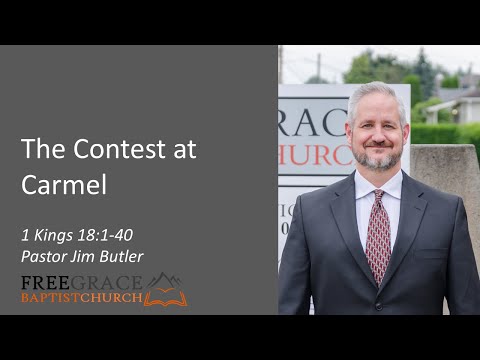
The Contest at Carmel
Elijah's confrontation with the prophets of Baal on Mount Carmel exposes the absolute futility of idolatry and the exclusive sovereignty of Yahweh. Set against the backdrop of Ahab's state-sponsored Baalism and a three-year drought, the passage drives a direct challenge: total allegiance belongs to the living God alone, with no syncretistic middle ground. The sermon traces the contest from Elijah's gauntlet through the false prophets' frenzied failure to God's decisive, fire-bearing answer, arguing that the same God who consumed the sacrifice at Carmel receives sinners today through the atoning blood of Christ. The application is direct: those who still halt between two opinions are called to repent and look to Christ in faith, while believers are charged to hold fast to God Most High without divided allegiance.

2LCF Chapter 3 - Of God's Decree
God's eternal decree—that He has foreordained whatsoever comes to pass, freely and unchangeably, from the counsel of His own most wise and holy will—is the subject of 2LCF Chapter 3. This study works through all seven paragraphs of the confession, grounding the doctrine first in divine sovereignty (God is most absolute, most free, and all-sufficient), then examining the decree's scope over all things, its special application to the predestination of the elect through Jesus Christ, and the reprobation of the wicked to the praise of His glorious justice. The decree is shown to be identical with the divine essence itself—eternal and unchangeable—and the means ordained by God (the redemptive work of Christ, the preaching of the Word, and the effectual work of the Spirit) are likewise foreordained. The proper posture before this doctrine is not boasting but humility, reverence, and abundant consolation in the God who saves sinners by His sovereign grace alone.

The Refuge for God's People
Psalm 46 sets the doctrine of God's sovereign presence as the only sufficient ground for courage in affliction. The psalm's threefold refrain — 'The Lord of hosts is with us; the God of Jacob is our refuge' — anchors the people of God against both natural catastrophe and the rage of hostile nations. Drawing on Job, the upper room discourse, Acts 14, and the letters to the seven churches in Revelation, this exposition argues that suffering is the normative texture of the Christian life, not an anomaly to be explained away. The command of verse 10 — 'Be still and know that I am God' — is not passive fatalism but a call to steady, covenant confidence in the God whose justice, power, and faithfulness guarantee the final exaltation of Christ among the nations.

The Binding of Isaac
Genesis 22, the binding of Isaac, presents Abraham's supreme test of faith as both a window into faithful perseverance under affliction and a richly typological passage pointing forward to the atoning work of Christ. The sermon traces three movements: the presentation of the test, the obedience of Abraham, and God's approval and confirmed promises. Central to the exposition is the typological reading — Abraham as a figure of the Father, Isaac as the only beloved son who bears the wood, and the ram caught in the thicket as a type of the substitutionary Lamb of God who takes away the sin of the world. The application calls believers to cultivate persevering faith through the ordinary means of grace, trusting that God furnishes sufficient grace for whatever trial he appoints.

The Rich Young Ruler
What must a man do to inherit eternal life? The rich young ruler's question exposes the deepest error of fallen religion: the assumption that man possesses the moral ability to commend himself to a holy God. This sermon expounds Matthew 19:16–22, tracing Christ's deliberate use of the law — particularly the tenth commandment — not as a path of salvation but as a hammer to shatter the young man's self-righteousness and drive him to seek grace outside himself. The central application is urgent: stop asking what you shall do and ask instead in whom you shall believe, for justification is by faith alone in Christ alone, whose righteousness becomes yours and whose cross bears your sin.

Live Stream - July 30, 2023
Second Samuel 22:21–25 presents David's claim that God rewarded him according to his righteousness — a claim that stands in apparent tension with his adultery, conspiracy to murder, and failure to act justly in the rape of Tamar. This sermon argues that David's righteousness is not a profession of sinlessness but a celebration of imputed righteousness: the perfect obedience of Christ credited to the believing sinner by faith alone, the same basis on which every saint in every covenant has ever stood before God. Drawing on Romans 4, 2 Corinthians 5:21, and Philippians 3:9, the sermon shows that David possessed a thorough theology of sin, atonement, and justification by faith alone — and calls both the unconverted and the believing congregation to rest in and pursue the God whose grace is capacious enough to cover even the most public and heinous failures.
The Arrival of the Hour
John 12:20–26 presents the arrival of the appointed 'hour' — the cross — through two interconnected scenes: Gentile Greeks seeking an audience with Jesus, and Christ's own declaration that the Son of Man must be glorified through death. The universal scope of redemption, foreshadowed throughout the Old Testament and confirmed in the Greeks' arrival, demonstrates that Israel's Messiah is the Savior of every tribe, tongue, people, and nation. Christ's death is not merely exemplary but substitutionary and necessary — the grain of wheat that must fall and die to produce much fruit — grounding both the imputation of His righteousness to believers and the certainty of their eternal union with Him. Genuine discipleship flows from this: those who by grace receive Christ are marked by a radical reorientation away from self-love and this present evil age toward willing service and following of the Lamb.

The Righteousness of David
David's declaration in 2 Samuel 22:21–25 that God rewarded him according to his righteousness stands in apparent tension with his gross sins of adultery, murder, and failure to act in the rape of Tamar. This sermon resolves that tension through the theology of justification by faith alone, demonstrating from Romans 4 that David, like Abraham, was accepted by God not on the basis of personal moral achievement but through the imputed righteousness of Christ received by faith — the same way any sinner in any covenant has ever entered the presence of God. David's own writings, particularly Psalm 32 and Psalm 51, confirm that he understood his standing before God to rest on atonement, forgiveness, and the crediting of another's righteousness, not sinless perfection. The sermon closes with a call to treasure public worship as David did, and to bring great sin to the great Savior who justifies the ungodly.

2LCF Chapter 2.3 - The Confessional Doctrine of the Trinity
The doctrine of the Trinity is the capstone of the confession's treatment of God, asserting that the one divine and infinite being eternally exists as Father, Son, and Holy Spirit — three subsistences of one substance, power, and eternity, each possessing the whole divine essence undivided. This session works through six confessional affirmations: that Trinitarian monotheism excludes tritheism; that confessing one God in three persons is no contradiction; that the persons do not collectively comprise God in fractional parts; that the persons are distinguished solely by their eternal relations of origin; that Father, Son, and Holy Spirit are fully co-equal, co-eternal, and consubstantial; and that the doctrine of the Trinity is not a cold academic exercise but the very foundation of all communion with God and comfortable dependence on Him.