
Topic
Typology
89 sermons · All topics

The Arrest of Jesus

John 18:1–12 records the arrest of Jesus, and the passage confronts the reader with a Savior who is not a hapless victim but the sovereign I AM who initiates, controls, and willingly enters every step of His own arrest. The sermon works through three movements: the betrayal by Judas and the convergence of internal, external, and spiritual threats upon Jesus; the glory of Christ displayed in His divine self-declaration that drives His captors to the ground; and the arrest itself, where the cup of divine wrath — not Peter's sword — is shown to be the true focus of the scene. The controlling application is that Christ's covenantal resoluteness in going to the cross for the salvation of His people is the proper ground for approaching the Lord's Supper with joy.

Life in the Wilderness and Canaan
Deuteronomy 8 sets the wilderness generation of Israel before the land of Canaan with a threefold movement: a reminder of God's providential humbling in the wilderness (vv. 1–5), a promise of abundant blessing in the land (vv. 6–10), and a solemn warning against the pride and forgetfulness that prosperity tends to generate (vv. 11–20). The wilderness was not divine cruelty but divine chastening — designed to produce dependence on God rather than self-sufficiency — a pattern the New Testament applies both to the believer's ongoing trials and to the person of Christ, who as the true Israel recapitulates the exodus, wilderness, and restoration that old covenant Israel failed to embody faithfully. The sermon closes by calling hearers to combat forgetfulness of God through regular remembrance of his word, his covenant, and his redemptive acts, recognising that the danger is never prosperity itself but the pride that severs gratitude from grace.

The Appearance of Christ to Mary
John 20:11–18 records the appearance of the risen Christ to Mary Magdalene at the empty tomb — the first resurrection appearance in John's Gospel. The sermon expounds three movements: Mary's examination of the tomb, the presence of the Lord, and the word of the Lord. The positioning of the two angels at the head and feet of where Christ lay is argued to be a deliberate theological echo of the cherubim over the mercy seat on the Ark of the Covenant, signifying that the tomb itself is the antitype of the place of propitiation — the locus of atonement accomplished by Christ's death, burial, and resurrection. The sermon closes with exhortations to believe in Christ as the sole mercy seat for sinners, to seek Him through His Word and ordinances when His presence seems distant, and to rest in Him as the elder brother who intercedes at the right hand of the Father by the Spirit.

The Crucifixion of Christ
How did it come to pass that the only holy, harmless, and undefiled man who ever lived was led out to be crucified between two criminals? John 19:16–24 answers on two levels: on the surface, the wickedness of men — Pilate's cowardice, the Sanhedrin's envy, the multitudes' manipulation — and beneath it, the sovereign, predetermined purpose of God who sent His Son to be the Lamb of God, the substitute for sinners. The sermon traces the location at Golgotha as the fulfillment of Genesis 3:15, the charge written by Pilate as an unwitting confession of Christ's kingship, and the conversion of the dying thief as the paradigm case of saving faith — seeing nothing but a bloodied, dying man on a cross and confessing Him as Lord of a kingdom.

The Bronze Serpent
Numbers 21:1–9 records Israel's sin of grumbling in the wilderness, God's judgment through fiery serpents, and the divinely prescribed remedy: look at the bronze serpent lifted on a pole and live. The sermon traces this narrative in two movements — the defeat of the Canaanites in verses 1–3, where Israel prays and trusts God, contrasted with the failure of verses 4–9, where they grumble despite God's provision. The bronze serpent functions as a type of Christ, as Jesus himself declares in John 3:14, and the sermon presses the application that justification is by faith alone — not by prior works, not by self-examination of the wound, but by looking to the one lifted up. Weak faith does not disqualify the sinner; even a feeble look at the appointed remedy brings the sinner into peace with God.

The Harlotry of Israel in Moab
Numbers 25 records the final plague upon the first generation of Israel: sexual harlotry with the women of Moab leading directly to idolatrous worship of Baal of Peor, the very site where God had been blessing Israel through Balaam's compelled oracles. The chapter unfolds in three movements — the sin of the people, the zealous intercession of Phinehas, and the commanded judgment on Midian — each illuminated by the Apostle Paul's use of this passage in 1 Corinthians 10 as a warning to the new covenant church. Phinehas, acting as a priestly guardian of the sanctuary with divinely commended zeal, typifies Christ's priestly office and intercession, pointing forward to the one whose unchangeable priesthood averts the wrath of God from new covenant Israel through his life, death, and resurrection. The passage calls the church to flee idolatry, to marry only in the Lord, and to perfect holiness in the fear of God, lest spiritual harlotry — defection from the living God through unholy alliances — repeat in the new covenant community what it wrought in the old.

The Wars of the LORD
Numbers 21 traces Israel's journey through military victory over the Canaanites, the punishment and grace of the bronze serpent, and the conquest of the Amorite kings Sihon and Og. The bronze serpent — condemned people bitten by fiery serpents, healed only by looking in faith to the remedy God prescribed — is taken up by Jesus in John 3:14 as a type of his own crucifixion, teaching that salvation comes by divine initiative alone, received through faith, not works. The same recurring sins of complaint, lack of faith in providence, and idolatry that marked the first generation persist in the second, warning the church that these corruptions follow the sin nature across every generation. The chapter closes with God's sovereign hardening of Sihon and the defeat of the giant Og, both down payments on the promised conquest and demonstrations of God's faithfulness, sovereignty, and goodness to his people.

The Waters at Meribah
Numbers 20 records a pivotal transition: the first generation of Israel is dying off, yet the second generation repeats the same sins — grumbling, blaming Moses and Aaron, and longing to return to Egypt. At the waters of Meribah, Moses himself falls under divine chastisement for failing to hallow God before the people, striking the rock rather than speaking to it and presumptuously attributing the miracle to himself and Aaron. The chapter closes with the death of Aaron, whose priestly garments pass to his son Eleazar — a token of covenantal continuity pointing forward to the greater High Priest who stands between the dead and the living. The recurring lesson for the people of God in every generation is that the hardships of the wilderness are not evidence of divine abandonment but instruments of providence by which God conforms his people to the image of his Son.

The Covenant Ceremony With Abraham
Genesis 15 records the covenant ceremony by which God confirmed his promises of seed and land to Abram — not with a bilateral oath, but with a unilateral, self-maledictory act in which God alone passed between the divided animals. The sermon traces Abraham's justification by faith alone in verse 6, examines the ancient covenant-ratification ritual as a type of Christ bearing the covenant curse, and shows that the smoking oven and burning torch passing through the pieces preaches the substitutionary atonement of the Lord Jesus Christ. The application presses believers to rest their assurance not in their own covenant faithfulness but in the faithfulness of the God who swore by himself and sealed that oath in the blood of his Son.

The Vindication of the Aaronic Priesthood
Numbers 16:41–17 records the immediate aftermath of Korah's rebellion: Israel accuses Moses and Aaron of murder, God's wrath breaks out in a plague, and Aaron runs into the congregation with a censer to make atonement, standing between the dead and the living until the plague stops. Chapter 17 then confirms the Aaronic priesthood definitively when Aaron's rod alone buds, blossoms, and produces ripe almonds, functioning as a perpetual sign against any future usurper of the priestly office. The typological weight of Aaron's intercession in verse 48 points forward to Christ, who stands between dead sinners and the wrath of God, propitating that wrath by his blood. The sermon calls hearers to recognize both the sinfulness of Israel's hasty accusation and the glory of the priestly atonement that alone grants the unholy access to a holy God.

The Gospel of Christ in the Valley of Elah

David's victory over Goliath in 1 Samuel 17 is not merely an episode in Israelite history but a Christological shadow pointing forward to the greater conquest of Christ over Satan at Golgotha. This sermon works through twelve points of typological correspondence between David and Christ — from Bethlehem's birthplace, to the shepherd-king, to vicarious representation, to the skull motif of Genesis 3:15 — demonstrating that the whole of Scripture is organically unified around the person and work of the Lord Jesus Christ. The exposition serves as a Lord's Supper meditation, calling believers to rejoice in their conquering substitute and urging the unconverted to flee to the champion who uses death itself to destroy death.
Introduction to the book of Numbers
The book of Numbers records Israel's wilderness sojourn from Sinai to the plains of Moab, functioning as the narrative of a covenant community learning to live under Yahweh's sovereign guidance. This introductory study surveys the title, authorship, structure, and major themes of Numbers within the framework of the whole Pentateuch, tracing how the glory cloud of Exodus 40 provides the predicate for both Leviticus and Numbers. The overarching argument is that every element of the book — census, legislation, failure, and restoration — testifies not to Israel's faithfulness but to God's faithfulness to his covenant promise to the patriarchs, a promise that finds its ultimate fulfillment in the Lord Jesus Christ.

Ask FGBC #9 - How is Jesus the greater fulfillment of the Old Testament Israel?
How does the New Testament present Jesus as the fulfillment of Old Testament Israel? This question-and-answer exchange traces the biblical-theological thread from Adam as 'son of God' in Luke 3:38, through Israel as God's firstborn son in Exodus 4, through the Exodus typology developed by the prophets, to Jesus as the obedient new Israel and last Adam who accomplishes what both God's first son and corporate Israel failed to do. The discussion concludes with the observation that the apostles read the Old Testament through Christ because he is their Lord — what one participant calls 'lordship hermeneutics.'

The Atonement at Gibeah
The atonement made at Gibeah — where seven descendants of Saul were executed to satisfy the blood-guilt incurred by Saul's slaughter of the Gibeonites — is expounded as a typological anticipation of penal substitutionary atonement. David's inquiry of God, the Gibeonites' insistence that no silver or gold could ransom a murderer (Numbers 35:33), and the hanging of the seven men before the Lord all illustrate that atonement is the satisfaction of divine justice through blood. The sermon argues that Rizpah's grief beside the bodies of her sons is a solemn, sin-cursed scene designed to strip away abstraction and force the reader to feel the horror of what atonement costs. Only when the gore of Gibeah is taken seriously does Golgotha regain its proper weight: Christ, the greater Son of David, stood in the place of his people to quench the wrath of God and secure the covenant safety of all whom the Father gave him.

The True Vine
When Jesus declares 'I am the true vine' in John 15:1, he is not merely offering a pastoral metaphor — he is making a claim that draws together the entire sweep of Old Testament revelation. This sermon traces the two categories of 'I am' statements in John's Gospel, first the absolute 'I am' without a predicate (rooted in Exodus 3:14 and the Isaianic Yahweh-speeches), and then the seven predicative 'I am' statements, culminating in the vine. The second half sets that declaration in its biblical-theological frame: Old Covenant Israel was named God's firstborn son (Exodus 4:22), and Matthew's Gospel deliberately patterns the opening of Jesus' ministry — the flight to Egypt, the passage through water, the wilderness temptation — on Israel's national history, identifying Jesus as the true and obedient Israel who succeeds where Adam and Israel failed. The sermon calls hearers to believe on the one who says 'if you do not believe that I am, you will die in your sins,' and to worship him as the fulfillment of every covenant promise.

The Context of John 3:16, Part 1

John 3:16 opens with the word 'for,' marking it as a continuation of a preceding argument — yet the verse is almost universally quoted without its Old Testament context. This sermon expounds Numbers 21:4–9, the account of the bronze serpent in the wilderness, which Jesus himself cites in John 3:14 as the direct backdrop for his declaration of the gospel to Nicodemus. The sin of Israel — grumbling against a gracious God despite his continual provision — brought deadly judgment in the form of fiery serpents, and the God-ordained remedy was not the removal of the snakes but a look of faith toward a bronze serpent lifted on a pole. Hearers are called to repent of complaining against God and the authorities he has appointed, and to return for the evening service where the typological fulfillment in the lifting up of the Son of Man will be applied to the gospel.

The Binding of Isaac
Genesis 22, the binding of Isaac, presents Abraham's supreme test of faith as both a window into faithful perseverance under affliction and a richly typological passage pointing forward to the atoning work of Christ. The sermon traces three movements: the presentation of the test, the obedience of Abraham, and God's approval and confirmed promises. Central to the exposition is the typological reading — Abraham as a figure of the Father, Isaac as the only beloved son who bears the wood, and the ram caught in the thicket as a type of the substitutionary Lamb of God who takes away the sin of the world. The application calls believers to cultivate persevering faith through the ordinary means of grace, trusting that God furnishes sufficient grace for whatever trial he appoints.
The Day of Atonement
Leviticus 16 stands at the structural center of the Pentateuch, and its legislation governing the Day of Atonement reveals both the absolute holiness of God and the total sinfulness of man. The two goats — one slaughtered as a sin offering and one driven into the wilderness as the scapegoat — together signify substitutionary atonement and the definite removal of guilt from a specific covenant people. The high priest's own need for sacrifice before he could minister for Israel exposes the inadequacy of the Levitical priesthood and anticipates the once-for-all, self-sufficient sacrifice of Christ, whose blood retroactively atoned for Old Covenant believers and finally accomplished what the annual rite could only shadow. Believers in the New Covenant era need no further Day of Atonement ceremony; every observance of the Lord's Supper recalls the same removal of guilt that the scapegoat ceremony made visible to Israel.

The Installation of the Priesthood
Leviticus 8–10 records the ordination, ministry, and judgment of Israel's priesthood, tracing the way sinful man may approach a thrice-holy God through divinely prescribed sacrifice. The death of Nadab and Abihu for offering that which the Lord had not commanded warns that worship is regulated by God alone, not by the worshiper's innovation. Christ fulfills every type embedded in this system — as the holy, harmless, and undefiled High Priest who satisfies divine justice once for all. The sermon calls new-covenant worshipers to approach the Lord's Supper with the same reverence and eager joy that the priestly fire of Leviticus 9 ought to have kindled.

The Installation of the Priesthood
Leviticus 8–10 presents the ordination, ministry, and judgment of the Aaronic priesthood as a unified theological unit — the resolution of the tension left at the end of Exodus 40, where the glory of God filled the tabernacle but no one could enter. The divine approval signaled by fire consuming the sacrifice in Leviticus 9 stands in sharp contrast to the lethal fire that devours Nadab and Abihu in Leviticus 10, grounding the regulative principle of worship in the character of God himself: He must be regarded as holy, and He alone determines the manner of approach. The detailed legislation of chapters 1–7 is not merely ceremonial scaffolding but the appointed means by which a holy God draws near to an unclean people, typifying the better access secured by Christ in the New Covenant. The sermon calls the congregation to receive New Covenant worship as an advancement of — not a departure from — the principle that God's people must come to Him on His terms.

Introduction to the Book of Leviticus
The book of Leviticus resolves a theological tension created at the close of Exodus: the tabernacle has become God's dwelling place, but no Israelite — not even Moses — can enter it. This introductory exposition surveys Leviticus 1:1 and the book as a whole, tracing three dominant theological themes: the holiness of God, the sacrificial system as God's own provision for sinful man's access to His presence, and the purity required of His covenant people. The Levitical types find their antitypes in the Lord Jesus Christ, who is simultaneously the high priest and the sacrificial victim, and whose atoning work is the substance toward which the entire ceremonial law pointed.
The Tabernacle Erected, and the Glory of God
Exodus 35–40 records the construction, assembly, and divine consecration of the Israelite tabernacle, culminating in the glory cloud filling the completed dwelling place. This session surveys those chapters as the climax of the book of Exodus, tracing the biblical-theological theme of God's dwelling with his people from Eden through the tabernacle, the Solomonic temple, and forward to the incarnate Word who tabernacled among us. A sustained exegetical focus falls on the tension in Exodus 40:35 — Moses unable to enter the glory-filled tabernacle — and its resolution in Leviticus 9, where blood atonement transforms God's dwelling place into a meeting place. The session closes by drawing out the regulative principle of worship, the typological significance of the tabernacle as a shadow of Christ, and the necessity of blood atonement for sinful creatures to approach a holy God.

The Sanctuary and Ark of the Testimony
Exodus 25:1–22 opens the third major division of Exodus — the dwelling of God among his redeemed people — which the sermon argues is the climax of the entire book. Working through the offerings for the tabernacle, the purpose of the sanctuary, and the construction and function of the ark, the exposition traces how God's intent to dwell with Israel typologically anticipates the new covenant reality secured by Christ, the great high priest and true mercy seat. The regulative principle of worship is grounded exegetically in God's precise prescriptions for the tabernacle and applied to New Covenant church practice. Hearers are called to count corporate worship a privilege and to approach God only in the manner he has commanded in Holy Scripture.

The Champion of the Howling Wilderness
Matthew 4:1–11 presents the temptation of Christ not primarily as a model for personal resistance to sin, but as the decisive act of single combat in which the Lord Jesus Christ, as the second Adam and the true Israel, vicariously perfects obedience for his elect people. Where Adam fell in the garden amid every provision and where Israel failed in the wilderness under divine care, the Son of God enters a howling wilderness—hungry, alone, and unarmed—and vanquishes the devil point for point through resolute dependence on the word of God. The rich typological connections to Adam's expulsion, Israel's forty years of wandering, Moses' fast on Sinai, and David's unarmed single combat against Goliath converge on the one claim the passage presses: Christ alone is the covenantally faithful champion, and salvation belongs exclusively to those who trust in his doing, dying, and rising. Christians are therefore called to rejoice in their champion rather than to reduce this episode to a moral technique for fighting temptation.

The Ratification of the Covenant, Part I
Exodus 24:1–8 records the formal ratification of the old covenant at Sinai, and this expository study examines three elements the text presents: God's instructions structuring nearness and distance on the mountain, Moses' compliance in writing the covenant words and erecting the altar and twelve pillars, and the blood-sprinkling ceremony that sealed the covenant between Yahweh and Israel. The sermon argues that the old covenant, far from being a mere administration of the covenant of grace, is a republication of the covenant of works — a position the 1689 LBCF reflects in distinction from the Westminster Confession. The blood of the ratification ceremony finds its antitype in the blood of Christ, whose once-for-all sacrifice inaugurates the new covenant in which believers stand accepted not by their own obedience but by that of their covenant head.

The Problem of Israel's Apostasy
Israel's apostasy in Judges 2:7–3:6 follows a pattern rooted not in ignorance but in a failure to know the Lord experientially — a failure that produced syncretism, Baal worship, and divine chastisement. The sermon traces the root, description, and divine response to Israel's apostasy, showing that God's repeated raising up of judges was not provoked by Israel's repentance but by his own covenant faithfulness and mercy. Samson is presented as a type of Christ, each of the twelve judges pointing typologically to the Savior who would definitively deliver his people from their sins. The church is exhorted to keep herself unspotted from the world, resisting the toleration that leads by degrees to full apostasy.
The Oppression of Israel by Pharaoh
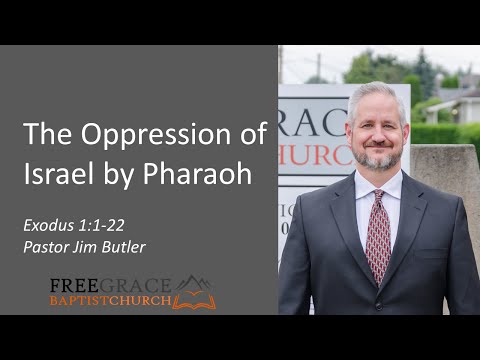
Exodus 1 records the escalating oppression of Israel in Egypt — from the rise of an ignorant pharaoh, through forced labor, to an explicit policy of infanticide targeting Hebrew male infants. This exposition traces the passage in two movements: the connection between Exodus and the Abrahamic promises of Genesis, and the progressive stages of Pharaoh's tyranny, culminating in a national decree of genocide. The Hebrew midwives Shiphrah and Puah are held up as models of God-fearing civil disobedience, and the whole chapter is read typologically, anticipating the greater deliverance wrought through Moses and ultimately through the seed of Abraham, Jesus Christ. The congregation is called to imitate the courage of the faithful — to obey God rather than men in whatever sphere God has placed them.

The Feeding of the Five Thousand
John 6:1–15 presents the feeding of the five thousand as a sign — a theological event designed to reveal who Jesus is, not merely a remarkable act of provision. The miracle is set against the backdrop of the Passover and the Mosaic exodus, inviting comparison between the manna in the wilderness and Jesus as the living bread come down from heaven. The crowd's response — declaring him the prophet of Deuteronomy 18 and then attempting to seize him as a political king — exposes the persistent confusion between a physical, temporal messianic expectation and the spiritual, eternal salvation Christ actually came to accomplish. The sermon calls hearers to see in the bread and fish the One who supplies all things abundantly, who has both the compassion and the omnipotence to save every sinner who comes to him in faith.

The Discourse on God's Salvation, Part 1
Jesus answers Nicodemus's question — 'How can these things be?' — by pointing to three realities: his own incarnation as the one who descended from heaven, the Old Testament typology of the bronze serpent in Numbers 21, and the necessity of his crucifixion as the antitype to whom sinners must look in faith. The sermon works through John 3:11–15, examining Christ's authority to speak of heavenly things, the doctrine of the hypostatic union and the communication of idioms, and the parallel between Israel's look-and-live prescription in the wilderness and saving faith in the crucified Son of Man. The application is direct: the antidote to sin is not moral reformation but faith in the lifted-up Christ, who alone secures justification and eternal life for believing sinners.
Exodus 13 - The consecration of the firstborn
Exodus 13 grounds the consecration of Israel's firstborn in the redemptive logic of the tenth plague: because God spared Israel's firstborn while striking Egypt's, Israel's firstborn belong to him — to be set apart, sacrificed if clean, or redeemed if human or unclean. The chapter's twin emphases on perpetual remembrance through the Feast of Unleavened Bread and the catechetical instruction of children press the same truth across generations: God's people are defined by what God has done for them, not by their own merit or strength. The typological weight of substitutionary redemption — one life in the place of another — finds its terminus in the Lamb of God who takes away the sin of the world, making these ordinances intelligible only in light of Christ. Practically, the sermon calls the congregation to remember the mighty works of God, to sacrifice freely in gratitude for redemption received, and to pass this theological inheritance faithfully to the next generation.