
Topic
Soteriology
2,240 sermons · All topics

The Parables of the Dragnet and Scribe

Matthew 13:47–53 closes the kingdom parables with two final teachings: the dragnet and the scribe. The dragnet parable presses the certainty of coming judgment — at the end of the age, angels will separate the wicked from the just and cast the wicked into the furnace of fire — a reality Jesus repeats deliberately so that no hearer can ignore it. The parable of the scribe then turns to those entrusted with the mysteries of the kingdom: disciples who have understood these truths bear a corresponding responsibility to function as faithful householders, bringing out of the treasure things new and old. The sermon calls every hearer either to flee to Christ as the only refuge from the wrath to come, or, if already a believer, to take seriously the stewardship of gospel knowledge.
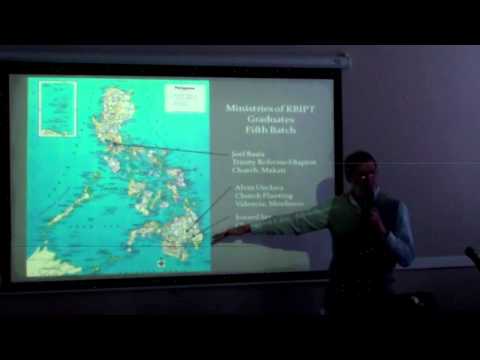
Free Grace Baptist Church - March 21 Missions Event
A Reformed Baptist missionary with thirty years of service in the Philippines presents an overview of the work in Metro Manila and beyond: church planting, a three-year pastoral training institute covering biblical languages and systematic theology, and itinerant teaching among pastors in remote provinces. The presentation is grounded in Revelation 5 and Romans 10 — Christ has purchased a people from every tribe, tongue, and nation, and messengers must be sent to gather them. The evening closes with prayer requests for the elders of Moonwalk Community Bible Church, the graduates scattered across the Philippine islands, and the ongoing effort to bring the gospel to Roman Catholics, Muslims, and those ensnared in health-and-wealth Christianity.

The Gospel's Prophetic Prologue

Mark 1:1–4 introduces the gospel not as a literary convention but as the announcement of a real, historical event: the life, death, and resurrection of Jesus Christ, the Son of God. This passage establishes that the gospel's ministerial beginning is rooted in prophetic fulfillment, as both Malachi 3 and Isaiah 40 foresaw a wilderness messenger who would prepare the way of Yahweh himself. The identity of Jesus as the divine Son of God is not incidental to the gospel but is its very foundation — without his deity, there is no sufficient Redeemer. The sermon closes with a call for believers to know and proclaim the gospel precisely, to walk in a manner worthy of it, and for unbelievers to turn from sin and believe on Christ alone.

The Parables on the Value of the Kingdom
Matthew 13:44–46 presents two parables in which men sell everything they possess to acquire a hidden treasure and a pearl of great price — both illustrating the supreme value of the kingdom of heaven. The sermon argues that coming to Christ is never a loss: the sinner who forsakes all gains everything, and joy rather than grief ought to mark that transaction. Drawing on Moses in Hebrews 11, Paul in Philippians, and the attributes of the triune God from the 1689 confession, the sermon calls both the unconverted to seek Christ urgently and the believer to rest in the surpassing worth of what they already possess.

The Parable of the Tares Explained
Matthew 13:34–43 records Christ's private explanation of the parable of the wheat and tares to His disciples, and the sermon works through that explanation in two movements: the purpose of parabolic teaching and the seven details of the parable itself. The disciples' question falls on the tares, not the wheat, and the sermon follows that emphasis — the final destiny of the wicked, cast into the furnace of fire, stands at the center of the exposition. The identity of the sons of the kingdom and the sons of the wicked one is traced from Genesis 3:15 through the New Testament, establishing that the antithesis between the two seeds runs the entire length of redemptive history. The sermon closes with urgent evangelistic appeal: flee to Christ now, for every person will stand before the Son of Man who is both Savior and Judge.

From Alienation to Reconciliation
Colossians 1:21–22 sets the alienation and enmity of sinners against the sovereign, monergistic reconciliation God effects through the incarnate death of His Son. The sermon moves through three aspects of the Colossian believers' transformation: their previous state as those alienated from God, hostile in mind, and outwardly manifesting wicked works; their present status as those God has reconciled through the physical, substitutionary death of Christ; and their future blessedness as those being presented holy, blameless, and above reproach — a goal that is the consequence of reconciliation, never its cause. Communion is the occasion for this exposition, pressing believers to remember the depth of the grace that drew them out of enmity and into fellowship with God.
Judges 4 & 5
Judges 4 exposes the recurring cycle of Israel's sin, oppression, and divine deliverance, demonstrating that God is the sovereign architect of both judgment and rescue. The narrative centers on Barak as the appointed judge-deliverer, with Deborah functioning as prophetess and Jael as instrument of God's final blow against Sisera — neither woman is a proto-feminist heroine but an agent of the divine agenda against oppressive Canaanites. God's sovereignty over history is traced from the raising up of Jabin's iron-chariot army to the flooding of the Kishon River and the tent peg in Sisera's temple, with the summary of verses 23–24 deliberately crediting no human agent. The study calls hearers to rest in the warrior-God who delivers His people by means as minute as a relocated tent and as decisive as a sleeping general's death.
The Description of Israel's Apostasy
Israel's apostasy in Judges 2:7–3:6 is traced to a second generation that possessed cognitive knowledge of Yahweh but had no experiential, saving faith — a spiritual death that issued inevitably in Baal worship, covenant judgment, and escalating moral degradation. The passage unfolds three movements: the root of apostasy in the failure to know the Lord, the description of that apostasy in the service of Baals and Ashtoreths, and the divine response of covenant judgment followed by sovereign, gracious deliverance through imperfect human judges. Each judge prefigures the one deliverer — Jesus Christ — who alone can break the power of reigning sin where no left-handed savior can. The sermon calls believers to mortify spiritual amnesia through faithful use of the means of grace, and calls the unconverted to believe the gospel of Christ rather than await a full intellectual resolution of divine sovereignty.
Judges 3:7-31
Judges 3:7–31 presents the first three judges of Israel — Othniel, Ehud, and Shamgar — as instruments of divine deliverance in a recurring cycle of sin, oppression, and rescue. The study examines how God sovereignly raises up unlikely, even morally complex figures to save a people who cry out not in repentance but in pain, underscoring that the emphasis of the book falls entirely on divine grace rather than human merit or spiritual recovery. The satirical portrayal of Eglon and the vivid detail of Ehud's assassination are treated not as embarrassments but as deliberate literary devices designed to humble Israel and magnify God. Each earthly deliverer points typologically to Christ, the only Savior capable of breaking the deeper bondage of sin itself.

The Parables of Seed and Leaven
The two briefest parables in Matthew 13's kingdom discourse — the mustard seed and the leaven — address a perennial temptation: to judge the kingdom of God by its small and seemingly insignificant beginnings. This exposition argues that both parables teach the same essential truth: the kingdom inaugurated by Christ begins imperceptibly but grows inevitably and pervasively, and its lowly origin in the incarnation, ministry, and crucifixion of Jesus is not a contradiction of royal power but its very pattern. The sermon concludes with a threefold application — the parables explain Christ's ministry, call the church to resist discouragement, and confront the unconverted with the call to believe on the Lord Jesus Christ.
The Conduct of the Good Minister, Part 1
What marks a minister as truly 'good' in the sight of God? Expounding 1 Timothy 4:6–11, this sermon argues that ministerial faithfulness is defined not by popularity, giftedness, or leadership skill, but by the diligent instruction of the congregation in sound doctrine — the words of faith and good teaching. The pursuit of godliness, understood as rigorous training for the unhindered service of God, surpasses all bodily discipline because it carries promise for both the present life and the age to come. The sermon concludes by addressing the contested phrase 'Savior of all men' in verse 10, rejecting universalism and unlimited atonement in favour of a reading grounded in God's common grace and providential preservation, with special and saving grace belonging distinctively to those who believe.
Judges 2
Judges 2:7–3:6 exposes the root, description, and divine response to Israel's apostasy in a pattern that drives the entire book. The generation that arose after Joshua had only cognitive knowledge of Yahweh — not saving, experiential knowledge — and that deficiency produced the idolatry, covenant-breaking, and moral devolution that follows. Yet the dominant note of the passage is the unmerited grace of God, who raised up deliverers for a people whose groaning was not repentance but merely the pain of consequence. Each earthly judge is a type pointing forward to the one decisive Deliverer, and the church neglects the book of Judges at the cost of losing fresh reasons to sing of amazing grace.
The Conversion of the Ethiopian Eunuch
Acts 8:26–40 records the Spirit-directed encounter between Philip the evangelist and an Ethiopian eunuch who was reading Isaiah 53 on his return from Jerusalem. The sermon traces three movements in the passage: the Holy Spirit's sovereign direction of Philip to the eunuch, Philip's exposition of Isaiah 53 as fulfilled in the person and work of Christ, and the eunuch's conversion and subsequent baptism by immersion. The central burden is that Christ's atoning work — his obedient life, substitutionary death, and vindicating resurrection — is the only ground on which any sinner, however excluded by law or circumstance, may be forgiven and brought near to God, and that believer's baptism is the public, visible sign of that inward, Spirit-wrought grace.
Hebrews 1

Hebrews 1:3 declares that Christ 'by himself purged our sins' before sitting down at the right hand of the Majesty on high — a compressed statement of the entire work of redemption. This Bible study exposition unpacks that purging under four aspects: it was a thorough cleansing of sin, an expiatory sacrifice removing legal guilt, a propitiatory sacrifice satisfying divine wrath, and a substitutionary act in which Christ bore the curse in the place of his people. The finality of the work is sealed by Christ's session at the Father's right hand — a posture no Levitical priest could assume because their work was never complete — and by his own word from the cross, 'It is finished.'
The Parable of the Wheat and Tares
Matthew 13:24–30 presents the parable of the wheat and tares, in which Christ teaches that his kingdom advances through a world — and a visible church — where genuine believers co-exist with those sown by the devil. The sermon addresses the theodicy embedded in the parable: God's sovereignty over evil does not mean the immediate expulsion of wickedness, but its certain, final judgment at the eschaton. Hearers are called to grow as wheat, to resist an overly censorious spirit toward apparent tares, and to trust that the Master has the harvest entirely under his control.
The Parable of the Sower Explained
Matthew 13:18–23 presents Christ's own interpretation of the Parable of the Sower, identifying four types of hearers who encounter the Word of the kingdom. The sermon argues that the parable was given primarily to explain the widespread rejection of Jesus in his own ministry, and secondarily to prepare and embolden the disciples against future discouragement. Working through each soil in turn, the exposition exposes the hardened unbeliever, the shallow apostate scandalized by trial, the fruitful-appearing hypocrite choked by carnal anxiety and prosperity, and the genuine believer who hears, understands, and bears fruit — all as a summons to honest self-examination before the Word.
Introduction to Judges
The book of Judges is not primarily a dark catalogue of human failure but a sustained testimony to the deliverance God works on behalf of a sinful, covenant-breaking people. This introductory study of Judges 2 surveys the book's date, authorship, literary structure, and governing cycle of sin, oppression, and deliverance, arguing that the judges themselves are typological pointers to the Lord Jesus Christ — the one deliverer who is without blemish and who executes the demands of the covenant through perfect obedience. The study draws out three dimensions of Israel's sin (failure to obey Deuteronomy 7, failure to transmit the faith of Deuteronomy 6, and outright rejection of Yahweh for Baal), and closes with the charge that the character of God displayed in Judges — patient, initiating, long-suffering — is the same grace that saves sinners through Christ today.
The Parable of the Sower Stated
Matthew 13:1–17 presents the parable of the sower and Christ's explanation of why he teaches in parables. The sermon works through two sections: the parable itself (vv. 1–9), exposing four types of hearers — hardened, shallow, crowded, and fruitful — and the purpose of parabolic teaching (vv. 10–17), which is both to reveal kingdom mysteries to the converted and to conceal them from the unconverted by divine design. The two-fold purpose of parables is grounded in sovereign election, drawing on Isaiah 6:9–10 and the language of Matthew 11:25–27, pressing hearers to examine whether they are genuinely receptive soil and to submit to the Godhood of God rather than resist his sovereign purposes in grace.
Joshua 24
Joshua 24 presents Israel's covenant renewal ceremony at Shechem, where Joshua rehearses the sovereign grace of God from Abraham's call out of idolatry through the conquest of Canaan, drawing out the logical demand for exclusive covenant fidelity. The chapter is examined as a formal covenant document — preamble, historical prologue, stipulations, and ratification — and shown to anticipate the same gospel pattern Paul unfolds in Romans: God's gracious act precedes and grounds the required response. Joshua's warning that Israel cannot serve the Lord apart from grace exposes the bankruptcy of emotional self-confident religion and points forward to the need for a covenant head, the Lord Jesus Christ, who alone can satisfy the terms of the covenant of grace.
The Murder of the Preborn, Part 2
Exodus 21:22–25 grounds a biblical answer to the hardest objections raised against the prohibition of abortion. The sermon establishes that Scripture recognises exactly three instances of lawful killing — self-defense, just and necessary war, and capital punishment — and demonstrates that abortion satisfies none of them. The death penalty, far from contradicting the sanctity of life, is its strongest legal expression, grounded in the imago Dei of Genesis 9:6 and confirmed for the new covenant era by Romans 13:1–4. The church's response to abortion requires preaching the law of God without apology, loving neighbours through practical compassion, and declaring the gospel of the Lord Jesus Christ as the only remedy for guilt.
The Identity and Confession of the Church
Paul's instructions to Timothy in 1 Timothy 3:14–16 ground the order and conduct of the local church in two anchoring realities: the church's identity as the house of the living God, pillar and ground of the truth, and the church's confession of the mystery of godliness centered on the person and work of Christ. The sermon presses the regulative principle of worship against pragmatism and innovation, arguing that how the church prays, orders its gender distinctions, and qualifies its officers is not optional but divinely mandated. Verse 16's early creedal fragment — God manifested in the flesh, justified in the Spirit, received up in glory — is shown to be the doctrinal center of gravity that holds the whole letter together and explains why ordered church life matters.
The Family of Christ
Matthew 12:46–50 presents Christ identifying his true family not by bloodline but by faith — those who do the will of his Father in heaven. The sermon expounds this text in two movements: the approach of Jesus' physical family (vv. 46–47) and his instruction concerning his spiritual family (vv. 48–50), demonstrating that entry into this family is by faith alone in Christ alone, not by moral achievement. The doctrine of adoption grounds the exposition: chosen in eternity, secured by the Son, sealed by the Spirit, the believer is called brother, sister, and mother by the holy Lord of heaven — not begrudgingly, but because of sovereign grace. The sermon closes with a threefold application: marvel at the privileges of belonging to God's family, bear its responsibilities faithfully, and above all behold the glory of the Christ who is not ashamed to call sinners his own.
The Demand for a Sign
Matthew 12:38–45 exposes the demand of the scribes and Pharisees for a sign as a mask for ethical rebellion: the problem is not insufficient evidence but an unwillingness to fear God and repent. Christ identifies them as an evil and adulterous generation, declares that his death and resurrection will be the only sign given, and warns that Gentiles — the Ninevites and the Queen of Sheba — will rise in judgment to condemn those who rejected far greater light. The passage closes with a parable warning that moral reformation without the conquering grace of the gospel leaves a man in a worse condition than before, and the application presses hearers to believe the word, flee moral reform as a substitute for the gospel, and reckon with the greater condemnation that falls on those who enjoy greater privilege.
The Priestly Office of Christ
Hebrews 2:16–18 introduces the high priestly office of Christ, which the author of Hebrews will develop through chapters 5 to 10. This exposition works through three interlocking truths: Christ's role as covenant mediator — taking on the seed of Abraham rather than the nature of angels — establishes the ground of His representation; His incarnational identification with His brethren qualifies Him to serve as a merciful and faithful High Priest; and His function of propitiation reveals that He exhausted the wrath of God on behalf of a particular people given to Him by the Father, making definite atonement the only coherent conclusion. Believers are called to cry out to their interceding High Priest in every temptation, since He who withstood the full weight of temptation without sin is able to aid those who are tempted.
The Word Became Flesh
John 1:14 presents one of the most concentrated statements of Christology in all of Scripture: the eternal Word, who was God and was with God in the beginning, became flesh and tabernacled among men. This sermon expounds the incarnation under two heads — the fact of the Word becoming flesh, and the glory beheld in that incarnate Word — with sustained attention to the doctrine of eternal generation, the Shekinah-tabernacle background of John's prologue, and the covenantal purpose of the incarnation in redemption. The hearer is called to rest in the Christ who perfectly fulfilled the law, bore the wrath due to sinners in their stead, and rose for their justification, and to hold fast to a sound Christology as the very ground of salvation.
The Manger's Heavenly Guest
Luke 2:1–14 presents the incarnation of the Lord Jesus Christ not as myth or allegory but as verifiable, prophecy-fulfilling history. The sermon works through four headings: the fact of the incarnation (its straightforward, openly disclosed, prophetically saturated character), the humility of the incarnation (God taking on humanity in an inglorious condition, pointing toward the cross), the message of the incarnation (good tidings of a Savior delivered to unpolished shepherds by divine kindness), and the hymn of the incarnation (the angelic doxology ascribing all glory to God and proclaiming peace to those who receive Christ). Hearers are pressed to follow the trajectory of Christmas not to a sentimental infant but to a crucified, risen, and ascended Savior, and those who reject Him are warned of judgment to come.
Colossians 1:9-14
Paul's intercessory prayer in Colossians 1:9–14 sets the pattern for how believers ought to pray for one another: not merely for temporal relief, but for a life that walks worthy of the Lord and fully pleases Him. The sermon works through four participles that Paul uses to describe that worthy walk — fruitfulness in good works, growth in the knowledge of God, strength for patient endurance, and thankfulness — showing these as a unified package rather than a menu of options. The closing verses of the passage (vv. 12–14) then ground that thankfulness in three cosmic realities: qualification for the inheritance of the saints, deliverance from the dominion of darkness, and transfer into the kingdom of Christ, all secured by redemption through His blood.
The Tree and Its Fruits
Matthew 12:33–37 confronts every hearer with the inseparable connection between the inner condition of the heart and the words that proceed from it. Working through Christ's fourfold address to the Pharisees — exhortation to repent, condemnation of their wickedness, explanation of the heart's role as the source of speech, and anticipation of the Day of Judgment — the sermon establishes that words are not morally neutral but are the public evidence of what a person truly is before God. The doctrines of total depravity and total inability undergird the exposition: no one can speak good things from an evil heart, and only sovereign regeneration — God removing the heart of stone and giving a heart of flesh — can change the root so that the fruit changes. The only shelter from that coming day of accounting is the Lord Jesus Christ, the one man who never spoke an idle word, whose righteousness alone justifies the ungodly.
Joshua 15-18
The allotment of Canaan to Judah, Ephraim, and Manasseh in Joshua 15–17 is not a tedious roster of city names but the concrete, geographical fulfillment of the covenant promises God made to Abraham in Genesis. Each border description and town name is evidence of divine fidelity, foreshadowing the bodily resurrection and new creation that the land of Canaan itself anticipated. Running through these chapters are three sober warnings — Judah, Ephraim, and Manasseh each failed to drive out the Canaanites — sowing the seeds of the syncretism and apostasy that will characterize the book of Judges. The Josephite tribes' complaint against their lot and their fear of iron chariots is set in sharp contrast to Caleb's faith, calling hearers to trust the power of God rather than retreat into faithless discontentment.
The Unpardonable Sin
Matthew 12:31–32 contains Christ's solemn warning about the blasphemy against the Holy Spirit — the one sin that will not be forgiven in this age or the age to come. This exposition sets the saying in its Matthean context: the Pharisees, having witnessed the Spirit-empowered works of the Davidic Son, willfully and self-consciously attributed those works to Beelzebub. Drawing on parallel passages in Mark 3, Hebrews 6, Hebrews 10, and 1 John, the sermon distinguishes this sin from sins of ignorance and ordinary moral failure, showing that the unpardonable sin is not a moment's rashness but a settled, knowing rejection of the gospel accompanied by an irreversible hardening of heart. The sermon closes with a dual application: believers are urged to use the means of grace and guard against spiritual stagnation, while unbelievers are warned that persistent rejection only hardens the heart, and are called to flee to Christ while there is still time.