
Topic
Christian Living
1,146 sermons · All topics
The Maintenance of Justice (Higher Court and Monarchy)

Deuteronomy 17:8–20 establishes two institutions for the maintenance of justice in Old Covenant Israel: a higher court to adjudicate cases too complex for local tribunals, and a monarchy governed by the law of God. The higher court — composed of priests, Levites, and judges at the central sanctuary — held binding authority over difficult cases involving degrees of guilt, civil disputes, and punishments, with criminal contempt of that court carrying a capital sanction. The king was not an absolute sovereign but a servant under God's law, prohibited from multiplying horses, wives, and wealth as a guard against misplaced trust, and required to read the law of God daily so that fear of the Lord, not pride or military power, would govern his reign.

The Qualifications for Elders, Part 1
What qualifies a man to lead Christ's church as an elder, and how is a genuine call to ministry recognized? Expounding 1 Timothy 3:1, this sermon works through four elements of a man's call to eldership drawn from Albert N. Martin's Pastoral Theology: the desire of the man, the graces of the man, the gifts of the man, and the opportunity for the man. The internal, subjective desire for ministry must be checked by external, objective criteria — the qualifications of verses 2–7 and the common suffrage of the local church as confessed in the Second London Baptist Confession, chapter 26. The sermon closes with exhortations to the congregation to pray for gospel laborers and to take the qualification process seriously, and with a call to unbelievers to trust the Christ whom these ambassadors proclaim.

The Maintenance of Justice
Deuteronomy 16:18–17:7 establishes the framework for civil justice in Old Covenant Israel: the appointment of impartial judges, the prohibition of idolatrous practices that precede full apostasy, and a carefully guarded procedure for prosecuting capital offenses. The passage demonstrates that God's theocratic ordering of Israel required both judicial righteousness and cultic holiness, since Yahweh was simultaneously God and King. Israel's repeated failure to maintain this standard drives the expectation forward to Christ, the true Israel, who alone executes judgment with perfect righteousness. The enduring principles of due process, equal application of law, and capital punishment remain binding norms for civil government in every age, grounded not in Mosaic theocracy alone but in the Noahic covenant and the New Testament's own teaching on the sword.

The Conduct of Women in Corporate Worship (Authority)
First Timothy 2:11–15 contains one of the New Testament's clearest directives on the role of women in corporate worship, and this exposition works through the passage in three movements: the duty of women to receive the Word in silence and submission (v. 11), the apostolic prohibition against women teaching or exercising authority over men (vv. 12–14), and the blessing held out to women in the childbearing (v. 15). The prohibition is grounded not in the culture of first-century Ephesus but in creation order and the fall, the same foundations the apostles consistently invoke across Ephesians 5, Colossians 3, 1 Corinthians 11 and 14, and 1 Peter 3. The messianic reading of verse 15 is defended: 'she will be saved in the childbearing' points to the incarnation of Christ as the hope for Eve and every believing woman, not to physical childbirth as a condition of salvation. Women are called to embrace their creationally ordered role — silent, submissive reception of the Word and the full range of ministry open to them — as the sphere in which they work out their salvation in faith, love, holiness, and self-control.

The Sin of David and the Grace of God
David's adultery with Bathsheba and the murder of Uriah the Hittite stand as the gravest sins of Israel's greatest king, yet 2 Samuel 12:1–15 is ultimately a text about the pursuing grace of God. Through Nathan's carefully constructed parable, God exposes David's sin in all its senselessness and treachery — making clear that to despise the commandment of God is to despise God himself. The sermon traces three movements in the passage: God's confrontation through his servant Nathan, the full indictment of David's covenant treachery, and the stunning declaration that the Lord has put away David's sin — a declaration that underlies David's celebration of forgiveness throughout the Psalter and points forward to the atoning work of David's greater Son.

The Conduct of Women in Corporate Worship (Adornment)
Paul's instruction in 1 Timothy 2:9–10 on the adornment of women in corporate worship is not a blanket condemnation of ornamentation but a call to modesty and moderation governed by the priority of Christ in public worship. A biblical theology of adornment — from Genesis through Revelation — establishes that adorning is assumed and even commanded by God; what Paul prohibits is the ostentatiousness that draws attention to oneself and away from the Lord. The sermon works through four observations: the operating assumption that women will adorn, the general principles of propriety and moderation, the particular prohibitions against elaborate hairdressing, gold, pearls, and costly clothing, and the positive exhortation to adorn with good works befitting a profession of godliness.

The Gospel's Precious Liberty

Galatians 5:1–6 commands believers to stand fast in the liberty Christ has purchased, refusing any entanglement with a yoke of bondage. This sermon traces the full weight of Paul's argument through Galatians to show that Christian liberty is freedom from the dominion, guilt, and condemnation of sin, from the grip of the devil, and from the yoke of the ceremonial law. The forfeiture of that liberty — by adding circumcision or any other work to the ground of justification — renders Christ of no profit and leaves the soul estranged from grace. Seven means by which believers stand fast in this liberty are set out, all grounded in the Spirit's sustaining work through the means of grace.

2LCF Chapter 27 - Of the Communion of the Saints
Chapter 27 of the 1689 London Baptist Confession teaches that the communion of the saints is grounded in the believer's union with Jesus Christ as mediator — a union that is real and transforming but does not divinize the believer or diminish Christ. From that foundation flow concrete obligations: corporate worship, mutual edification, relief of temporal need, and the exercise of gifts and graces for one another's good. Private property is affirmed against any communistic reading of Acts 2 and 4, and the discussion concludes with pastoral cautions against both antinomian indifference and Pharisaic legalism in measuring one another's communion.

2LCF Chapter 26 - Of the Church
Chapter 26 of the 1689 London Baptist Confession of Faith ('Of the Church') teaches that Christ alone is the supreme and sovereign head of the church, from whom all authority for church governance flows. This session surveys five historical and contemporary models of church polity — Erastianism, Episcopalianism, Presbyterianism, Denominationalism, and Congregationalism/Independency — evaluating each against Scripture and the confession. The particular Baptist position is identified as plural elder-led associational congregationalism: each congregation of baptized believers governed by a plurality of elders under Christ alone, walking in voluntary associational communion with other churches for mutual edification, counsel, and support.

Laws Concerning Debt, Slaves, and Firstborn
Deuteronomy 15 sets out three bodies of legislation governing Old Covenant Israel: the sabbatical release of debts, the release and provision for indentured servants, and the sanctification of the firstborn. The sermon traces how each law flows from a divinely ordered reciprocity — God prospers his covenant people so that prosperity rolls downward to the poor and the victim — while insisting that outward compliance must be driven by an internal disposition of genuine covenantal loyalty. The firstborn legislation is read as pointing forward to the unblemished firstborn Son of God, whose sacrifice fulfils what the animal offerings could only foreshadow.

2LBC Chapter 25, Of Marriage
The 1689 London Baptist Confession of Faith chapter 25 offers a concise yet comprehensive definition of marriage as a lifelong covenant between one man and one woman, established by God in creation for companionship, procreation, and the lawful expression of sexual relations. This study works through each paragraph of the confession's chapter on marriage, examining the monogamous nature of marriage, the major purposes for which it was ordained, and the lawful parties who may enter it. The session also draws on Westminster Confession chapters 24, paragraphs 5 and 6, together with Deuteronomy 24, Matthew 5 and 19, and 1 Corinthians 7, to argue that Scripture authorizes divorce on the grounds of porneia and desertion, and that a lawfully divorced innocent party is free to remarry. The Protestant 'permanence view' of marriage is examined and found to be both exegetically deficient and pastorally harmful to innocent parties whom God's own law was designed to protect.

Deuteronomy 14:1-29. Laws of Death, Diet, and Tithing
Deuteronomy 14 regulates mourning rites, dietary practices, and tithing for Old Covenant Israel — not as arbitrary impositions but as expressions of a holy people set apart by God from the nations around them. The chapter's controlling logic is covenantal identity: because Israel bore the status of God's firstborn son, every dimension of daily life, from the menu to the method of mourning, was to reflect that consecration. The dietary laws, now abrogated under the New Covenant as ceremonial law fulfilled in Christ, nevertheless carry a permanent New Covenant counterpart: the people of God are still to be distinguished from the world in holiness, presenting their bodies as living sacrifices. The tithing section closes the chapter with a call to generous, joyful giving that cares for the Levite, the stranger, the fatherless, and the widow — a call that carries into the New Covenant era as well.

The Resurrection-Hope of the Righteous One
Psalm 16 is expounded as a Messianic psalm concerning the mind and experience of Christ in his earthly ministry — his earnest petition for divine preservation, his joyful contentment amid sorrow, and his sufficiency rooted in the Father alone. The apostolic witness of Peter in Acts 2 and Paul in Acts 13 establishes that David speaks in this psalm concerning the Lord Jesus Christ, and only secondarily of David and the saints in union with him. The sermon calls believers to follow the pattern of their Savior: praying for preservation, finding sufficiency in God rather than earthly blessings, meditating on Scripture in the night seasons, and navigating trial through a settled confidence in divine providence.
SLBC Chapter 23: Of oaths and vows
Lawful oaths and vows occupy a distinct place in Christian ethics, grounded in the third commandment's demand for reverence toward the divine name and the ninth commandment's prohibition of false witness. This confession-study exposition of 1689 LBCF Chapter 23 distinguishes oaths (horizontal promises between men, made before God as witness) from vows (vertical commitments made directly to God), explains why both the Quaker rejection and Catholic corruption of oaths are condemned, and works through five paragraphs covering definition, solemnity, carefulness, integrity, and the lawful use of vows. The governing application is that the integrity of speech in all of life — family, church, and civic — flows from a rightly ordered fear of the God in whose name oaths are taken.

The Solicitation to Apostasy
Deuteronomy 13 confronts Israel with three escalating scenarios of solicitation to apostasy: the false prophet, the intimate family member or friend, and the corrupt city given over to idolatry. In each case the text demands not tolerance but purging, because defection from the living and true God constitutes treason against the theocratic covenant order. The chapter's severity is inseparable from its mercy: faithful execution of justice removes the cause of divine wrath and secures the covenant blessings sworn to the fathers. The passage presses the hearer to examine whether fidelity to God holds firm against both miraculous signs that lead astray and the subtler pull of intimate relationships.

Testimony, confession, and baptism: Hans
A baptismal service in which a new believer makes public profession of faith through immersion, grounded in the 1689 London Baptist Confession's teaching on baptism as a sign of union with Christ through his death and resurrection. The candidate recounts a providential journey from Eastern mysticism and Stoic philosophy to Scripture, tracing his conversion to a sermon on Matthew 24:15 and the destruction of Jerusalem in 70 AD as the demonstration of God's simultaneous justice and mercy. The confession of faith is administered through four credal questions, after which the candidate is baptized as a public declaration of a grace already received.

2LBC Chapter 24 - Of the Civil Magistrate
2 London Baptist Confession Chapter 24 examines the divine origin, proper scope, and Christian obligations relating to civil government. Civil magistrates are ordained by God, under his authority, for his glory and the public good, with their power limited to maintaining justice and peace through the sword — encompassing criminal punishment, capital justice, and defense against foreign invasion. The sermon argues that Christians may lawfully serve as magistrates or soldiers, directly contra the Anabaptist tradition, and that the Confession's three paragraphs provide a sufficient framework for navigating contemporary political crises. Believers are called to submit to lawful commands, resist unlawful ones, and pray persistently for governing authorities so that the church may worship freely.

The Goodness of God's Law
The law of God is good — but only when used lawfully. Expounding 1 Timothy 1:8–11, this sermon defends the goodness of the moral law against both antinomian dismissal and legalistic distortion, situating Paul's argument within the classical Reformed framework of the law's three uses: civil, pedagogical, and normative. The false teachers in Ephesus had neither understood the law nor handled it properly, and Paul's corrective is not to demote the law but to demonstrate its proper function — restraining lawlessness in society, exposing the sinner's need for Christ, and directing the justified believer in the path of sanctification.

The Lament of the Psalmist
Psalm 13 is a lament psalm of David that moves through raw grief — the perceived forgetfulness of God, the daily sorrow of the soul, and the threat of encroaching enemies — to a resolved trust in the covenant mercy of God. The sermon traces this trajectory through the true humanity of Christ, who himself prayed lamentingly in Gethsemane and on the cross, establishing lament as a legitimate and God-given vehicle of prayer for his people. Lament is distinguished sharply from whining: whining refuses to petition God and ends in despair, while biblical lament drives the soul toward God and terminates in doxology. The congregation is called to bring their distress boldly to the throne of grace, resting in the hesed of God covenanted to all who are found in Christ.

The Apostle's Charge to Timothy
Paul's charge to Timothy in 1 Timothy 1:3–7 commands the silencing of false teachers in Ephesus who taught other doctrine, devoted themselves to fables and endless genealogies, and generated disputes rather than godly edification. The charge is not motivated by power or animosity but by love flowing from a pure heart, a good conscience, and sincere faith — the fruit of regeneration. The false teachers compounded their error by combining ignorance of the law with arrogant confidence in their own assertions, a combination the apostle deems disqualifying. Churches today must hold the same line: qualifying teachers rigorously, refusing platforms to the heterodox, and measuring all teaching against the truth as it is in Jesus.

The Psalmist's Cry in an Age of Deceit
Psalm 12 presses the question Psalm 11 leaves open: not what becomes of the wicked in the end, but how the people of God survive and remain faithful in the present evil age. The sermon traces two movements in the psalm — the destruction of foundations (vv. 1–4), marked by idle speech, flattery, and the proud autonomy of godless men, and the preservation of the righteous (vv. 5–8), grounded in God's arising to deliver the oppressed and in the utter purity of his Word. David's prayer is read through a Christological lens: the psalm is supremely the prayer of Christ in his earthly ministry, opposed at every step, yet sustained by the Father's Word and promise. The congregation is urged to respond to cultural and ecclesiastical decay not by retreat or despair but by theology, prayer, and dependent trust in the pure and preserving Word of God.
Ask FGBC #64: Who Should Catechize Your Children?
Deuteronomy 6 and Ephesians 6:4 establish the family — and the father in particular — as the primary locus of catechetical responsibility for children, not the church, the school, or civil government. The church's role is complementary: it equips parents, and through preaching, catechism classes, and Sunday school it instructs children alongside the home. Rote memorization of a catechism plants doctrinal truth that takes deep root at conversion, making faithful repetition a discipline as foundational as teaching a child to read or to do arithmetic.

The Central Demand of the Covenant
Deuteronomy 10 presents the central demand of the Mosaic covenant — that Israel fear, love, and serve the Lord with all their heart and soul — set against the backdrop of the golden calf incident and the covenant's renewal. The sermon traces this demand from its roots in Deuteronomy 10:12–13 through its echoes in Genesis 18, Proverbs 21, Hosea 12, Zechariah 7, Micah 6, and Matthew 23, demonstrating that obedience rooted in heart religion has always been God's requirement of His people. The threefold division of the law is expounded, with the moral law established as perpetually binding while the ceremonial law finds its fulfillment in Christ and the judicial law expires with the Israelite theocracy. The sermon closes by pressing believers to hold fast to God, keeping His law not as a means of justification but as the pattern for sanctification purchased by Christ, the true Israel who alone fulfilled the covenant.
The Courage of the Righteous One
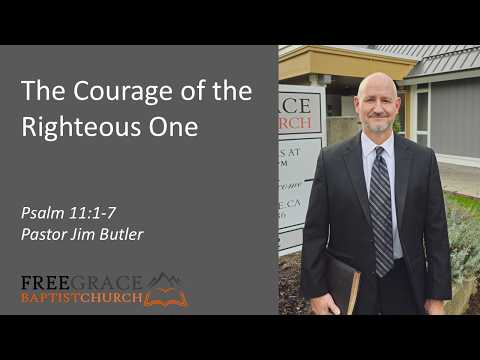
Psalm 11 presents the righteous man — supremely the Lord Jesus Christ — facing the temptation to abdicate his calling when wicked enemies ready their arrows and the foundations of moral order appear destroyed. The sermon expounds two movements: the temptation to flee (vv. 1–3) and the fortification found in contemplating God's sovereignty, omniscience, and justice (vv. 4–7). Because Christ steadfastly set his face toward Jerusalem and drank the cup of divine wrath to its dregs in the place of his people, believers have every reason to resist the same temptation to cowardice and unbelief, and to stand firm in the Lord.

Being Strengthened

Colossians 1:11 describes one of four characteristics of a life that pleases God: being strengthened — a passive reception of divine power, not a self-generated act of will. The sermon expounds the action, the gift, the measure of the gift, and the goal of the gift, arguing that God infuses his people with all needed power according to the inexhaustible measure of his own glorious might. This strengthening is the mechanism by which believers endure patience and longsuffering under any and all circumstances of life. Sinners who have not yet come to Christ are invited to the only Savior who both grants entrance into the Christian life and sustains his people all the way to glory.

CTF 2026 - Dr Richard Barcellos Book Presentation - A Faithful Steward
At a seminary conference, colleagues and friends present Dr. Richard Barcellos with a festschrift titled 'A Faithful Steward,' compiled in his honor. The presentation draws on 1 Corinthians 4:2 — 'it is required of stewards that they be found faithful' — as the governing theme of his decades of ministry in preaching, writing, and theological education. John Gill's exposition of that verse is read as a description of Barcellos's own ministry: preaching the pure gospel without human mixture, declaring the whole counsel of God, seeking the honor of Christ rather than the applause of men.
Ask FGBC 68: Are Reformed Baptists More Baptist or More Reformed?
The question 'Are Reformed Baptists more Baptist or more Reformed?' draws out a careful answer: the two labels are not competing loyalties but successive correctives — Reformed Christianity corrects medieval Roman Catholic and Lutheran error, while the Baptist stream carries the Reformation's logic further in ecclesiology, the church-state relation, and liberty of conscience. Which emphasis comes to the foreground depends entirely on the conversation partner: against Christian nationalism the Baptist distinctives press harder; against Arminian dispensationalism the Reformed heritage dominates. The panel settles on a working formulation: Reformed in soteriology and theology proper, Baptistic in ecclesiology, and — with the addition of what the Reformation did not yet reform — small-c Catholic, Reformed, and Baptist.

The Theater of His Glory

Psalm 19 sets creation and Scripture side by side as God's two books of revelation: the heavens declare His glory in every language to every people, while the Word of God converts the soul and opens eyes to see what unbelief cannot perceive. The sermon works through the psalm to show that general revelation leaves all people without excuse before God, yet only the regenerate, illumined by the Spirit through Scripture, properly receive the theater of God's glory. The three closing applications call Christians to train their children in a Christ-centered view of both books of revelation, to cultivate daily awareness of God's hand in creation, and above all to prize the Word of God as the supreme gift that leads to life and holiness.

Life in the Wilderness and Canaan
Deuteronomy 8 sets the wilderness generation of Israel before the land of Canaan with a threefold movement: a reminder of God's providential humbling in the wilderness (vv. 1–5), a promise of abundant blessing in the land (vv. 6–10), and a solemn warning against the pride and forgetfulness that prosperity tends to generate (vv. 11–20). The wilderness was not divine cruelty but divine chastening — designed to produce dependence on God rather than self-sufficiency — a pattern the New Testament applies both to the believer's ongoing trials and to the person of Christ, who as the true Israel recapitulates the exodus, wilderness, and restoration that old covenant Israel failed to embody faithfully. The sermon closes by calling hearers to combat forgetfulness of God through regular remembrance of his word, his covenant, and his redemptive acts, recognising that the danger is never prosperity itself but the pride that severs gratitude from grace.

The Commendation of the Philippian Church
Philippians 4:14–23 closes Paul's letter with a commendation of the Philippian church for their constant and consistent financial partnership in his apostolic ministry. The sermon works through four observations: the apostle's commendation of the church's sacrificial generosity, his contentment that transcends material circumstances, his confidence that God will supply the church's needs according to his infinite riches, and the concluding greetings — including the remarkable note that believers within Caesar's own household send greetings to Philippi. The central application is that everything praiseworthy in the Philippians — their fellowship, their sacrifice, their fruitfulness — is itself the fruit of divine grace, so that God alone receives the glory.